
Quick Answer
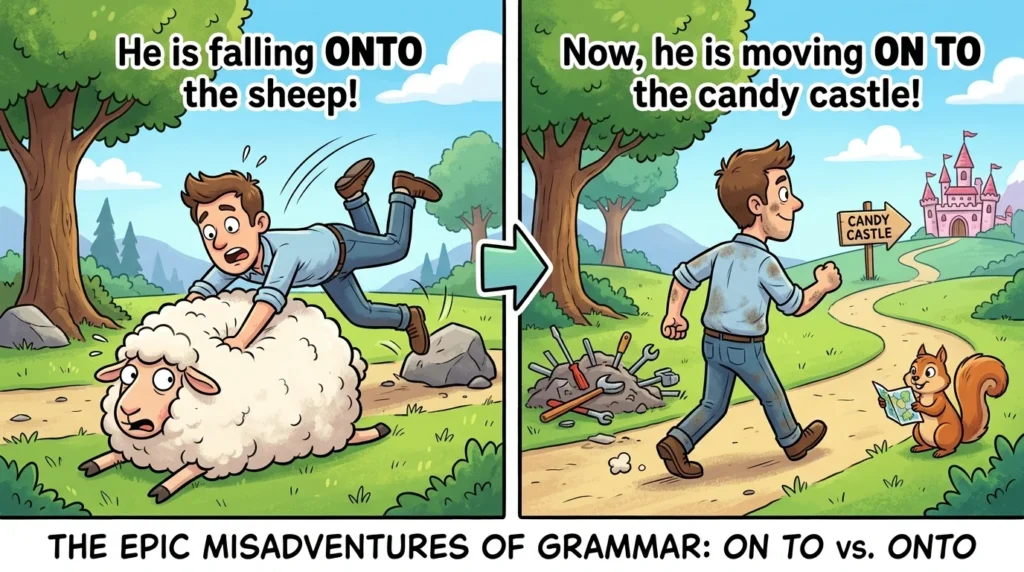
Onto is usually a single preposition that means moving to a position on something.
On to is a combination of the words on and to, typically used when on belongs to the verb and to begins a new phrase.
Examples:
- The cat jumped onto the table.
- After finishing dinner, we moved on to dessert.
What Does Onto Mean?
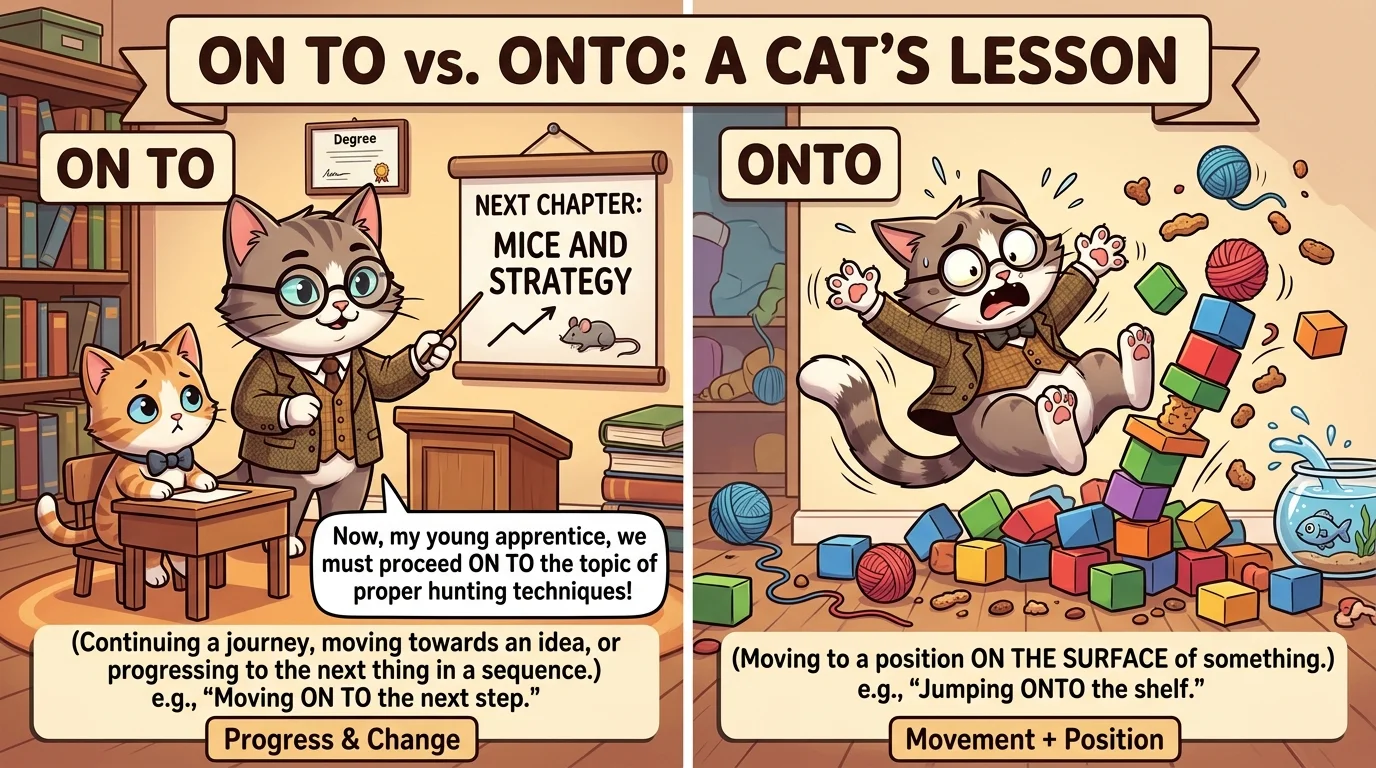
Onto is a preposition that indicates movement toward a surface or position.
Definition
Onto means:
- To a position on something
- Moving up and resting on a surface
- Transferring to another place or object
Usage Rules
Use onto when there is physical movement toward a surface or location.
Examples of Onto
- The child climbed onto the bed.
- She placed the books onto the shelf.
- The bird flew onto the roof.
- He stepped onto the stage.
Key Insight
If you can replace the phrase with upon and the sentence still makes sense, onto is usually correct.
Example:
- The cat jumped onto the couch.
- The cat jumped upon the couch.
Both sentences work, so onto is correct.
What Does On To Mean?
On to consists of two separate words:
- On usually belongs to the verb.
- To introduces another phrase or action.
Definition
On to means:
- Continuing to another activity
- Proceeding to the next stage
- Passing from one topic or task to another
Usage Rules
Use on to when:
- A verb is followed by on and then to
- The sentence means continue to or move to the next thing
Examples of On To
- Let’s move on to the next chapter.
- The meeting went on to discuss the budget.
- After breakfast, we went on to visit the museum.
- She held on to her purse tightly.
Key Insight
If removing on changes the meaning of the verb, you probably need on to instead of onto.
On To vs Onto: Key Differences
Although they look similar, their grammatical functions are different.
Quick Differences
- Onto = one word and usually indicates physical movement.
- On to = two words and usually indicates continuation or progression.
- Onto acts as a preposition.
- On to often follows phrasal verbs.
| Feature | On To | Onto |
|---|---|---|
| Number of Words | Two | One |
| Function | Phrasal combination | Preposition |
| Main Meaning | Continue to the next thing | Move to a surface |
| Usually Indicates | Progression | Physical movement |
| Example | Move on to the next topic. | Jump onto the table. |
Real-World Usage Examples
Example 1
Incorrect: The cat jumped on to the couch.
Correct: The cat jumped onto the couch.
🎯 Lesson: Use onto for movement toward a surface.
Example 2
Incorrect: Let’s move onto the next lesson.
Correct: Let’s move on to the next lesson.
🎯 Lesson: Use on to when progressing to another activity.
Example 3
Incorrect: She climbed on to the horse.
Correct: She climbed onto the horse.
🎯 Lesson: Physical movement generally requires onto.
Example 4
Incorrect: We carried onto discussing the proposal.
Correct: We carried on to discussing the proposal.
🎯 Lesson: Phrasal verbs often require on to.
Common Mistakes
Mistake 1: Using On To for Physical Movement
Incorrect:
- He jumped on to the platform.
Correct:
- He jumped onto the platform.
Why it happens: Writers separate the words because they sound identical.
Mistake 2: Using Onto for Progression
Incorrect:
- Let’s move onto the next question.
Correct:
- Let’s move on to the next question.
Why it happens: People assume every movement requires onto, even when the sentence refers to progressing through ideas or tasks.
Mistake 3: Ignoring Sentence Meaning
The correct choice depends on the meaning, not pronunciation.
Always ask:
- Is someone physically moving onto a surface?
- Or are they progressing to another activity?
Memory Tricks
Trick 1
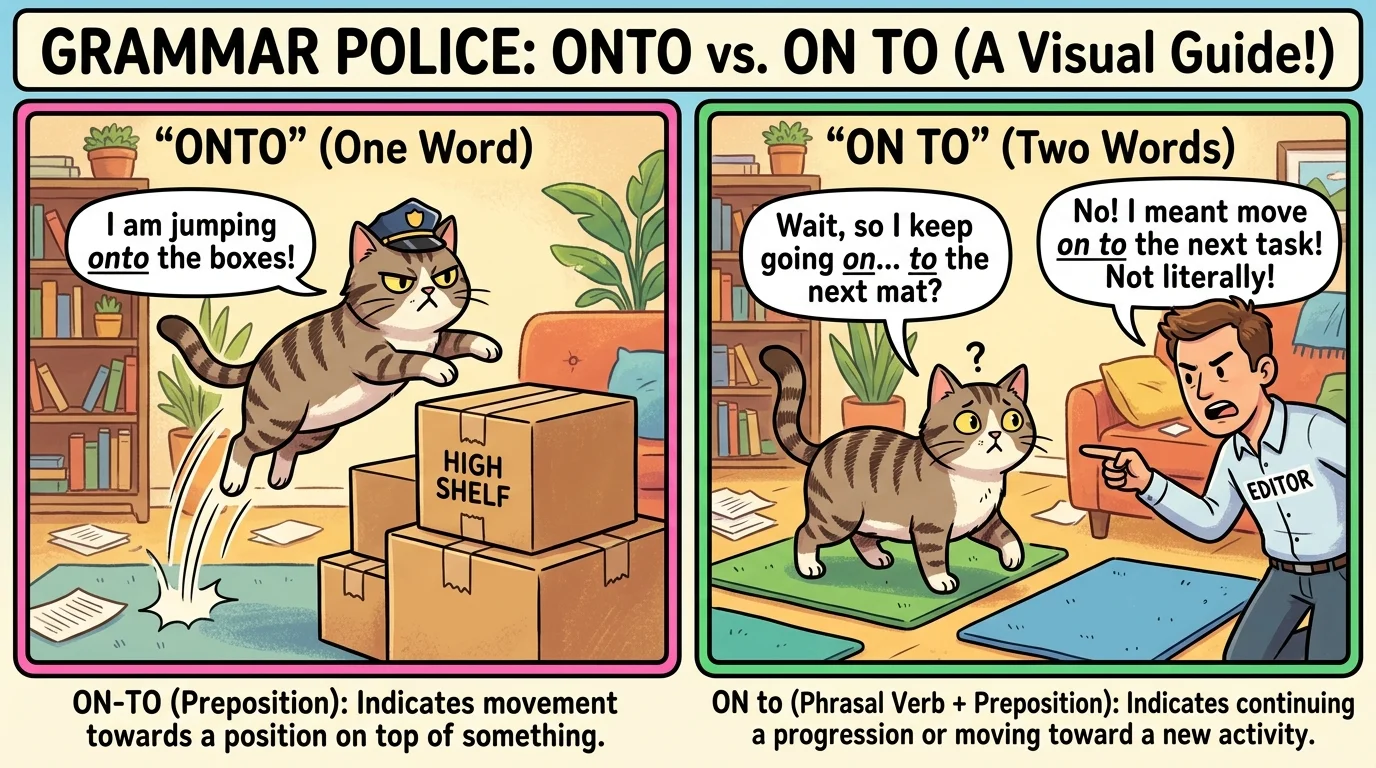
Onto = One Word = One Surface
If someone moves to a physical surface, use onto.
Trick 2
On To = Continue To
If the sentence means “continue to” or “proceed to,” use on to.
Trick 3
Try replacing onto with upon.
If the sentence still makes sense, onto is probably correct.
Expert Insights
The distinction between on to and onto developed as English evolved. Originally, writers often used on to for both meanings. Over time, onto became accepted as a separate preposition to make sentences clearer when describing movement to a surface.
Modern style guides generally recommend:
- Onto for physical movement and placement.
- On to for continuation, progression, and phrasal verb constructions.
Understanding this distinction improves both grammatical accuracy and writing clarity.