

Quick Answer
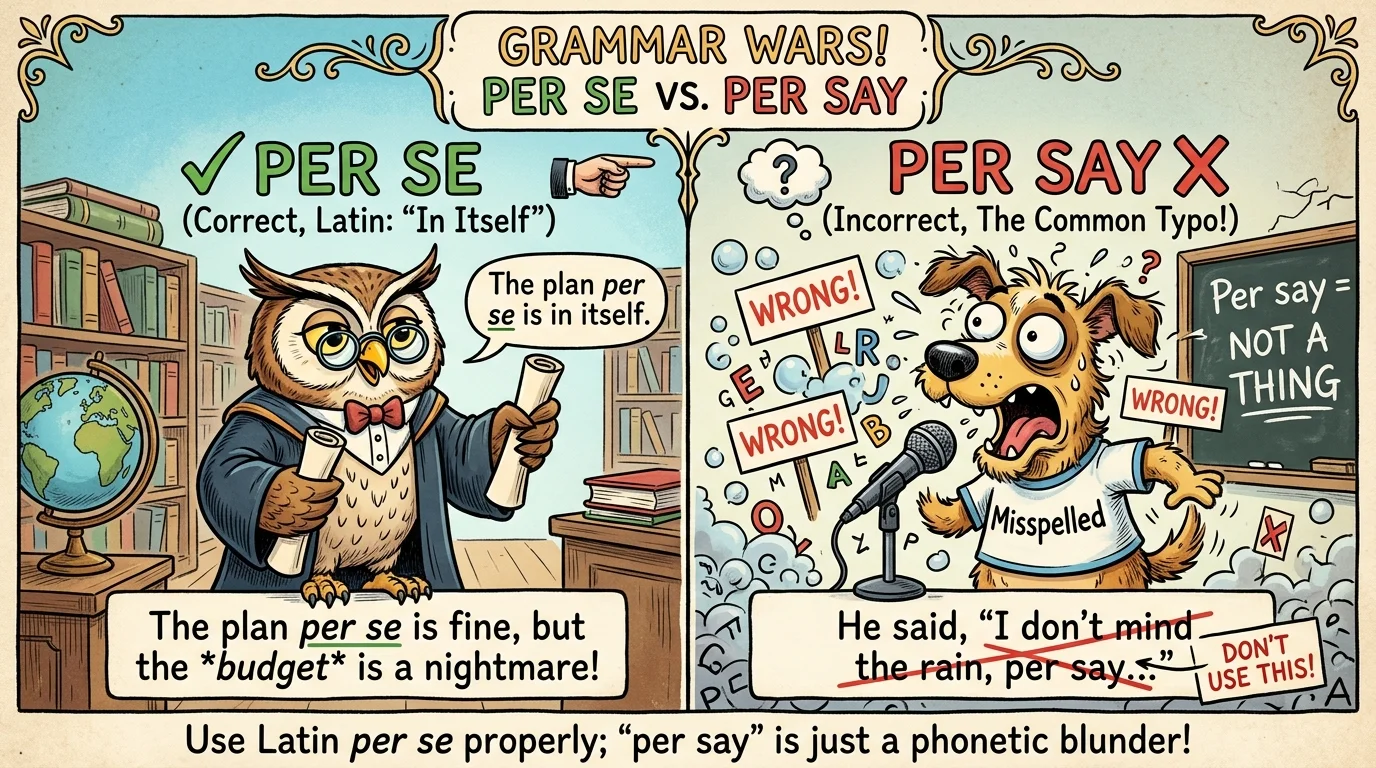
Per se is a Latin phrase that means “by itself,” “in itself,” or “intrinsically.” It is used when referring to something in its own nature rather than in relation to something else.
Per say is usually a misspelling of per se. Although many people say it aloud, it is not considered the correct written form.
What Does “Per Se” Mean?
The phrase per se means by itself, inherently, or in and of itself. It is used to clarify that something is not necessarily the direct issue but may be connected to a broader situation.
Usage Rules
Use per se when:
- Referring to the intrinsic nature of something
- Clarifying that something is not the direct cause or problem
- Distinguishing an issue from related circumstances
Examples
- Money is not evil per se, but greed can lead to harmful actions.
- Social media is not dangerous per se; how people use it matters.
- The policy isn’t unfair per se, but its implementation needs improvement.
Key Insight: The phrase helps make nuanced distinctions and prevents overgeneralization.
What Does “Per Say” Mean?
Strictly speaking, per say has no recognized meaning in standard English. It appears because people hear the pronunciation of per se and assume the phrase contains the word “say.”
Why People Use “Per Say”
- They learned the expression through speech rather than reading.
- The pronunciation sounds like “say.”
- They are unaware that the phrase comes from Latin.
Examples of Incorrect Usage
Incorrect:
- The movie wasn’t bad per say.
- Success isn’t about money per say.
Correct:
- The movie wasn’t bad per se.
- Success isn’t about money per se.
Key Insight: Whenever you are tempted to write per say, use per se instead.
Per Se vs Per Say: Key Differences
Bullet Differences
- Meaning: Per se means “in itself”; per say has no standard meaning.
- Function: Per se clarifies intrinsic qualities; per say is simply a misspelling.
- Usage: Per se is acceptable in formal and informal writing; per say should be avoided.
- Origin: Per se comes from Latin; per say has no linguistic origin.
- Common Mistake: People write per say because it sounds identical to per se.
| Feature | Per Se | Per Say |
|---|---|---|
| Meaning | By itself; inherently | No standard meaning |
| Usage | Correct expression | Misspelling |
| Context | Formal and informal writing | Should be avoided |
| Origin | Latin phrase | None |
| Example | The issue isn’t money per se. | Incorrect form |
Real-World Usage Scenarios
Scenario 1
Incorrect: “The project isn’t difficult per say.”
Correct: “The project isn’t difficult per se.”
🎯 Lesson: Use per se when you mean “in itself.”
Scenario 2
Incorrect: “Technology isn’t bad per say.”
Correct: “Technology isn’t bad per se.”
🎯 Lesson: The issue is often how something is used, not the thing itself.
Scenario 3
Incorrect: “Exercise isn’t tiring per say.”
Correct: “Exercise isn’t tiring per se.”
🎯 Lesson: Remember that per se introduces a subtle distinction.
Scenario 4
Incorrect: “The rule isn’t unfair per say.”
Correct: “The rule isn’t unfair per se.”
🎯 Lesson: If you mean “intrinsically” or “by itself,” choose per se.
Common Mistakes
Mistake 1: Writing “Per Say”
Why it happens: People hear the phrase more often than they read it.
Correction: Always write per se.
Mistake 2: Using “Per Se” to Mean “Exactly”
Why it happens: Some speakers use the phrase vaguely.
Correction: Use it only when referring to something’s inherent nature.
Mistake 3: Overusing the Phrase
Why it happens: Writers think it sounds sophisticated.
Correction: Use it only when it genuinely adds clarity.
Memory Tricks to Remember the Difference
Trick 1
Per se = by itself.
Think:
“Se” = self.
Both start with the letter S, making it easier to remember that per se refers to something in itself.
Trick 2
If you can replace the phrase with:
- inherently
- intrinsically
- by itself
then per se is the correct choice.
Trick 3
Remember this simple rule:
Per se is real. Per say is a spelling mistake.
Expert Insight
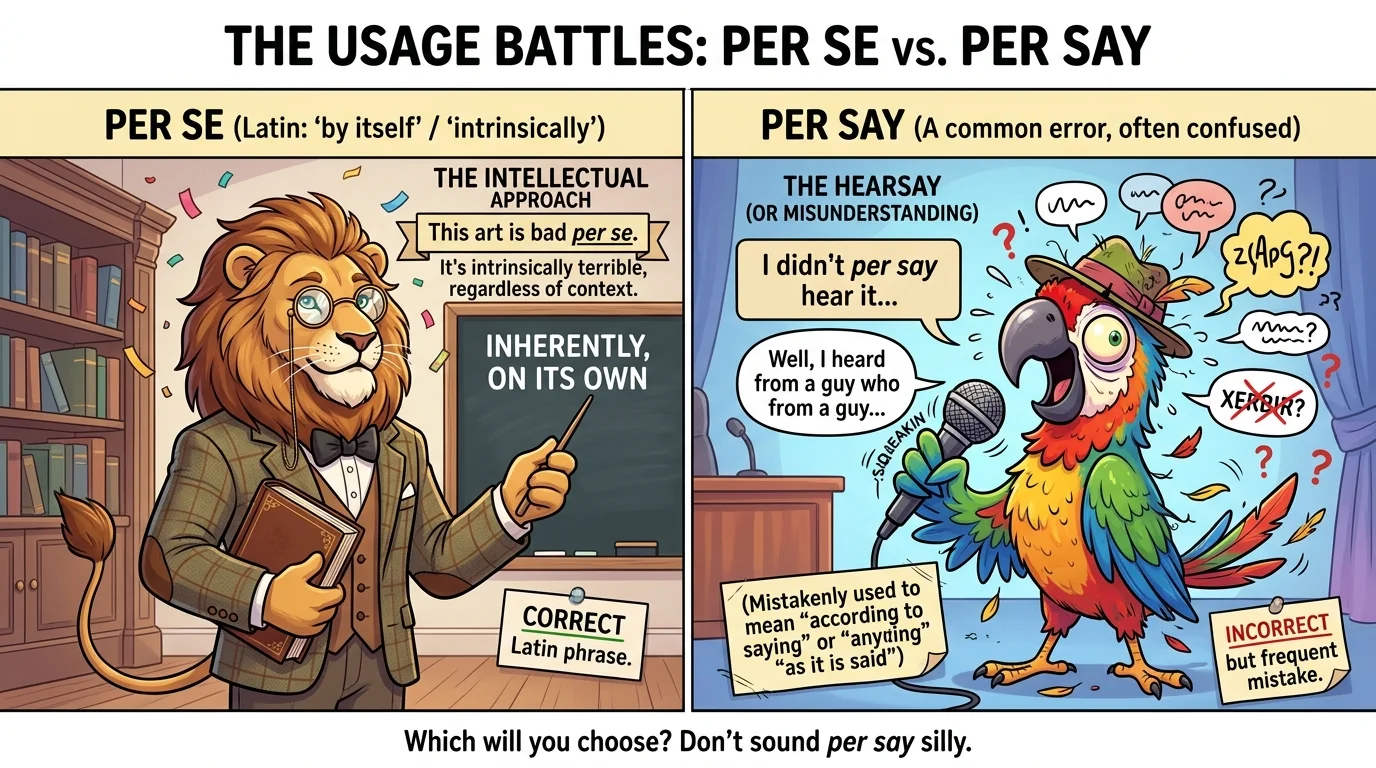
The expression per se comes from Latin and literally means “through itself” or “by itself.” Over time, English adopted the phrase because it provides a concise way to express nuanced ideas.
Writers, lawyers, academics, and journalists frequently use per se to separate an object’s inherent qualities from surrounding circumstances. This precision makes the phrase especially valuable in analytical and professional writing.
The confusion with per say demonstrates how spoken language can influence spelling. Because both forms sound identical, many people unknowingly use the incorrect version until they encounter the phrase in writing.