
Quick Answer
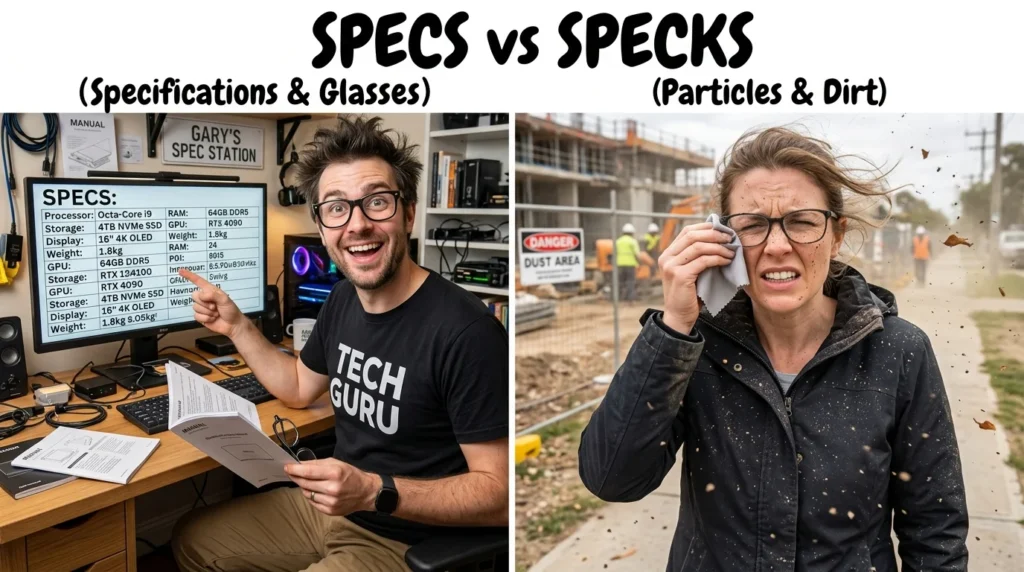
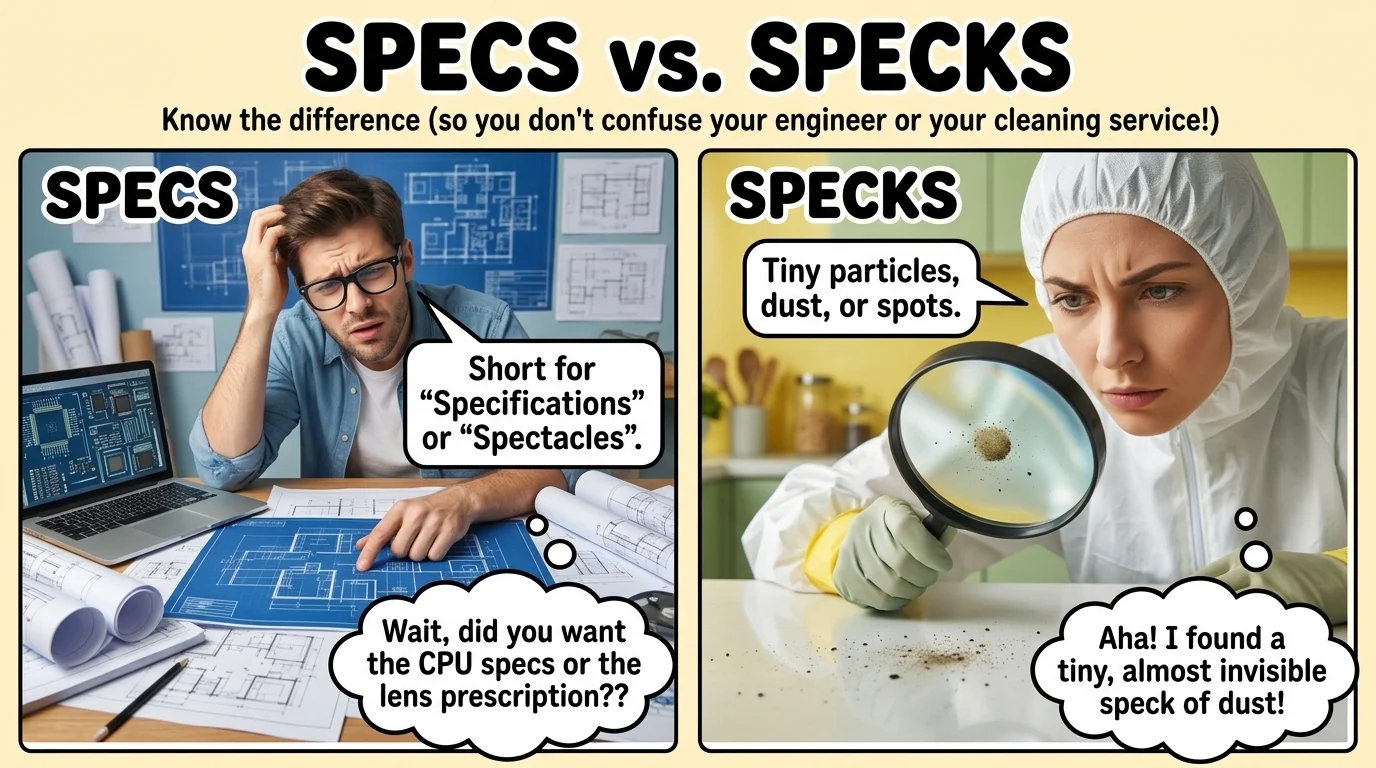
Specs is the plural form of spec, which commonly means specifications or eyeglasses.
Specks is the plural form of speck, meaning tiny spots, particles, or small pieces of something.
Simply put, specs are details or glasses, while specks are tiny spots or particles.
What Does “Specs” Mean?
Specs has two common meanings in English. It can refer to specifications, which are detailed requirements or descriptions, or it can be an informal term for eyeglasses.
Usage Rules
Use specs when referring to:
- Technical specifications or requirements
- Product features and details
- Eyeglasses in informal conversation
Examples
- Check the laptop’s specs before buying it.
- The architect reviewed the building specs carefully.
- He forgot his specs at home and couldn’t read the menu.
Key Insight: If you’re talking about details, requirements, features, or glasses, use specs.
What Does “Specks” Mean?
Specks refers to tiny spots, particles, or very small pieces of something. The word often describes dust, dirt, paint, or small marks.
Usage Rules
Use specks when referring to:
- Tiny particles of dust or dirt
- Small spots or marks
- Very tiny pieces of a substance
- Minute amounts of something visible
Examples
- There were specks of dust on the bookshelf.
- Tiny specks of paint covered his shirt.
- I noticed several black specks on the white paper.
Key Insight: If you can replace the word with tiny particles or small spots, then specks is the correct choice.
Specs vs Specks: Key Differences
Bullet Differences
- Meaning: Specs means specifications or eyeglasses; specks means tiny spots or particles.
- Context: Specs is common in technology and everyday speech; specks is common when describing small visible particles.
- Usage: Specs refers to details or objects; specks refers to tiny pieces or marks.
- Function: Specs describes information or glasses; specks describes physical particles.
- Common Mistake: Writers sometimes type specs when they mean tiny spots and vice versa.
| Feature | Specs | Specks |
|---|---|---|
| Meaning | Specifications or eyeglasses | Tiny spots or particles |
| Context | Technology, products, everyday speech | Dust, dirt, paint, small marks |
| Function | Refers to details or glasses | Refers to tiny pieces or spots |
| Example | The phone has impressive specs. | Specks of dust covered the table. |
| Related To | Information and objects | Small particles |
Real-World Usage Scenarios
Scenario 1
Incorrect: “The computer’s specks are impressive.”
Correct: “The computer’s specs are impressive.”
🎯 Lesson: Product features and requirements are called specs.
Scenario 2
Incorrect: “There were black specs on the window.”
Correct: “There were black specks on the window.”
🎯 Lesson: Tiny spots or marks are called specks.
Scenario 3
Incorrect: “I need new specks because my glasses are broken.”
Correct: “I need new specs because my glasses are broken.”
🎯 Lesson: In informal English, eyeglasses are often called specs.
Scenario 4
Incorrect: “The shirt had white specs of paint.”
Correct: “The shirt had white specks of paint.”
🎯 Lesson: Tiny particles of paint are specks.
Common Mistakes
Mistake 1: Using “Specks” for Product Specifications
Why it happens: The words sound almost identical.
Correction: Technical details and features are called specs.
Mistake 2: Using “Specs” for Tiny Spots
Why it happens: The spellings differ by only one letter.
Correction: Tiny particles or marks are called specks.
Mistake 3: Forgetting Context
Why it happens: Writers focus on pronunciation rather than meaning.
Correction: Determine whether the sentence discusses details or small particles.
Memory Tricks to Remember the Difference
Trick 1
Specs = Specifications
Both words start with spec-.
Think:
Specs = Specs sheet.
Trick 2
Specks = Small Spots
The extra k can remind you of a tiny particle or mark.
Think:
Specks = Small specks of dust.
Trick 3
Ask yourself:
Am I talking about details or tiny particles?
- Details or glasses → Specs
- Tiny particles or spots → Specks
Trick 4
Remember this simple rule:
Specs describe features. Specks describe tiny spots.
Expert Insight
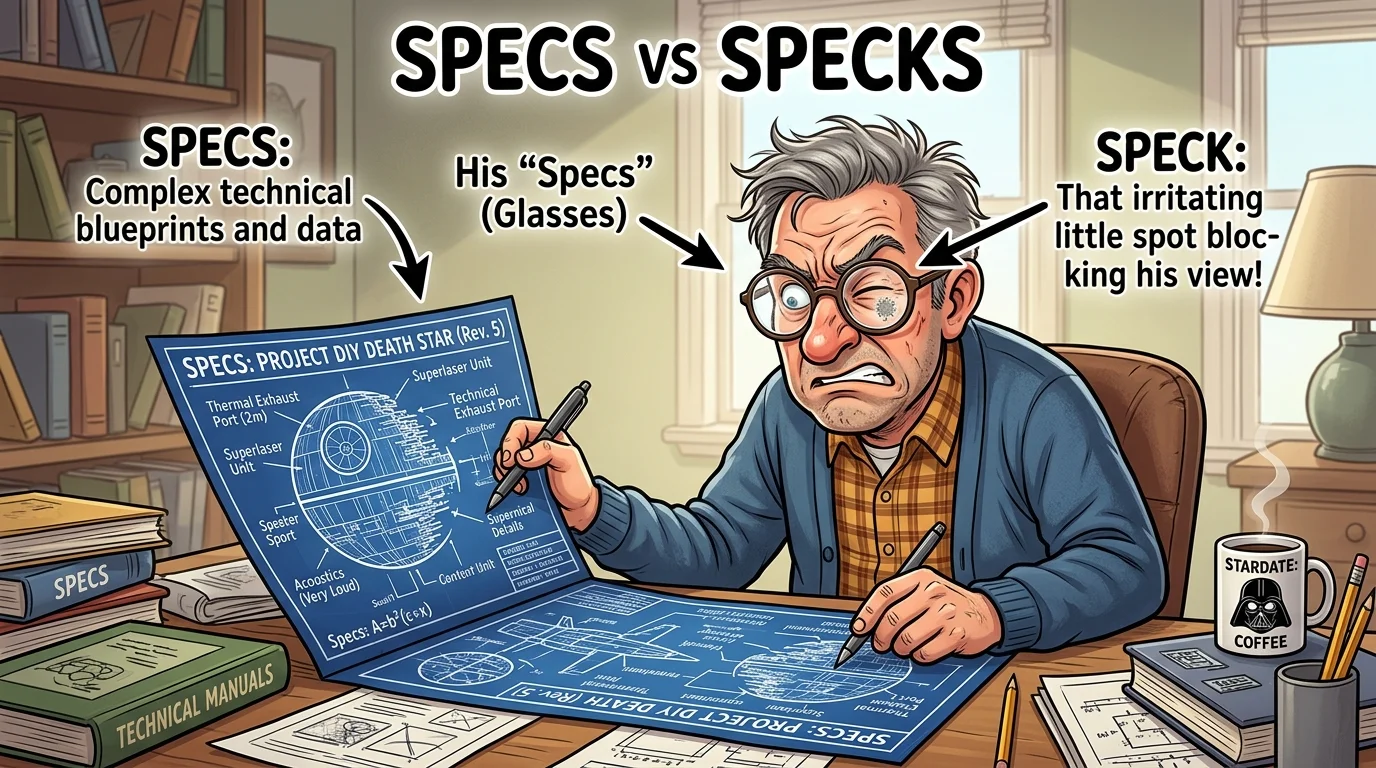
The word specs is an abbreviation of specifications, a term commonly used in technology, engineering, and product descriptions. In informal British and American English, specs is also widely used as a shortened form of spectacles, meaning eyeglasses.
The word speck, however, comes from older terms meaning a tiny spot or stain. Its meaning has remained remarkably consistent over time and still refers to very small visible particles.
Because both words share similar spellings and pronunciations, they are frequently confused. Context usually provides the clearest clue for choosing the correct term.