
Quick Answer: Tagliatelle vs. Pappardelle
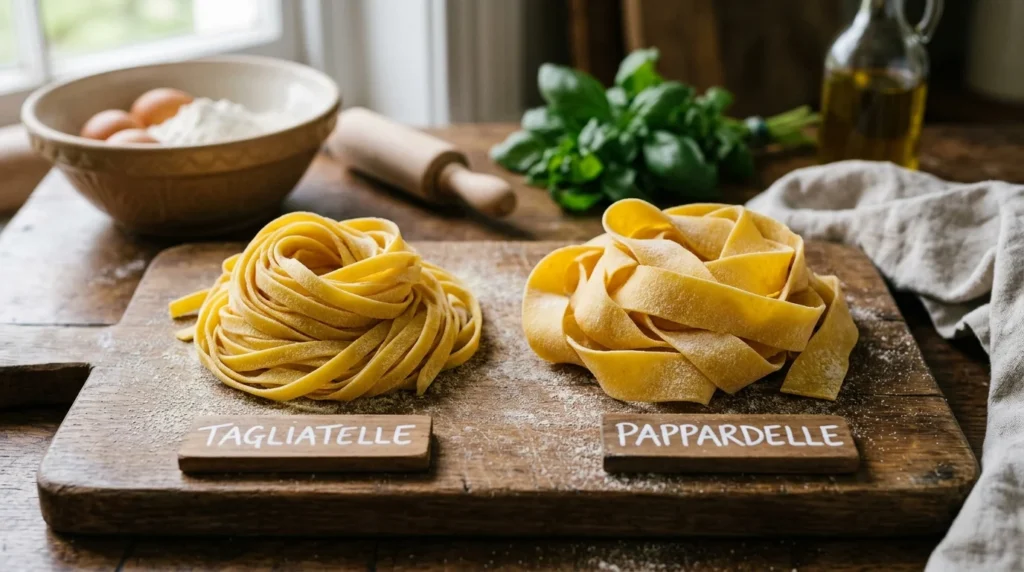
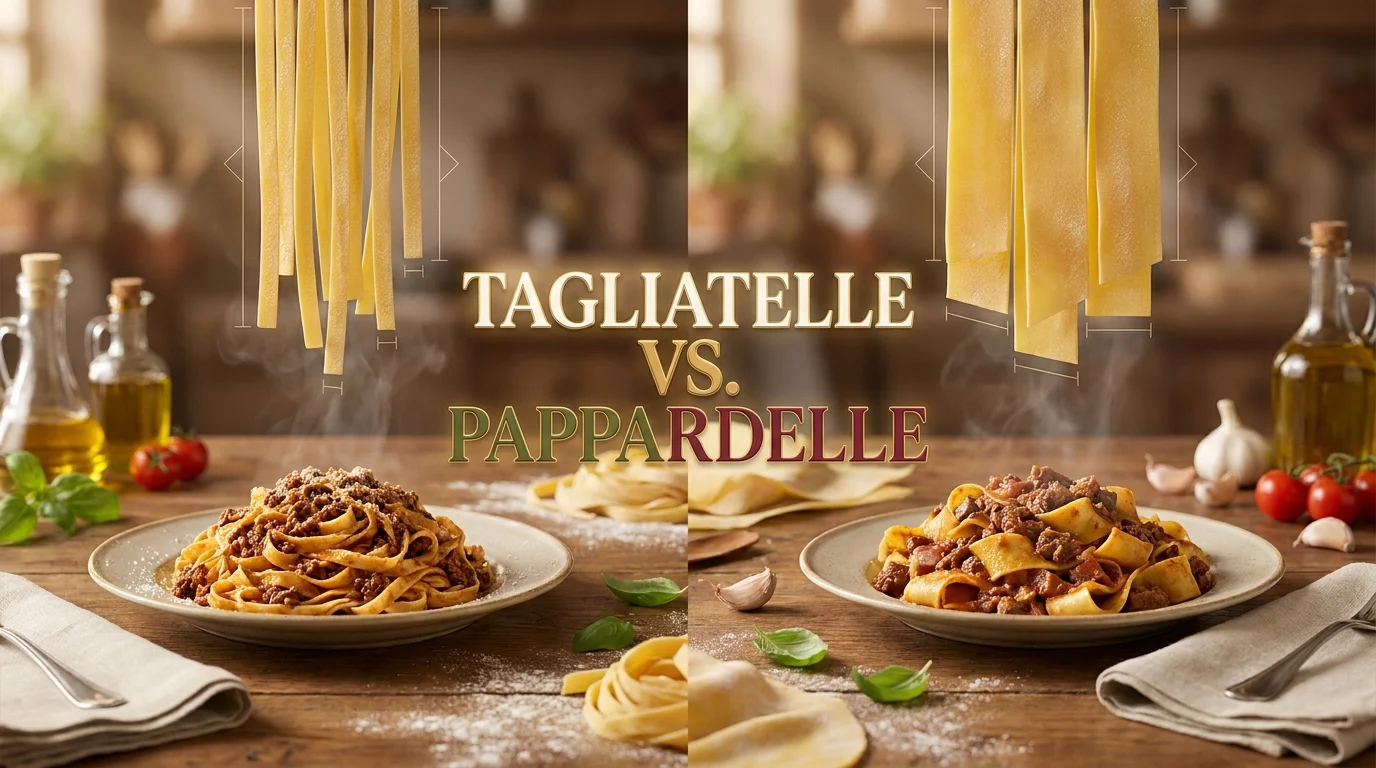
Tagliatelle is a long, narrow ribbon pasta, while pappardelle is a much wider ribbon pasta.
Both are traditionally associated with central and northern Italy and work particularly well with rich sauces.
Choose tagliatelle for moderately rich meat, cream, mushroom, or tomato-based sauces.
Choose pappardelle when you want a wider pasta that can stand up to thick, chunky, slow-cooked sauces and ragùs.
What Is Tagliatelle?
Tagliatelle is a long, flat ribbon pasta traditionally made with flour and eggs.
The name comes from the Italian verb tagliare, meaning “to cut,” referring to the way the pasta is cut into ribbons.
Tagliatelle is especially associated with Emilia-Romagna, where it is a staple of traditional Italian cooking.
What Does Tagliatelle Look Like?
Tagliatelle is:
- Long
- Flat
- Ribbon-shaped
- Relatively narrow
- Often egg-based
- Usually sold fresh or dried
Its width is generally around 6–8 mm, although exact dimensions can vary depending on the maker and regional tradition.
Best Sauces for Tagliatelle
Tagliatelle pairs particularly well with:
- Bolognese-style ragù
- Mushroom sauces
- Cream sauces
- Butter and Parmesan
- Truffle sauces
- Meat sauces
- Tomato-based sauces
For example:
Tagliatelle al ragù is one of the best-known traditional combinations.
🎯 Key Insight: Tagliatelle has enough surface area to hold substantial sauces without being as broad and heavy as pappardelle.
What Is Pappardelle?
Pappardelle is another long, flat ribbon pasta, but it is considerably wider than tagliatelle.
The name is associated with the Italian verb pappare, meaning roughly “to gobble up” or “to eat enthusiastically.”
Pappardelle is strongly associated with Tuscany and central Italian cuisine.
What Does Pappardelle Look Like?
Pappardelle is:
- Long
- Flat
- Very wide
- Often egg-based
- Typically served with hearty sauces
Its width is commonly around 2–3 cm, although measurements vary among producers and traditional preparations.
Best Sauces for Pappardelle
Pappardelle is especially well suited to:
- Wild boar ragù
- Beef ragù
- Duck ragù
- Mushroom sauces
- Braised meat sauces
- Rich tomato-meat sauces
- Hearty game sauces
For example:
Pappardelle with wild boar ragù is a classic Tuscan-style pairing.
🎯 Key Insight: Its broad ribbons make pappardelle particularly effective at carrying thick, chunky, slow-cooked sauces.
Tagliatelle vs. Pappardelle: Main Difference
| Feature | Tagliatelle | Pappardelle |
|---|---|---|
| Shape | Long, flat ribbon | Long, flat ribbon |
| Width | Narrower | Much wider |
| Typical width | About 6–8 mm | About 2–3 cm |
| Texture | Delicate but substantial | Broad and substantial |
| Traditional associations | Emilia-Romagna | Tuscany |
| Common sauces | Ragù, cream, mushrooms, butter | Hearty ragù, game, braised meat |
| Egg pasta | Traditionally yes | Traditionally yes |
| Best for | Medium-rich sauces | Thick, chunky sauces |
Tagliatelle vs. Pappardelle: The Biggest Difference
The easiest way to distinguish them is to look at the width.
Tagliatelle
Think:
Narrow ribbon
It is wider than spaghetti but significantly narrower than pappardelle.
Pappardelle
Think:
Wide ribbon
Its broad surface makes it particularly suitable for robust sauces containing meat, mushrooms, or other substantial ingredients.
🎯 Lesson: If the ribbon is noticeably wider, you’re probably looking at pappardelle.
Real-World Usage Scenarios
Scenario 1: Classic Ragù
You’re making a rich meat ragù and want a traditional pasta pairing.
Tagliatelle is an excellent choice.
Tagliatelle al ragù is a classic combination associated with Bologna and Emilia-Romagna.
🎯 Lesson: Tagliatelle is a traditional partner for ragù.
Scenario 2: Wild Boar Sauce
You’re making a slow-cooked wild boar ragù with a thick, intensely flavored sauce.
Pappardelle is an excellent choice.
Pappardelle with wild boar ragù is strongly associated with Tuscan cuisine.
🎯 Lesson: Wide pasta works beautifully with chunky game-based sauces.
Scenario 3: Creamy Mushroom Sauce
You have a creamy mushroom sauce with Parmesan.
Tagliatelle works particularly well because its ribbons provide enough surface area to hold the sauce without overwhelming the dish.
🎯 Lesson: Tagliatelle is versatile enough for both meat and vegetarian sauces.
Scenario 4: Hearty Braised Beef
You’re serving a thick sauce made from slow-braised beef.
Pappardelle is the stronger choice.
Its wide ribbons complement the substantial texture of the sauce.
🎯 Lesson: Heavy sauce → wider pasta is a useful cooking rule.
Common Mistakes
Mistake 1: Thinking Tagliatelle and Pappardelle Are the Same
They’re closely related, but their widths are different.
Pappardelle is substantially wider.
Mistake 2: Choosing Pasta Only by Sauce Flavor
The sauce’s texture and thickness matter too.
A delicate sauce doesn’t necessarily need the broadest pasta.
A chunky ragù can benefit from a wider ribbon.
Mistake 3: Assuming Every Manufacturer Uses the Same Width
Pasta dimensions can vary by:
- Brand
- Region
- Fresh vs. dried preparation
- Handmade vs. machine-cut pasta
So width ranges should be treated as general guidelines rather than absolute measurements.
Mistake 4: Thinking Pappardelle Is Always Better for Ragù
Not necessarily.
Tagliatelle is famously paired with ragù, while pappardelle is especially suited to very hearty versions such as game and braised-meat sauces.
🎯 Lesson: Both can work with ragù—the style and thickness of the sauce help determine the better choice.
Tagliatelle vs. Pappardelle: Which Is Better?
There isn’t one universal winner.
Choose Tagliatelle If You Want:
- A narrower ribbon
- Classic Bolognese-style ragù
- Creamy sauces
- Mushroom sauces
- Butter and Parmesan
- Truffle-based sauces
- A versatile everyday ribbon pasta
Choose Pappardelle If You Want:
- A much wider ribbon
- Hearty meat sauces
- Wild game ragù
- Braised meat
- Chunky mushroom sauces
- A more substantial pasta texture
Memory Tricks
🎀 Tagliatelle = Thin-ish Ribbon
Think:
Tagliatelle = tidy, narrower ribbons
🏞️ Pappardelle = Powerful, Wide Ribbon
Think:
Pappardelle = broad enough for big, bold sauces
⭐ One-Line Memory Trick
Tagliatelle is narrow; pappardelle is wide.
If the sauce is heavy and chunky, think pappardelle.
If you want a versatile ribbon pasta, think tagliatelle.
Expert Insight: Why Pasta Width Matters
Pasta shape isn’t merely decorative. Its dimensions affect how sauce, pasta, and texture interact.
A wider ribbon provides more surface area and a substantial bite, making it particularly effective with sauces containing larger ingredients or long cooking times.
Tagliatelle occupies a useful middle ground: it is broad enough to support rich sauces but narrow enough to remain relatively delicate.
This is why traditional Italian cuisine developed such a strong relationship between pasta shape and sauce style.
Rather than thinking:
“Which pasta is better?”
A better question is:
“Which pasta shape best complements this sauce?”
Quick Test: Tagliatelle or Pappardelle?
1. Which one is wider?
Pappardelle ✅
2. Which is traditionally associated with Emilia-Romagna?
Tagliatelle ✅
3. Which is strongly associated with Tuscany?
Pappardelle ✅
4. Which is traditionally paired with Bolognese-style ragù?
Tagliatelle ✅
5. Which is excellent with wild boar ragù?
Pappardelle ✅
6. Which is better for a very chunky sauce?
Pappardelle ✅