
Quick Answer
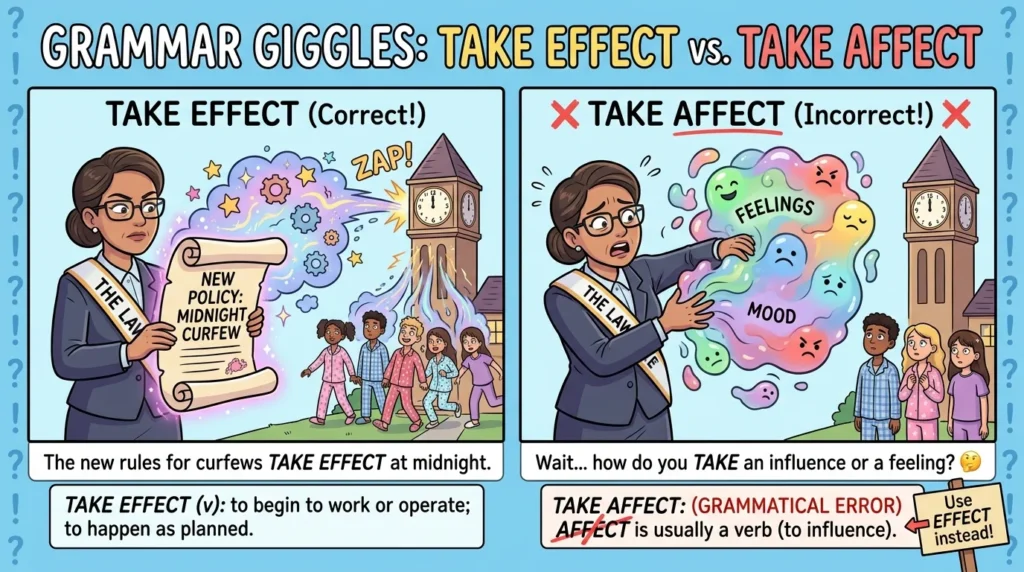
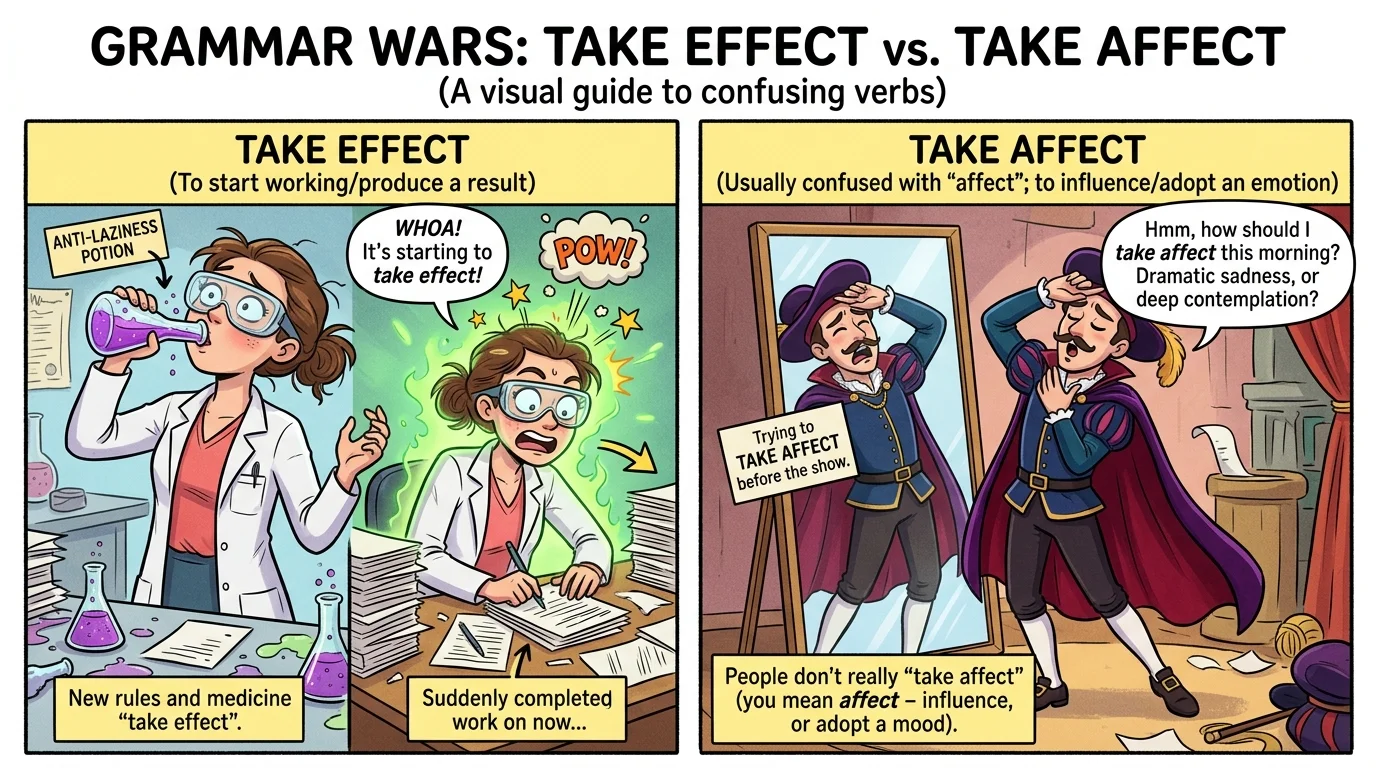
Take effect is the correct phrase. It means to begin operating, become active, or start producing results.
Take affect is incorrect in almost all situations and should be avoided.
Examples:
- Correct: The new law will take effect next month.
- Incorrect: The new law will take affect next month.
Deep Explanation: Take Effect
Take effect is a common English expression used when something begins to work, operate, or become official.
Meaning of Take Effect
The phrase can mean:
- To start working
- To become active
- To become official
- To begin producing results
Common Uses of Take Effect
Take effect often appears in discussions about:
- Laws and regulations
- Medications
- Policies and rules
- Contracts and agreements
- Changes and decisions
Correct Examples
✅ The new tax policy will take effect on January 1.
✅ The medicine should take effect within thirty minutes.
✅ The company’s updated rules take effect immediately.
Key Insight
Whenever something starts working or becomes active, the correct phrase is take effect.
Deep Explanation: Take Affect
Take affect is generally incorrect.
The confusion happens because effect and affect sound very similar.
Why Do People Write “Take Affect”?
People often make this mistake because:
- They confuse affect and effect.
- The pronunciation of both words is similar.
- They know that affect is related to change and influence.
However, the expression is take effect, not take affect.
Incorrect Examples
❌ The medication will take affect soon.
❌ The new rules take affect next week.
❌ The agreement will take affect immediately.
Each sentence should use take effect instead.
Key Insight
Take affect is not a standard English expression and is almost always considered an error.
Take Effect vs Take Affect: Key Differences
Quick Differences
- Take effect is correct.
- Take affect is incorrect.
- Take effect means to begin working or become active.
- Take affect is not an accepted expression in standard English.
| Feature | Take Effect | Take Affect |
|---|---|---|
| Meaning | To begin working or become active | Incorrect expression |
| Grammar | Correct idiomatic phrase | Incorrect phrase |
| Usage | Laws, medicine, policies, agreements | Should be avoided |
| Dictionary Recognition | Yes | No |
| Example | The changes take effect tomorrow. ✅ | The changes take affect tomorrow. ❌ |
Real-World Usage Scenarios
Example 1
Government Announcement:
The new regulations will take effect on July 1.
🎯 Lesson: Laws and regulations usually take effect.
Example 2
Doctor:
This pain medication should take effect within twenty minutes.
🎯 Lesson: Medicines also take effect when they begin working.
Example 3
Employer:
Your new salary will take effect next month.
🎯 Lesson: Workplace changes and agreements commonly take effect.
Example 4
Incorrect:
The policy will take affect immediately.
Correct:
The policy will take effect immediately.
🎯 Lesson: Always use take effect, not take affect.
Common Mistakes
Mistake 1: Writing “Take Affect”
❌ The rule will take affect tomorrow.
✅ The rule will take effect tomorrow.
Why it happens: The words sound similar and are frequently confused.
Mistake 2: Assuming Affect Means Something Becomes Active
❌ The medicine will take affect.
✅ The medicine will take effect.
Why it happens: People know affect relates to change and mistakenly substitute it.
Mistake 3: Mixing Up Affect and Effect
❌ The new policy will take affect.
✅ The new policy will take effect.
Why it happens: Affect and effect are among the most commonly confused words in English.
Memory Tricks
Remember this phrase:
Take effect = Results begin.
Think:
Effect = End result or outcome.
When something starts producing results, it takes effect.
Another easy trick:
- Medicine → Takes effect
- Law → Takes effect
- Policy → Takes effect
- Agreement → Takes effect
If something becomes active or starts working, use take effect.
Expert Insight
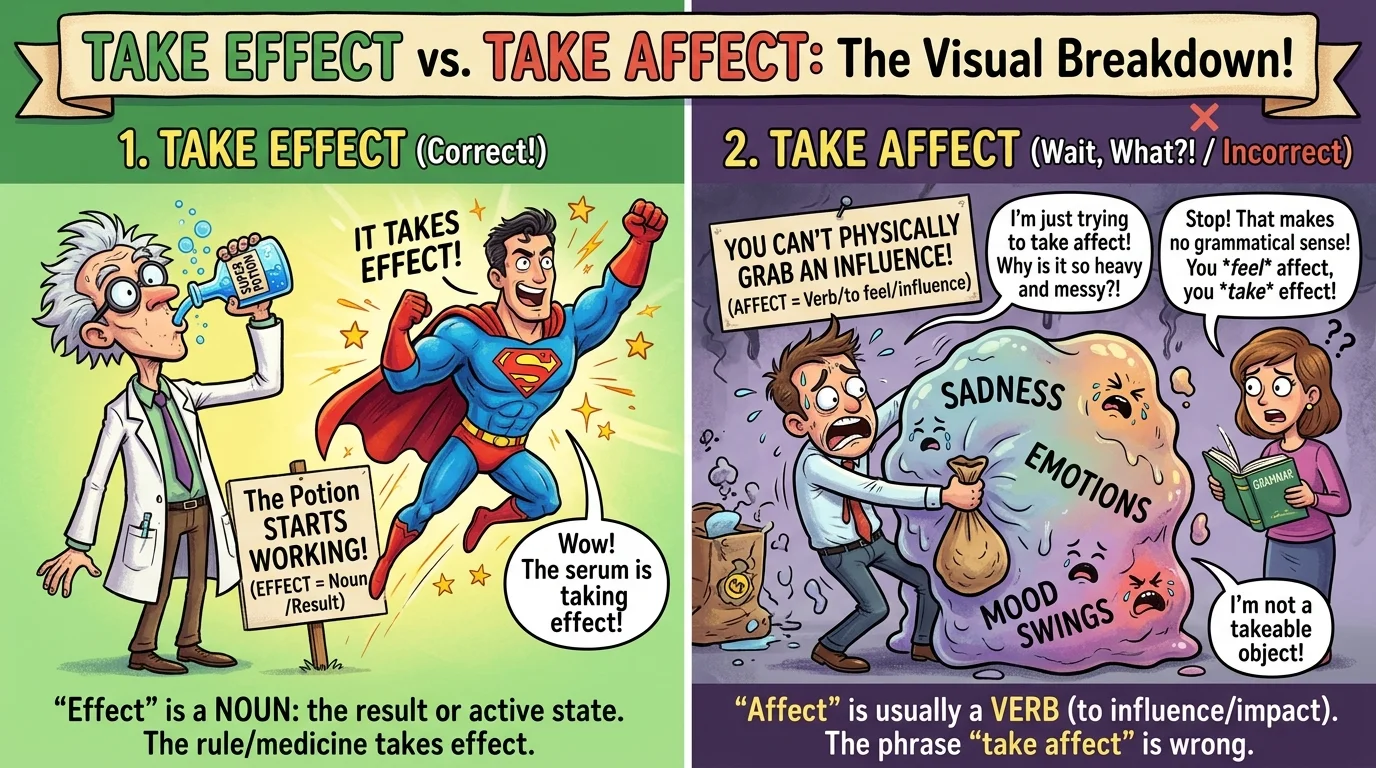
The noun effect refers to a result, consequence, or outcome. The phrase take effect developed to describe the moment when something begins producing its intended result.
The word affect, by contrast, is usually a verb meaning to influence or to change.
Examples:
- The weather affects crops.
- Stress affects sleep.
Because both words have similar pronunciations and related meanings, writers often substitute one for the other. However, standard English consistently recognizes take effect as the only correct expression.
Dictionaries, legal documents, medical publications, and professional style guides overwhelmingly use take effect and reject take affect.