
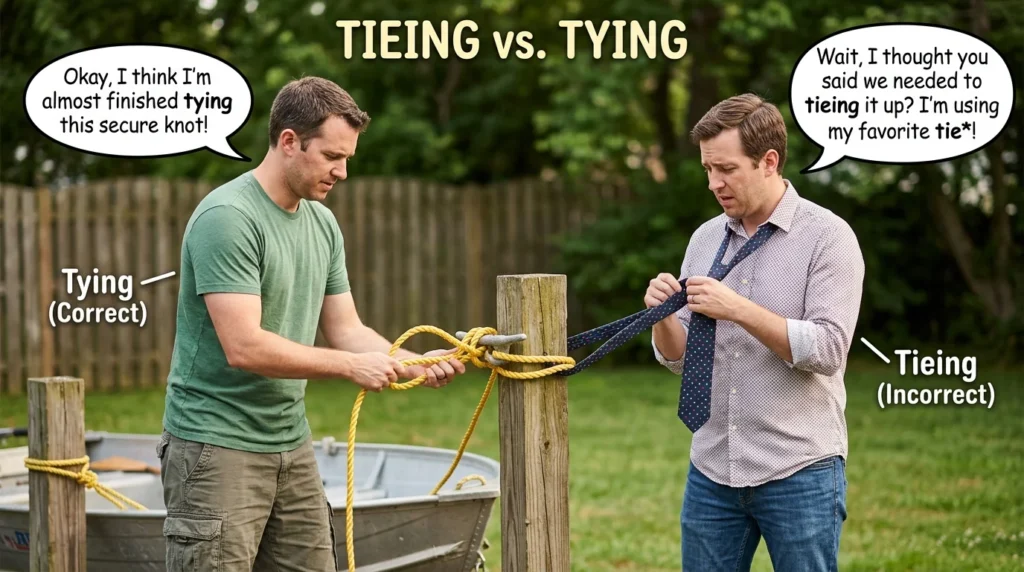
Quick Answer: Tieing vs Tying
Tying is the correct present participle and gerund form of the verb tie, meaning to fasten, secure, or bind something.
Tieing is generally considered a misspelling in modern English and should usually be avoided.
In short, use tying, not tieing, in standard English writing.
Deep Explanation: Tieing
Definition
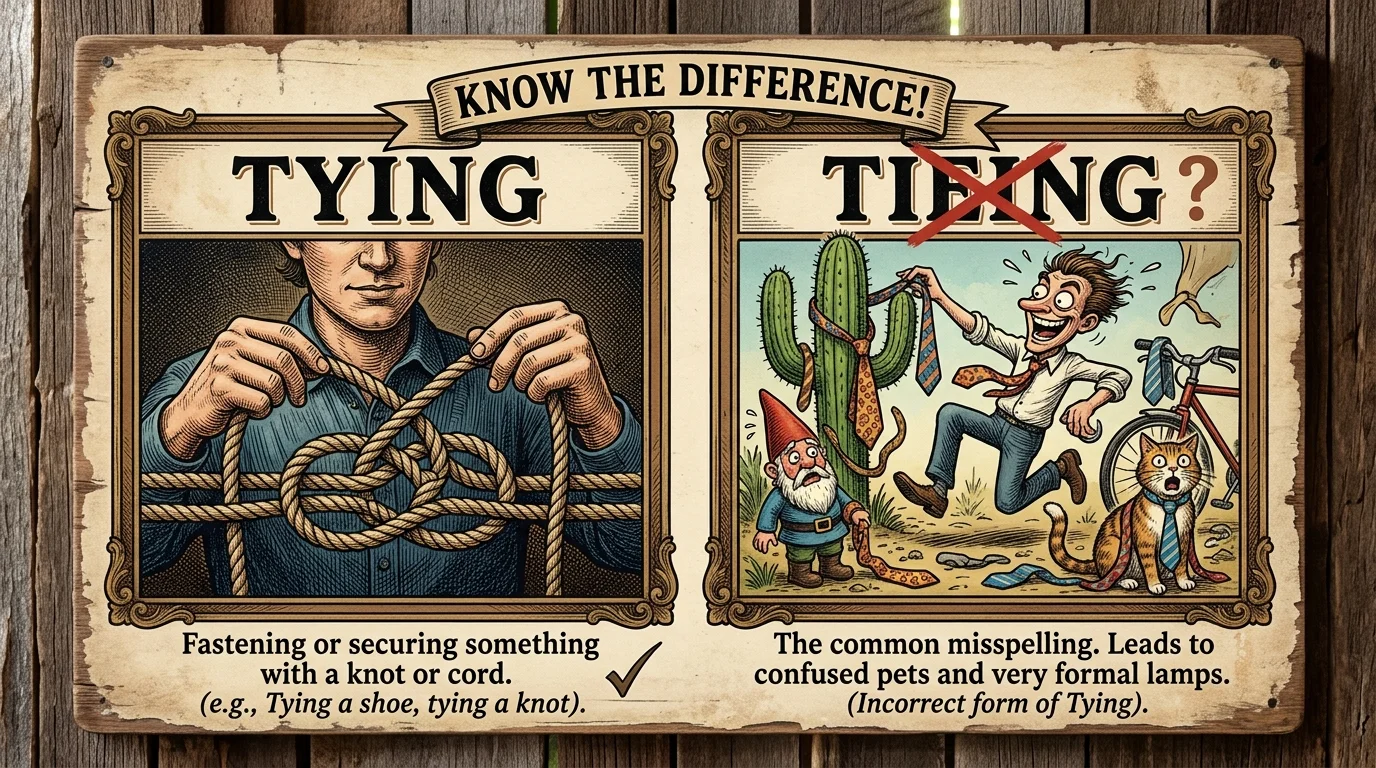
Tieing is a nonstandard spelling that people sometimes use when trying to form the -ing version of the verb tie.
Usage Rules
Most English verbs simply add -ing:
- See → Seeing
- Agree → Agreeing
- Free → Freeing
Because of this pattern, some writers incorrectly assume:
Tie + ing = Tieing
However, this assumption is incorrect.
Context
In modern English, dictionaries and style guides generally do not accept tieing as the standard spelling.
Examples
Incorrect:
- She is tieing her shoes.
- They are tieing ribbons around the gifts.
- He spent the afternoon tieing fishing knots.
Key Insight: Although tieing may seem logical, it is not considered standard English.
Deep Explanation: Tying
Definition
Tying is the correct present participle and gerund form of the verb tie.
It means fastening, binding, securing, or connecting something.
Usage Rules
Use tying whenever you need the -ing form of tie.
Context
The word can be used literally and figuratively.
Literal meaning:
- Tying shoelaces
- Tying ropes
- Tying gift ribbons
Figurative meaning:
- Tying bonuses to performance
- Tying one idea to another
Examples
- She is tying her shoes.
- They are tying the boat to the dock.
- The company is tying employee bonuses to sales targets.
Key Insight: Whenever you mean the act of fastening or connecting something, tying is the correct spelling.
Tieing vs Tying: Key Differences
Main Differences
- Meaning: Both attempt to refer to the act of tying something.
- Correctness: Only tying is standard English.
- Usage: Tying should be used in all forms of writing.
- Grammar: Tieing is generally treated as a spelling error.
- Common Mistake: Writers apply normal -ing rules to the verb tie.
Comparison Table
| Feature | Tieing | Tying |
|---|---|---|
| Meaning | Intended to mean the act of tying | The act of fastening or securing |
| Standard English | No | Yes |
| Usage | Avoid | Use in all situations |
| Context | Nonstandard spelling | Formal and informal writing |
| Example | She is tieing her shoes. ❌ | She is tying her shoes. ✅ |
Real-World Usage Scenarios
Scenario 1
Student: “I wrote, ‘I am tieing my shoes.’ Is that right?”
Teacher: “No. The correct spelling is ‘I am tying my shoes.'”
🎯 Lesson: Always use tying as the -ing form of tie.
Scenario 2
Employee: “I’m tieing customer rewards to purchases.”
Manager: “Write ‘tying’ instead.”
🎯 Lesson: The rule applies in professional writing too.
Scenario 3
Friend: “Why isn’t it spelled tieing?”
Friend: “Because verbs ending in -ie often change to -y before adding -ing.”
🎯 Lesson: English has special spelling rules for certain verbs.
Common Mistakes
Mistake 1: Simply Adding -ing
Incorrect thinking:
Tie + ing = Tieing
Why it happens: Most verbs simply add -ing.
Correction: The spelling changes to tying.
Mistake 2: Assuming Both Spellings Are Acceptable
Why it happens: Both spellings appear reasonable.
Correction: Standard English accepts only tying.
Mistake 3: Following Similar Verb Patterns
Writers compare tie with:
- See → Seeing
- Agree → Agreeing
- Free → Freeing
Why it happens: English often follows predictable patterns.
Correction: The verb tie is an exception.
Memory Tricks
Trick 1: Remember the Letter Y
Think:
Tie → Tying
The ie changes to y before adding -ing.
Trick 2: Use This Phrase
When you tie, add a Y.
Trick 3: Remember Similar Words
- Die → Dying
- Lie → Lying
- Tie → Tying
The same spelling rule applies to all three verbs.
Expert Insight
English contains several verbs ending in -ie that replace ie with y before adding -ing. This spelling change makes words easier to read and pronounce.
For this reason:
- Die becomes dying
- Lie becomes lying
- Tie becomes tying
The spelling tieing has largely disappeared from standard English usage because tying follows this established grammatical pattern.