

Quick Answer
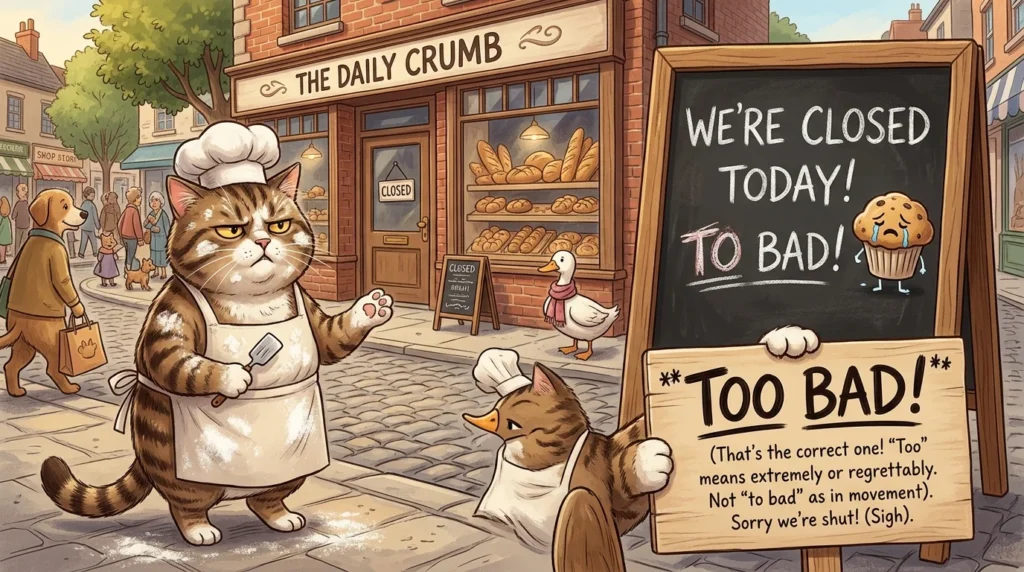
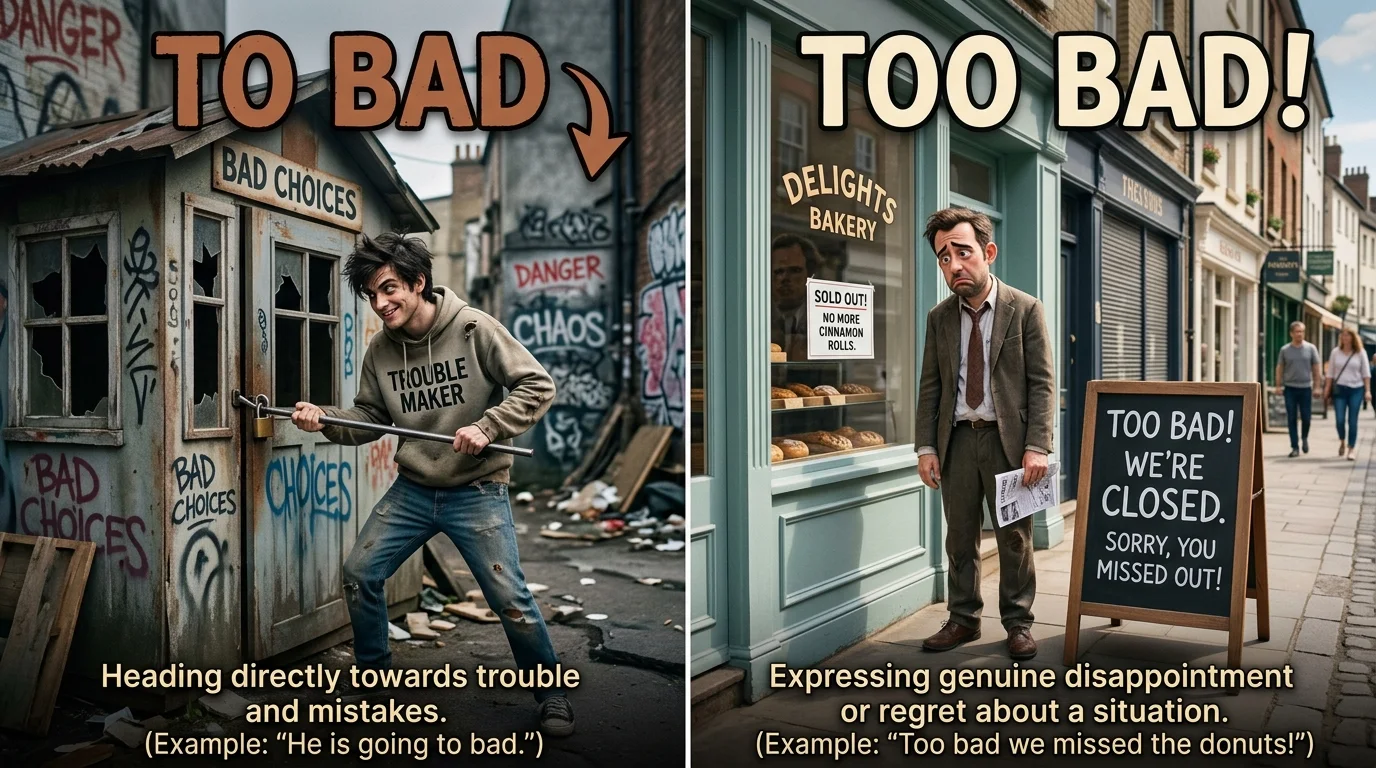
Too bad is the correct and common expression. It means unfortunate, a shame, or regrettable.
To bad is usually incorrect and should generally be avoided.
Examples:
- Correct: It’s too bad that you missed the concert.
- Incorrect: It’s to bad that you missed the concert.
Deep Explanation: To Bad
To bad is generally considered incorrect in standard English.
Most people write to bad because:
- To and too are pronounced the same way.
- English homophones often cause spelling mistakes.
- Writers may type quickly and accidentally omit an extra o.
Why Is “To Bad” Usually Wrong?
The word to typically functions as:
- A preposition
- Part of an infinitive verb
Examples:
- I went to school.
- I want to study.
- She walked to the store.
Since bad is an adjective, the combination to bad rarely makes grammatical sense.
Incorrect Examples
❌ It’s to bad that you couldn’t come.
❌ That’s to bad.
❌ It’s to bad we missed the movie.
All of these sentences should use too bad instead.
Rare Exceptions
In very unusual sentence structures, to bad could technically appear.
Example:
✅ The situation went from good to bad.
Here, to means from one state to another, so the phrase is grammatically correct.
However, this usage is unrelated to the expression too bad.
Deep Explanation: Too Bad
Too bad is the correct phrase and a common English expression.
It usually means:
- Unfortunate
- Regrettable
- A shame
- Disappointing
Common Uses of Too Bad
People often use too bad when discussing:
- Missed opportunities
- Unfortunate events
- Disappointments
- Regretful situations
Correct Examples
✅ It’s too bad that the game was canceled.
✅ That’s too bad. I was looking forward to seeing you.
✅ It’s too bad we didn’t have more time together.
Key Insight
Too bad can also be used conversationally to express mild sympathy.
Example:
Person A: I failed my driving test.
Person B: That’s too bad.
In this context, it means:
I’m sorry to hear that.
To Bad vs Too Bad: Key Differences
Quick Differences
- Too bad is the correct expression.
- To bad is usually incorrect.
- Too means excessively or serves as an intensifier.
- Too bad means unfortunate or regrettable.
| Feature | To Bad | Too Bad |
|---|---|---|
| Meaning | Usually incorrect | Unfortunate; regrettable |
| Grammar | Rarely correct | Correct idiomatic phrase |
| Usage | Should generally be avoided | Common everyday expression |
| Context | Rare transitions like “good to bad” | Sympathy and disappointment |
| Example | It’s to bad. ❌ | It’s too bad. ✅ |
Real-World Usage Scenarios
Example 1
Person A: I couldn’t attend the wedding.
Person B: That’s too bad.
🎯 Lesson: Use too bad to express sympathy.
Example 2
Friend:
It’s too bad that the restaurant closed.
🎯 Lesson: The phrase commonly expresses disappointment.
Example 3
Teacher:
It’s too bad you missed the field trip.
🎯 Lesson: Too bad often refers to missed opportunities.
Example 4
Incorrect:
It’s to bad that it rained.
Correct:
It’s too bad that it rained.
🎯 Lesson: Use too bad, not to bad, for unfortunate situations.
Common Mistakes
Mistake 1: Writing “To Bad”
❌ That’s to bad.
✅ That’s too bad.
Why it happens: Both words sound identical.
Mistake 2: Forgetting That “Too” Means More Than One Thing
❌ Too only means “also.”
✅ Too can mean:
- Also
- Excessively
- An intensifier in expressions like too bad
Why it happens: Learners often know only one meaning of too.
Mistake 3: Assuming Sound Determines Spelling
❌ To bad
✅ Too bad
Why it happens: English spelling frequently differs from pronunciation.
Memory Tricks
Remember this phrase:
Too bad has two O’s because it expresses extra disappointment.
Notice:
- Too = Twoo
- Both contain two o’s.
Another easy trick:
If you can replace the phrase with:
What a shame!
You almost certainly need:
Too bad
Example:
It’s too bad you missed the concert.
↓
What a shame you missed the concert.
The sentence still works, so too bad is correct.
Expert Insight
The phrase too bad developed as an idiomatic expression in English to convey regret, disappointment, or sympathy. Over time, it became one of the most common conversational responses to unfortunate news.
Because to and too are perfect homophones, writers frequently confuse them. This error is especially common in text messages, social media posts, and informal writing.
Dictionaries, educational institutions, and professional style guides consistently recognize too bad as the standard expression.
The phrase to bad is generally considered incorrect unless it appears in unusual constructions that indicate movement from one condition to another, such as from good to bad.