


Quick Answer
To that effect means with that meaning, along those lines, or expressing a similar idea.
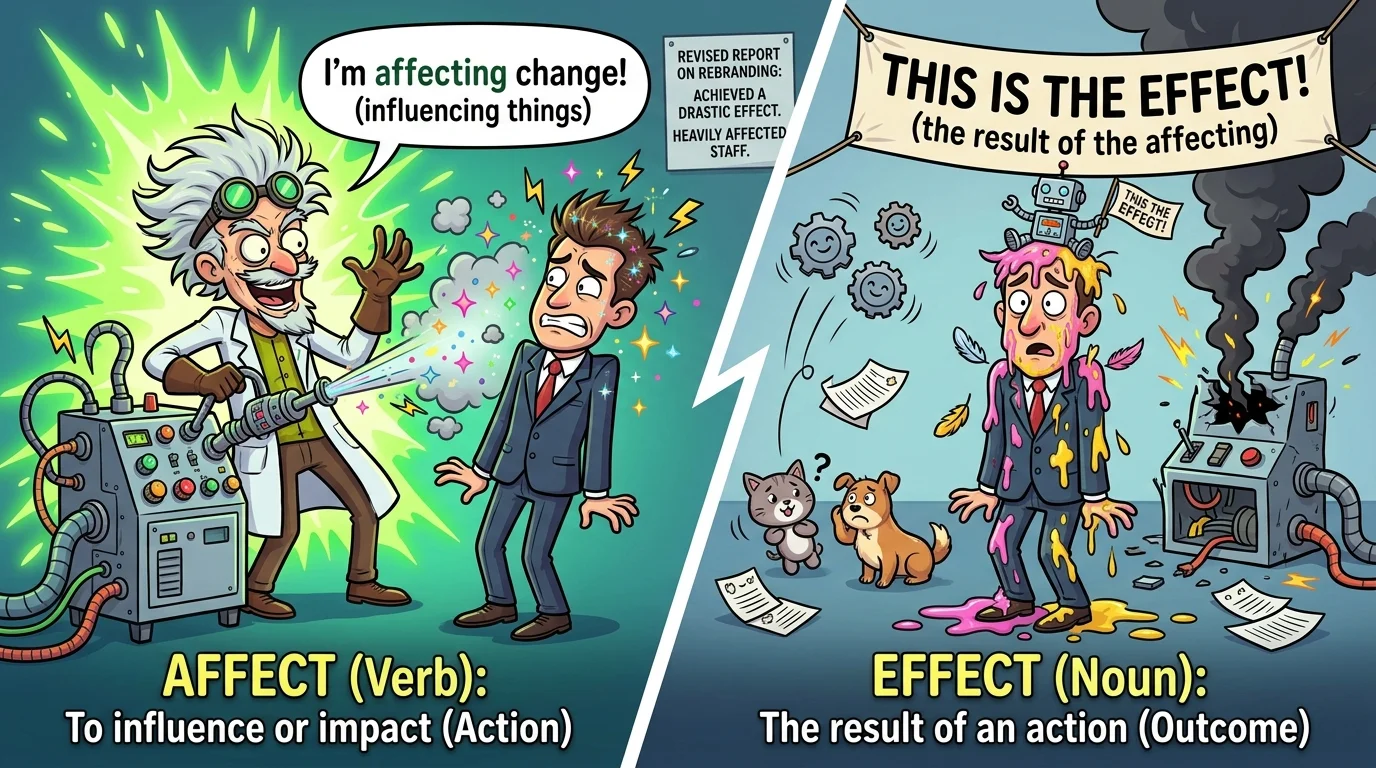
Affect usually means to influence, alter, or make a difference to something.
Examples:
- Correct: She said something to that effect.
- Correct: The weather can affect your mood.
These expressions are unrelated and cannot be used interchangeably.
Deep Explanation: To That Effect
To that effect is an idiomatic phrase used when you do not remember someone’s exact words but know the general meaning of what was said.
Meaning of “To That Effect”
The phrase means:
- Having a similar meaning
- Expressing approximately the same idea
- Along those lines
- In words with that general sense
Correct Examples
✅ He said he wasn’t interested, or words to that effect.
✅ The manager announced that changes were coming, or something to that effect.
✅ She wrote that she needed more time, or words to that effect.
Key Insight
To that effect does not describe influence or change. Instead, it refers to the meaning or substance of a statement.
Deep Explanation: Affect
Affect is usually a verb.
It means:
- To influence
- To change
- To have an impact on something
- To produce an effect
Common Uses of Affect
Affect often appears in discussions about:
- Health
- Business
- Education
- Emotions
- Weather
- Economics
Correct Examples
✅ Lack of sleep can affect your concentration.
✅ Inflation affects consumer spending.
✅ Stress can affect physical health.
Key Insight
In most cases, if you’re talking about one thing influencing another, you need the word affect.
To That Effect vs Affect: Key Differences
Quick Differences
- To that effect means “with that meaning” or “along those lines.”
- Affect means “to influence” or “to change.”
- To that effect is an idiomatic phrase.
- Affect is usually a verb.
| Feature | To That Effect | Affect |
|---|---|---|
| Meaning | With that meaning; along those lines | To influence or change |
| Part of Speech | Idiomatic phrase | Usually a verb |
| Usage | Referring to someone’s words or meaning | Describing influence or impact |
| Context | Conversations and quotations | Cause-and-effect relationships |
| Example | He said something to that effect. ✅ | The news affected everyone. ✅ |
Real-World Usage Scenarios
Example 1
Person A: What exactly did she say?
Person B: She said she was too busy, or something to that effect.
🎯 Lesson: Use to that effect when paraphrasing someone’s words.
Example 2
Teacher:
Poor study habits can affect your grades.
🎯 Lesson: Use affect when one thing influences another.
Example 3
Manager:
The memo stated that additional training was required, or words to that effect.
🎯 Lesson: To that effect refers to meaning rather than exact wording.
Example 4
Doctor:
Smoking can affect your heart and lungs.
🎯 Lesson: Affect expresses influence or impact.
Common Mistakes
Mistake 1: Using Affect Instead of To That Effect
❌ He said something affect.
✅ He said something to that effect.
Why it happens: The words sound somewhat similar and both appear in discussions involving communication.
Mistake 2: Using To That Effect to Mean Influence
❌ Lack of exercise can to that effect your health.
✅ Lack of exercise can affect your health.
Why it happens: People confuse the noun effect inside the phrase with the verb affect.
Mistake 3: Confusing Effect and Affect
❌ The weather had a bad affect on crops.
✅ The weather had a bad effect on crops.
Why it happens: Affect and effect are among the most commonly confused words in English.
Memory Tricks
Remember this simple rule:
To that effect = To that meaning
Think:
Effect = Meaning in this phrase.
For affect, remember:
Affect = Action
If something acts upon, changes, or influences something else, use affect.
Another easy trick:
- To that effect = Similar wording
- Affect = Influence or impact
Expert Insight
The phrase to that effect developed as an idiomatic way of indicating approximate wording rather than quoting someone exactly. It is commonly used in journalism, conversations, and professional communication.
The word affect, on the other hand, comes from Latin roots related to influencing or acting upon something. In modern English, it functions primarily as a verb describing impact or change.
Although both expressions contain the word effect or sound similar to it, they perform entirely different grammatical roles and should never be used interchangeably.
Understanding this distinction can significantly improve writing clarity and prevent one of the more subtle vocabulary errors in English.