
Quick Answer
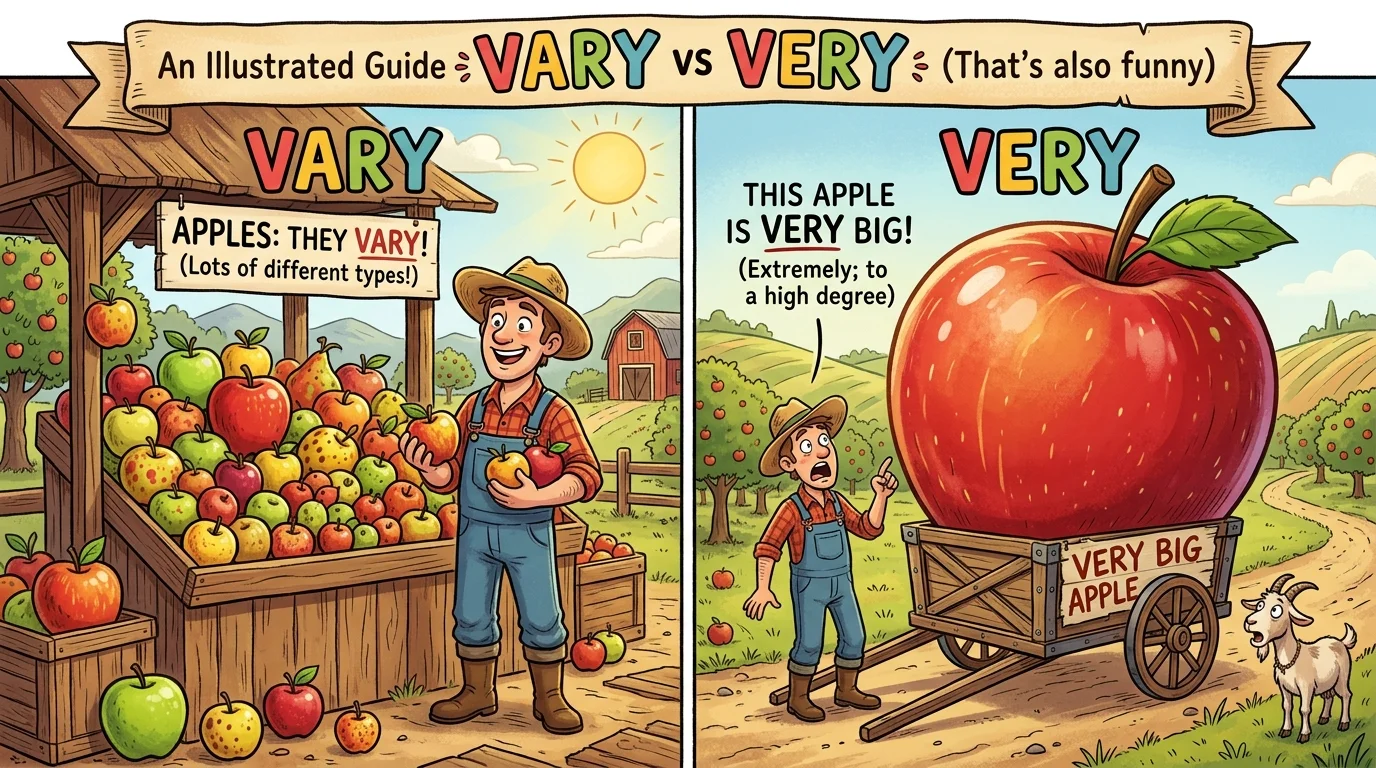
Vary is a verb that means to change, differ, or become different.
Very is an adverb that means to a high degree or extremely.
Simply put, vary describes change, while very adds emphasis or intensity.
What Does “Vary” Mean?
Vary means to change, differ, or have differences. It is a verb, so it describes an action or state of change.
Usage Rules
Use vary when:
- Something changes over time
- Things are different from one another
- There are differences in size, amount, or type
- You want to describe variation or diversity
Examples
- Prices vary from one store to another.
- Weather conditions vary throughout the year.
- People’s opinions often vary on this topic.
Key Insight: If you can replace the word with change or differ, use vary.
What Does “Very” Mean?
Very is an adverb used to emphasize adjectives, other adverbs, and sometimes participles. It adds intensity to what you are describing.
Usage Rules
Use very when:
- Intensifying an adjective
- Emphasizing an adverb
- Indicating a high degree of something
- Making descriptions stronger
Examples
- The movie was very interesting.
- She speaks very quietly.
- The exam was very difficult.
Key Insight: If the word means extremely or to a high degree, use very.
Vary vs Very: Key Differences
Bullet Differences
- Meaning: Vary means to change or differ; very means extremely or to a high degree.
- Part of Speech: Vary is a verb; very is usually an adverb.
- Function: Vary describes change; very intensifies descriptions.
- Usage: Vary often appears with subjects that change; very usually comes before adjectives and adverbs.
- Common Mistake: Writers sometimes use very when they mean change or use vary when they need emphasis.
| Feature | Vary | Very |
|---|---|---|
| Meaning | To change or differ | Extremely; to a high degree |
| Part of Speech | Verb | Adverb |
| Function | Describes change | Adds emphasis |
| Example | Temperatures vary by season. | The water is very cold. |
| Related To | Differences and changes | Intensity and emphasis |
Real-World Usage Scenarios
Scenario 1
Incorrect: “The prices very from store to store.”
Correct: “The prices vary from store to store.”
🎯 Lesson: Since prices are changing or differing, use vary.
Scenario 2
Incorrect: “The movie was vary exciting.”
Correct: “The movie was very exciting.”
🎯 Lesson: Since you are emphasizing the adjective exciting, use very.
Scenario 3
Incorrect: “Opinions very on this issue.”
Correct: “Opinions vary on this issue.”
🎯 Lesson: Different opinions indicate variation, so use vary.
Scenario 4
Incorrect: “She is vary intelligent.”
Correct: “She is very intelligent.”
🎯 Lesson: The word intensifies intelligent, so use very.
Scenario 5
Incorrect: “Temperatures very throughout the year.”
Correct: “Temperatures vary throughout the year.”
🎯 Lesson: Since temperatures change over time, use vary.
Common Mistakes
Mistake 1: Writing “Very” Instead of “Vary”
Why it happens: The words have similar spellings and pronunciations.
Correction: If you mean change or differ, use vary.
Mistake 2: Writing “Vary” Instead of “Very”
Why it happens: English learners often confuse the spellings.
Correction: If you mean extremely or to a high degree, use very.
Mistake 3: Ignoring the Part of Speech
Why it happens: Writers focus on pronunciation instead of grammar.
Correction: Determine whether the sentence needs a verb or an intensifier.
Memory Tricks to Remember the Difference
Trick 1
Vary = Variation
Both words begin with var-.
Think:
Vary = Variation = Change.
Trick 2
Very = Extremely
You can often replace very with extremely.
Example:
- She is very happy.
- She is extremely happy.
Both sentences make sense.
Trick 3
Ask yourself:
Do I mean change or intensity?
- Change or difference → Vary
- Intensity or emphasis → Very
Trick 4
Remember this simple rule:
Vary means change. Very means extremely.

Expert Insight
The confusion between vary and very largely results from their similar spellings and pronunciations. However, grammatically they belong to completely different categories.
Vary comes from words associated with change and diversity. It remains a verb that describes differences and variations.
Very, on the other hand, developed as an intensifier. Modern English uses it extensively to strengthen descriptions and express degrees of intensity.
Professional writers often use a simple test. If they can replace the word with change or differ, they use vary. If they can replace it with extremely, they choose very.