

Quick Answer
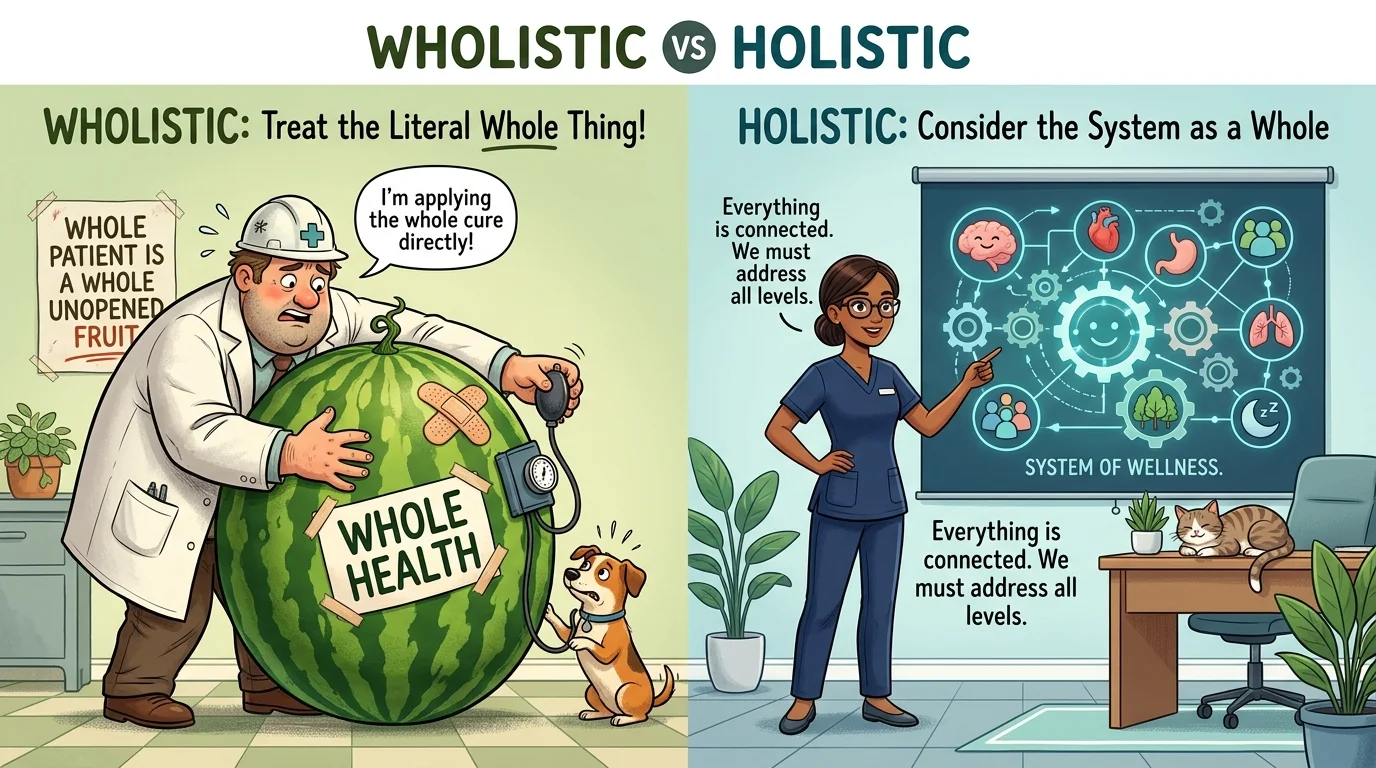
Holistic is the standard and preferred spelling in modern English. It describes an approach that considers the whole system rather than focusing on individual parts.
Wholistic is a less common alternative spelling. Some people use it to emphasize the concept of whole or wholeness, particularly in wellness and personal development contexts.
Examples:
- Standard: She believes in a holistic approach to healthcare.
- Alternative: The coach promotes a wholistic approach to well-being.
Deep Explanation: Wholistic
Wholistic is an alternative spelling of holistic.
Although it appears in books, websites, and wellness communities, it is much less common than holistic.
Why Do Some People Use “Wholistic”?
Some writers intentionally choose wholistic because the spelling visibly contains the word whole. They feel this spelling better communicates the idea of treating a person, organization, or problem as an interconnected whole.
Common Contexts for Wholistic
The term wholistic often appears in:
- Wellness programs
- Spiritual practices
- Life coaching
- Personal development courses
- Alternative health discussions
Examples
✅ The retreat promotes a wholistic approach to personal growth.
✅ The therapist emphasizes wholistic well-being.
✅ The organization uses a wholistic framework for employee wellness.
Key Insight
Wholistic is not generally considered incorrect, but it is less standard and may appear unusual to many readers.
Deep Explanation: Holistic
Holistic is the standard and widely accepted spelling in English.
It refers to an approach that considers all parts of a system as interconnected and examines the whole rather than isolated components.
Common Uses of Holistic
Holistic is commonly used in:
- Healthcare
- Education
- Psychology
- Business management
- Environmental studies
- Personal development
Examples
✅ The doctor recommends a holistic treatment plan.
✅ The school uses a holistic approach to education.
✅ The company adopted a holistic strategy for long-term growth.
Key Insight
A holistic approach focuses on the relationships among different elements and seeks comprehensive solutions instead of addressing only one aspect of a problem.
Wholistic vs Holistic: Key Differences
Quick Differences
- Holistic is the standard and preferred spelling.
- Wholistic is a less common alternative spelling.
- Both generally refer to considering the whole rather than individual parts.
- Wholistic is often used to emphasize the idea of wholeness.
| Feature | Wholistic | Holistic |
|---|---|---|
| Meaning | Alternative spelling emphasizing wholeness | Standard term meaning considering the whole |
| Grammar | Accepted but less common | Standard and preferred |
| Usage | Wellness and personal development contexts | Academic, medical, educational, and business contexts |
| Dictionary Recognition | Recognized but uncommon | Widely recognized |
| Example | A wholistic wellness program. ✅ | A holistic wellness program. ✅ |
Real-World Usage Scenarios
Example 1
Doctor:
We need a holistic treatment plan that addresses your physical and emotional health.
🎯 Lesson: Holistic is the preferred term in healthcare.
Example 2
Life Coach:
I teach a wholistic method of personal transformation.
🎯 Lesson: Some wellness professionals intentionally use wholistic.
Example 3
School Administrator:
Our curriculum takes a holistic approach to student development.
🎯 Lesson: Academic institutions usually prefer holistic.
Example 4
Business Consultant:
A holistic strategy considers employees, customers, finances, and operations together.
🎯 Lesson: Holistic is standard in professional communication.
Common Mistakes
Mistake 1: Assuming “Wholistic” Is Wrong
❌ Wholistic is always incorrect.
✅ Wholistic is a recognized but less common alternative spelling.
Why it happens: Most dictionaries and publications overwhelmingly prefer holistic.
Mistake 2: Using “Wholistic” in Formal Academic Writing
❌ The research recommends a wholistic healthcare model.
✅ The research recommends a holistic healthcare model.
Why it happens: Academic and professional publications usually favor holistic.
Mistake 3: Thinking the Words Have Completely Different Meanings
❌ Holistic and wholistic describe entirely different concepts.
✅ Both generally refer to considering the whole system.
Why it happens: The additional w makes some people assume there is a major difference in meaning.
Memory Tricks
Remember this simple rule:
Holistic = Standard spelling
Wholistic = Whole-focused alternative spelling
Think:
Most professionals prefer holistic.
Another easy trick:
If you’re writing for:
- Academic papers → Holistic
- Business communication → Holistic
- General audiences → Holistic
- Personal branding emphasizing “wholeness” → Wholistic may be acceptable
Expert Insight
The word holistic originated from the concept of holism, a philosophy emphasizing that systems should be viewed as integrated wholes rather than separate parts.
Over time, some practitioners began using wholistic to highlight the connection with the word whole. Although this spelling gained popularity in certain wellness and spiritual communities, mainstream dictionaries, universities, medical organizations, and publishers continue to favor holistic.
Because holistic is far more common and widely recognized, it is generally the safer choice for professional and academic writing.