
Quick Answer: Indecisive vs. Undecisive
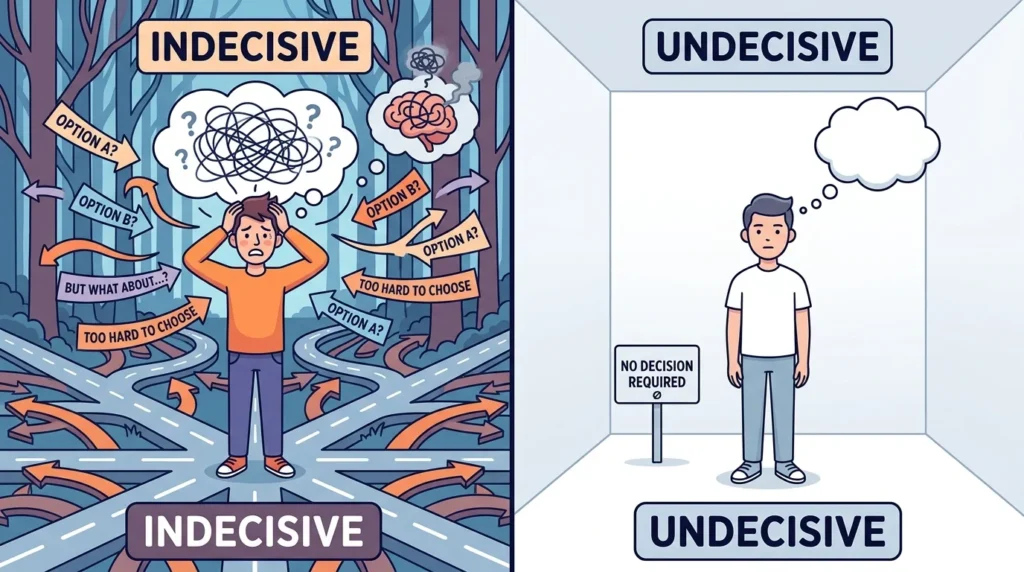
Indecisive is the correct standard word when you mean unable or unwilling to make a decision.
She is indecisive about which dress to buy.
Undecisive is not normally used in standard modern English. In most situations, replace it with indecisive, uncertain, or undecided, depending on your intended meaning.
The easiest rule:
Use “indecisive.” Avoid “undecisive.”
What Does “Indecisive” Mean?
Indecisive is an adjective describing someone who has difficulty making decisions, often because they keep changing their mind, hesitate between options, or struggle to choose.
It can also describe a situation, action, or result that does not produce a clear decision or outcome.
Examples of “Indecisive”
- She is indecisive when choosing what to order at a restaurant.
- He became indecisive when faced with two equally attractive offers.
- The committee’s indecisive response created more confusion.
Describing a Person
I am very indecisive when shopping for clothes.
This means the person has trouble choosing.
Describing an Action or Result
The debate ended with an indecisive result.
This means the result did not clearly settle the issue.
🎯 Key Insight: Indecisive is the standard adjective for difficulty or lack of firmness in making a decision.
What Does “Undecisive” Mean?
Undecisive is sometimes encountered, but it is not the normal standard English choice for describing someone who struggles to make decisions.
In everyday and professional English, native speakers overwhelmingly prefer:
indecisive
For example:
❌ She is undecisive about her career.
✅ She is indecisive about her career.
If you encounter undecisive, it may be a rare or nonstandard formation based on the word undecided, but it is generally better to avoid it.
What Should You Use Instead?
Depending on the meaning, choose:
- Indecisive → unable to make a decision
- Undecided → not having made a decision yet
- Uncertain → not sure about something
These words are related but are not exact synonyms.
Indecisive vs. Undecided
This distinction is especially important because people sometimes use undecisive when they actually mean undecided.
Indecisive
Describes a tendency or difficulty to make decisions.
He is indecisive.
This suggests that making choices is generally difficult for him.
Undecided
Describes a current state in which someone has not made a particular decision.
He is undecided about which university to attend.
This does not necessarily mean he has trouble making decisions generally.
Indecisive Meaning
Indecisive is an adjective that describes a person who struggles to make a choice, reach a conclusion, or commit to a decision. It can also describe behavior or actions characterized by hesitation or a lack of clear determination.
For example:
- I’m indecisive about which college to attend.
- She is very indecisive when choosing what to order.
- His indecisive behavior delayed the project.
The word can describe anything from a small everyday choice to an important decision. Someone may be called indecisive because they take a long time to choose, keep changing their mind, or have difficulty committing to one option.
Undecisive Meaning
Undecisive is a much less common adjective. It can be understood as meaning not decisive, but it is not the usual word native speakers choose when describing someone who has difficulty making decisions.
In ordinary writing and conversation, indecisive is much more natural:
- Natural: He is indecisive about his career.
- Uncommon: He is undecisive about his career.
If you are writing an essay, email, article, professional document, or other standard English text, indecisive is the safer and more conventional choice.
Is Undecisive a Word?
Yes, undecisive can be found in English usage, but its existence does not make it the preferred alternative to indecisive. The two forms are not equally common or equally natural in contemporary standard English.
The important distinction is that indecisive is the established everyday adjective for a person who cannot easily make decisions. Undecisive is comparatively rare and may sound unusual or awkward to many readers.
So, if you are wondering whether to write “indecisive or undecisive,” use indecisive in normal modern English.
Indecisive vs. Undecisive: What Is the Difference?
The main difference is usage and standardness, rather than a major difference in meaning.
Indecisive means unable or reluctant to make a decision, especially because of hesitation or uncertainty.
Undecisive can convey the idea of something being not decisive, but it is uncommon and is rarely needed when indecisive expresses the intended meaning clearly.
Compare these examples:
- Maria is indecisive about which dress to buy.
- The committee was indecisive about the final proposal.
In both cases, the idea is that a decision has not been made because of hesitation or uncertainty. Indecisive is the natural choice.
Indecisive in a Sentence
Here are some examples showing how indecisive works naturally in everyday English:
- I tend to be indecisive when I have too many options.
- He was indecisive about whether to accept the job.
- She became indecisive after hearing both sides of the argument.
- The manager’s indecisive approach caused confusion among the employees.
- Don’t be so indecisive; choose the option that works best for you.
Notice that indecisive commonly appears with phrases such as about, when, and whether to:
- indecisive about what to do
- indecisive when making decisions
- indecisive about whether to stay or leave
Indecisive Synonyms
Depending on the context, synonyms for indecisive include hesitant, uncertain, wavering, hesitant, irresolute, and undetermined.
However, these words are not always interchangeable. For example, hesitant often emphasizes reluctance to act, while indecisive specifically focuses on difficulty making a choice.
Compare:
- She was hesitant to speak. — She was reluctant or unsure about speaking.
- She was indecisive about what to say. — She could not settle on a choice.
This distinction can help you select the most precise word for your sentence.
Indecisive vs. Undecisive in a Sentence
If you are choosing between the two forms, these examples show why indecisive is normally preferred:
Preferred:
James is indecisive about which car to buy.
Less common:
James is undecisive about which car to buy.
Preferred:
The team was indecisive about which strategy to use.
Less common:
The team was undecisive about which strategy to use.
For standard English, the first form in each pair is the better choice.
Which Is Correct: Indecisive or Undecisive?
When you mean having difficulty making a decision, indecisive is the correct and conventional choice.
Use indecisive in:
- Everyday conversation
- Academic writing
- Professional communication
- Formal documents
- Articles and blog posts
- School assignments
Undecisive is not usually necessary because indecisive already expresses the intended meaning naturally.
Quick rule: If you are describing a person who cannot easily decide, choose indecisive.
Compare:
Sarah is indecisive.
= Sarah generally struggles to make decisions.
Sarah is undecided about where to go.
= Sarah has not made this particular decision yet.
🎯 Key Insight: Indecisive = difficulty deciding. Undecided = decision not yet made.

Indecisive vs. Uncertain
These words are also related but have different meanings.
Indecisive
Focuses on making a choice.
He is indecisive about which car to buy.
Uncertain
Focuses on not knowing or being sure.
He is uncertain whether the car is reliable.
Someone can be uncertain without being indecisive.
For example, you might know that you need to make a decision but lack enough information to feel certain.
Indecisive vs. Undecisive: Main Differences
| Feature | Indecisive | Undecisive |
|---|---|---|
| Standard English? | Yes | Generally no / nonstandard |
| Meaning | Unable or slow to make decisions | Intended to mean not decisive |
| Common usage | Very common | Rare |
| Recommended? | Yes | No |
| Better alternatives | Indecisive, undecided, uncertain | Use one of the standard alternatives |
| Example | She is indecisive. | Avoid: She is undecisive. |
Bottom Line
Indecisive is the word you should normally use.
Real-World Usage Scenarios
Scenario 1: Choosing a Restaurant
❌ I’m so undecisive about where to eat.
✅ I’m so indecisive about where to eat.
🎯 Lesson: If you have difficulty choosing between options, use indecisive.
Scenario 2: A Decision Has Not Been Made
❌ She is undecisive about whether to accept the offer.
Better:
✅ She is undecided about whether to accept the offer.
Or:
✅ She is indecisive about whether to accept the offer.
🎯 Lesson: Both undecided and indecisive can work, but they express slightly different ideas.
Scenario 3: A General Personality Trait
He has always been indecisive.
🎯 Lesson: Indecisive is the natural choice when describing someone’s general tendency to struggle with decisions.
Scenario 4: Lack of Certainty
She is uncertain about the best option.
🎯 Lesson: Use uncertain when the problem is lack of confidence or knowledge rather than an inability to choose.
Scenario 5: A Professional Setting
The manager’s indecisive leadership delayed the project.
🎯 Lesson: Indecisive can describe a person, leadership style, response, action, or decision-making process.
Common Mistakes With Indecisive and Undecisive
Mistake 1: Assuming “un-” Makes the Correct Opposite
❌ He is undecisive.
✅ He is indecisive.
Why it happens:
English frequently forms opposites with un-, so it may seem logical to create undecisive. But English vocabulary is not always predictable from prefixes.
The established word is indecisive.
Mistake 2: Confusing “Indecisive” With “Undecided”
These words aren’t exactly interchangeable.
❌ I am indecisive about the result.
This may sound as if you have a general problem making decisions.
If you simply haven’t chosen yet:
✅ I am undecided about the result.
Mistake 3: Using “Undecisive” in Formal Writing
Because undecisive is uncommon and nonstandard in most modern contexts, it can make formal writing sound awkward.
Instead, choose:
- indecisive
- undecided
- uncertain
- hesitant
depending on what you mean.
How to Choose the Right Word
Ask yourself what you are trying to say.
Do you mean “has trouble making decisions”?
Use indecisive.
She is indecisive about her career.
Do you mean “hasn’t made a decision yet”?
Use undecided.
She is undecided about which job to accept.
Do you mean “not sure”?
Use uncertain.
She is uncertain about the outcome.
Do you mean “slow or reluctant to choose”?
Use hesitant.
She was hesitant to make a final choice.
Do you mean “undecisive”?
In standard modern English, simply replace it with the more precise word above.
Memory Tricks: Indecisive vs. Undecisive
🧠 Trick 1: Remember “Indecisive” as the Established Word
Don’t try to construct the word logically from decisive.
Simply memorize:
Decisive → Indecisive
This is the standard pair.
🔄 Trick 2: Think “Indecisive = Can’t Decide”
Break the meaning down mentally:
Indecisive → can’t decide
If someone keeps changing their mind or struggles to choose, they’re indecisive.
🎯 Trick 3: Use “Undecided” for a Decision That Is Still Open
Remember:
Indecisive = person/problem with decision-making
Undecided = decision not made yet
⭐ One-Line Memory Trick
Indecisive means “can’t decide”; undecided means “hasn’t decided.”
And for undecisive:
Skip it—use “indecisive” instead.
Expert Insight: Why “Undecisive” Sounds Plausible
The word undecisive seems logical because English frequently uses un- to create opposites:
- certain → uncertain
- clear → unclear
- happy → unhappy
- willing → unwilling
However, English word formation does not always work by simply adding a prefix.
The standard adjective formed from decide and decisive is:
decisive → indecisive
The prefix in- in indecisive expresses the opposite or absence of decisiveness.
It’s also useful to distinguish the related forms:
decide → decision → decisive → indecisive
This word family is standard and widely established.
A More Precise Vocabulary Guide
Choosing the right word can make your writing more accurate.
Indecisive
Someone struggles to make decisions.
He is indecisive and constantly changes his mind.
Undecided
Someone has not made a particular decision yet.
He is undecided about which offer to accept.
Uncertain
Someone lacks confidence or knowledge about something.
He is uncertain about the results.
Hesitant
Someone pauses or feels reluctant before acting.
She was hesitant to sign the agreement.
These words overlap, but they aren’t identical.
Quick Test: Indecisive or Undecisive?
Choose the best word.
- She can’t choose between the two dresses because she is ________.
- He hasn’t decided which university to attend; he is still ________.
- The manager’s ________ behavior delayed the project.
- I’m ________ about whether the plan will succeed.
- She was ________ to make the final decision.
Answers
- indecisive
- undecided
- indecisive
- uncertain
- hesitant
The Pattern
Indecisive = difficulty making decisions
Undecided = decision not yet made
Uncertain = not sure
Hesitant = reluctant or slow to act
Undecisive = generally avoid it