
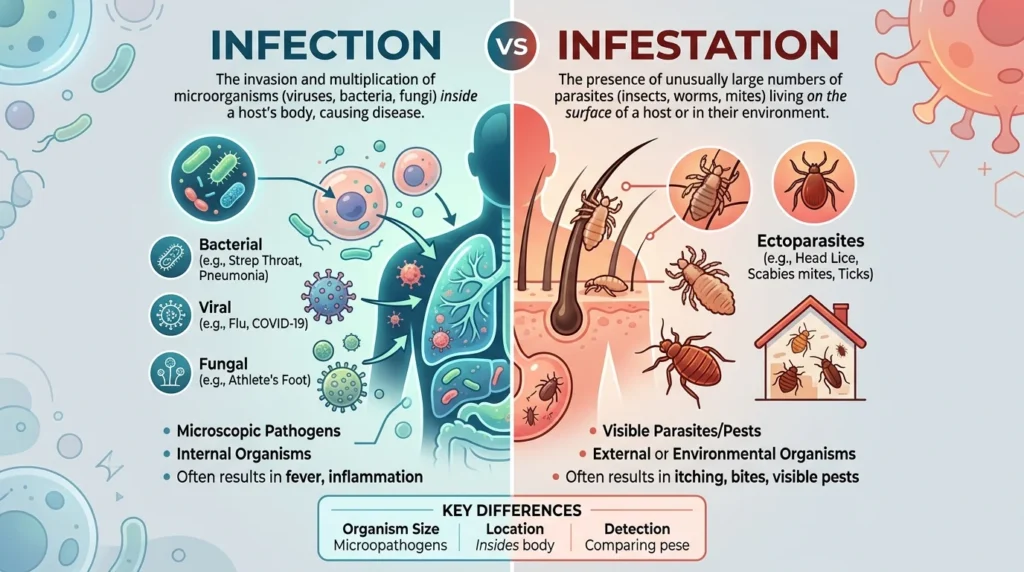
Quick Answer: Infection vs. Infestation
Infection means that a disease-causing microorganism has entered a host and is multiplying or causing disease.
The doctor diagnosed a bacterial infection.
Infestation generally means that a person, animal, or place is heavily affected or invaded by parasites or pests.
The child has a head-lice infestation.
The easiest rule
Infection = pathogens infect
Infestation = parasites or pests infest
A simple memory trick is:
Infection → inside the body
Infestation → organisms living on or around a host
There are exceptions and overlaps, particularly with parasitic organisms, so context matters.
What Does “Infection” Mean?
An infection is the invasion and multiplication of a disease-causing organism in a host.
The organisms involved can include:
- Bacteria
- Viruses
- Fungi
- Protozoa
- Parasitic organisms in certain contexts
Examples of Infection
She developed a bacterial infection.
The doctor treated the wound for infection.
The virus caused a respiratory infection.
The patient has a fungal infection.
The infection spread to nearby tissue.
🎯 Key Insight: Infection focuses on a pathogen invading and multiplying in a host.
What Does “Infestation” Mean?
Infestation generally describes the presence, invasion, or colonization of parasites or pests, particularly when they are present in significant numbers.
Common examples include:
- Head lice
- Fleas
- Bedbugs
- Mites
- Certain intestinal worms
- Other parasitic organisms
Examples of Infestation
The child has a head-lice infestation.
The house was treated for a bedbug infestation.
The dog had a severe flea infestation.
The farmer discovered a pest infestation in the crops.
🎯 Key Insight: Infestation focuses on parasites or pests occupying or invading a host, place, or environment.
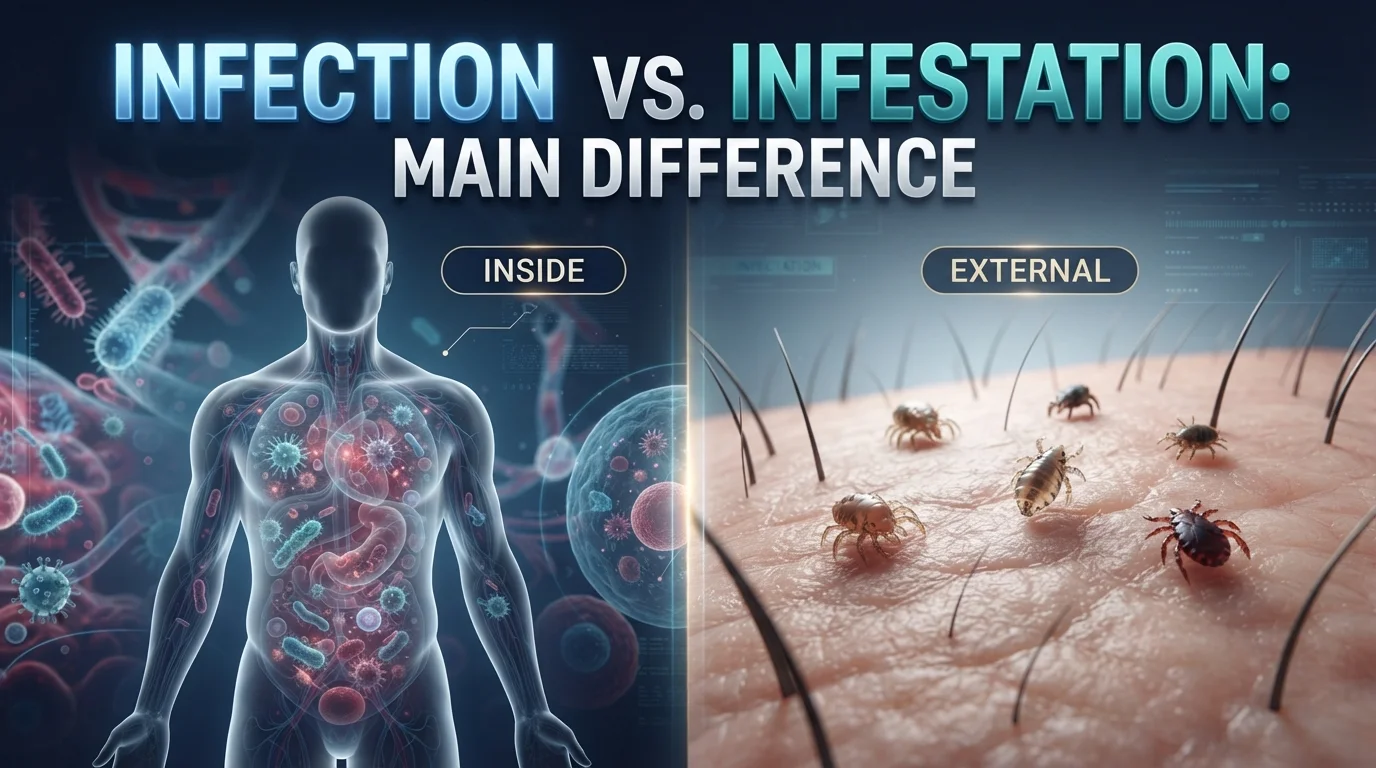
Infection vs. Infestation: Main Difference
| Feature | Infection | Infestation |
|---|---|---|
| Core meaning | Invasion/multiplication of pathogens in a host | Presence or invasion of parasites or pests |
| Common organisms | Bacteria, viruses, fungi, some parasites | Lice, fleas, mites, bedbugs, worms, pests |
| Typical location | Often inside body tissues or cells | On the body, in the body, or in an environment |
| Common examples | Bacterial infection, viral infection | Lice infestation, flea infestation |
| Main focus | Disease-causing infection | Parasite/pest presence |
| Typical verb | Infect | Infest |
Bottom Line
Infection is primarily about pathogens infecting a host.
Infestation is primarily about parasites or pests occupying or invading a host or environment.
Infection in Medical Contexts
In medicine, infection is a broad term.
A person can have an infection caused by different types of microorganisms.
Bacterial Infection
The patient has a bacterial infection.
Examples can include infections affecting the skin, lungs, urinary tract, or other parts of the body.
Viral Infection
The test confirmed a viral infection.
Viruses can cause illnesses such as influenza and many other viral diseases.
Fungal Infection
The doctor diagnosed a fungal infection.
Fungi can cause infections of the skin, mouth, nails, and other areas.
🎯 Lesson: In medical terminology, infection is a broad category describing disease-causing microorganisms interacting with a host.
Infestation in Medical Contexts
Infestation is especially common when discussing parasites that live on or in a host.
Head Lice
The child has a head-lice infestation.
The lice live on the scalp and feed there.
Scabies
The patient was diagnosed with a mite infestation causing scabies.
The mites are parasites that live in the skin.
Intestinal Parasites
The patient was treated for a parasitic infestation.
Here, the focus is on parasites occupying the host.
🎯 Lesson: Infestation is commonly used for parasitic organisms rather than bacteria or viruses.
Infection vs. Infestation With Parasites
This is where the distinction can become more complicated.
Some parasites can be described using infection, while others are more naturally described as an infestation.
For example, medical and scientific writing commonly uses:
parasitic infection
for certain parasites that invade and multiply within a host.
But it may use:
lice infestation
or
flea infestation
when referring to parasites living on the host.
So the distinction isn’t simply:
inside = infection
and
outside = infestation
That is a useful beginner’s shortcut, but it isn’t a complete scientific rule.
🎯 Expert Insight: Infection and infestation overlap in some parasitological contexts. The preferred term depends on the organism, its relationship with the host, and established medical terminology.
Infection vs. Infestation in Everyday Language
The distinction becomes easier in everyday examples.
You Would Usually Say:
a bacterial infection
a viral infection
a fungal infection
a head-lice infestation
a flea infestation
a bedbug infestation
a pest infestation
You Would Not Normally Say:
❌ a bacterial infestation
when you mean a bacterial disease.
Instead:
✅ a bacterial infection
Likewise:
❌ a bedbug infection
Instead:
✅ a bedbug infestation
Real-World Usage Scenarios
Scenario 1: Bacteria
The wound became red and painful because of a bacterial infection.
🎯 Lesson: Bacteria causing disease are normally described as causing an infection.
Scenario 2: Head Lice
The school informed parents about a head-lice infestation.
🎯 Lesson: Lice are commonly described as causing an infestation.
Scenario 3: Bedbugs
The hotel closed the room because of a bedbug infestation.
🎯 Lesson: When pests occupy a building or room, infestation is the natural term.
Scenario 4: Fungal Disease
The athlete developed a fungal infection on his foot.
🎯 Lesson: Fungal diseases are generally described as infections.
Scenario 5: Fleas
The veterinarian treated the dog for a flea infestation.
🎯 Lesson: Fleas living on an animal are commonly described as an infestation.
Infection vs. Infestation: Common Mistakes
Mistake 1: Calling Lice an Infection
❌ She has a lice infection.
While people may understand what you mean, the standard expression is:
✅ She has a lice infestation.
More naturally:
✅ She has a head-lice infestation.
🎯 Why? Lice are external parasites that live on the host.
Mistake 2: Calling Bacteria an Infestation
❌ He has a bacterial infestation.
Usually:
✅ He has a bacterial infection.
🎯 Why? Bacterial disease is conventionally described as an infection.
Mistake 3: Thinking “Infestation” Always Means Inside
Infestation isn’t limited to organisms living outside the body.
Some parasites can inhabit internal parts of a host, and medical terminology may still use infestation.
So don’t rely on location alone.
Mistake 4: Thinking “Infection” Always Means Bacteria
An infection isn’t limited to bacteria.
It can involve:
- Viruses
- Fungi
- Bacteria
- Certain parasites
- Other infectious agents
🎯 Lesson: Infection is a broad concept.
Infection vs. Infestation vs. Inflammation
These three terms are also frequently confused.
Infection
An infection involves a disease-causing organism.
The wound developed an infection.
Infestation
An infestation involves parasites or pests occupying or invading a host or environment.
The dog had a flea infestation.
Inflammation
Inflammation is a biological response of tissue to injury, infection, irritation, or other causes.
The injury caused inflammation.
Important Difference
You can have inflammation without infection.
For example, an injury can cause inflammation without a microorganism causing an infection.
Likewise, an infection can cause inflammation, but the two terms don’t mean the same thing.
Infection vs. Infestation vs. Contamination
Another useful distinction is contamination.
Infection
A pathogen has entered and established itself in a host.
Infestation
Parasites or pests are present in or on a host or environment.
Contamination
A harmful or unwanted substance or organism is present where it shouldn’t be, but this does not necessarily mean an infection has occurred.
For example:
The food was contaminated with bacteria.
This does not automatically mean:
The person who ate it developed a bacterial infection.
🎯 Key Insight: Contamination describes presence; infection describes a biological process in a host.
Memory Tricks: Infection vs. Infestation
🦠 Trick 1: Infection = Infectious Organisms
Think:
INFECTION → infectious disease
Bacteria, viruses, and fungi commonly cause infections.
🪳 Trick 2: Infestation = Invading Pests
Think:
INFESTATION → insects and parasites
Lice, fleas, bedbugs, and mites commonly cause infestations.
🧠 Trick 3: Remember the Examples
Bacteria → infection
Virus → infection
Fungus → infection
Lice → infestation
Fleas → infestation
Bedbugs → infestation
⭐ One-Line Memory Trick
Infection is usually about pathogens causing disease; infestation is usually about parasites or pests occupying a host or environment.
Expert Insight: Why the Terms Are Not Perfect Opposites
The words come from different conceptual traditions.
Infection focuses on the process by which an infectious organism enters and establishes itself in a host.
Infestation traditionally emphasizes the occupation or invasion of a host or environment by parasites or pests, often in considerable numbers.
Modern medical terminology does not always divide these categories perfectly. Some parasitic diseases are called infections, while others are commonly described as infestations.
Therefore, the most reliable approach is to consider the organism and the established terminology used for that disease or condition, rather than relying solely on whether the organism is inside or outside the body.
Quick Test: Infection or Infestation?
1. The patient has a bacterial ________.
Answer: infection
2. The dog has a severe flea ________.
Answer: infestation
3. The child has a head-lice ________.
Answer: infestation
4. The doctor diagnosed a viral ________.
Answer: infection
5. The house has a bedbug ________.
Answer: infestation
6. The patient developed a fungal ________.
Answer: infection
7. The wound became infected after bacteria entered it.
Answer: infection