
Quick Answer
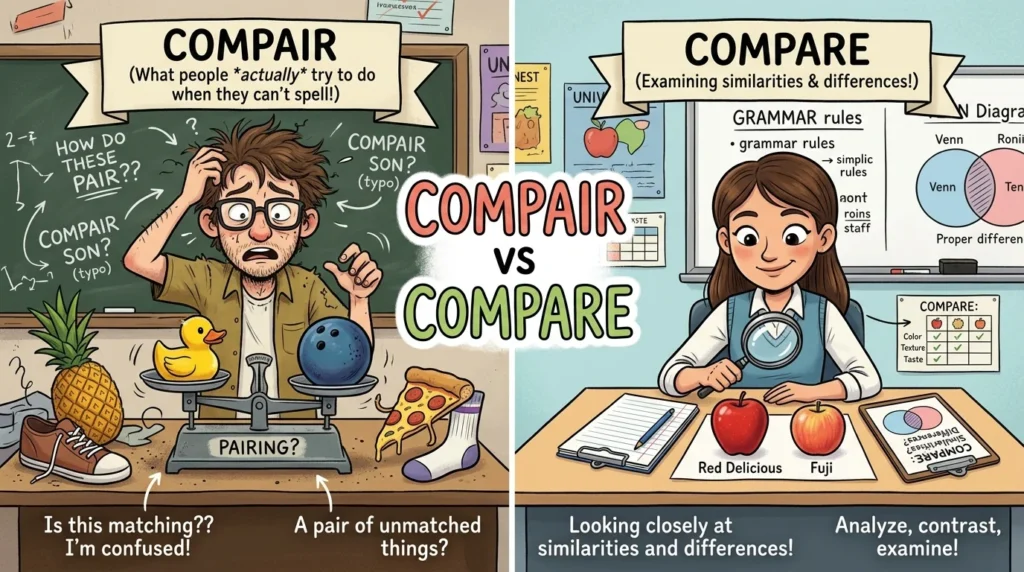
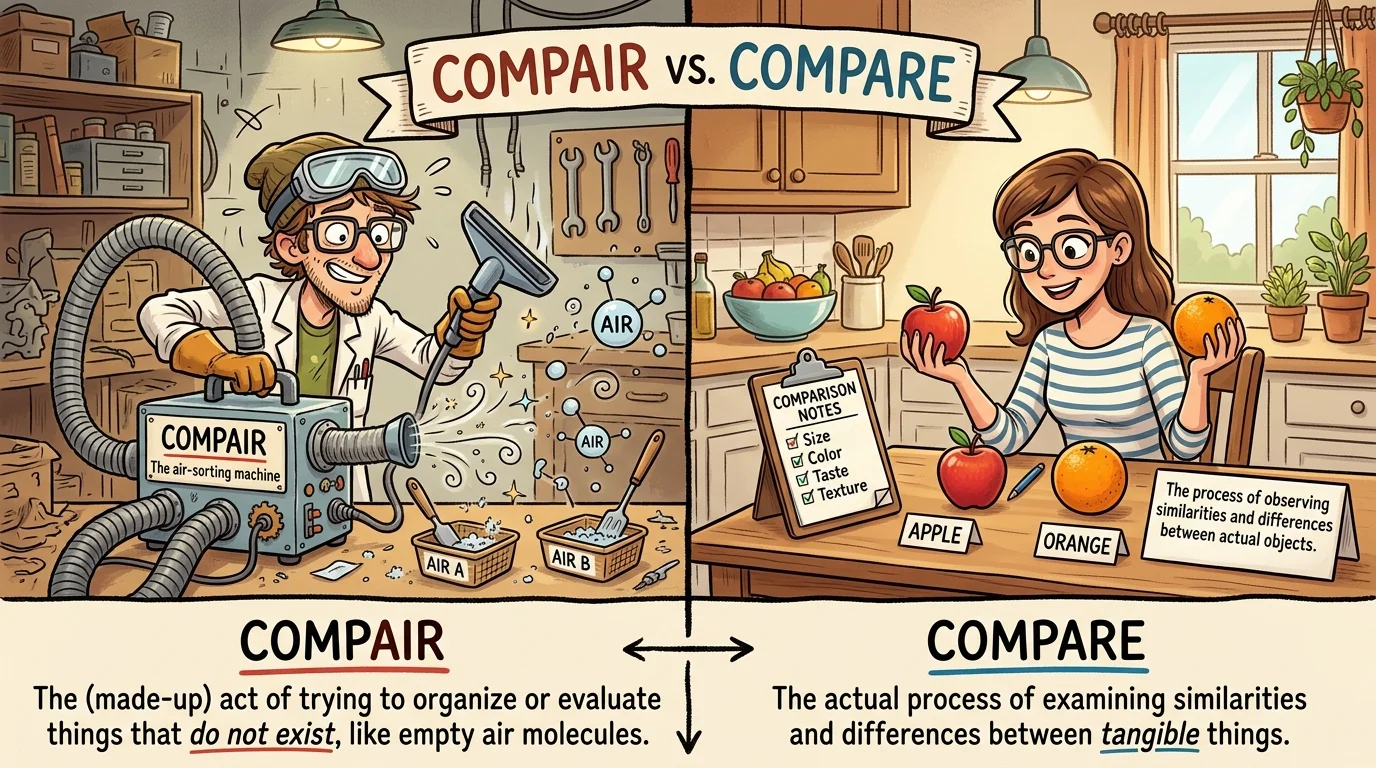
Compare is the correct spelling.
Compair is incorrect and should not be used in standard English.
Use compare whenever you’re examining similarities, differences, qualities, or relationships between two or more things.
Examples:
- Correct: Let’s compare the two products.
- Correct: Teachers often compare different learning methods.
- Incorrect: Let’s compair the two products.
Deep Explanation: Compair
Definition
Compair is a misspelling of compare.
It is not recognized as a standard English word in modern dictionaries.
Usage Rules
Avoid using compair in:
- Essays
- Reports
- Emails
- Business documents
- Academic writing
- Online content
Context
People commonly write compair because:
- The pronunciation sounds similar to compare
- They confuse it with words ending in -air
- English spelling patterns can be inconsistent
Examples
Incorrect:
- We need to compair prices.
- Please compair these results.
- The article compairs two theories.
Correct:
- We need to compare prices.
- Please compare these results.
- The article compares two theories.
Key Insight
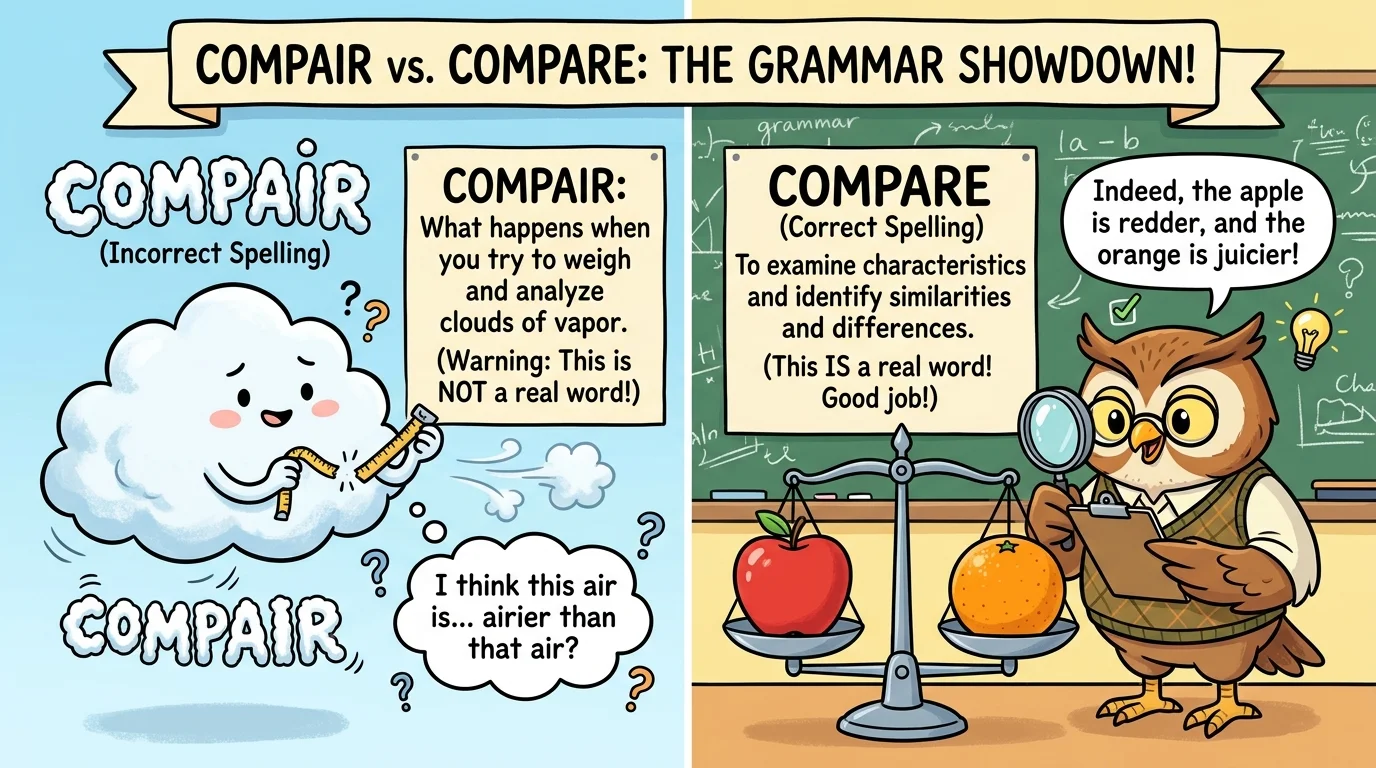
Whenever you’re talking about examining similarities or differences, compair is never the correct spelling.
Deep Explanation: Compare
Definition
Compare is a verb that means:
- To examine similarities between things
- To identify differences between things
- To evaluate one thing against another
- To assess qualities, features, or performance
Usage Rules
Use compare whenever discussing:
- Products
- Services
- Ideas
- Data
- Performance
- People, places, or objects
Common Contexts
- Compare prices
- Compare products
- Compare results
- Compare performance
- Compare options
- Compare data
Real Examples
- Let’s compare the features of both smartphones.
- Scientists compare research findings to identify patterns.
- The report compares last year’s sales with this year’s.
- Parents often compare schools before making a decision.
Key Insight
Compare is the only correct spelling in modern English.
Compair vs Compare
Key Differences
- Compare is correct.
- Compair is incorrect.
- Compare appears in dictionaries.
- Compair is a spelling mistake.
- Professional and academic writing always uses compare.
Comparison Table
| Feature | Compair | Compare |
|---|---|---|
| Correct Spelling | No | Yes |
| Dictionary Recognition | No | Yes |
| Standard English | No | Yes |
| Professional Writing | Incorrect | Correct |
| Meaning | None | Examine similarities or differences |
| Example | Compair products ❌ | Compare products ✔ |
Real-World Usage Scenarios
Scenario 1
Shopper: “I want to compare prices before buying.”
Friend: “That’s a smart idea.”
🎯 Lesson: Use compare when evaluating options.
Scenario 2
Teacher: “Compare the two poems.”
Student: “I’ll identify their similarities and differences.”
🎯 Lesson: Academic tasks commonly use compare.
Scenario 3
Manager: “Let’s compare this quarter’s results with last quarter’s.”
Team Member: “I’ll prepare the data.”
🎯 Lesson: Business reports frequently use compare.
Scenario 4
Researcher: “We compared several studies.”
Colleague: “The findings were interesting.”
🎯 Lesson: Scientific writing consistently uses compare.
Scenario 5
Traveler: “I compared hotel prices before booking.”
Friend: “That probably saved you money.”
🎯 Lesson: Everyday English uses compare, never compair.
Common Mistakes
Mistake 1: Writing Compair Instead of Compare
Incorrect:
- Compair products
- Compair prices
- Compair options
Correct:
- Compare products
- Compare prices
- Compare options
Why It Happens
People often spell words according to how they sound rather than their established spelling.
Mistake 2: Confusing Compare with Words Ending in -air
Examples:
- Repair
- Fair
- Chair
Because these words end in -air, some writers incorrectly assume compare follows the same pattern.
Why It Happens
English spelling contains many exceptions and historical influences.
Mistake 3: Using Compair in Professional Documents
Using compair in reports, resumes, emails, or articles can make writing appear careless.
Always use compare.
Memory Tricks
Trick 1: Think of “Comparison”
The noun form is:
- Comparison
Not:
- Compairison
Since comparison uses compare as its root, the correct spelling becomes easier to remember.
Trick 2: Remember the Ending
The word ends with:
-pare
Not:
-pair
Trick 3: Connect Compare and Comparison
Think:
- Compare
- Compared
- Comparing
- Comparison
All use the same root spelling.
Expert Insight
The word compare comes from Latin through Old French and has been part of English for centuries. It derives from a root meaning “to place together” or “to examine side by side.”
Because of this historical development, the spelling compare became standardized in dictionaries, educational systems, and professional writing. Although compair may seem logical based on pronunciation, it never became an accepted English spelling.
As a result, teachers, editors, grammar experts, and style guides consistently recognize compare as the correct form.