

Quick Answer: Sole vs. Soul
Sole means the bottom of a foot or shoe, the only one, or a type of flatfish.
Soul means the spiritual or emotional essence of a person.
The easiest way to remember:
- Sole = shoe, only, or fish
- Soul = spirit or inner self
If you’re talking about the bottom of your shoe, use sole.
If you’re talking about someone’s spirit or inner being, use soul.
What Does “Sole” Mean?
Sole has several meanings, so context matters.
1. Sole = Bottom of a Foot or Shoe
The most common physical meaning of sole is the bottom surface of a person’s foot or a shoe.
Examples:
- The sole of my shoe is starting to wear out.
- My feet hurt because the soles of these shoes are too thin.
- The sole of his foot was covered in mud.
🎯 Key insight: If you’re talking about a shoe or foot, the correct word is sole.
2. Sole = Only
Sole can also be an adjective meaning only or single.
Examples:
- She was the sole winner of the competition.
- He is the sole owner of the company.
- The sole reason I called was to ask a question.
Here, sole means there is no other person or thing of the same kind.
🎯 Key insight: Sole = only one.
3. Sole = A Type of Fish
A sole is also a type of flatfish.
Example:
- We ordered grilled sole for dinner.
This meaning is less common in everyday conversation, but it is important to recognize.
What Does “Soul” Mean?
Soul generally refers to the spiritual or non-physical essence of a person.
It is commonly used in religious, philosophical, emotional, and literary contexts.
Examples:
- She believes that the soul continues after death.
- Music can touch the soul.
- He poured his whole soul into the painting.
The word can also describe someone’s deepest emotions, character, or inner self.
Soul in Everyday Expressions
You may hear soul in phrases such as:
- kind soul
- old soul
- lost soul
- soul mate
- soul-searching
- heart and soul
- bare your soul
For example:
She is a kind soul who always helps others.
Here, soul refers figuratively to the person’s character or inner nature.
🎯 Key insight: When the meaning involves spirit, inner self, emotions, or a person’s deepest nature, use soul.
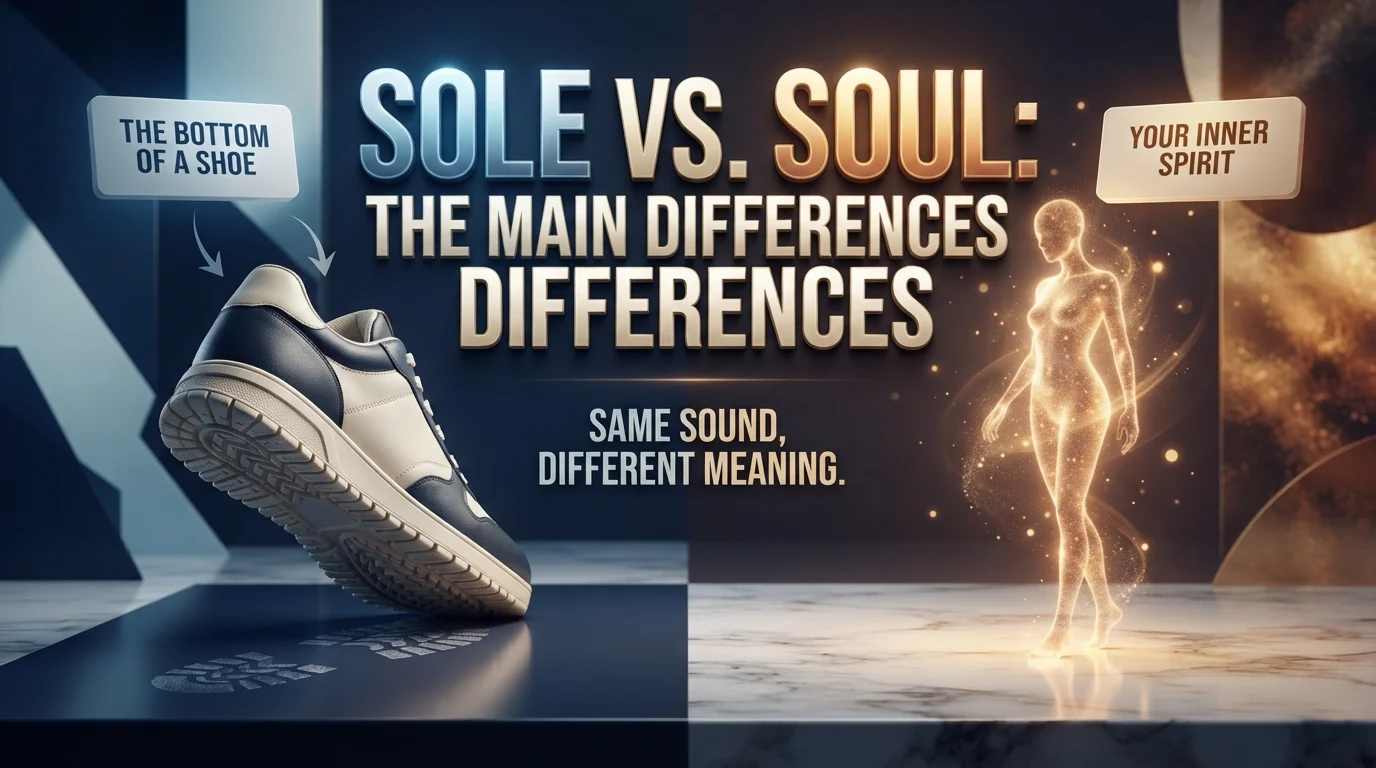
Sole or Soul: Meaning, Differences, and Examples
Sole or Soul Meaning
Sole or soul is a common word-choice question because both words have the same pronunciation but different meanings. Sole can refer to the bottom of a foot or shoe, or it can mean only or single. Soul refers to the spiritual or emotional essence of a person and is often associated with a person’s deepest feelings, identity, or inner nature. For example, “She was the sole owner of the business” uses sole to mean the only owner, while “Music touched my soul” uses soul to describe a deep emotional connection.
Sole
- Means the bottom of a foot or shoe
- Can mean only or single
- Can refer to a type of fish
- Often appears in physical or factual contexts
Soul
- Refers to a person’s spirit
- Can mean someone’s inner self
- Can describe deep emotions or character
- Often appears in religious, philosophical, emotional, and literary contexts
Comparison Table
| Feature | Sole | Soul |
|---|---|---|
| Meaning | Bottom of foot/shoe, only, or a fish | Spirit, inner self, or deepest nature |
| Context | Physical, factual, or grammatical | Spiritual, emotional, philosophical |
| Common phrase | Sole owner | Kind soul |
| Example | The sole of my shoe is damaged. | Music touched my soul. |
| Memory clue | Sole → shoe | Soul → spirit |
Sole or Soul Synonym
The synonyms for sole and soul depend on their meanings and contexts. When sole means “only,” suitable synonyms include single, exclusive, individual, and lone. When it refers to the bottom of a shoe or foot, related terms may include underside or bottom. In contrast, soul may have synonyms such as spirit, inner self, essence, or psyche, depending on whether the context is spiritual, emotional, or philosophical. These words are not interchangeable in every sentence, so choose a synonym that preserves the intended meaning.
Sole or Soul Purpose
The correct phrase is “sole purpose,” meaning the only reason or main objective for doing something. The word sole emphasizes that there is just one purpose, not multiple reasons. For example, “The sole purpose of the meeting was to discuss the new schedule.” Using soul purpose in this context is incorrect because soul refers to a person’s spiritual or inner self, not the idea of something being the only objective. Remember that sole purpose is the standard expression in formal and everyday English.
Sole or Soul in a Sentence
Understanding how sole and soul work in sentences makes their difference easier to remember. Here are examples of both words in context:
Sole: “He was the sole survivor of the accident.”
Sole: “The sole of my shoe is coming loose.”
Sole: “Her sole responsibility was to organize the event.”
Soul: “The poem expressed the writer’s soul.”
Soul: “She believes that the soul lives beyond the body.”
Soul: “His kindness showed that he had a generous soul.”
In each example, sole refers to being the only one or to the bottom of a foot or shoe, while soul refers to a person’s spiritual or inner nature.
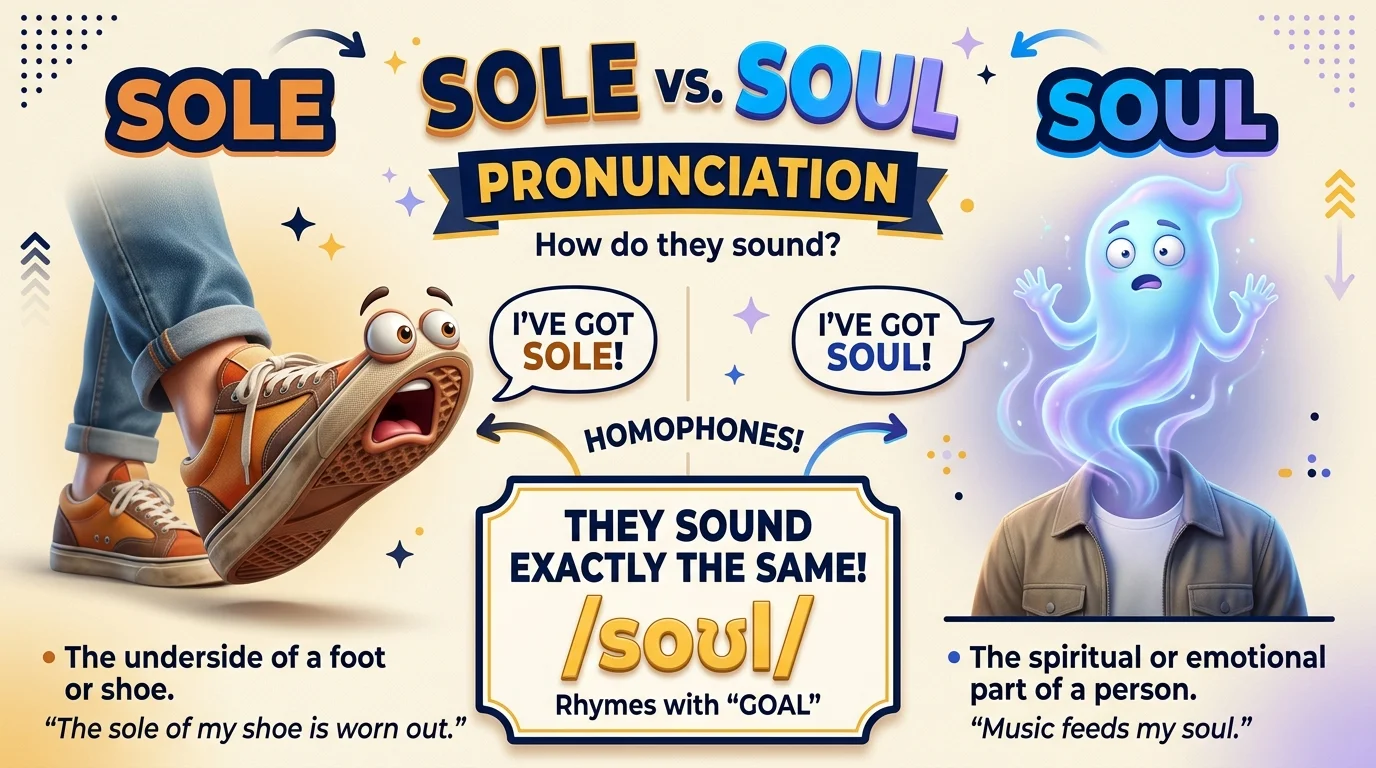
Sole vs. Soul Pronunciation
Sole and soul are homophones, which means they sound alike but have different spellings and meanings. In standard American English, both are pronounced /soʊl/. Their vowel sound is the same as the long “o” sound in go and home. Because pronunciation cannot distinguish these words, you must rely on context and meaning to choose the correct spelling. If a sentence refers to something being the only one, use sole. If it refers to a person’s spirit, emotions, or inner self, use soul.
Soul and Sole Homophones
Yes, soul and sole are homophones because they have the same pronunciation but different meanings and spellings. English contains many homophones, including pair and pear, right and write, and sea and see. The difference between sole and soul becomes clear from the context. For example, “the sole of his foot” refers to the bottom of his foot, whereas “a kind soul” describes someone with a compassionate nature. Recognizing homophones helps improve spelling, reading comprehension, and written communication.
Soul Meaning
The word soul generally refers to the spiritual or immaterial part of a person, often understood as the part connected with identity, consciousness, or life beyond the physical body. Its meaning can vary depending on religious, philosophical, and cultural beliefs. In everyday language, soul can also describe someone’s deepest feelings, character, or emotional nature. For example, “She poured her soul into her artwork” means she put deep emotion, care, and personal expression into what she created. Expressions such as kind soul, soulmate, and soul-searching use the word in related but distinct ways.
Sole Adjective
Sole is an adjective when it means only, single, or exclusive. It emphasizes that a person or thing is the one and only person or thing involved in a particular role, situation, or responsibility. For example, “She is the sole beneficiary of the estate” means she is the only beneficiary. Similarly, “He was the sole reason for the team’s success” identifies him as the only reason, although this wording may be an exaggeration depending on the circumstances. The word sole can also be a noun, as in “the sole of a shoe,” so its grammatical role depends on how it is used in a sentence.
Quick Summary: Sole vs. Soul
Sole: Means only or single when used as an adjective, or the bottom of a foot or shoe when used as a noun.
Soul: Refers to a person’s spirit, inner self, or deepest emotional nature.
Sole purpose: The correct phrase when referring to the only reason or objective.
Pronunciation: Both words are pronounced /soʊl/ in standard American English.
Homophones: Sole and soul sound alike but differ in spelling and meaning.
The easiest way to remember the difference is that sole means “only,” while soul relates to the spirit or inner self.
Real-World Usage Scenarios
Scenario 1: Talking About Shoes
Incorrect:
The soul of my shoe is damaged.
Correct:
The sole of my shoe is damaged.
🎯 Lesson: A shoe has a sole, not a soul.
Scenario 2: Talking About Someone’s Spirit
Incorrect:
Music touched the sole.
Correct:
Music touched the soul.
🎯 Lesson: If you’re talking about deep emotions or someone’s spirit, use soul.
Scenario 3: Meaning “Only”
She was the sole person responsible for the project.
🎯 Lesson: Here, sole means only.
You could replace it with:
She was the only person responsible for the project.
Scenario 4: Talking About Inner Character
He is a gentle soul who cares deeply about animals.
🎯 Lesson: Soul can describe someone’s character or inner nature.
Scenario 5: A Type of Fish
The restaurant serves grilled sole with vegetables.
🎯 Lesson: When referring to the fish, the correct spelling is sole.
Common Mistakes With Sole and Soul
Mistake 1: “Soul of the shoe”
❌ The soul of my shoe is worn out.
✅ The sole of my shoe is worn out.
Why it happens:
Both words are pronounced the same, so writers sometimes choose the wrong spelling.
Mistake 2: “Sole” for someone’s spirit
❌ She has a beautiful sole.
✅ She has a beautiful soul.
Why it happens:
The writer may remember the pronunciation but not the spelling.
Mistake 3: Confusing “sole” with “only”
Sometimes writers avoid sole because they associate the word only with shoes.
For example:
He was the sole survivor.
This is completely correct.
Here, sole means only.
Sole or Soul: How to Choose the Right Word
Ask yourself one simple question:
Are you talking about a shoe, “only,” or a fish?
If yes, use sole.
The sole of the shoe is dirty.
She was the sole survivor.
They caught a sole.
Are you talking about spirit, emotions, or someone’s inner self?
If yes, use soul.
He has a generous soul.
The song touched my soul.
She searched her soul for an answer.
Memory Tricks: Sole vs. Soul
👟 Trick 1: Sole = Shoe
Both sole and shoe are physical things.
Think:
SOLE → SHOE
The sole is the part of the shoe that touches the ground.
🧠 Trick 2: Soul = Spirit
Think:
SOUL → SPIRIT
If you’re talking about someone’s spiritual or emotional nature, use soul.
🔢 Trick 3: Sole = Only One
Remember:
Sole = single
Both start with S and describe one thing.
Sole → single → only
⭐ The One-Line Memory Trick
Sole goes on your shoe; soul lives within you.
This is probably the easiest way to remember the difference.
Sole vs. Soul in Common Expressions
Understanding common phrases makes the distinction even easier.
Expressions with “Sole”
- sole purpose
- sole owner
- sole survivor
- sole responsibility
- sole source
- sole of the shoe
Examples:
The sole purpose of this meeting is to solve the problem.
She is the sole owner of the business.
Expressions with “Soul”
- kind soul
- old soul
- soul mate
- soul-searching
- heart and soul
- bare your soul
- save your soul
Examples:
He is an old soul who enjoys classical music.
She put her heart and soul into the project.
Expert Insight: Why Sole and Soul Are Confused
Sole and soul are homophones: words that have the same pronunciation but different meanings and spellings.
This is why listening alone cannot tell you which word to use.
English contains many homophone pairs, such as:
- their / there / they’re
- right / write
- flower / flour
- peace / piece
- sole / soul
The solution is to identify the meaning and context before choosing the spelling.
Interestingly, sole has multiple meanings itself. It can refer to a shoe’s bottom, something that is the only one, or the fish. Soul, by contrast, centers primarily on the idea of a person’s spiritual or inner essence, although it has many figurative uses.
So the most reliable strategy is not to memorize every sentence. Instead, connect each spelling to its core concept.
Quick Test: Sole or Soul?
Choose the correct word.
- The ________ of my boot is coming loose.
- She is a kind ________.
- He was the ________ survivor.
- The music touched my ________.
- The restaurant served grilled ________.
Answers
- sole
- soul
- sole
- soul
- sole
The Pattern
Sole = shoe, only, fish
Soul = spirit, emotions, inner self