
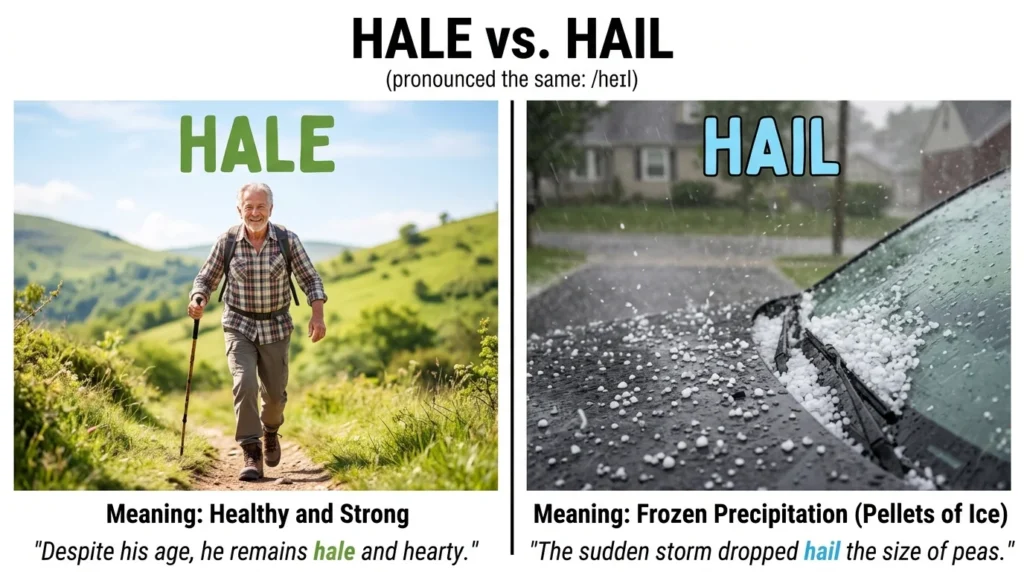
Quick Answer: Hale vs. Hail
Hale means healthy, strong, and vigorous, especially when describing a person.
Hail usually means small pieces of ice that fall from a storm, but it can also mean to call out to someone, greet someone, or praise someone.
The easiest way to remember:
- Hale = healthy
- Hail = ice or calling out
If you’re describing someone’s health, use hale.
If you’re talking about an ice storm, calling someone, or praising someone, use hail.
What Does “Hale” Mean?
Hale is an adjective that means healthy, vigorous, and physically strong.
It is particularly common when describing someone who is older but remains healthy and active.
Examples of “Hale”
- His grandfather is still hale and active at ninety.
- She remained hale and hearty despite her age.
- The farmer was a hale, strong man who worked outdoors every day.
“Hale and Hearty”
One of the most familiar expressions containing hale is:
hale and hearty
It means healthy, strong, and energetic.
For example:
At eighty-five, he is still hale and hearty.
🎯 Key Insight: Think of hale whenever you are describing someone’s health, strength, or physical condition.
What Does “Hail” Mean?
Hail has several meanings, so context is important.
1. Hail = Ice From a Storm
The most familiar meaning of hail is small balls or lumps of ice that fall from certain thunderstorms.
Examples:
- Hail damaged several cars during the storm.
- The farmers were worried that the hail would destroy their crops.
- We had to take shelter when hail began falling.
🎯 Key Insight: If you’re talking about weather, storms, ice, crops, or damaged cars, use hail.
2. Hail = Call Out to Someone
As a verb, hail can mean to call out to someone, especially to get their attention.
Examples:
- She hailed a taxi from the sidewalk.
- The traveler hailed the passing driver.
- He hailed his friend from across the street.
This meaning is especially common in phrases such as:
hail a taxi
3. Hail = Praise or Welcome
Hail can also mean to praise, celebrate, or recognize someone or something as important or successful.
Examples:
- Critics hailed the movie as a masterpiece.
- The scientist was hailed as a pioneer in her field.
- The team was hailed as national heroes.
In this use, hail is usually followed by a noun or phrase describing how someone or something is regarded.
🎯 Key Insight: Hail can mean ice, call, or praise.
4. “Hail From” = Come From
The phrase hail from means to come from a particular place.
Examples:
- She hails from Lahore.
- The actor hails from a small town in Texas.
- The players hail from different countries.
This is another common use of hail that has nothing to do with weather.

Hale vs. Hail: The Main Differences
Hale
- Means healthy and strong
- Usually an adjective
- Commonly describes a person’s physical condition
- Often appears in the expression hale and hearty
- Related to health and vitality
Hail
- Can mean ice falling from a storm
- Can mean to call out or attract attention
- Can mean to praise or celebrate
- Can mean to come from a place in “hail from”
- Used as both a noun and a verb
Comparison Table
| Feature | Hale | Hail |
|---|---|---|
| Meaning | Healthy, strong, vigorous | Ice from a storm; call; praise; come from |
| Part of speech | Mainly adjective | Noun and verb |
| Common context | Health and physical condition | Weather, communication, praise, origin |
| Common phrase | Hale and hearty | Hail a taxi |
| Another use | — | Hail from a place |
| Example | He is hale and hearty. | Hail damaged the roof. |
| Memory clue | Hale → healthy | Hail → ice |
Real-World Usage Scenarios
Scenario 1: Talking About Health
Incorrect:
My grandfather is still hail and hearty.
Correct:
My grandfather is still hale and hearty.
🎯 Lesson: The expression is hale and hearty, because hale means healthy and strong.
Scenario 2: Talking About Weather
Incorrect:
The storm brought heavy hale.
Correct:
The storm brought heavy hail.
🎯 Lesson: Ice falling from the sky is hail.
Scenario 3: Calling a Taxi
Incorrect:
I haled a taxi outside the hotel.
Correct:
I hailed a taxi outside the hotel.
🎯 Lesson: When you call out to get someone’s attention, the verb is hail.
Scenario 4: Praising Someone
The researchers hailed her discovery as a major breakthrough.
🎯 Lesson: Here, hailed means praised or recognized as important.
Scenario 5: Describing Someone’s Origin
The author hails from a small village.
🎯 Lesson: Hails from means comes from.
Common Mistakes With Hale and Hail
Mistake 1: Writing “hale” for storm ice
❌ The hailstorm damaged the roof with large pieces of hale.
✅ The hailstorm damaged the roof with large pieces of hail.
Why it happens:
The words sound identical, so spelling the word from memory can lead to confusion.
Mistake 2: Writing “hail and hearty”
❌ He is still hail and hearty.
✅ He is still hale and hearty.
Why it happens:
Because hail is the more familiar everyday word, writers sometimes substitute it for hale.
Mistake 3: Confusing “hail” with “hale” when calling someone
❌ She haled a taxi.
✅ She hailed a taxi.
Why it happens:
The past tense adds -ed, but the base verb is hail, not hale.
Mistake 4: Using “hale from”
❌ He hales from Karachi.
✅ He hails from Karachi.
Why it happens:
The phrase hail from is unrelated to the adjective hale.
Hale vs. Hail: How to Choose the Right Word
Ask yourself what you’re describing.
Is it someone’s health or strength?
Use hale.
He is hale and hearty.
Is it ice falling from the sky?
Use hail.
The hail damaged the crops.
Are you calling someone or something?
Use hail.
She hailed a taxi.
Are you praising someone?
Use hail.
Critics hailed the author as a genius.
Are you saying where someone comes from?
Use hail.
She hails from Pakistan.
Memory Tricks: Hale vs. Hail
💪 Trick 1: Hale = Healthy
The easiest connection is:
Hale → Healthy
Both describe being in good physical condition.
🌨️ Trick 2: Hail = Ice
Think:
Hail → Hailstorm → Ice
If it falls from a storm and can damage your car or roof, it’s hail.
🚕 Trick 3: Hail a Taxi
Remember the familiar expression:
hail a taxi
You’re calling the taxi to get its attention.
⭐ The One-Line Memory Trick
Hale means healthy; hail can fall from the sky or call someone nearby.
Hale vs. Hail in Common Expressions
Expressions With “Hale”
Hale and hearty
Despite his age, he remains hale and hearty.
This means healthy, strong, and energetic.
Expressions With “Hail”
Hail a taxi
We hailed a taxi outside the station.
Hail from
She hails from a small town.
Hailed as
The invention was hailed as a major achievement.
Hailstorm
The hailstorm damaged several buildings.
Pronunciation: Hale and Hail
In standard English, hale and hail are homophones.
They are pronounced the same:
/heɪl/
The difference is therefore not pronunciation but meaning and spelling.
This is why context is so important when choosing between them.
Expert Insight: Why Hale and Hail Are Confused
Hale and hail are homophones: they share the same pronunciation but have different spellings and meanings.
This is a common source of spelling errors in English because spoken language does not provide enough information to distinguish the words.
The best solution is to connect each spelling to its semantic category:
- Hale → health and strength
- Hail → weather, calling, praise, or origin
There is also an interesting difference in grammatical flexibility. Hale is primarily an adjective, while hail can function as both a noun and a verb.
For example:
He is hale. — adjective
Hail fell from the sky. — noun
She hailed a taxi. — verb
Critics hailed the book as brilliant. — verb
Recognizing the grammatical role of the word can therefore help you choose the correct spelling.
Quick Test: Hale or Hail?
Choose the correct word.
- The ________ damaged the farmer’s crops.
- My grandfather is still ________ and hearty.
- She ________ a taxi outside the hotel.
- The actor ________ from a small town.
- Critics ________ the novel as a masterpiece.
Answers
- hail
- hale
- hailed
- hails
- hailed
The Pattern
Hale = healthy and strong
Hail = ice, call, praise, or come from