
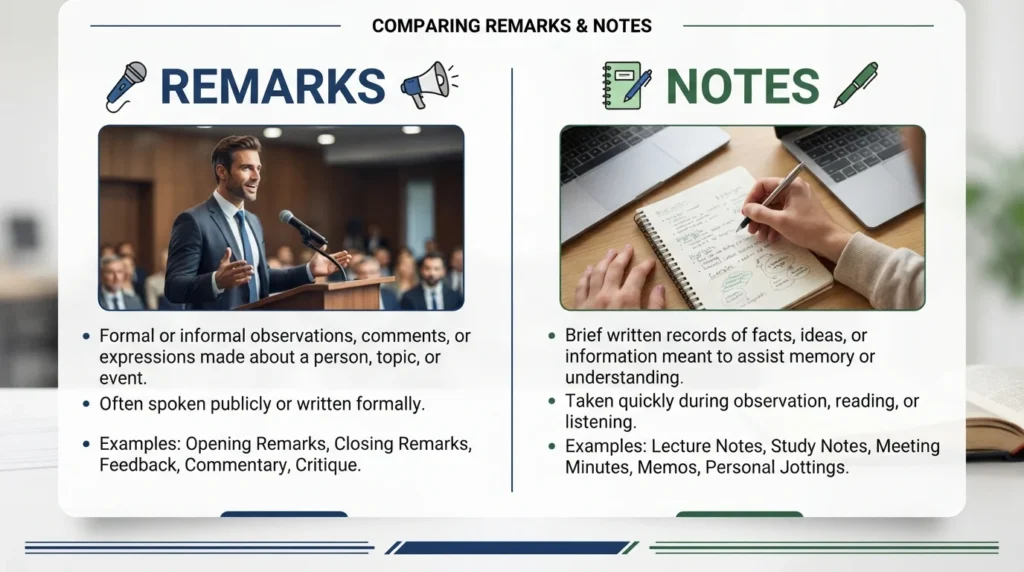

Quick Answer: Remarks vs. Notes
Remarks are usually comments, observations, or statements, especially something someone says or writes in response to a situation.
She made a few remarks about the new policy.
Notes are usually written information, reminders, records, or brief additional comments.
She made some notes about the new policy.
The easiest rule
Remarks = comments
Notes = written information or reminders
If you’re talking about what someone said about something, remarks is often appropriate.
If you’re talking about information someone wrote down to remember or record, use notes.
What Does “Remarks” Mean?
Remarks is the plural of remark.
A remark is a comment or statement made about a person, situation, event, or subject.
Examples
His remarks upset his colleagues.
The manager made several remarks about the company’s future.
Her remarks were thoughtful and constructive.
The politician’s remarks attracted criticism.
In these examples, remarks refers to things someone said or expressed.
Remarks Can Be Positive, Neutral, or Negative
A remark isn’t automatically negative.
She made some kind remarks about my work.
Positive.
He made an interesting remark during the meeting.
Neutral.
His offensive remarks caused an argument.
Negative.
🎯 Key Insight: Remark focuses on a comment or observation.
What Does “Notes” Mean?
Notes is the plural of note.
It has several common meanings, but in this comparison it usually refers to written information, reminders, records, or brief comments.
Notes as Written Information
I took notes during the lecture.
She wrote notes about the meeting.
The doctor made notes in the patient’s file.
Here, notes are written down to record or remember information.
Notes as Additional Information
Note can also introduce or provide extra information.
Note: The office will be closed on Friday.
Please note that the deadline has changed.
Here, note means something like pay attention to this information.
🎯 Key Insight: Notes commonly focus on recording, remembering, or communicating information.
Remarks vs. Notes: Main Difference
| Feature | Remarks | Notes |
|---|---|---|
| Basic meaning | Comments or observations | Written information or brief messages |
| Main purpose | Expressing an opinion/comment | Recording, remembering, or providing information |
| Usually associated with | Speaking or commenting | Writing or recording |
| Tone | Can be positive, neutral, or negative | Usually neutral and practical |
| Example | His remarks were helpful. | I took notes during the meeting. |
| Memory clue | Comment | Record |
Bottom Line
Remarks are comments.
Notes are usually information written down or added for reference.
Remarks in Real-World Contexts
During a Meeting
The director made several remarks about the company’s performance.
Here, remarks means comments made by the director.
In an Interview
Her remarks about the project received attention.
Her statements or comments attracted attention.
In a Speech
The president’s opening remarks were brief.
Here, remarks means the comments or statements made at the beginning of the speech.
About Someone’s Behavior
He made some rude remarks about his coworker.
Here, remarks means spoken or written comments.
🎯 Lesson: Use remarks when the focus is on comments or statements.
Notes in Real-World Contexts
In a Classroom
Students should take notes during the lecture.
The students are recording important information.
At Work
I made some notes during the meeting.
The notes are a record of what was discussed.
As a Reminder
I left a note on your desk.
Here, a note is a short written message.
In a Document
Please read the notes below the table.
Here, the notes provide additional information or explanation.
🎯 Lesson: Use notes when the focus is on recording or communicating information.
Remarks vs. Notes: When Both Are Possible
There are situations where both words are grammatically correct but the meaning changes.
Consider:
The teacher made remarks about the student’s essay.
This means the teacher commented on the essay.
Now compare:
The teacher made notes about the student’s essay.
This suggests the teacher wrote down observations or information about the essay.
The Difference
Remarks:
What the teacher said or commented.
Notes:
What the teacher wrote down or recorded.
This distinction is especially useful in professional and academic writing.
Remarks vs. Notes in a Workplace
Remarks
The manager’s remarks during the meeting were encouraging.
The manager made comments.
Notes
I reviewed my notes from the meeting.
The notes are a written record.
Both Together
You can even use both in the same context:
I took notes while listening to the manager’s remarks.
This sentence makes the distinction very clear.
Remarks = what the manager said.
Notes = what you wrote down.
Remarks vs. Notes in Academic English
The distinction is also important in education.
Remarks
The professor made several remarks about the research.
The professor expressed comments or observations.
Notes
The students took notes during the lecture.
The students recorded information.
Teacher Feedback
You might also see:
The teacher added remarks to the student’s assignment.
This means the teacher added comments or observations.
But:
The teacher added notes to the student’s assignment.
This sounds more like additional written information or annotations.
🎯 Key Insight: In academic contexts, remarks often emphasize commentary, while notes emphasize recorded or supplementary information.
Common Mistakes With Remarks and Notes
Mistake 1: Using “Remarks” for Personal Study Notes
❌ I took remarks during the lecture.
Usually, say:
✅ I took notes during the lecture.
🎯 Why? You’re recording information, so notes is the natural word.
Mistake 2: Using “Notes” When You Mean Spoken Comments
Suppose someone made an offensive statement.
❌ His notes offended everyone.
If you mean what he said:
✅ His remarks offended everyone.
🎯 Why? A spoken comment is a remark, not normally a note.
Mistake 3: Assuming Remarks Are Always Negative
They aren’t.
The speaker made some encouraging remarks.
Remarks can be positive, neutral, or negative.
Mistake 4: Thinking Notes Must Always Be Personal
They don’t.
Notes can be:
- Personal reminders
- Lecture notes
- Meeting records
- Medical notes
- Explanatory notes
- Notes in a document
- Short written messages
Remarks vs. Comments
Another word that overlaps strongly with remarks is comments.
In many contexts:
remarks ≈ comments
For example:
He made some interesting remarks.
He made some interesting comments.
Both are natural.
However, remarks can sometimes sound slightly more formal, especially in expressions such as:
opening remarks
closing remarks
official remarks
public remarks
Remarks vs. Notes vs. Comments
| Word | Core Meaning | Example |
|---|---|---|
| Remarks | Comments or observations | Her remarks were insightful. |
| Notes | Written records or additional information | I took notes during the lecture. |
| Comments | Opinions, reactions, or observations | He made several comments. |
Simple Rule
Remarks = comments
Notes = records
Comments = opinions/reactions
There is some overlap, but this distinction works well in most everyday situations.
Memory Tricks: Remarks vs. Notes
🗣️ Trick 1: Remarks = What Someone Says
Think:
Remark = comment
If someone says something about a subject, it can be a remark.
He made a remark about the weather.
✍️ Trick 2: Notes = What You Write
Think:
Note = write it down
I took notes during the lecture.
⭐ One-Line Memory Trick
Remarks are comments; notes are records.
Or even simpler:
Remarks = say. Notes = write.
This isn’t an absolute rule because remarks can also be written and notes can sometimes refer to comments, but it is an excellent general guide.
Expert Insight: Why the Meanings Overlap
The words overlap because both can describe brief pieces of information or language.
The main semantic difference is their function.
A remark is primarily an act of commenting.
A note is primarily a record, reminder, message, or additional piece of information.
That is why:
He made a remark about the issue.
focuses on his commentary.
While:
He made a note about the issue.
focuses on him recording information.
Context determines which meaning is intended.
Quick Test: Remarks or Notes?
1. I took ________ during the lecture.
Answer: notes
You recorded information.
2. His ________ about the incident were controversial.
Answer: remarks
He made comments about the incident.
3. Please read the ________ at the bottom of the page.
Answer: notes
They provide additional information.
4. The speaker’s opening ________ were brief.
Answer: remarks
Opening remarks is a common expression for introductory comments.
5. She left a ________ on my desk.
Answer: note
A short written message.
6. The manager made several ________ about the new policy.
Answer: remarks
The manager made comments or observations.