
Quick Answer: ECT vs. TMS
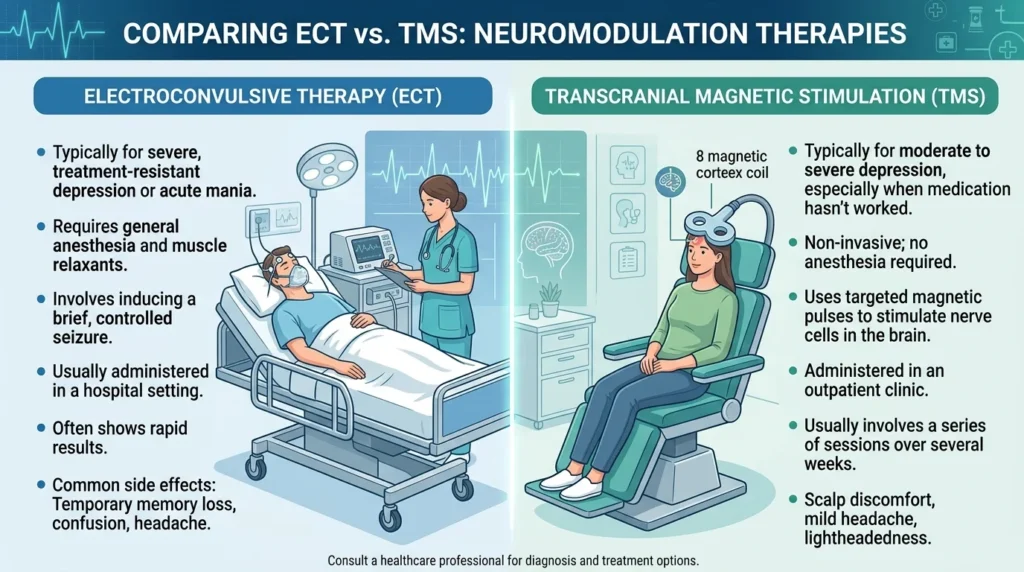
ECT uses controlled electrical stimulation to intentionally produce a therapeutic seizure while the patient is under anesthesia.
TMS uses magnetic pulses to stimulate specific areas of the brain and generally does not require anesthesia or intentionally cause a seizure.
In broad terms:
ECT = electrical stimulation + therapeutic seizure + anesthesia
TMS = magnetic stimulation + targeted brain activity + usually no anesthesia
What Is ECT?
ECT (electroconvulsive therapy) is a medical treatment in which controlled electrical stimulation is delivered to the brain to produce a brief, medically supervised seizure.
ECT is performed in a clinical setting with appropriate monitoring and general anesthesia, along with medication to relax the muscles.
What Is ECT Used For?
ECT can be used for certain severe psychiatric conditions, particularly when rapid improvement is important or other treatments have not worked adequately.
It may be considered for:
- Severe depression
- Depression with psychotic features
- Severe mania
- Catatonia
- Certain other serious psychiatric conditions
The exact indications depend on the individual patient and clinical judgment.
What Happens During ECT?
A typical treatment involves:
- The patient receives anesthesia.
- Medical staff monitor vital signs and brain activity.
- Electrodes deliver a carefully controlled electrical stimulus.
- A brief therapeutic seizure occurs.
- The patient is monitored during recovery.
🎯 Key Insight: ECT is not simply “sending electricity through the brain.” It is a carefully controlled medical procedure designed to produce a therapeutic seizure under anesthesia.
What Is TMS?
TMS (transcranial magnetic stimulation) uses a device positioned near the head to deliver rapidly changing magnetic pulses.
These magnetic fields induce electrical currents in targeted areas of the brain.
Unlike ECT, standard TMS generally:
- Does not require general anesthesia
- Does not intentionally induce a seizure
- Allows the patient to remain awake
- Is usually performed during an outpatient visit
What Is TMS Used For?
TMS is commonly used for major depressive disorder, particularly in people who have not responded adequately to certain other treatments.
Depending on the specific TMS device and regulatory approval, it may also be used for certain other conditions.
🎯 Key Insight: TMS is generally a targeted, outpatient brain-stimulation treatment, whereas ECT is a more intensive procedure performed under anesthesia.
ECT vs. TMS: Main Difference
| Feature | ECT | TMS |
|---|---|---|
| Full name | Electroconvulsive therapy | Transcranial magnetic stimulation |
| Energy used | Electrical | Magnetic |
| Therapeutic seizure | Yes | No, not intentionally |
| General anesthesia | Yes | Usually no |
| Patient awake? | No during procedure | Yes |
| Typical setting | Medical facility | Usually outpatient |
| Speed of response | Can work rapidly | Usually requires repeated sessions |
| Memory effects | Can occur, especially around treatment | Much less prominent |
| Common immediate effects | Headache, confusion, muscle soreness | Scalp discomfort, headache |
| Treatment course | Usually a series of treatments | Usually multiple sessions over several weeks |
| Best-known psychiatric use | Severe depression and other serious conditions | Depression, depending on treatment/device |
ECT vs. TMS: How They Work
How ECT Works
ECT produces a controlled seizure through electrical stimulation.
The exact biological mechanisms responsible for its therapeutic effects are complex and are not completely understood.
ECT appears to produce broad changes in brain activity and neurochemical signaling.
How TMS Works
TMS uses magnetic pulses to stimulate neurons in specific regions of the brain.
Different TMS protocols can target different brain networks and use different pulse patterns.
🎯 Lesson: Both treatments influence brain activity, but ECT produces a therapeutic seizure while TMS uses targeted magnetic stimulation without intentionally inducing one.
ECT vs. TMS: Which Works Faster?
One of the major differences is speed.
ECT
ECT can produce significant improvement relatively quickly, which is one reason clinicians may consider it when someone is severely ill or requires a rapid response.
TMS
TMS generally requires a series of repeated treatment sessions before benefits become apparent.
🎯 Key Insight: When rapid improvement is clinically important, ECT may be considered because its effects can emerge more quickly than those of typical TMS courses.
ECT vs. TMS: Side Effects
ECT Side Effects
Possible effects include:
- Temporary confusion
- Memory problems
- Headache
- Muscle soreness
- Nausea related to anesthesia
- Temporary blood pressure or heart-rate changes
Memory impairment is one of the most important side effects associated with ECT.
The degree and duration vary between individuals and treatment approaches.
TMS Side Effects
Common side effects may include:
- Scalp discomfort
- Headache
- Facial muscle twitching during stimulation
- Temporary discomfort at the treatment site
Serious complications are uncommon, although seizure is a rare potential risk.
🎯 Key Insight: Memory problems are much more strongly associated with ECT than with standard TMS.
ECT vs. TMS: Real-World Scenarios
Scenario 1: Severe Depression Requiring Rapid Treatment
A person has severe depression with significant functional impairment and needs a treatment that may work relatively quickly.
A clinician may consider ECT.
🎯 Lesson: ECT can be particularly important when rapid therapeutic effects are needed.
Scenario 2: Outpatient Depression Treatment
A person with depression wants a noninvasive treatment that doesn’t require general anesthesia.
TMS may be an option, depending on their diagnosis and medical history.
🎯 Lesson: TMS is typically delivered while the patient remains awake.
Scenario 3: Concern About Memory
A patient is particularly concerned about temporary or longer-lasting memory effects.
This concern may influence the discussion between treatment options because ECT has a substantially greater association with memory impairment than TMS.
🎯 Lesson: Side-effect profiles are an important part of treatment decisions.
Scenario 4: Catatonia
A person develops severe catatonic symptoms.
ECT may be considered urgently, depending on the clinical situation.
🎯 Lesson: ECT has important applications beyond depression.
Common Mistakes About ECT and TMS
Mistake 1: Thinking ECT and TMS Are the Same Treatment
❌ They’re not.
ECT intentionally induces a therapeutic seizure under anesthesia.
TMS uses magnetic pulses and generally does not induce a seizure.
Mistake 2: Thinking TMS Uses Electrical Current Directly on the Brain
❌ Not exactly.
TMS uses magnetic fields to induce electrical activity in targeted brain tissue.
Mistake 3: Assuming ECT Is the Same as an Uncontrolled Seizure
❌ No.
ECT is a controlled medical procedure performed by trained professionals with anesthesia, monitoring, and carefully selected electrical parameters.
Mistake 4: Assuming TMS Requires Anesthesia
❌ Usually not.
Patients generally remain awake and can return home after treatment.
Mistake 5: Assuming One Treatment Is Always Better
❌ There is no universal winner.
The appropriate treatment depends on factors such as:
- Diagnosis
- Severity
- Previous treatment response
- Need for rapid improvement
- Medical history
- Patient preferences
- Potential risks and benefits
ECT vs. TMS: Treatment Experience
What ECT Feels Like
Because ECT is performed under general anesthesia, the patient is unconscious during the procedure.
Afterward, they may experience temporary confusion, headache, or muscle soreness.
They generally need time to recover from the anesthesia and procedure.
What TMS Feels Like
During TMS, the patient remains awake.
They may hear clicking sounds and feel tapping or pressure on the scalp.
Some people experience temporary scalp discomfort or headache.
🎯 Lesson: ECT is a procedure performed under anesthesia; TMS is generally an awake outpatient treatment.
Memory Trick: ECT vs. TMS
⚡ ECT = Electrical + Convulsion
Think:
ECT → Electrical → Controlled therapeutic seizure
🧲 TMS = Transcranial Magnetic
Think:
TMS → Magnetic stimulation → Targeted brain activity
⭐ One-Line Memory Trick
ECT induces a therapeutic seizure; TMS stimulates the brain with magnetic pulses without intentionally inducing one.
Expert Insight: ECT vs. TMS
ECT and TMS belong to the broader category of neuromodulation or brain-stimulation treatments, but they operate at very different levels of intensity and clinical procedure.
ECT produces a generalized therapeutic seizure and can cause substantial changes in brain activity. It has remained an important treatment for severe psychiatric illness because it can be highly effective and relatively rapid.
TMS, by contrast, uses magnetic stimulation to influence specific cortical regions and connected neural networks. Its noninvasive nature and lack of general anesthesia make it an attractive option for certain patients.
The choice is therefore not simply about deciding which technology is “stronger.” It involves matching the treatment to the clinical situation, urgency, expected benefits, risks, and patient’s circumstances.
Quick Test: ECT or TMS?
1. Uses magnetic pulses
TMS ✅
2. Uses electrical stimulation to induce a therapeutic seizure
ECT ✅
3. Usually performed without general anesthesia
TMS ✅
4. Commonly associated with temporary memory problems
ECT ✅
5. Usually performed as an outpatient treatment while the patient is awake
TMS ✅
6. May be considered when rapid improvement is especially important
ECT ✅