
Quick Answer: Pastor vs. Priest
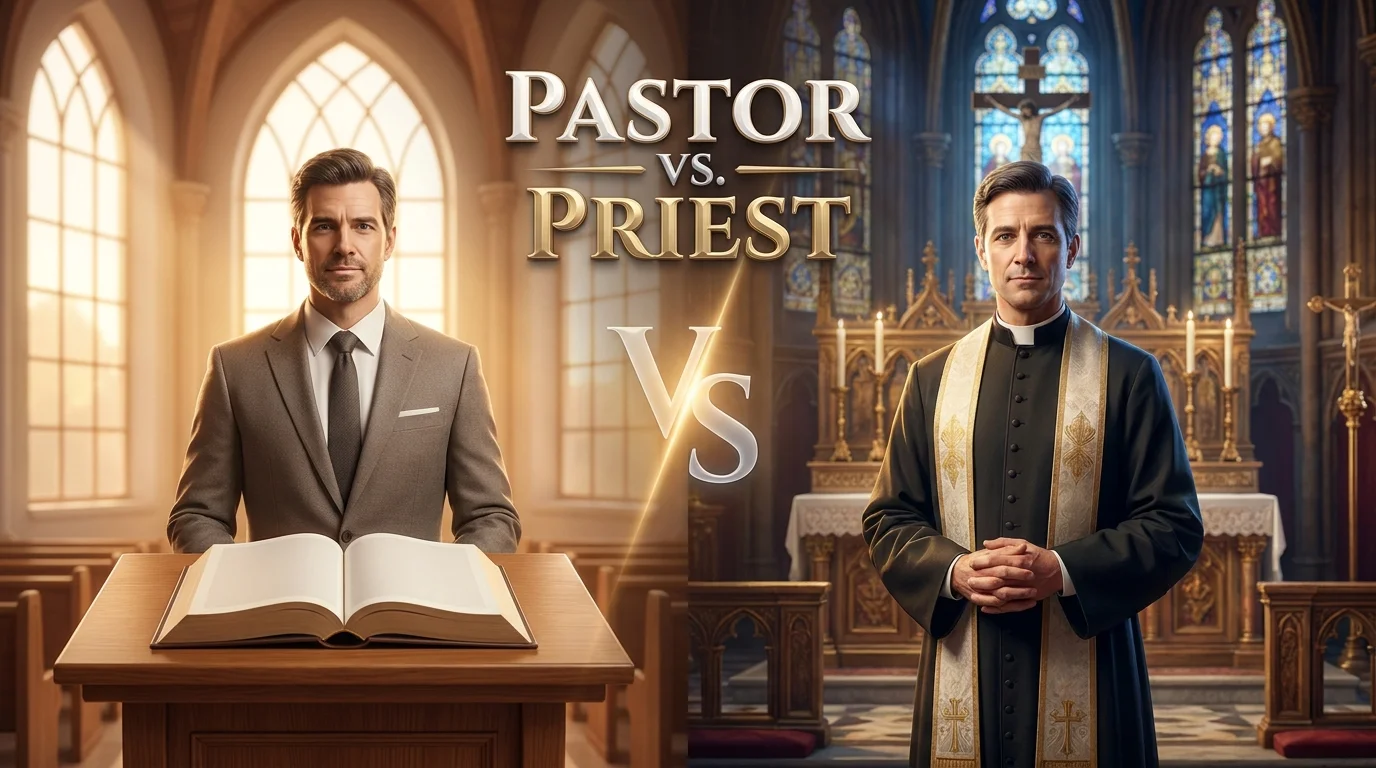
Pastor = a Christian minister who leads and cares for a congregation.
Priest = an ordained Christian clergy member whose role can include administering sacraments and presiding over worship.
The terms can overlap in some traditions, but pastor describes a role of spiritual leadership and care, while priest describes a particular form of ordained ministry.
What Is a Pastor?
A pastor is a Christian religious leader responsible for guiding and caring for a congregation.
The word comes from a Latin word meaning “shepherd,” reflecting the idea of spiritually caring for a community.
What Does a Pastor Do?
Depending on the denomination, a pastor may:
- Lead worship services
- Preach sermons
- Teach the Bible
- Provide pastoral counseling
- Visit sick or elderly members
- Conduct weddings
- Conduct funerals
- Baptize believers
- Lead church programs
- Provide spiritual guidance
Example
The pastor preached a sermon about forgiveness on Sunday.
🎯 Key Insight: Pastor emphasizes the role of caring for and guiding a Christian congregation.
What Is a Priest?
A priest is an ordained member of the clergy in several Christian traditions.
The role is particularly important in churches such as:
- The Catholic Church
- Eastern Orthodox churches
- Oriental Orthodox churches
- Anglican churches
- Some other sacramental Christian traditions
What Does a Priest Do?
Depending on the denomination, a priest may:
- Preside at worship
- Celebrate or administer sacraments
- Hear confessions
- Offer spiritual guidance
- Visit the sick
- Conduct weddings
- Conduct funerals
- Lead a parish community
In Catholic and Orthodox traditions, priests have specific sacramental responsibilities that distinguish their ministry from that of pastors in many Protestant churches.
Example
The priest celebrated Mass on Sunday morning.
🎯 Key Insight: Priest is an ordained clergy title with particular sacramental responsibilities in traditions that use the term.
Pastor vs. Priest: Main Difference
| Feature | Pastor | Priest |
|---|---|---|
| Basic meaning | Christian spiritual leader/caregiver | Ordained Christian clergy member |
| Common traditions | Especially Protestant churches | Catholic, Orthodox, Anglican, and other traditions |
| Leads worship? | Usually | Usually |
| Preaches? | Usually | Often |
| Provides pastoral care? | Yes | Yes |
| Administers sacraments? | Depends on denomination | Often central to the role |
| Hears confession? | Depends on denomination | Common in Catholic and Orthodox traditions |
| Leads a congregation/parish? | Often | Often |
| Married clergy? | Often permitted, depending on denomination | Rules vary significantly by tradition |
Pastor vs. Priest: The Biggest Difference
The most important point is that Christian denominations organize clergy differently.
In Many Protestant Churches
A pastor may be the primary leader of a local congregation.
For example:
The pastor leads the church’s weekly worship service.
The word priest may not be used at all.
In Catholic Christianity
A priest is an ordained minister who can celebrate the Eucharist and administer certain sacraments.
A priest may also be the pastor of a parish.
This means:
A Catholic priest can also function as a pastor.
🎯 Lesson: The terms aren’t always mutually exclusive.
Pastor vs. Priest in Different Christian Traditions
Protestant Churches
Many Protestant denominations use terms such as:
- Pastor
- Minister
- Reverend
The exact responsibilities vary by denomination.
Roman Catholic Church
The term priest is central.
A priest may serve as a pastor of a parish, making both terms applicable to different aspects of the same person’s ministry.
Eastern Orthodox Churches
Priest is the usual term for the ordained minister who serves a parish and celebrates the Divine Liturgy.
Anglican Churches
Anglican churches commonly use priest, although pastor may also be used in certain contexts.
🎯 Key Insight: You cannot understand the difference completely without considering the denomination.
Real-World Usage Scenarios
Scenario 1: Protestant Congregation
“The pastor delivered the sermon.”
This is a natural use of pastor in many Protestant churches.
🎯 Lesson: Pastor is a common title for a Protestant church leader.
Scenario 2: Catholic Parish
“The priest celebrated Mass.”
This is the standard terminology in Catholic Christianity.
🎯 Lesson: Priest is the normal term for the ordained minister who celebrates the Eucharist in the Catholic tradition.
Scenario 3: Catholic Pastor
“The pastor of St. Mary’s parish announced the new schedule.”
A Catholic priest can serve as the pastor of a parish.
🎯 Lesson: Pastor and priest can describe different aspects of the same person’s role.
Scenario 4: Anglican Church
“The priest led the Sunday Eucharist.”
This is natural Anglican terminology.
🎯 Lesson: Some Protestant traditions, particularly Anglicanism, retain the term priest.
Common Mistakes About Pastor and Priest
Mistake 1: Thinking Every Christian Church Has Pastors
❌ Not necessarily.
Different denominations use different titles for their clergy.
Mistake 2: Thinking Priest and Pastor Are Always Synonyms
❌ Not exactly.
Their roles overlap, but their meanings depend heavily on the church tradition.
Mistake 3: Assuming “Priest” Means Catholic Only
❌ Incorrect.
Priests are also found in Eastern Orthodox, Oriental Orthodox, Anglican, and other Christian traditions.
Mistake 4: Assuming a Catholic Priest Cannot Be Called a Pastor
❌ Incorrect.
A Catholic priest can be appointed pastor of a parish.
Mistake 5: Thinking All Pastors Have the Same Authority
❌ Not necessarily.
The responsibilities and authority of a pastor vary significantly between denominations.
Memory Tricks: Pastor vs. Priest
🐑 Pastor = Shepherd
Remember:
Pastor → pastoral care → shepherding people
The word is associated with the idea of a shepherd caring for a flock.
⛪ Priest = Ordained Sacramental Minister
Think:
Priest → priesthood → sacraments and ordained ministry
This is especially useful when thinking about Catholic and Orthodox traditions.
⭐ One-Line Memory Trick
Pastor emphasizes caring for a congregation; priest emphasizes a particular ordained clergy role.
Expert Insight: Why the Terms Overlap
The distinction isn’t simply a matter of two job titles.
Christian traditions developed different systems of ordination, church authority, worship, and sacramental theology.
In many Protestant traditions, the local minister is commonly called a pastor.
In Catholic and Orthodox traditions, the ordained minister who celebrates the Eucharist is called a priest.
At the same time, a priest may also have pastoral responsibility for a parish.
Therefore:
“Pastor” describes what a Christian minister may do, while “priest” identifies a particular ordained ministry in traditions that use priesthood terminology.
Quick Test: Pastor or Priest?
1. A Protestant congregation’s main spiritual leader
Pastor ✅
2. A Catholic minister who celebrates Mass
Priest ✅
3. A Catholic priest responsible for a parish
Pastor and priest can both apply. ✅
4. An Eastern Orthodox ordained minister
Priest ✅
5. A Protestant church leader providing pastoral care
Pastor ✅