
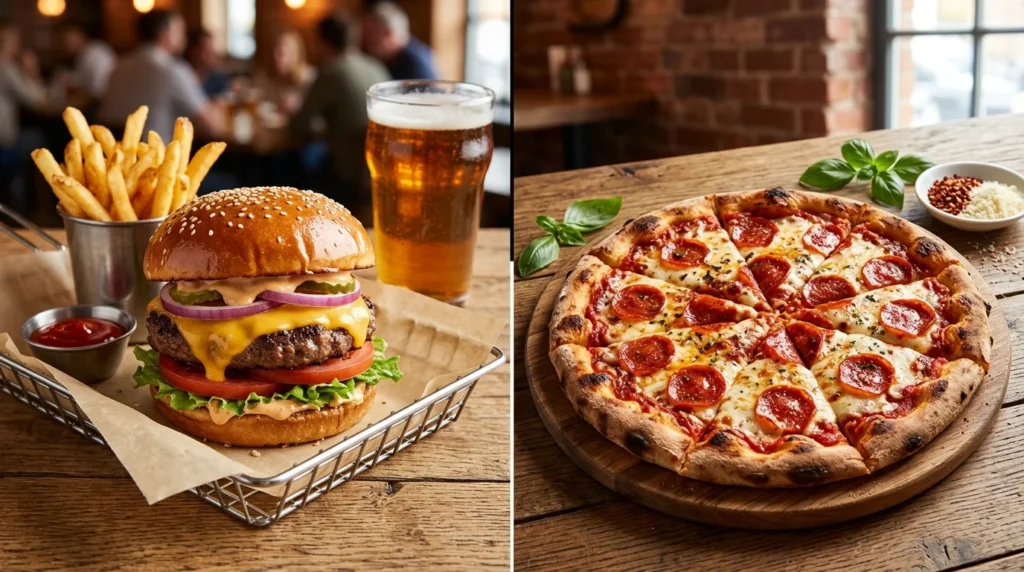
Quick Answer: Burger vs. Pizza
Choose a burger if you want a protein-focused, individually portioned meal. Choose pizza if you want a highly shareable, customizable meal with more variety in each bite.
For nutrition, neither food is automatically healthier. A simple burger can beat a heavily topped pizza, while a vegetable-loaded thin-crust pizza can beat a double cheeseburger with fries.
The simplest verdict:
Burger = protein + portability.
Pizza = variety + sharing.
Burger vs. Pizza at a Glance
| Feature | Burger | Pizza |
|---|---|---|
| Main base | Bun + patty | Dough + sauce + toppings |
| Protein potential | High | Moderate to high |
| Customization | Excellent | Excellent |
| Portion control | Easier individually | Can be harder |
| Shareability | Moderate | Excellent |
| Portability | Excellent | Good |
| Variety per bite | Moderate | Excellent |
| Leftovers | Good | Excellent |
| Social meals | Good | Excellent |
| Quick meal | Excellent | Excellent |
| Vegetarian options | Available | Very easy |
| Calorie range | Highly variable | Highly variable |
| Best for | Individual meals | Groups and sharing |
| Overall winner | Depends on goal | Depends on goal |
What Is a Burger?
A burger, short for hamburger, is typically a cooked ground-meat patty served inside a sliced bun with toppings and condiments.
Traditional burgers often include:
- Beef patty
- Bun
- Lettuce
- Tomato
- Onion
- Pickles
- Cheese
- Ketchup
- Mustard
- Mayonnaise
But modern burgers can include almost anything.
You can choose:
- Beef
- Chicken
- Turkey
- Fish
- Vegetarian patties
- Plant-based patties
You can also change the toppings, sauce, cheese, and bun.
Burger’s biggest strength
Protein and portability.
A burger is designed as an individual meal, making it easy to eat on the go.
Nutrition varies significantly by recipe. For example, McDonald’s Pakistan lists a basic beef burger at 270 calories and 14 g of protein, while its Quarter Pounder with Cheese is 599 calories and 34 g of protein.
That huge difference shows why “burger” isn’t a single nutritional category.
What Is Pizza?
Pizza is traditionally made from a dough base topped with sauce, cheese, and other ingredients before being baked.
Common toppings include:
- Mozzarella
- Pepperoni
- Beef
- Chicken
- Mushrooms
- Olives
- Peppers
- Onions
- Tomatoes
- Jalapeños
Pizza also comes in many styles:
- Thin crust
- Hand-tossed
- Thick crust
- Deep dish
- Stuffed crust
- Neapolitan-style
- Sicilian-style
This variety makes pizza one of the most customizable foods around.
Pizza’s biggest strength
Variety and shareability.
One pizza can contain several toppings, allowing everyone at the table to find something they like.
Burger vs. Pizza: Calories
This is one of the most searched questions in the debate.
The problem is that there is no universal calorie count for either food.
A plain hamburger can be relatively modest in calories, while a double cheeseburger with sauces can become much heavier.
Pizza has the same problem.
A thin vegetable pizza slice may be relatively light, while a thick-crust meat-and-cheese pizza can contain substantially more calories.
A recent comparison using USDA FoodData Central data puts pizza at about 266 calories per 100 g versus 231 calories per 100 g for hamburger, although individual recipes and portions can differ considerably.
Calorie winner?
Burger has a potential advantage when comparing similar portions, but portion size matters more than the food’s name.
For example, eating three pizza slices can easily outweigh the calories in one modest burger.
🎯 Lesson: Don’t compare “one burger” with “one slice of pizza.” Compare realistic portions.
Burger vs. Pizza: Protein
If protein is your priority, burgers generally have an advantage.
The reason is simple:
A burger’s central ingredient is usually a substantial protein source.
Pizza contains protein from cheese and meat toppings, but its base is primarily carbohydrate-rich dough.
USDA-based comparisons cited in recent 2026 nutrition analyses put hamburger at around 13.3 g of protein per 100 g, compared with about 11.4 g for pizza.
However, adding meat or extra cheese can change pizza’s protein content considerably.
Protein winner: Burger
Burger generally wins when protein density is the main goal.
Burger vs. Pizza: Carbohydrates
Pizza usually gets more of its calories from carbohydrates because of its dough.
A burger also contains carbohydrates from the bun, but the patty itself contributes little carbohydrate.
USDA-based figures cited in a 2026 comparison show approximately:
- Pizza: 33.4 g carbs per 100 g
- Hamburger: 29.6 g carbs per 100 g
Carb winner: Burger
A simple burger can be slightly lower in carbohydrates than pizza on an equal-weight basis.
But sauces, buns, crusts, and toppings can change the result.
Burger vs. Pizza: Fat
Both can be high in fat.
Burger fat primarily comes from:
- Beef
- Cheese
- Mayonnaise
- Fried toppings
- Bacon
Pizza fat often comes from:
- Cheese
- Pepperoni
- Sausage
- Meat toppings
- Oil
- High-fat sauces
A recent USDA-based comparison puts hamburger slightly higher in total fat per 100 g, while pizza contains somewhat more saturated fat in the cited dataset.
Fat winner?
Neither wins automatically.
A lean burger can be relatively moderate in fat, while a heavily topped pizza can be extremely rich.
Likewise, a cheese-heavy burger with bacon and mayo can easily become the heavier option.
Burger vs. Pizza: Sodium
Both foods can contain a lot of sodium.
Pizza’s major sodium sources include:
- Cheese
- Processed meats
- Sauce
- Salted dough
- Toppings
Burger sodium can come from:
- Patty seasoning
- Cheese
- Pickles
- Sauces
- Processed toppings
- Bun
USDA-based comparisons show pizza at around 598 mg sodium per 100 g, compared with approximately 487 mg for hamburger in one 2026 dataset.
Sodium winner: Burger
A basic burger may have less sodium per 100 g, but recipes vary dramatically.
Burger vs. Pizza: Which Is Healthier?
This question sounds simple, but the answer isn’t.
Neither burger nor pizza is automatically healthy or unhealthy.
Consider two meals:
Meal A
- Simple grilled burger
- Lean patty
- Whole-grain bun
- Lettuce
- Tomato
- Onion
- Minimal sauce
Meal B
- Deep-dish pizza
- Extra cheese
- Pepperoni
- Sausage
- Extra sauce
The first meal may be much more nutritionally balanced.
Now reverse it:
Meal C
- Thin-crust pizza
- Tomato sauce
- Moderate cheese
- Mushrooms
- Peppers
- Onions
Meal D
- Double bacon cheeseburger
- Extra cheese
- Mayo
- Large fries
- Sugary drink
The pizza can easily become the lighter choice.
Health winner?
It depends on ingredients, portion size, cooking method, and what you eat alongside it.
Burger vs. Pizza: Which Is Better for Weight Loss?
Neither food automatically causes or prevents weight loss.
The key factors are:
- Total calorie intake
- Portion size
- Protein
- Fiber
- Overall diet
- Physical activity
A burger can be easier to portion because you’re typically eating one individual sandwich.
Pizza can be trickier because one slice can turn into two, three, or four.
Weight-management winner: Burger
Burger gets a practical advantage because portion control can be easier.
But a thin-crust vegetable pizza eaten in a sensible portion can also fit comfortably into a balanced diet.
🎯 Lesson: Portion control matters more than choosing a food based on its label.
Burger vs. Pizza: Which Is More Filling?
Satiety depends on protein, fiber, fat, volume, and total calories.
A burger with a substantial meat patty can provide a strong protein hit.
Pizza can also be filling because it combines:
- Carbohydrates
- Fat
- Protein
- Cheese
- Toppings
But people often eat multiple slices without realizing how much they’ve consumed.
Fullness winner: Burger
A protein-rich burger generally has an advantage for satiety per individual serving.
Burger vs. Pizza: Which Is More Customizable?
This one is close.
Burger customization
You can change:
- Patty
- Bun
- Cheese
- Sauce
- Vegetables
- Pickles
- Bacon
- Spice level
Pizza customization
You can change:
- Crust
- Sauce
- Cheese
- Meat
- Vegetables
- Herbs
- Spice
- Portion
Pizza has one unique advantage:
Different sections of the same pizza can have different toppings.
That makes it especially useful for groups.
Customization winner: Tie
Both are extremely customizable.
Burger vs. Pizza: Which Is Better for Groups?
Pizza wins this category easily.
One large pizza can be sliced into multiple portions and shared among several people.
You can even order different toppings on different sections.
A burger, by contrast, is usually an individual meal.
Winner: Pizza
Pizza is the natural choice for parties, family gatherings, game nights, and group orders.
Burger vs. Pizza: Which Is More Portable?
Burgers are built for portability.
They’re:
- Individually wrapped
- Easy to carry
- Easy to eat with your hands
- Suitable for takeout
- Convenient for road trips
Pizza can certainly be eaten on the go, but it’s generally better suited to a plate or box.
Winner: Burger
Burger is the more convenient handheld meal.
Burger vs. Pizza: Which Has Better Leftovers?
Pizza has a legendary advantage here.
Cold pizza is widely considered a perfectly acceptable next-day meal.
It can also be reheated in:
- Oven
- Air fryer
- Skillet
- Microwave
Burgers are harder to preserve because the bun can become soggy and the toppings can lose their texture.
Winner: Pizza
Pizza wins the leftover battle.
Burger vs. Pizza: Which Is More Affordable?
Cost depends heavily on location, restaurant, size, and ingredients.
But pizza has one important advantage:
It can feed multiple people from one order.
A single large pizza may serve several people, while a group ordering individual burgers needs one meal per person.
Winner for group value: Pizza
For individual meals, the price difference can be much smaller.
Burger vs. Pizza: Taste and Texture
This category is completely subjective.
Burger delivers:
- Juicy meat
- Soft bun
- Crunchy vegetables
- Creamy cheese
- Tangy sauces
The experience is usually concentrated into every bite.
Pizza delivers:
- Crispy or chewy crust
- Tangy sauce
- Melted cheese
- Savory toppings
- Different textures across the slice
Taste winner?
Tie.
Your craving decides the winner.
Burger vs. Pizza Comparison Table
| Category | Burger | Pizza | Winner |
|---|---|---|---|
| Protein | Generally higher | Moderate to high | 🏆 Burger |
| Carbohydrates | Generally lower | Generally higher | 🏆 Burger |
| Portion control | Easier | Can be harder | 🏆 Burger |
| Portability | Excellent | Good | 🏆 Burger |
| Shareability | Moderate | Excellent | 🏆 Pizza |
| Customization | Excellent | Excellent | 🤝 Tie |
| Leftovers | Good | Excellent | 🏆 Pizza |
| Group meals | Good | Excellent | 🏆 Pizza |
| Variety per meal | Good | Excellent | 🏆 Pizza |
| Vegetarian flexibility | Good | Excellent | 🏆 Pizza |
| Calories | Highly variable | Highly variable | 🤝 Depends |
| Taste | Subjective | Subjective | 🤝 Tie |
| Overall | Individual meals | Social meals | 🤝 Depends |
Real-World Burger vs. Pizza Scenarios
Scenario 1: You Want a High-Protein Meal
You: “I’m hungry and want something filling with plenty of protein.”
Better choice: Burger.
🎯 Lesson: A substantial burger patty can provide more protein than a typical pizza serving.
Scenario 2: You’re Feeding Six People
You: “Everyone wants something different.”
Better choice: Pizza.
🎯 Lesson: Multiple toppings and easy slicing make pizza ideal for groups.
Scenario 3: You’re Counting Calories
You: “I want to control my portion.”
Better choice: A simple burger may be easier to portion.
🎯 Lesson: One burger gives you a defined individual serving, while pizza can encourage multiple slices.
Scenario 4: You’re Ordering for Game Night
You: “I need food everyone can share.”
Better choice: Pizza.
🎯 Lesson: Pizza’s shareability makes it a classic group-food winner.
Scenario 5: You’re Taking Food on a Road Trip
You: “I need something easy to eat.”
Better choice: Burger.
🎯 Lesson: The handheld design gives burgers a portability advantage.
Common Mistakes in the Burger vs. Pizza Debate
Mistake 1: Saying Pizza Is Always Unhealthy
Not true.
A pizza with vegetables, moderate cheese, and a thinner crust can have a very different nutritional profile from a loaded deep-dish pizza.
Why it happens: People treat all pizza as one food.
Correction: Look at the actual ingredients and portion.
Mistake 2: Assuming Every Burger Is High in Protein
Not necessarily.
A small burger may contain much less protein than a large double-patty burger.
Correction: Check the actual nutrition information when available.
Mistake 3: Comparing One Slice With One Burger
That’s not an equal comparison.
One slice may weigh far less than a burger.
Correction: Compare realistic portions or nutrition per 100 g.
Mistake 4: Forgetting the Side Dish
A burger with fries and a sugary drink is a very different meal from a burger with vegetables and water.
The same applies to pizza with cheesy sides, wings, or dessert.
Correction: Evaluate the whole meal, not just the main food.
Mistake 5: Thinking “Healthy” Means “Low Calorie”
A food can contain useful nutrients while still being calorie-dense.
Correction: Consider calories, protein, fiber, sodium, fat, and portion size together.
Memory Trick: Burger vs. Pizza
Need an easy way to remember the biggest differences?
🍔 Burger = Protein + Portability
Think:
Burger → Patty → Protein → Portable
🍕 Pizza = Variety + Sharing
Think:
Pizza → Slices → Sharing → Variety
So remember:
Burger is built for one. Pizza is built for many.
It’s not an absolute rule, but it’s a useful way to remember their biggest practical differences.
Expert Insight: Why There Is No Universal Winner
The biggest mistake in the burger vs. pizza debate is treating both foods as fixed recipes.
They’re not.
A burger can be:
- Lean or fatty
- Small or enormous
- Grilled or fried
- With or without cheese
- Vegetable-heavy or meat-heavy
Pizza can be:
- Thin or thick
- Small or large
- Cheese-heavy or vegetable-heavy
- Meat-loaded or vegetarian
- Lightly topped or stuffed with extras
That’s why nutrition comparisons can produce different answers.
For example, one USDA-based 2026 comparison found hamburger lower in calories and carbohydrates and higher in protein per 100 g than pizza. But individual restaurant meals can look completely different.
Official restaurant nutrition data illustrates the same point: McDonald’s Pakistan lists its beef burger at 270 calories and its Quarter Pounder with Cheese at 599 calories, while Domino’s Pakistan lists pizzas ranging widely in calories per slice depending on the product.
The recipe—not the category—ultimately determines the nutritional profile.
Which Is Better: Burger or Pizza?
Choose a burger if you want:
- More protein
- An individual serving
- Easy portability
- Easier portion control
- A handheld meal
- A meat-centered dish
Choose pizza if you want:
- A shareable meal
- More topping variety
- Easy group ordering
- Excellent leftovers
- Vegetarian flexibility
- Different flavors in one order
Choose burger for:
Protein, portability, and individual meals.
Choose pizza for:
Sharing, variety, and social occasions.