
Quick Answer: ECT vs. TMS
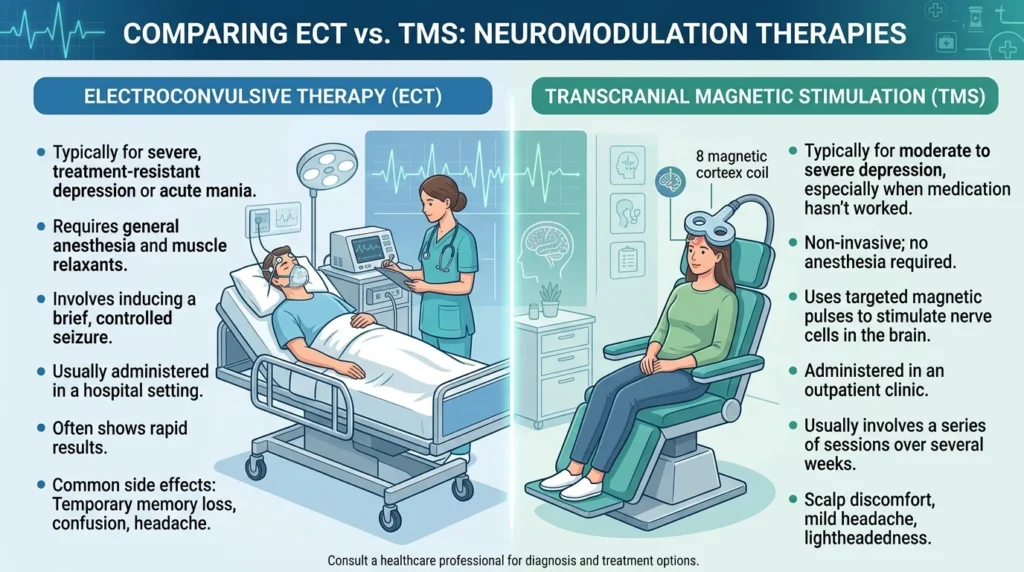
ECT uses controlled electrical stimulation to intentionally produce a therapeutic seizure while the patient is under anesthesia.
TMS uses magnetic pulses to stimulate specific areas of the brain and generally does not require anesthesia or intentionally cause a seizure.
In broad terms:
ECT = electrical stimulation + therapeutic seizure + anesthesia
TMS = magnetic stimulation + targeted brain activity + usually no anesthesia
What Is ECT?
ECT (electroconvulsive therapy) is a medical treatment in which controlled electrical stimulation is delivered to the brain to produce a brief, medically supervised seizure.
ECT is performed in a clinical setting with appropriate monitoring and general anesthesia, along with medication to relax the muscles.
What Is ECT Used For?
ECT can be used for certain severe psychiatric conditions, particularly when rapid improvement is important or other treatments have not worked adequately.
It may be considered for:
- Severe depression
- Depression with psychotic features
- Severe mania
- Catatonia
- Certain other serious psychiatric conditions
The exact indications depend on the individual patient and clinical judgment.
What Happens During ECT?
A typical treatment involves:
- The patient receives anesthesia.
- Medical staff monitor vital signs and brain activity.
- Electrodes deliver a carefully controlled electrical stimulus.
- A brief therapeutic seizure occurs.
- The patient is monitored during recovery.
🎯 Key Insight: ECT is not simply “sending electricity through the brain.” It is a carefully controlled medical procedure designed to produce a therapeutic seizure under anesthesia.
What Is TMS?
TMS (transcranial magnetic stimulation) uses a device positioned near the head to deliver rapidly changing magnetic pulses.
These magnetic fields induce electrical currents in targeted areas of the brain.
Unlike ECT, standard TMS generally:
- Does not require general anesthesia
- Does not intentionally induce a seizure
- Allows the patient to remain awake
- Is usually performed during an outpatient visit
What Is TMS Used For?
TMS is commonly used for major depressive disorder, particularly in people who have not responded adequately to certain other treatments.
Depending on the specific TMS device and regulatory approval, it may also be used for certain other conditions.
🎯 Key Insight: TMS is generally a targeted, outpatient brain-stimulation treatment, whereas ECT is a more intensive procedure performed under anesthesia.
ECT vs. TMS: Main Difference
| Feature | ECT | TMS |
|---|---|---|
| Full name | Electroconvulsive therapy | Transcranial magnetic stimulation |
| Energy used | Electrical | Magnetic |
| Therapeutic seizure | Yes | No, not intentionally |
| General anesthesia | Yes | Usually no |
| Patient awake? | No during procedure | Yes |
| Typical setting | Medical facility | Usually outpatient |
| Speed of response | Can work rapidly | Usually requires repeated sessions |
| Memory effects | Can occur, especially around treatment | Much less prominent |
| Common immediate effects | Headache, confusion, muscle soreness | Scalp discomfort, headache |
| Treatment course | Usually a series of treatments | Usually multiple sessions over several weeks |
| Best-known psychiatric use | Severe depression and other serious conditions | Depression, depending on treatment/device |
ECT vs. TMS: How They Work
How ECT Works
ECT produces a controlled seizure through electrical stimulation.
The exact biological mechanisms responsible for its therapeutic effects are complex and are not completely understood.
ECT appears to produce broad changes in brain activity and neurochemical signaling.
How TMS Works
TMS uses magnetic pulses to stimulate neurons in specific regions of the brain.
Different TMS protocols can target different brain networks and use different pulse patterns.
🎯 Lesson: Both treatments influence brain activity, but ECT produces a therapeutic seizure while TMS uses targeted magnetic stimulation without intentionally inducing one.
ECT vs. TMS: Which Works Faster?
One of the major differences is speed.
ECT
ECT can produce significant improvement relatively quickly, which is one reason clinicians may consider it when someone is severely ill or requires a rapid response.
TMS
TMS generally requires a series of repeated treatment sessions before benefits become apparent.
🎯 Key Insight: When rapid improvement is clinically important, ECT may be considered because its effects can emerge more quickly than those of typical TMS courses.
ECT vs. TMS: Side Effects
ECT Side Effects
Possible effects include:
- Temporary confusion
- Memory problems
- Headache
- Muscle soreness
- Nausea related to anesthesia
- Temporary blood pressure or heart-rate changes
Memory impairment is one of the most important side effects associated with ECT.
The degree and duration vary between individuals and treatment approaches.
TMS Side Effects
Common side effects may include:
- Scalp discomfort
- Headache
- Facial muscle twitching during stimulation
- Temporary discomfort at the treatment site
Serious complications are uncommon, although seizure is a rare potential risk.
🎯 Key Insight: Memory problems are much more strongly associated with ECT than with standard TMS.
ECT vs. TMS: Real-World Scenarios
Scenario 1: Severe Depression Requiring Rapid Treatment
A person has severe depression with significant functional impairment and needs a treatment that may work relatively quickly.
A clinician may consider ECT.
🎯 Lesson: ECT can be particularly important when rapid therapeutic effects are needed.
Scenario 2: Outpatient Depression Treatment
A person with depression wants a noninvasive treatment that doesn’t require general anesthesia.
TMS may be an option, depending on their diagnosis and medical history.
🎯 Lesson: TMS is typically delivered while the patient remains awake.
Scenario 3: Concern About Memory
A patient is particularly concerned about temporary or longer-lasting memory effects.
This concern may influence the discussion between treatment options because ECT has a substantially greater association with memory impairment than TMS.
🎯 Lesson: Side-effect profiles are an important part of treatment decisions.
Scenario 4: Catatonia
A person develops severe catatonic symptoms.
ECT may be considered urgently, depending on the clinical situation.
🎯 Lesson: ECT has important applications beyond depression.
TMS vs. ECT: Effectiveness, Benefits, Side Effects, and Key Differences
Transcranial magnetic stimulation (TMS) and electroconvulsive therapy (ECT) are medical treatments used for certain mental health conditions, especially depression. Both can help when symptoms have not improved with other treatments, but they work differently and suit different clinical situations.
TMS is noninvasive and does not require general anesthesia, while ECT involves a controlled electrical stimulus under general anesthesia. ECT is often considered when depression is severe, urgent, or accompanied by symptoms such as psychosis. TMS may be appealing to people seeking a treatment with fewer cognitive side effects, although it generally requires repeated outpatient sessions.
The better option depends on symptom severity, diagnosis, medical history, treatment goals, and a psychiatrist’s assessment.
TMS vs ECT effectiveness
Both TMS and ECT can be effective for depression, but their effectiveness varies depending on the individual and the condition being treated.
ECT is generally considered one of the most effective treatments for severe major depression, particularly when symptoms are urgent, psychotic, or associated with a high risk of suicide. It may also help when other treatments have failed. However, some people experience memory problems, confusion, or other side effects.
TMS can also improve depression, including treatment-resistant depression. It does not require general anesthesia and generally has fewer concerns about memory impairment than ECT. However, not everyone responds, and improvement often develops over several weeks of repeated sessions.
The comparison depends on several factors:
Speed: ECT may produce improvement more quickly in some severe cases. TMS usually involves a course of frequent sessions over several weeks.
Symptom severity: ECT may be preferred when a rapid, substantial response is needed.
Side effects: TMS commonly causes temporary scalp discomfort or headache. ECT can cause short-term confusion and memory difficulties.
Relapse: Symptoms can return after either treatment, so maintenance treatment and follow-up care may be necessary.
Individual response: Neither treatment works for everyone, and results depend on the diagnosis and treatment plan.
There is no single success rate that applies to every patient. A psychiatrist can explain the likely benefits and risks based on a person’s specific circumstances.
TMS or ECT for depression
TMS and ECT are both options for depression that has not responded adequately to other treatments, but they are not interchangeable in every situation.
TMS uses magnetic pulses to stimulate specific brain regions involved in mood regulation. Treatment is typically performed while the patient is awake, without general anesthesia. A course commonly involves multiple sessions each week over several weeks, with the schedule depending on the device and protocol.
ECT uses a brief electrical stimulus to induce a controlled seizure while the patient is under general anesthesia and receives muscle-relaxing medication. It is administered by a trained medical team and requires monitoring and recovery time after each session.
TMS may be considered when depression has not improved with medication or psychotherapy and the person is medically suitable for the procedure. ECT may be recommended when depression is especially severe, when psychotic features are present, when a rapid response is important, or when other treatments have not worked.
Factor | TMS | ECT |
|---|---|---|
How it works | Magnetic pulses stimulate targeted brain regions | Controlled electrical stimulation induces a seizure under anesthesia |
Anesthesia | Not usually required | General anesthesia is required |
Treatment setting | Usually outpatient | Often outpatient, but sometimes inpatient |
Typical course | Repeated sessions over several weeks | A series of treatments, often several times weekly |
Memory effects | Usually limited; significant memory problems are uncommon | Memory difficulties and confusion can occur |
Best-known role | Depression, including treatment-resistant depression | Severe or urgent depression, including some cases with psychosis |
Main limitation | Requires repeated visits and may not work for everyone | Requires anesthesia and has greater cognitive side-effect concerns |
The choice should be based on clinical need rather than assuming that one treatment is always superior. A person with severe or rapidly worsening depression may need a different approach from someone whose symptoms are persistent but medically stable.
ECT vs TMS for bipolar
ECT and TMS may be considered for some people with bipolar disorder, but the evidence and treatment decisions differ from those for major depressive disorder.
ECT has an established role in treating severe bipolar episodes, including bipolar depression and acute mania, particularly when symptoms are dangerous, psychotic, resistant to other treatments, or require a rapid response. It may be considered when someone cannot eat or drink adequately because of depression, experiences catatonia, or has severe suicidal symptoms.
TMS has shown promise for bipolar depression, but its evidence base is more limited than its evidence for major depressive disorder. It may be considered as an additional treatment when standard options have not helped sufficiently. The specific stimulation protocol and the person’s current mood episode matter.
Factor | TMS | ECT |
|---|---|---|
Bipolar depression | May help, but evidence is more limited | Established option, especially for severe or resistant episodes |
Bipolar mania | Evidence is limited and protocol-dependent | Recognized option for severe or treatment-resistant mania |
Anesthesia | Usually not required | Required |
Memory effects | Significant memory problems are uncommon | Confusion and memory difficulties can occur |
Mania risk | Treatment-emergent mania is possible but appears uncommon | Can produce mood switching; careful monitoring is needed |
Role in treatment | Often considered an adjunctive option | May be used when rapid or substantial improvement is necessary |
A key consideration is the risk of mood switching. TMS protocols that stimulate mood-related brain regions may trigger manic or hypomanic symptoms in some people. ECT can also be associated with mood switching, so clinicians monitor symptoms during treatment.
People with bipolar disorder should receive an assessment of their current mood state and medication regimen before either treatment. Mood stabilizers and other prescribed medications should not be stopped or adjusted without medical guidance.
ECT vs TMS for schizophrenia
ECT and TMS are not interchangeable treatments for schizophrenia. Their roles depend on the symptoms being treated, and neither replaces a comprehensive schizophrenia treatment plan.
ECT may be considered for selected cases of schizophrenia, particularly when symptoms remain severe despite appropriate medication, or when catatonia is present. It may also be used alongside antipsychotic medication in certain treatment-resistant cases. ECT is not generally the first treatment for schizophrenia itself.
TMS has been studied for specific schizophrenia symptoms, but the evidence is mixed. Researchers have investigated its use for auditory hallucinations, negative symptoms such as reduced motivation, and cognitive difficulties. Results vary by symptom and stimulation protocol, and TMS is not an established replacement for antipsychotic medication.
Factor | TMS | ECT |
|---|---|---|
Main role | Investigational or specialist use for selected symptoms | Selected severe, treatment-resistant, or catatonic presentations |
Auditory hallucinations | Studied, with inconsistent results | Not usually selected solely for hallucinations |
Negative symptoms | Evidence remains uncertain | Not routinely used solely for negative symptoms |
Catatonia | Not a standard first-line treatment | An important option, especially in severe cases |
Treatment-resistant symptoms | May be considered for specific symptoms in specialist settings | May be considered as an adjunct in selected cases |
Cognitive effects | Usually fewer memory-related effects | Confusion and memory difficulties can occur |
The important distinction is that schizophrenia includes several symptom groups that may respond differently to treatment. A therapy that helps depression or a particular symptom does not necessarily improve the entire disorder.
A psychiatrist should determine whether the main concern is psychosis, catatonia, persistent hallucinations, negative symptoms, or co-occurring depression before recommending either procedure.
TMS vs ECT Reddit
Discussions about TMS vs ECT on Reddit can provide personal perspectives on treatment experiences, recovery, side effects, and practical challenges. However, these discussions are anecdotal and cannot establish which treatment is more effective overall.
People discussing TMS may describe:
Appreciating that treatment does not require general anesthesia.
Experiencing headaches, scalp discomfort, or temporary fatigue.
Finding repeated clinic visits difficult to fit around work or family responsibilities.
Noticing gradual improvement rather than an immediate change.
Feeling disappointed when symptoms do not respond.
People discussing ECT may describe:
Significant improvement after other treatments failed.
Concern about memory loss or confusion.
The practical burden of anesthesia, transportation, and recovery.
The need for ongoing treatment to reduce the risk of relapse.
Mixed feelings about a treatment that helped symptoms but caused difficult side effects.
These experiences can differ considerably. One person may experience substantial relief with TMS, while another may need ECT after TMS or medication has not helped. Some people may experience side effects that are mild, while others find them disruptive.
When evaluating Reddit discussions, look for details about the person’s diagnosis, symptom severity, treatment protocol, number of sessions, concurrent medications, and length of follow-up. These factors help explain why experiences differ.
The most useful takeaway from Reddit is that patient experiences can help prepare you for treatment, but they should not replace clinical evidence or an individualized psychiatric assessment. Neither positive nor negative anecdotes reliably predict an individual’s outcome.
ECT vs TMS vs Spravato
ECT, TMS, and Spravato are three different treatment approaches that may be considered for treatment-resistant depression. Spravato is the brand name for esketamine nasal spray, which is administered under medical supervision.
They differ in how they work, how treatment is delivered, their side effects, and the situations in which clinicians may recommend them.
How the three treatments compare
Factor | TMS | ECT | Spravato |
|---|---|---|---|
Treatment type | Magnetic brain stimulation | Electrical stimulation that induces a controlled seizure under anesthesia | Esketamine nasal spray |
General anesthesia | No | Yes | No |
Typical setting | Outpatient clinic | Outpatient or inpatient medical setting | Certified treatment setting with monitoring |
Treatment schedule | Repeated sessions over several weeks, depending on protocol | A series of treatments determined by clinical response | Supervised dosing sessions followed by an individualized maintenance schedule |
Memory effects | Significant memory problems are uncommon | Memory difficulties and confusion can occur | Dissociation and temporary cognitive or perceptual changes may occur |
Other common concerns | Headache and scalp discomfort | Anesthesia-related risks, headache, confusion, and memory changes | Dizziness, nausea, sedation, increased blood pressure, and dissociation |
Main consideration | Requires repeated sessions and may not work for everyone | Often considered for severe or urgent depression | Requires supervised administration and post-dose monitoring |
Which treatment may be preferred?
ECT may be favored when depression is extremely severe, psychotic, associated with catatonia, or requires a rapid response. Its potential benefits must be weighed against anesthesia and cognitive risks.
TMS may be favored when someone wants a noninvasive treatment without general anesthesia and can attend repeated sessions. It is an established option for major depression, including treatment-resistant cases.
Spravato may be considered for eligible adults with treatment-resistant depression, or for depressive symptoms in adults with major depressive disorder and acute suicidal ideation or behavior under the relevant prescribing indication. The exact treatment plan depends on the indication and clinical circumstances.
These treatments should not be ranked using a single universal success rate. Direct comparative evidence is limited, and studies differ in patient populations, treatment protocols, and outcome measures. A psychiatrist can help compare likely benefits, risks, availability, and maintenance requirements.
TMS vs ECT for anxiety
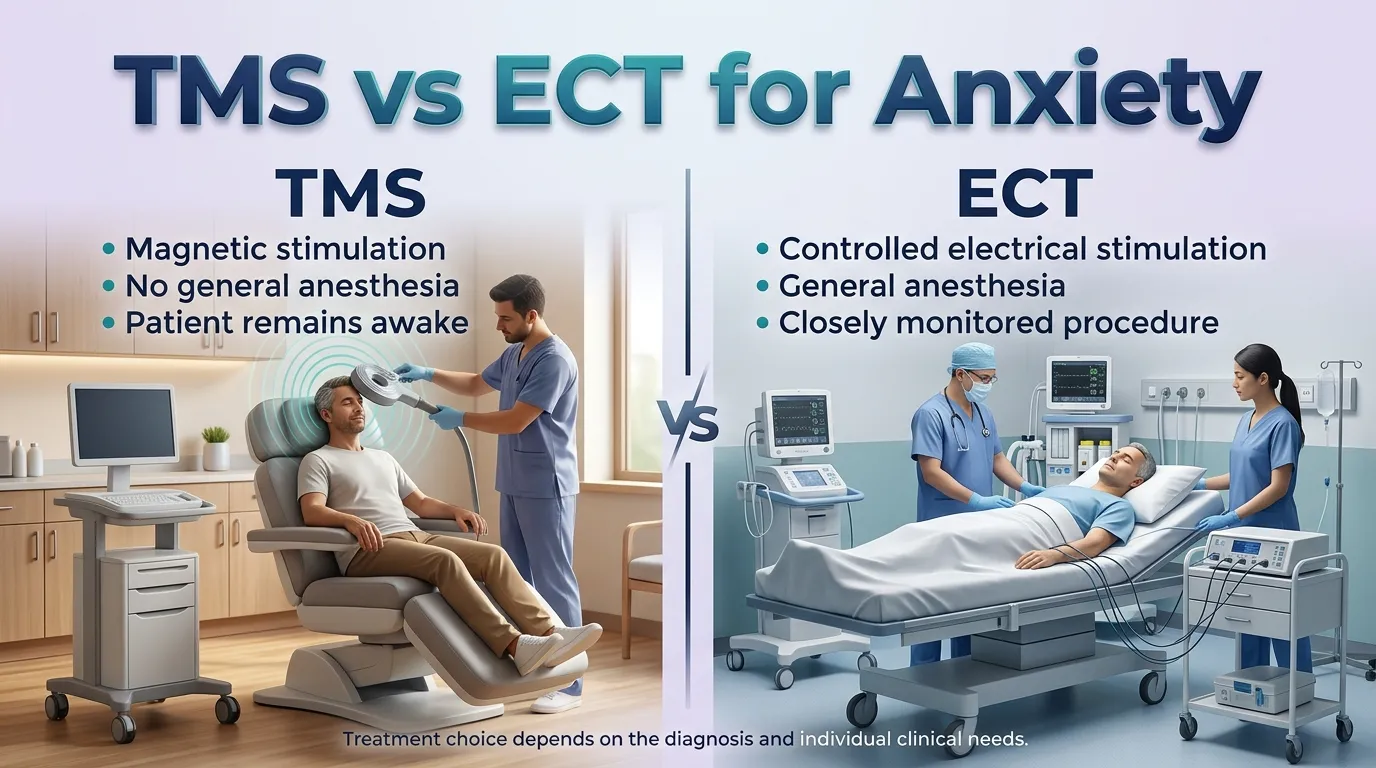
TMS and ECT have different roles when anxiety is the main concern.
TMS has some evidence for reducing anxiety symptoms, particularly when anxiety occurs alongside depression. Certain TMS protocols are also used for specific psychiatric conditions, such as obsessive-compulsive disorder, under applicable indications. However, the evidence for treating anxiety disorders themselves varies by diagnosis and protocol.
ECT is not generally used as a first-line treatment for an anxiety disorder alone. It may be considered when a person has severe depression accompanied by significant anxiety, or when another condition requiring ECT is present.
Factor | TMS | ECT |
|---|---|---|
Anxiety without depression | Evidence depends on the specific disorder and protocol | Not a routine treatment |
Anxiety with major depression | May improve depressive symptoms and associated anxiety | May help when severe depression is the main treatment target |
Obsessive-compulsive disorder | Specific TMS protocols may be available | Not routinely used for OCD alone |
Anesthesia | Usually not required | Required |
Main risks | Headache, scalp discomfort, and rare serious complications | Anesthesia risks, confusion, and memory difficulties |
It is important to identify the type of anxiety involved. Generalized anxiety disorder, panic disorder, social anxiety, and obsessive-compulsive disorder are distinct conditions with different evidence-based treatment options.
For anxiety without severe depression, psychotherapy, medication, or disorder-specific treatment may be more appropriate than either TMS or ECT. A qualified clinician can determine whether brain stimulation is suitable for the diagnosis and treatment history.
TMS side effects
TMS is generally well tolerated, and most side effects are mild or temporary. The exact risk depends on the stimulation method, treatment settings, medical history, and medications.
Common TMS side effects
Headache: Some people develop a headache during or after a session. It often improves as treatment continues or with simple measures recommended by the treating clinician.
Scalp discomfort: The magnetic coil produces tapping sensations and may cause discomfort where it contacts the scalp. Adjusting the coil position or treatment settings may help.
Facial muscle twitching: Stimulation can activate nearby facial muscles, creating brief twitching during a session.
Dizziness or lightheadedness: Some people experience temporary dizziness, although it is not universal.
Fatigue or sleep changes: Tiredness, insomnia, or changes in sleep can occur. These symptoms should be discussed with the treatment team, particularly if they affect daily functioning or mood.
Rare but serious TMS side effects
Seizure: A seizure is a rare but serious complication. Risk assessment is important, especially for people with a seizure history or other relevant risk factors.
Hearing problems: The equipment produces loud clicking sounds. Hearing protection is important because inadequate protection can risk hearing damage or tinnitus.
Mood switching: Some people, particularly those with bipolar disorder, may develop hypomanic or manic symptoms.
Fainting: Syncope is uncommon but can occur.
Common Mistakes About ECT and TMS
Mistake 1: Thinking ECT and TMS Are the Same Treatment
❌ They’re not.
ECT intentionally induces a therapeutic seizure under anesthesia.
TMS uses magnetic pulses and generally does not induce a seizure.
Mistake 2: Thinking TMS Uses Electrical Current Directly on the Brain
❌ Not exactly.
TMS uses magnetic fields to induce electrical activity in targeted brain tissue.
Mistake 3: Assuming ECT Is the Same as an Uncontrolled Seizure
❌ No.
ECT is a controlled medical procedure performed by trained professionals with anesthesia, monitoring, and carefully selected electrical parameters.
Mistake 4: Assuming TMS Requires Anesthesia
❌ Usually not.
Patients generally remain awake and can return home after treatment.
Mistake 5: Assuming One Treatment Is Always Better
❌ There is no universal winner.
The appropriate treatment depends on factors such as:
- Diagnosis
- Severity
- Previous treatment response
- Need for rapid improvement
- Medical history
- Patient preferences
- Potential risks and benefits
ECT vs. TMS: Treatment Experience
What ECT Feels Like
Because ECT is performed under general anesthesia, the patient is unconscious during the procedure.
Afterward, they may experience temporary confusion, headache, or muscle soreness.
They generally need time to recover from the anesthesia and procedure.
What TMS Feels Like
During TMS, the patient remains awake.
They may hear clicking sounds and feel tapping or pressure on the scalp.
Some people experience temporary scalp discomfort or headache.
🎯 Lesson: ECT is a procedure performed under anesthesia; TMS is generally an awake outpatient treatment.
Memory Trick: ECT vs. TMS
⚡ ECT = Electrical + Convulsion
Think:
ECT → Electrical → Controlled therapeutic seizure
🧲 TMS = Transcranial Magnetic
Think:
TMS → Magnetic stimulation → Targeted brain activity
⭐ One-Line Memory Trick
ECT induces a therapeutic seizure; TMS stimulates the brain with magnetic pulses without intentionally inducing one.
Expert Insight: ECT vs. TMS
ECT and TMS belong to the broader category of neuromodulation or brain-stimulation treatments, but they operate at very different levels of intensity and clinical procedure.
ECT produces a generalized therapeutic seizure and can cause substantial changes in brain activity. It has remained an important treatment for severe psychiatric illness because it can be highly effective and relatively rapid.
TMS, by contrast, uses magnetic stimulation to influence specific cortical regions and connected neural networks. Its noninvasive nature and lack of general anesthesia make it an attractive option for certain patients.
The choice is therefore not simply about deciding which technology is “stronger.” It involves matching the treatment to the clinical situation, urgency, expected benefits, risks, and patient’s circumstances.
Quick Test: ECT or TMS?
1. Uses magnetic pulses
TMS ✅
2. Uses electrical stimulation to induce a therapeutic seizure
ECT ✅
3. Usually performed without general anesthesia
TMS ✅
4. Commonly associated with temporary memory problems
ECT ✅
5. Usually performed as an outpatient treatment while the patient is awake
TMS ✅
6. May be considered when rapid improvement is especially important
ECT ✅