
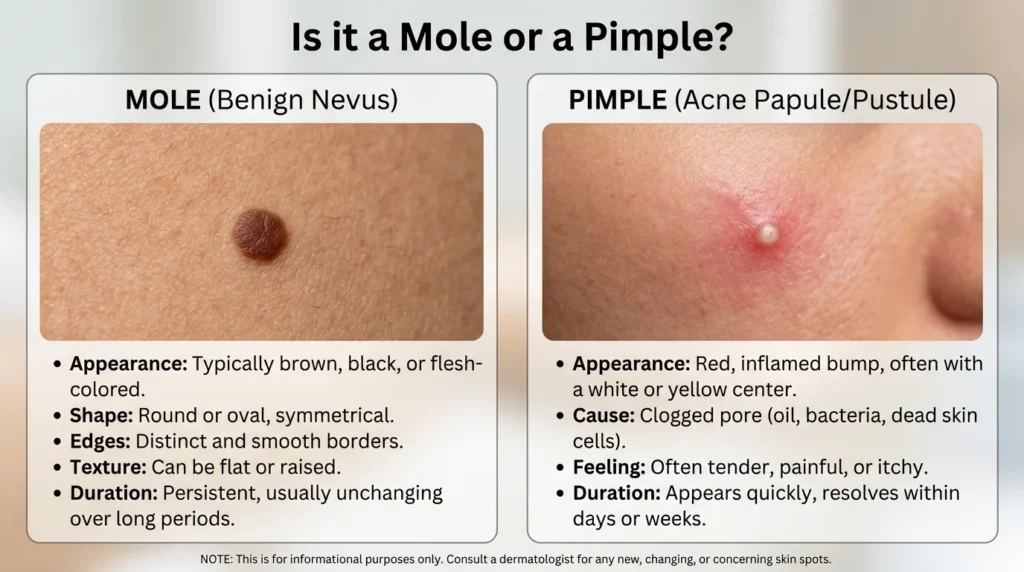
Quick Answer: Mole vs. Pimple
| Feature | Mole | Pimple |
|---|---|---|
| What is it? | Cluster of pigment-producing cells | Inflamed or clogged hair follicle |
| Typical appearance | Brown, black, pink, or skin-colored | Red, white, or skin-colored bump |
| Texture | Flat or raised | Usually raised |
| Pain | Usually painless | Can be tender or painful |
| Pus | ❌ Usually no | ✅ May contain pus |
| Changes quickly? | Usually stable | Often changes within days |
| Duration | Can last for years | Usually temporary |
| Can you pop it? | ❌ No | ❌ Best not to |
| Common location | Anywhere on the skin | Commonly face, chest, back, shoulders |
🎯 Simple rule: If a spot looks like a typical acne lesion and changes over days, it may be a pimple. A mole generally remains relatively stable over a much longer period.
What Is a Mole?
A mole, medically called a nevus, is a common type of skin growth.
Moles develop when pigment-producing cells called melanocytes grow in clusters instead of being distributed evenly throughout the skin.
What Does a Mole Look Like?
A typical mole may be:
- Brown
- Dark brown
- Black
- Pink
- Tan
- Skin-colored
It can be:
- Flat
- Slightly raised
- Round
- Oval
- Smooth
Some people have only a few moles, while others have many.
🎯 Key Insight: A typical mole tends to be persistent and relatively stable, rather than appearing and disappearing within a few days.
What Is a Pimple?
A pimple is an acne lesion that develops when a hair follicle becomes clogged.
Oil, dead skin cells, and other material can block the follicle. Inflammation can then produce a visible bump.
What Does a Pimple Look Like?
A pimple may appear as:
- A red bump
- Whitehead
- Blackhead
- Small swollen spot
- Pus-filled bump
- Tender or painful area
Unlike a typical mole, a pimple usually changes relatively quickly.
It may become red, develop a white center, shrink, and eventually disappear.
🎯 Key Insight: Rapid change is much more characteristic of a pimple than an ordinary mole.
Mole vs. Pimple: Appearance
One of the easiest ways to distinguish them is by looking at their appearance.
Typical Mole
A typical mole is often:
- Uniform in color
- Symmetrical
- Clearly defined
- Stable in appearance
- Flat or evenly raised
Typical Pimple
A pimple is more likely to be:
- Red or inflamed
- Swollen
- Tender
- White-tipped
- Temporary
However, appearance alone isn’t always enough to identify a skin lesion with certainty.
Mole vs. Pimple: How Long Do They Last?
Moles
Moles can remain on the skin for years or even decades.
Some may gradually change as a person ages, but a typical mole does not suddenly disappear after a few days.
Pimples
Pimples are generally temporary.
They can develop and change over days to weeks, depending on the type of acne lesion.
🎯 Easy memory trick:
Pimple = temporary
Mole = persistent
Mole vs. Pimple: Pain and Tenderness
A normal mole is generally not painful.
A pimple, especially an inflamed one, can be:
- Tender
- Sore
- Swollen
- Painful when touched
However, pain alone cannot determine exactly what a skin growth is.
🎯 Important: A changing, bleeding, itchy, or otherwise unusual mole should not simply be assumed to be a pimple.
Mole vs. Pimple: Can You Pop It?
Don’t Pop a Mole
A mole should not be squeezed, cut, scratched, or removed at home.
Trying to remove a mole yourself can cause:
- Bleeding
- Infection
- Scarring
- Incomplete removal
If a mole needs removal, a dermatologist can assess it and determine the appropriate method.
What About a Pimple?
Although people commonly pop pimples, squeezing them can increase inflammation and potentially contribute to scarring or infection.
🎯 Best practice: Avoid picking at either one.
How to Tell a Mole From a Pimple
Here is a simple comparison:
1. Check the Color
Mole: Often brown, black, tan, pink, or skin-colored.
Pimple: More commonly red, white, or skin-colored.
2. Check How Quickly It Changes
Mole: Usually stays relatively stable.
Pimple: Often changes noticeably over days.
3. Check for Inflammation
Mole: Usually isn’t swollen or inflamed.
Pimple: Frequently appears red, swollen, or irritated.
4. Check for a White Center
A white or pus-filled center is more consistent with a pimple than a typical mole.
5. Think About Its History
If you’ve had the spot for many years, it is more likely to be a mole.
If it appeared recently and behaves like an acne lesion, it may be a pimple.
🎯 But: These clues cannot replace a professional examination when a spot looks unusual.
When a Mole Needs Attention
Most moles are harmless, but some skin changes should be evaluated by a healthcare professional.
A commonly used warning system is the ABCDE approach.
A — Asymmetry
One half of the spot doesn’t look like the other half.
B — Border
The edges are irregular, uneven, blurred, or poorly defined.
C — Color
The spot contains multiple or uneven colors.
D — Diameter
The spot is larger than about 6 millimeters, although melanoma can be smaller.
E — Evolving
The mole is changing in:
- Size
- Shape
- Color
- Elevation
- Sensation
Evolving is particularly important.
A mole that is changing, bleeding, crusting, or developing other unusual characteristics should be evaluated by a dermatologist.
Mole vs. Pimple: Common Mistakes
Mistake 1: Assuming Every Dark Spot Is a Mole
Not every dark spot is a mole.
Other possibilities include freckles, sun spots, post-inflammatory pigmentation, and other skin conditions.
Mistake 2: Assuming Every Bump Is a Pimple
A raised skin lesion isn’t automatically acne.
If a bump doesn’t behave like a typical pimple or persists unusually long, professional evaluation may be appropriate.
Mistake 3: Trying to Remove a Mole at Home
This can cause injury and can make it harder for a professional to properly evaluate the lesion.
Mistake 4: Ignoring a Changing Mole
A mole that changes in appearance deserves attention, particularly if the change is persistent or accompanied by bleeding, crusting, itching, or other unusual symptoms.
Mistake 5: Picking at a Pimple
Repeated squeezing or picking can worsen inflammation and increase the risk of marks or scars.
Mole vs. Pimple: Treatment
How Are Moles Treated?
Most ordinary moles don’t require treatment.
If a mole is bothersome, suspicious, or cosmetically unwanted, a dermatologist may evaluate it and, when appropriate, remove it.
How Are Pimples Treated?
Treatment depends on the type and severity of acne.
Common acne approaches can include:
- Gentle cleansing
- Non-comedogenic skincare
- Benzoyl peroxide
- Salicylic acid
- Prescription acne treatments when necessary
🎯 Key Insight: The treatment for a pimple is completely different from the treatment for a mole.
Real-World Scenarios
Scenario 1: A Small Brown Spot You’ve Had for Years
A stable, long-standing brown spot is more consistent with a mole than a pimple.
Scenario 2: A Red Bump That Appeared Last Week
A new red, tender bump that changes over several days is more consistent with a pimple.
Scenario 3: A “Pimple” That Never Goes Away
If you have a spot that you believe is a pimple but it persists or keeps changing, don’t repeatedly squeeze it.
Consider having it examined by a dermatologist.
Scenario 4: A Mole That Suddenly Changes
A mole that changes in size, shape, color, or appearance should be professionally evaluated.
🎯 Lesson: Change over time matters more than simply whether something looks like a mole or pimple at one moment.
Memory Trick: Mole vs. Pimple
🟤 Mole = Long-Term
Think:
Mole → stays
🔴 Pimple = Short-Term
Think:
Pimple → changes
⭐ One-Line Memory Trick
A mole is usually persistent; a pimple is usually temporary and inflammatory.
Expert Insight: Mole or Pimple?
The most useful distinction isn’t simply “bump versus spot.”
Instead, consider:
- How long has it been there?
- Has it changed?
- Is it inflamed?
- Does it have a whitehead or pus?
- Is its color and shape consistent?
- Does it behave like your usual acne?
A typical pimple tends to evolve over a relatively short period.
A typical mole tends to remain relatively stable.
However, skin lesions can look alike, and photographs or descriptions cannot always provide a definite diagnosis.
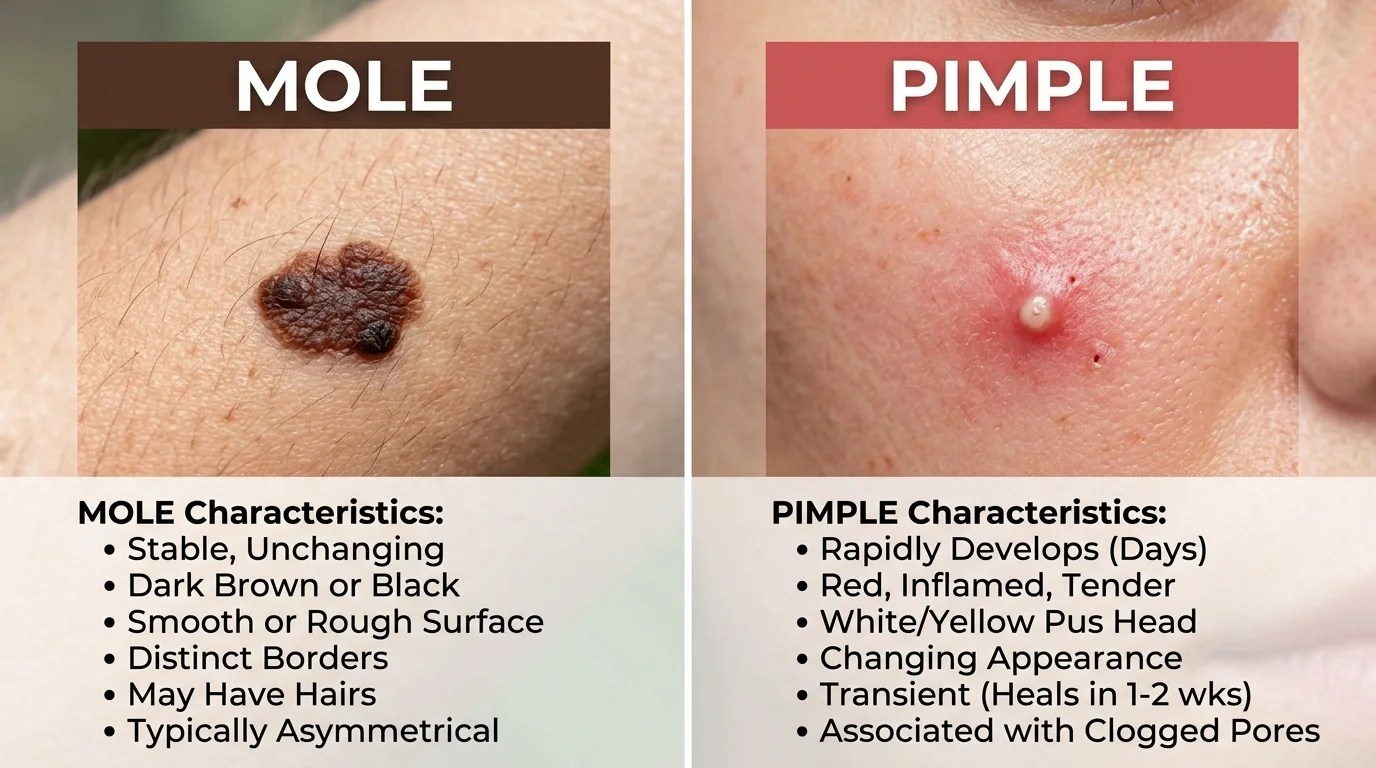
Quick Comparison: Mole or Pimple?
| Characteristic | Mole | Pimple |
|---|---|---|
| Usually persistent? | ✅ Yes | ❌ Usually temporary |
| Often red/inflamed? | ❌ Usually no | ✅ Often |
| May contain pus? | ❌ No | ✅ Sometimes |
| Can be flat? | ✅ Yes | Usually raised |
| Can be raised? | ✅ Yes | ✅ Yes |
| Usually painful? | ❌ No | Sometimes |
| Often changes within days? | ❌ No | ✅ Yes |
| Usually acne-related? | ❌ No | ✅ Yes |
| Can require professional evaluation? | ✅ If unusual/changing | ✅ If severe/persistent |