
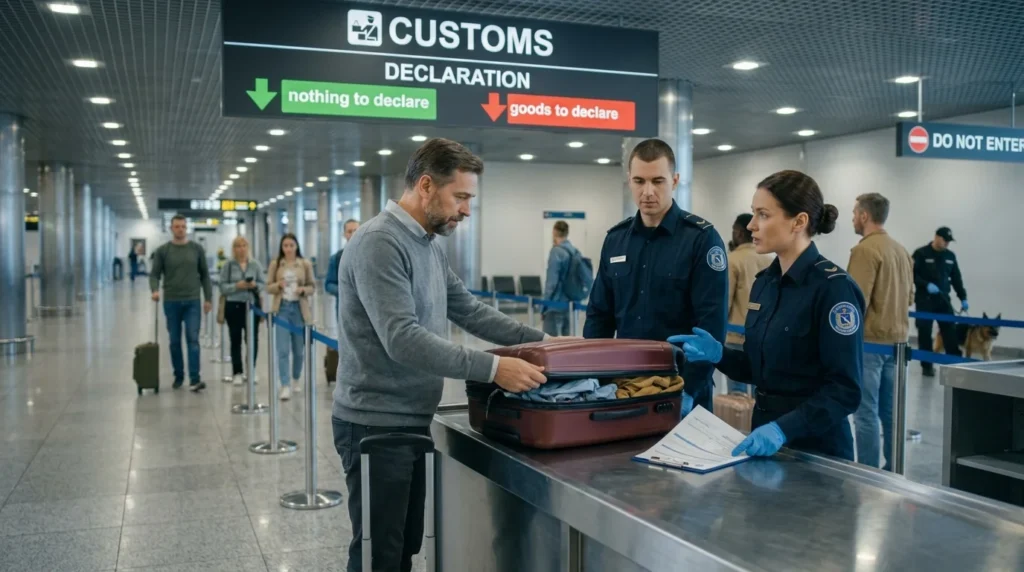
Quick Answer: Passport Control vs. Customs
Passport control is where officials verify:
- Your passport
- Visa (if required)
- Identity
- Permission to enter or leave a country
Customs is where officials check:
- Luggage
- Goods
- Food items
- Money declarations
- Restricted or taxable items
The easiest rule
Passport control checks people.
Customs checks things.
This simple rule works in almost every travel situation.
What Is Passport Control?
Passport control is the process where border or immigration officers verify your identity and your legal right to enter or leave a country.
Officials may check:
- Passport
- Visa
- Residence permit
- Travel documents
- Entry requirements
Examples
We waited in line at passport control.
The officer checked my passport and visa.
Passport control took about twenty minutes.
What Happens at Passport Control?
An officer may ask questions such as:
- Why are you visiting?
- How long will you stay?
- Where are you staying?
- What is the purpose of your trip?
After approval, your passport may be stamped or electronically recorded.
🎯 Key Insight: Passport control is about identity and permission to cross a border.
What Is Customs?
Customs is the government authority that controls goods entering or leaving a country.
Customs officers may inspect:
- Luggage
- Food
- Alcohol
- Tobacco
- Gifts
- Commercial goods
- Large amounts of money
- Restricted items
Examples
We went through customs after collecting our bags.
I declared expensive items at customs.
Customs officers inspected our luggage.
What Happens at Customs?
Travelers may need to:
- Declare goods
- Pay taxes or duties
- Report restricted items
- Answer questions about luggage
🎯 Key Insight: Customs is about items and goods, not personal identity.
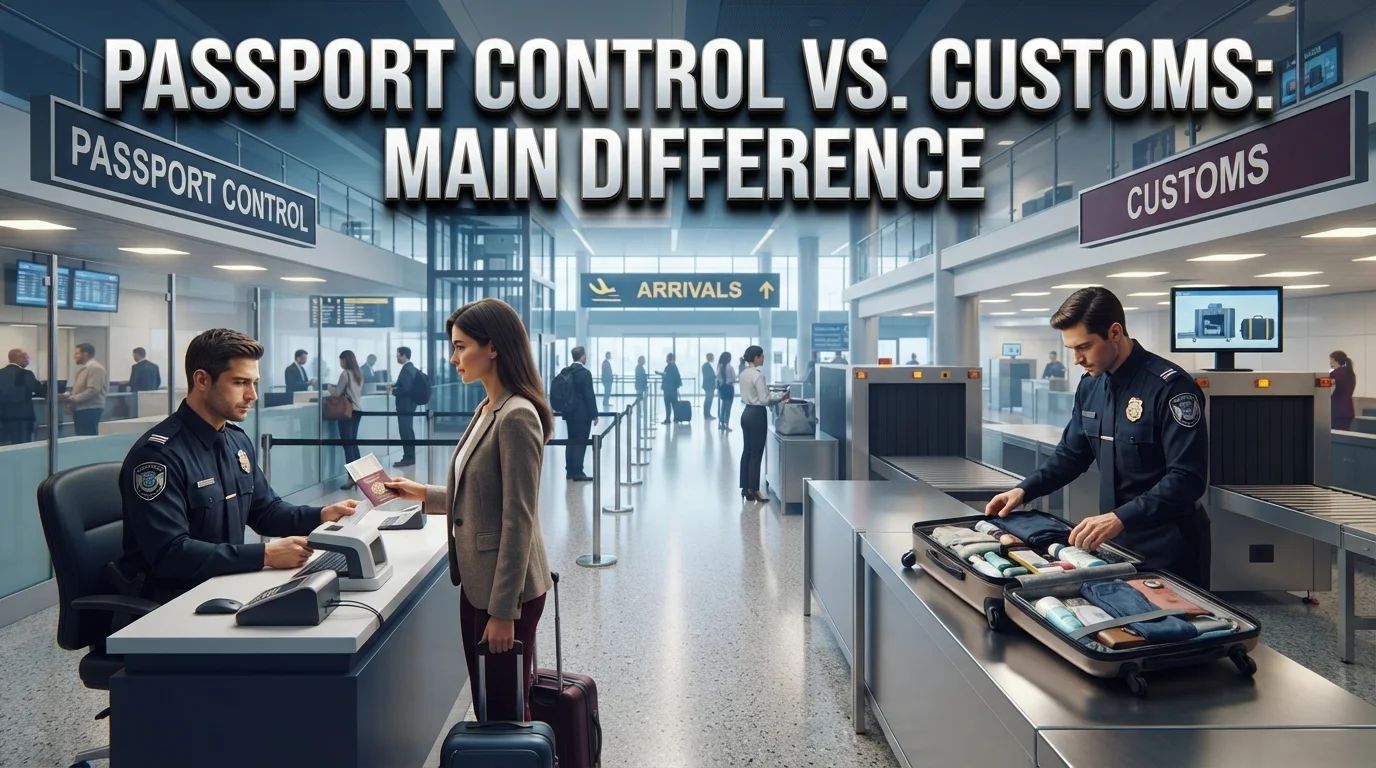
Passport Control vs. Customs: Main Difference
| Feature | Passport Control | Customs |
|---|---|---|
| Checks | People and documents | Goods and luggage |
| Main purpose | Verify identity and entry rights | Control imported/exported items |
| Officials | Immigration or border officers | Customs officers |
| Looks at | Passport, visa, identity | Bags, goods, declarations |
| Questions about | Travel plans | Items you are carrying |
| Example | Passport inspection | Luggage inspection |
Bottom Line
Passport control = person
Customs = possessions
Airport Arrival Process: Which Comes First?
The order can vary slightly by country, but for most international arrivals, the process is:
Step 1: Passport Control
Officials verify:
- Identity
- Passport
- Visa
- Entry permission
Step 2: Baggage Claim
Collect your checked luggage.
Step 3: Customs
Officials inspect goods and declarations.
Typical Flow
Plane → Passport Control → Baggage Claim → Customs → Exit
🎯 Lesson: You usually meet passport officers before customs officers.
Passport Control vs. Immigration
People often use these terms interchangeably.
Passport Control
The actual checkpoint where your documents are examined.
Immigration
The broader system governing entry and residence in a country.
Example:
I passed through passport control.
Immigration rules changed last year.
In many airports, signs may say:
- Immigration
- Passport Control
- Border Control
These often refer to the same area.
Customs vs. Security
Another common confusion is between customs and security.
Security
Checks for dangerous items before boarding a flight.
Examples:
- Scanners
- X-ray machines
- Metal detectors
Customs
Checks goods entering a country.
Examples:
- Imported items
- Food
- Declarations
Simple Difference
Security protects the flight.
Customs protects the country’s borders and economy.
Real-World Travel Examples
Example 1: Entering Another Country
I landed in France and went through passport control.
Officials checked:
- Passport
- Visa
- Entry requirements
Then:
I collected my luggage and passed through customs.
Officials checked goods.
🎯 Lesson: People first, luggage later.
Example 2: Carrying Food
You may pass passport control successfully but still face issues at customs if you carry prohibited food items.
🎯 Lesson: Customs focuses on what you bring.
Example 3: Visa Check
A visa is checked at:
✅ Passport control
Not usually at:
❌ Customs
Example 4: Duty-Free Purchases
Duty-free items may be examined at:
✅ Customs
Not at:
❌ Passport control
Common Mistakes
Mistake 1: Calling Customs “Passport Control”
❌ The customs officer stamped my passport.
Usually:
✅ The passport control officer stamped my passport.
Mistake 2: Thinking Customs Checks Visas
Customs officers usually focus on goods.
Passport officers focus on travel documents.
Mistake 3: Thinking Passport Control Checks Luggage
Normally:
- Passport control → documents
- Customs → luggage
Mistake 4: Confusing Security With Customs
Remember:
- Security = before boarding
- Customs = after arriving internationally
Passport Control vs. Customs Around the World
The names may vary:
Passport Control May Also Be Called:
- Immigration
- Border Control
- Entry Control
Customs May Also Be Called:
- Customs Inspection
- Customs Clearance
The function remains the same:
Passport control checks people.
Customs checks goods.
Memory Tricks
🛂 Trick 1: Passport = Person
Think:
Passport control → passport → person
🧳 Trick 2: Customs = Cargo
Think:
Customs → carrying things
⭐ One-Line Memory Trick
Passport control checks who you are.
Customs checks what you bring.
Expert Insight: Why Countries Have Both
Governments need two separate systems because they answer different questions:
Passport Control Asks:
Who are you?
Can you enter this country?
Customs Asks:
What are you bringing?
Is it legal?
Are taxes due?
A traveler may pass one check but have problems at the other.
For example:
- Valid passport ✅
- Prohibited goods ❌
Or:
- Allowed goods ✅
- Invalid visa ❌
This separation helps countries manage immigration, safety, trade, and public health.
Quick Test: Passport Control or Customs?
1. An officer checks your passport.
Answer: Passport control
2. An officer inspects your luggage.
Answer: Customs
3. You declare expensive goods.
Answer: Customs
4. Your visa is examined.
Answer: Passport control
5. Food restrictions are checked.
Answer: Customs
6. Identity is verified.
Answer: Passport control