
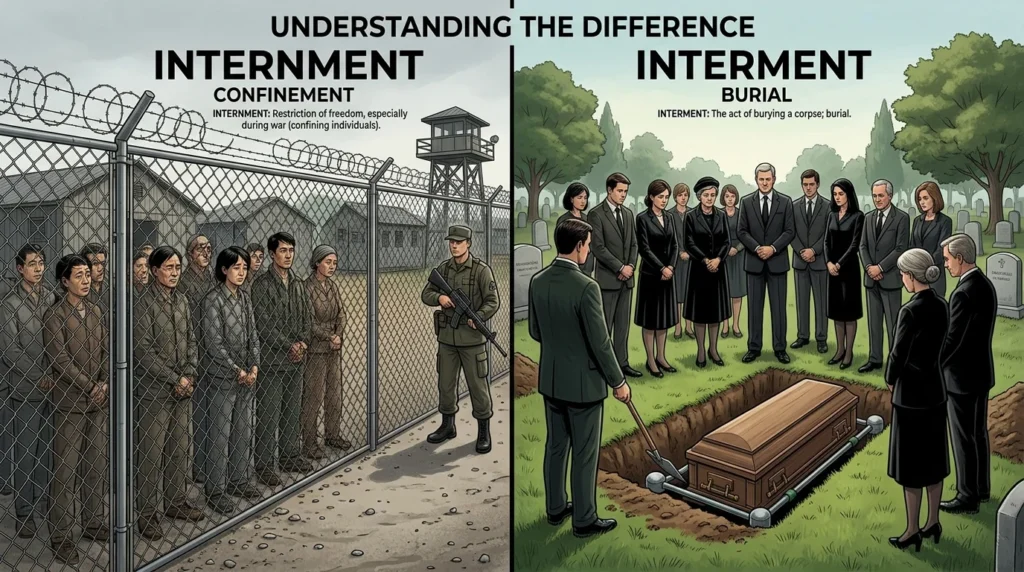
Quick Answer: Internment vs. Interment
Internment means the confinement or detention of people, particularly during wartime or periods of political conflict.
Thousands of civilians were subjected to internment during the war.
Interment means the act or ceremony of burying a dead person.
His interment took place at the family cemetery.
The easiest rule
Internment = confinement
Interment = burial
Memory trick
Internment has “intern” in it → think being held or confined.
Interment has “inter” → think putting someone into the earth.
What Does “Internment” Mean?
Internment is the act of detaining or confining people, often without a normal criminal trial, usually because of wartime, national-security, or political circumstances.
The people being confined may be considered:
- Enemy nationals
- Prisoners or detainees
- Civilians considered a security risk
- Political detainees
Examples
The government ordered the internment of enemy nationals during the war.
The historical museum documents the internment of civilians.
Many families suffered during the period of internment.
🎯 Key Insight: Internment is about keeping people in confinement.
What Does “Interment” Mean?
Interment is a formal word for the burial of a dead person.
It refers specifically to placing a person’s remains in a grave, tomb, or other final resting place.
Examples
The interment took place after the funeral service.
The family gathered for his interment.
Her interment was held in the family cemetery.
🎯 Key Insight: Interment is about burial after death.
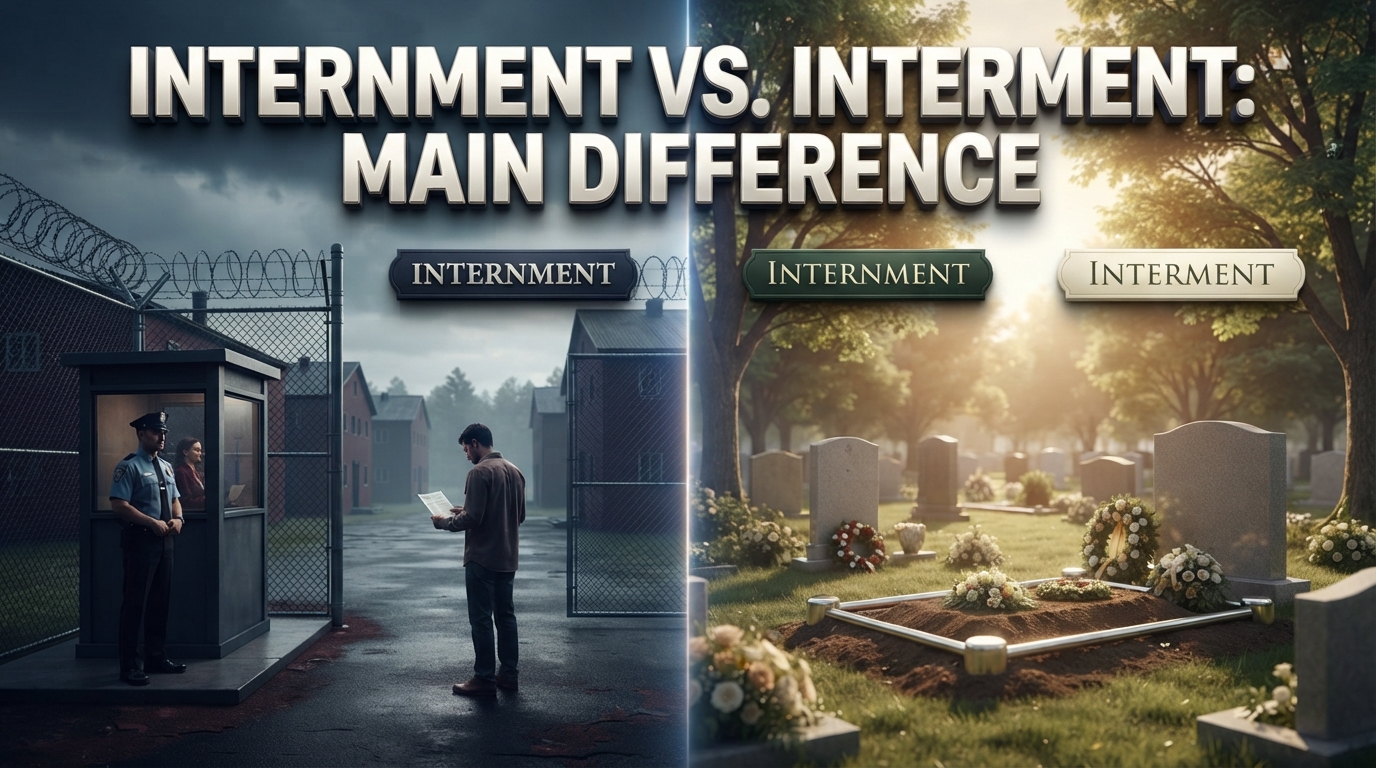
Internment vs. Interment: Main Difference
| Feature | Internment | Interment |
|---|---|---|
| Meaning | Confinement or detention | Burial of a dead person |
| Relates to | Living people | Deceased people |
| Common context | War, politics, national security | Funerals, cemeteries, death |
| Main action | Detaining/confining | Burying |
| Example | Internment of civilians | Interment of the deceased |
| Memory clue | Held | Buried |
Bottom Line
Internment = being confined.
Interment = being buried.
Changing just one letter completely changes the meaning.
Internment in Historical Context
Internment is frequently used when discussing wartime history.
Governments have sometimes detained groups of people because of their nationality, political status, or perceived security risk.
Example
The book examines the internment of Japanese Americans during World War II.
Here, internment refers to the forced confinement of people.
Another example:
The museum preserves documents from the internment camp.
The camp was a place where people were confined.
🎯 Lesson: When discussing detention or confinement, especially in historical or wartime contexts, use internment.
Interment in Funeral Contexts
Interment is a formal term used in connection with burial.
You may encounter it in:
- Funeral announcements
- Cemetery records
- Obituaries
- Death certificates
- Memorial services
- Genealogical records
Examples
Interment will follow the funeral service.
The interment ceremony was private.
The deceased was prepared for interment.
🎯 Lesson: When discussing burial, use interment.
Internment vs. Interment: Real-World Usage Scenarios
Scenario 1: Wartime Detention
The government established an internment camp during the conflict.
🎯 Lesson: People are being confined, so the word is internment.
Scenario 2: Burial
Interment followed the memorial service.
🎯 Lesson: A deceased person is being buried, so the word is interment.
Scenario 3: Historical Research
The historian studied records of wartime internment.
🎯 Lesson: Detention → internment.
Scenario 4: Cemetery Notice
Interment will take place at 2 p.m.
🎯 Lesson: Burial → interment.
Scenario 5: Confusing the Two
❌ The family attended the internment of their grandfather.
If you mean his burial, the correct word is:
✅ The family attended the interment of their grandfather.
🎯 Lesson: Interment is the funeral/burial word.
Common Mistakes With Internment and Interment
Mistake 1: Using “Internment” for Burial
❌ The interment was held at the cemetery.
Wait—this sentence is actually correct.
The mistake would be:
❌ The internment was held at the cemetery.
If you mean burial, use:
✅ The interment was held at the cemetery.
🎯 Why? Internment means confinement, not burial.
Mistake 2: Using “Interment” for Detention
❌ The prisoners experienced interment during the war.
If you mean confinement:
✅ The prisoners experienced internment during the war.
🎯 Why? Internment refers to detention.
Mistake 3: Thinking “Internment” Means Internship
The words look related because of intern, but they have nothing to do with a modern internship.
internment = confinement
internship = period of practical work experience
Don’t confuse the two.
Internment vs. Imprisonment
These words overlap but aren’t always identical.
Internment
Usually refers to detention or confinement, especially for political, wartime, or security reasons.
Imprisonment
Usually refers to confinement as a punishment for a crime, particularly in prison.
Compare
The civilians were subjected to internment during the war.
The criminal received a sentence of imprisonment.
🎯 Key Insight: Internment does not necessarily mean that the person has been convicted of a crime.
Interment vs. Burial
Interment and burial are very close in meaning.
The interment took place at the cemetery.
The burial took place at the cemetery.
However, interment is more formal.
Formal
Interment will follow the funeral.
Everyday
The burial will take place tomorrow.
🎯 Lesson: Interment = formal word for burial.
Memory Tricks: Internment vs. Interment
🧍 Trick 1: Internment = Interned Person
Think:
Internment → someone is being held.
A person is confined or detained.
⚰️ Trick 2: Interment = In the Earth
Think:
Interment → burial → earth
The deceased is placed in a final resting place.
⭐ One-Line Memory Trick
Internment = confinement.
Interment = burial.
Expert Insight: Why the Words Are Confused
The words are closely related in spelling and pronunciation, but their meanings developed along different paths.
Internment is related to the idea of interning someone, meaning detaining or confining them.
Interment comes from a term associated with burial.
The shared -ment ending makes both words look like nouns describing formal processes, while the difference between intern- and inter- is easy to overlook.
This is why proofreading is especially important in historical and funeral writing.
A single letter can completely change the meaning:
internment → detention
interment → burial
Quick Test: Internment or Interment?
1. The soldiers were held in an ________ camp.
Answer: internment
The camp was used for confinement.
2. The funeral service was followed by ________.
Answer: interment
The burial followed the service.
3. The museum documents the ________ of civilians during the war.
Answer: internment
The civilians were detained.
4. ________ will take place at the family cemetery.
Answer: Interment
The deceased will be buried.
5. The historian researched wartime ________.
Answer: internment
The subject is detention.
6. The family arranged the deceased’s ________.
Answer: interment
The family arranged the burial.