
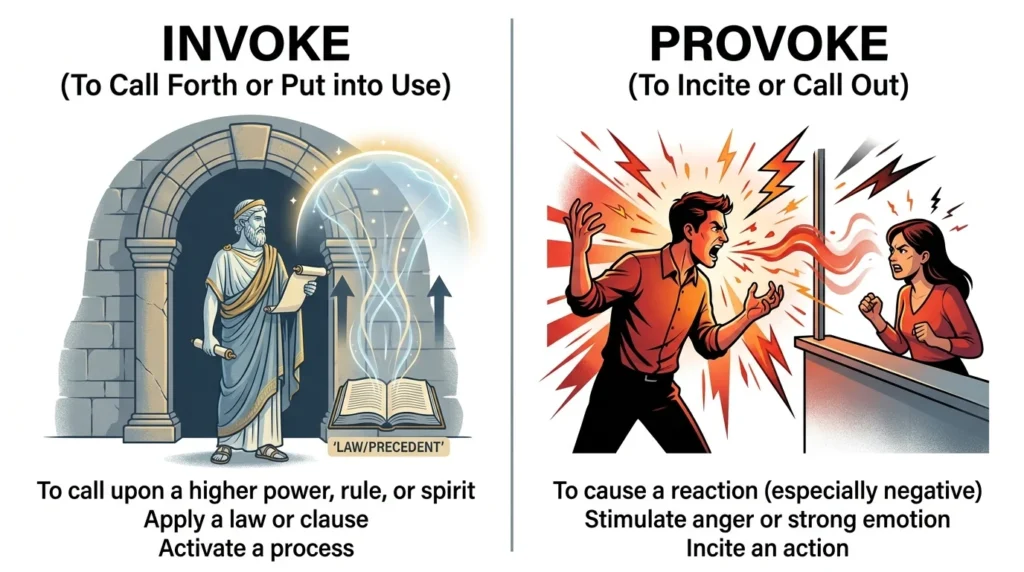
Quick Answer: Invoke vs. Provoke
Invoke means to call upon, appeal to, or bring something into use or effect.
She invoked her right to remain silent.
Provoke means to cause a reaction, especially anger or another strong emotion.
His remarks provoked an angry reaction.
The easiest rule
Invoke = call upon
Provoke = cause a reaction
Think:
INvoke → INvite something into action
PROvoke → PROduce a reaction
What Does “Invoke” Mean?
Invoke is a verb with several closely related meanings.
It can mean:
- To call upon a person, authority, principle, or power
- To appeal to a rule or law
- To put something into effect
- To mention something as support or justification
- To call forth a particular feeling, image, or idea
Example 1: Invoking a Right
The defendant invoked her right to remain silent.
Here, invoke means to formally exercise or rely on a right.
Example 2: Invoking a Law
The organization invoked the law to defend its position.
Here, invoke means to appeal to or cite the law as authority.
Example 3: Invoking an Image or Feeling
The painting invokes memories of childhood.
Here, invoke means to bring a feeling, memory, or idea to mind.
🎯 Key Insight: Invoke involves calling upon or bringing something forward, whether that thing is a rule, right, authority, memory, emotion, or idea.
What Does “Provoke” Mean?
Provoke means to cause something to happen, especially a reaction.
It is frequently associated with:
- Anger
- Irritation
- Arguments
- Emotional reactions
- Responses
- Thought
- Discussion
- Action
Example 1: Causing Anger
His rude comments provoked her anger.
Here, provoke means caused the anger.
Example 2: Causing a Reaction
The announcement provoked a strong reaction.
The announcement caused people to react strongly.
Example 3: Deliberately Irritating Someone
He kept teasing his brother to provoke him.
Here, provoke means deliberately trying to make someone react.
🎯 Key Insight: Provoke focuses on causing a reaction or response.
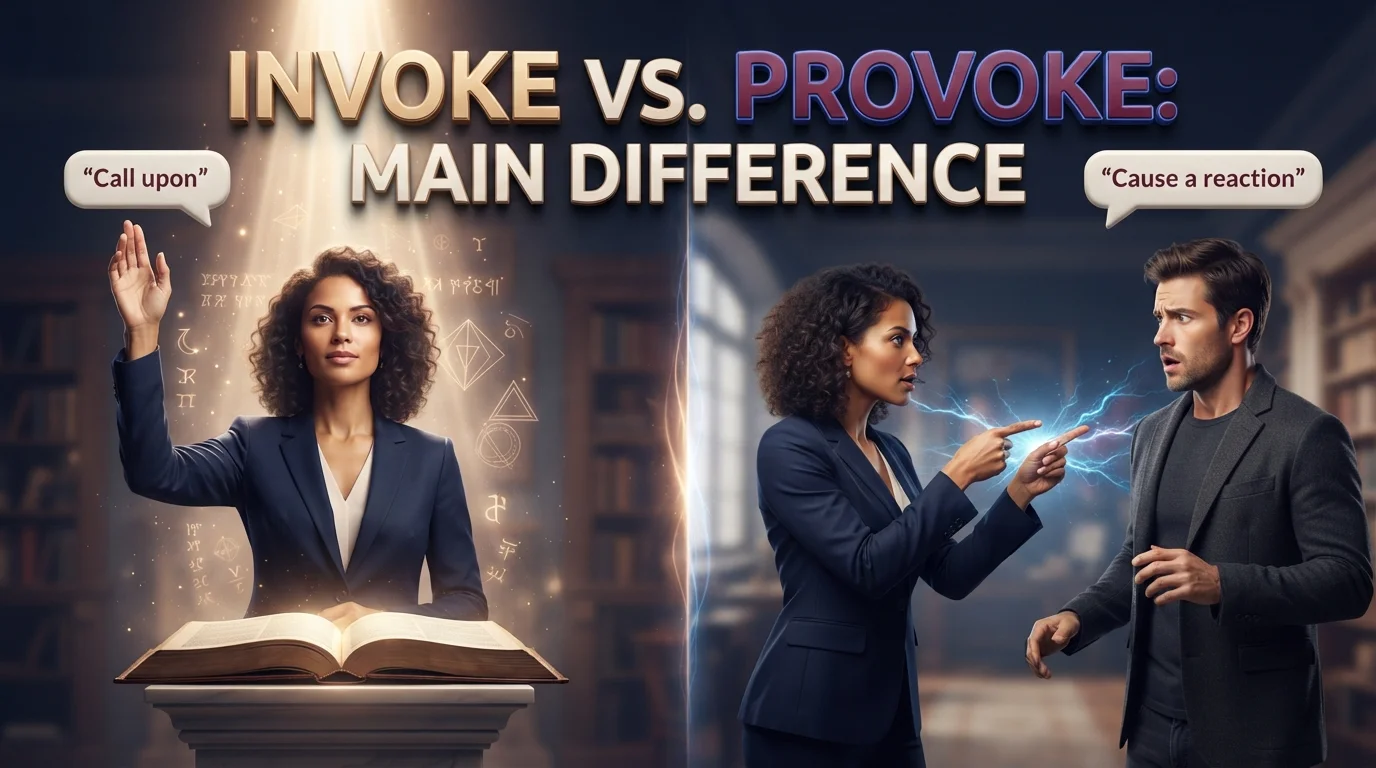
Invoke vs. Provoke: Main Difference
| Feature | Invoke | Provoke |
|---|---|---|
| Basic meaning | Call upon, appeal to, or bring into effect | Cause a reaction |
| Main idea | Calling something forth or relying on it | Triggering a response |
| Common objects | Laws, rights, authority, memories, principles | Anger, reactions, debate, conflict |
| Typical tone | Formal | Neutral to negative, depending on context |
| Example | She invoked her legal rights. | His remarks provoked anger. |
| Memory clue | Call upon | Cause a reaction |
Bottom Line
Invoke = call upon something.
Provoke = cause a reaction.
Invoke in Different Contexts
Invoking a Right
The employee invoked her right to privacy.
Meaning:
She formally relied on or exercised that right.
Invoking Authority
The official invoked his authority to stop the event.
Meaning:
He relied on his authority to take action.
Invoking a Rule
The referee invoked the rules to explain the decision.
Meaning:
The referee appealed to the rules.
Invoking a Memory
The song invoked memories of his childhood.
Meaning:
The song brought those memories to mind.
Invoking a Law
The company invoked the contract’s termination clause.
Meaning:
The company relied on that contractual provision.
🎯 Lesson: Invoke is often about bringing something into consideration, use, or effect.
Provoke in Different Contexts
Provoking Anger
His behavior provoked anger among the employees.
Meaning:
His behavior caused them to become angry.
Provoking a Reaction
The decision provoked a strong public reaction.
Meaning:
The decision caused people to react strongly.
Provoking a Debate
The article provoked an important debate.
Meaning:
The article caused people to discuss the issue.
Provoking Someone
Don’t provoke him.
Meaning:
Don’t deliberately make him angry or cause him to react.
Provoking Thought
The documentary provoked serious thought about the issue.
This demonstrates that provoke isn’t always negative.
It can mean stimulate or cause a response or mental activity.
🎯 Lesson: Provoke is broader than simply “make someone angry”; it means cause or stimulate a reaction.
Invoke vs. Provoke: Real-World Usage Scenarios
Scenario 1: Legal Rights
A: Why didn’t she answer the question?
B: She invoked her right to remain silent.
🎯 Lesson: Use invoke when someone formally relies on a right, law, rule, or authority.
Scenario 2: An Angry Reaction
A: Why was everyone upset?
B: His comments provoked an angry reaction.
🎯 Lesson: Use provoke when something causes a reaction.
Scenario 3: A Memory
A: Why does this song remind you of school?
B: It invokes memories of my childhood.
🎯 Lesson: Invoke can mean bring a memory, feeling, or image to mind.
Scenario 4: Deliberate Irritation
A: Why did you argue with him?
B: He was trying to provoke me.
🎯 Lesson: Provoke can mean deliberately trying to make someone react.
Scenario 5: A Debate
A: Why did the speech become controversial?
B: It provoked a heated debate.
🎯 Lesson: Provoke can describe something that stimulates discussion or debate, not just anger.
Invoke vs. Provoke in Legal English
The distinction is especially important in legal writing.
Invoke
Legal texts frequently use invoke with:
- Rights
- Laws
- Rules
- Clauses
- Privileges
- Powers
- Constitutional protections
Examples:
The defendant invoked her right to counsel.
The company invoked the arbitration clause.
The government invoked emergency powers.
In each case, something is being called upon or formally relied upon.
Provoke
Legal writing may use provoke when describing a reaction:
The statement provoked a legal dispute.
The incident provoked public criticism.
Here, something caused a response.
🎯 Key Insight: If you can replace the word with “appeal to” or “call upon,” use invoke. If you can replace it with “cause” or “trigger,” use provoke.
Invoke vs. Provoke: A Simple Substitution Test
This is one of the easiest ways to choose correctly.
If “call upon” works → INVOKE
She invoked her right to remain silent.
Try:
She called upon her right to remain silent.
The idea works.
If “cause” or “trigger” works → PROVOKE
His words provoked anger.
Try:
His words caused anger.
The meaning works.
Quick Formula
Invoke = call upon / appeal to
Provoke = cause / trigger / stimulate
Invoke vs. Provoke: Meaning, Synonyms, Examples, and Differences
Invoke vs Provoke Meaning
Invoke and provoke are verbs, but they describe different actions. Invoke means to call upon something, appeal to something, or put a rule, authority, or power into effect. Provoke means to cause a reaction, especially anger, annoyance, or a strong response.
Although both words can involve causing something to happen, they are not interchangeable in most situations.
What Does Invoke Mean?
Invoke means to call upon, appeal to, refer to, or use something as a source of authority, support, or inspiration. It is often used in legal, formal, religious, and technical contexts.
Examples:
The lawyer invoked the constitutional right to free speech.
She invoked her manager’s authority to resolve the dispute.
The speaker invoked the memory of past sacrifices.
The company invoked a clause in the contract.
The ceremony began when the priest invoked a blessing.
In each sentence, invoke refers to calling upon, appealing to, or putting something into use.
What Does Provoke Mean?
Provoke means to cause someone to react or to bring about a feeling, action, or response. It frequently describes anger or irritation, but it can also refer to curiosity, thought, laughter, or discussion.
Examples:
His rude remarks provoked an angry response.
The teacher asked a question designed to provoke thought.
The unfair decision provoked protests.
Her unusual artwork provoked curiosity.
The constant teasing provoked him into arguing.
In these examples, provoke describes something that triggers a reaction.
Invoke vs. Provoke: Key Differences
| Feature | Invoke | Provoke |
|---|---|---|
| Main meaning | Call upon, appeal to, or use | Cause or trigger a reaction |
| Common objects | A law, right, authority, name, memory, or blessing | Anger, curiosity, debate, laughter, or a response |
| Typical context | Legal, formal, religious, technical | Emotional, social, behavioral, or intellectual |
| Example | She invoked her legal rights. | His comments provoked an argument. |
Easy way to remember: You invoke a law or authority; you provoke a reaction.
Invoke vs Provoke Synonym
Invoke and provoke have different meanings, so their synonyms also differ. Some words may overlap in particular contexts, but they cannot replace one another in every sentence.
Synonyms of Invoke
Depending on the context, synonyms for invoke include:
Call upon: to ask for help or support.
Appeal to: to refer to a source of authority or assistance.
Cite: to mention a rule, law, or example as support.
Refer to: to mention or bring something into discussion.
Summon: to call someone or something to appear.
Evoke: to bring a feeling, memory, or image to mind.
Use: to put something into operation or practice.
Examples:
The lawyer cited the relevant law.
She appealed to the committee for support.
The poem evoked memories of childhood.
These alternatives are context-dependent. For example, cite may replace invoke when referring to a legal rule, but it does not work naturally in every sentence involving a blessing or authority.
Synonyms of Provoke
Depending on the context, synonyms for provoke include:
Trigger: to cause a reaction or event.
Incite: to encourage or stir up an action, often a strong or harmful one.
Irritate: to annoy or bother someone.
Agitate: to disturb or make someone anxious or upset.
Antagonize: to make someone hostile or angry.
Elicit: to draw out a response or reaction.
Stimulate: to encourage activity, thought, or interest.
Arouse: to awaken a feeling, interest, or response.
Prompt: to cause or encourage an action.
Examples:
His behavior irritated his coworkers.
The announcement triggered a public debate.
The question elicited several thoughtful answers.
The speech incited the crowd to protest.
Important distinction: Irritate usually involves annoyance, while provoke can cause many kinds of reactions. Elicit is often more neutral and emphasizes drawing out a response.
Provoke vs. Evoke vs. Invoke
Provoke, evoke, and invoke sound similar, but each has a distinct meaning.
Provoke: to cause or trigger a reaction.
Evoke: to bring a feeling, memory, image, or association to mind.
Invoke: to call upon, appeal to, or use something as authority, support, or inspiration.
Provoke Examples
Provoke emphasizes causing a reaction or response.
His behavior provoked anger.
The question provoked a lively discussion.
The film provoked strong reactions from viewers.
Evoke Examples
Evoke emphasizes bringing something to mind or making someone experience a feeling.
The photograph evoked memories of childhood.
The music evoked a feeling of peace.
The smell of fresh bread evoked memories of her grandmother’s kitchen.
Invoke Examples
Invoke emphasizes calling upon or appealing to something.
The lawyer invoked the right to remain silent.
The speaker invoked the nation’s founding principles.
The ceremony invoked a sense of tradition through its formal rituals.
Comparison Table
| Word | What it does | Example |
|---|---|---|
| Provoke | Causes a reaction | The comment provoked anger. |
| Evoke | Brings a feeling or memory to mind | The song evoked sadness. |
| Invoke | Calls upon or appeals to something | She invoked the law. |
Can These Words Be Used Interchangeably?
Usually, no.
Compare these sentences:
The painting provoked controversy. This means it caused controversy.
The painting evoked memories. This means it brought memories to mind.
The artist invoked a famous myth. This means the artist referred to or drew upon the myth.
A useful memory trick is:
Provoke = cause. Evoke = bring to mind. Invoke = call upon.
Evoke vs Invoke Meaning
Evoke and invoke are closely related because both can involve bringing something into a situation, but their meanings differ.
What Does Evoke Mean?
Evoke means to bring a feeling, memory, image, idea, or response to mind. It often describes the effect of music, art, language, smells, places, or experiences.
Examples:
The old photograph evoked happy memories.
Her words evoked sympathy from the audience.
The novel evokes the atmosphere of a small coastal town.
The scent of pine evokes the feeling of winter holidays.
His speech evoked a sense of hope.
What Does Invoke Mean?
Invoke means to call upon, appeal to, refer to, or put something into effect. It often appears when someone refers to a law, principle, authority, name, or power.
Examples:
The defendant invoked the right to remain silent.
The manager invoked the company’s safety policy.
The speaker invoked the courage of earlier generations.
The organization invoked an emergency procedure.
Evoke vs. Invoke: Side-by-Side
| Evoke | Invoke |
|---|---|
| Bring something to mind or stir up a feeling | Call upon or appeal to something |
| The song evoked nostalgia. | The lawyer invoked the law. |
| The painting evoked a sense of loneliness. | The speaker invoked a historical figure’s name. |
| The smell evoked childhood memories. | The official invoked emergency powers. |
Quick tip: If something reminds you of a feeling or memory, use evoke. If someone calls upon a rule, authority, principle, or source of support, use invoke.
Provoke Meaning
Provoke means to cause, trigger, or bring about a reaction. It often refers to anger or irritation, but it can also describe a response such as curiosity, laughter, thought, or debate.
Provoke as a Verb
Provoke is a transitive verb, meaning it commonly takes an object—the person, feeling, or reaction being affected.
Examples:
His insult provoked an argument.
The advertisement provoked public criticism.
The teacher’s question provoked serious thought.
Her performance provoked laughter throughout the room.
The sudden change provoked anxiety among employees.
Common Uses of Provoke
Provoke anger: to make someone angry.
Example: His repeated interruptions provoked the audience.
Provoke a reaction: to cause someone to respond.
Example: The announcement provoked an immediate reaction.
Provoke thought: to encourage careful thinking.
Example: The documentary provoked thought about environmental responsibility.
Provoke debate: to cause people to discuss or disagree about an issue.
Example: The new policy provoked debate among residents.
Provoke someone into doing something: to cause someone to take an action, often through pressure or irritation.
Example: His taunts provoked her into responding.
Is Provoke Always Negative?
No. Although provoke often has a negative association with anger or conflict, it can describe positive or neutral outcomes.
The book provoked a useful discussion.
Her question provoked an interesting idea.
The performance provoked laughter.
The surrounding words and context determine whether the reaction is positive, negative, or neutral.
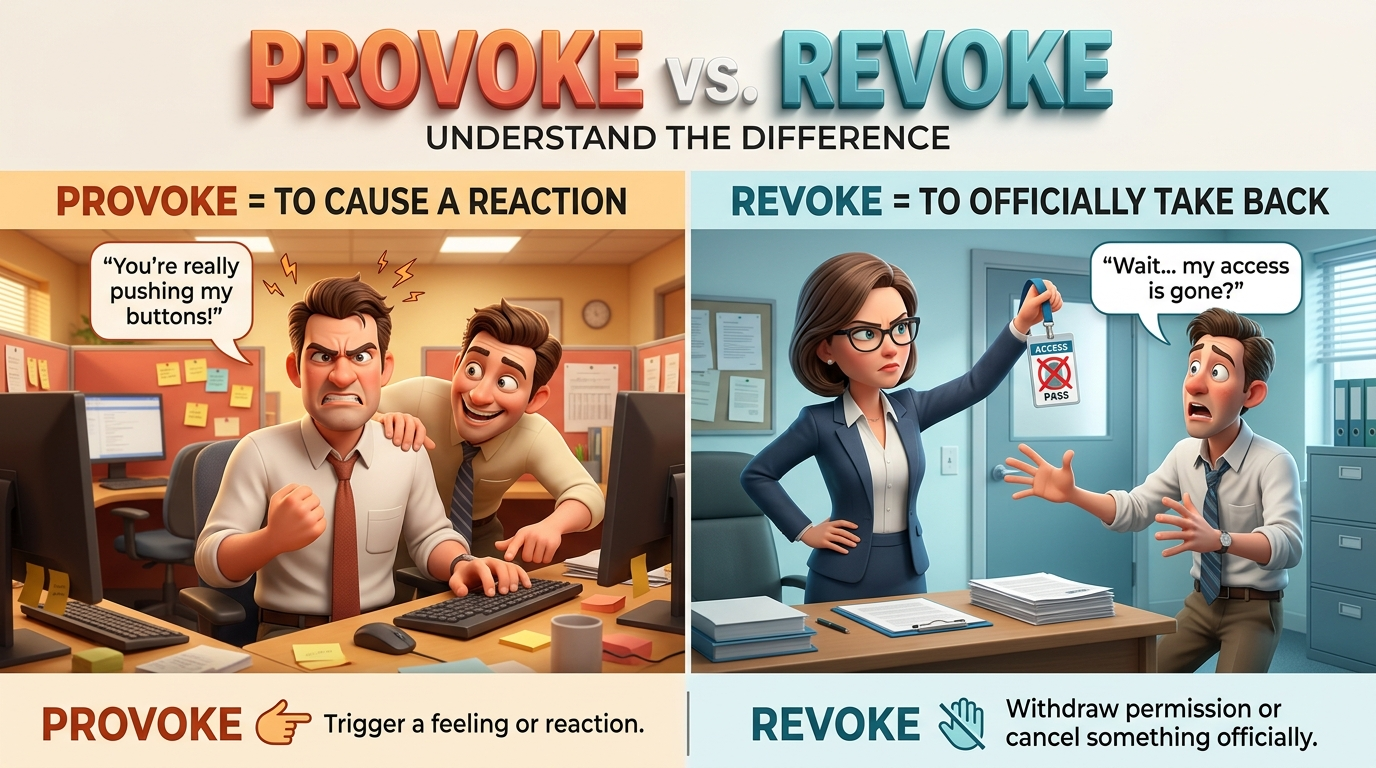
Provoke vs Revoke
Provoke and revoke differ in both meaning and usage. Provoke means to cause a reaction, while revoke means to officially cancel, withdraw, or take back something previously granted.
What Does Revoke Mean?
Revoke means to withdraw or cancel a decision, permission, license, privilege, or official authorization.
Examples:
The agency revoked his driver’s license.
The company revoked the employee’s access to confidential files.
The school revoked the student’s permission to leave campus.
The government revoked the permit.
The organization revoked its earlier invitation.
Provoke vs. Revoke: Comparison
| Feature | Provoke | Revoke |
|---|---|---|
| Meaning | Cause a reaction | Cancel or withdraw something |
| Common objects | Anger, debate, thought, reaction | License, permission, access, decision |
| Example | His comment provoked an argument. | The agency revoked his license. |
| Memory clue | Provoke a response | Revoke permission |
Provoke vs. Revoke in Sentences
The unfair rule provoked complaints from parents.
The school revoked the rule after reviewing the complaints.
The first sentence describes causing a reaction. The second describes officially withdrawing something.
Easy way to remember: You provoke a response, but revoke a permission or decision.
Invoke Provoke Evoke Cirque du Soleil
Invoke, Provoke, and Evoke are English verbs with different meanings. In discussions about Cirque du Soleil, they can describe different aspects of a theatrical performance, depending on the context.
Cirque du Soleil is known for theatrical circus productions that combine acrobatics, music, movement, costumes, and visual storytelling. The three words can be used to describe different effects such a performance may have.
Invoke in a Performance Context
Invoke can describe calling upon a theme, tradition, myth, or symbolic idea.
Example: The production invokes the imagery of ancient mythology through its costumes and stage design.
Meaning: The show draws on or refers to mythological ideas.
Provoke in a Performance Context
Provoke can describe causing an emotional or intellectual response in the audience.
Example: A daring acrobatic sequence may provoke excitement and suspense.
Meaning: The performance causes the audience to feel excitement or suspense.
Evoke in a Performance Context
Evoke can describe bringing a feeling, memory, atmosphere, or image to mind.
Example: The lighting and music evoke a dreamlike atmosphere.
Meaning: The combination of lighting and music creates or brings to mind a particular mood.
Quick Comparison
Invoke: The show invokes images of a mythical world.
Provoke: The acrobatics provoke excitement.
Evoke: The music evokes wonder.
These are illustrative examples of how the verbs can be used when discussing a performance. They are not claims about the official titles, plot, or specific scenes of a particular Cirque du Soleil production.
Provoke Synonym
The best synonym for provoke depends on what kind of reaction is being caused. No single synonym fits every context.
Common Synonyms for Provoke
| Synonym | Meaning | Example |
|---|---|---|
| Trigger | Cause a reaction or event | The news triggered widespread concern. |
| Incite | Stir up or encourage action | The speech incited protests. |
| Irritate | Annoy someone | The constant noise irritated him. |
| Antagonize | Make someone hostile | His sarcastic remarks antagonized his colleagues. |
| Agitate | Disturb or upset | The sudden change agitated the crowd. |
| Elicit | Draw out a response | The question elicited an honest answer. |
| Stimulate | Encourage activity or thought | The lecture stimulated discussion. |
| Arouse | Awaken a feeling or interest | The story aroused curiosity. |
| Prompt | Cause or encourage an action | The reminder prompted her to respond. |
| Instigate | Start or bring about an event, often conflict | The argument instigated a formal investigation. |
Provoke Synonyms in Different Contexts
When provoke means to make someone angry:
Irritate
Antagonize
Anger
Enrage
Aggravate
Example: His rude behavior angered the customers.
When provoke means to cause a response:
Trigger
Elicit
Prompt
Generate
Produce
Example: The announcement triggered a wave of questions.
When provoke means to encourage thought or discussion:
Stimulate
Inspire
Encourage
Spark
Generate
Example: The article sparked a debate about education.
When provoke means to stir up conflict or action:
Incite
Instigate
Stir up
Agitate
Example: The inflammatory statement incited a heated argument.
Antonyms of Provoke
Depending on the intended meaning, antonyms may include:
Calm: make someone feel peaceful.
Soothe: reduce distress or anger.
Pacify: calm someone who is upset or angry.
Prevent: stop something from happening.
Deter: discourage an action.
Example: Instead of provoking an angry response, the mediator tried to calm both sides.
Common Mistakes With Invoke and Provoke
Mistake 1: “He Provoked His Right”
❌ He provoked his right to remain silent.
Correct:
✅ He invoked his right to remain silent.
🎯 Why? A right is something you invoke, not something you provoke.
Mistake 2: “Her Comments Invoked Anger”
This sentence isn’t necessarily impossible, but it is usually the wrong word if you mean that her comments caused anger.
Better:
✅ Her comments provoked anger.
🎯 Why? The comments caused the anger.
Mistake 3: “The Law Provoked”
❌ The lawyer provoked the law.
Correct:
✅ The lawyer invoked the law.
The lawyer is appealing to or relying on the law.
Mistake 4: Thinking “Provoke” Always Means Anger
Not necessarily.
You can provoke:
- A reaction
- A response
- A debate
- Thought
- Discussion
- Curiosity
- Opposition
For example:
The question provoked considerable thought.
So provoke means more broadly cause or stimulate a response.
Invoke vs. Evoke vs. Provoke
A third word often causes confusion: evoke.
Invoke
Call upon or appeal to
The lawyer invoked the law.
Evoke
Bring a feeling, memory, image, or response to mind
The photograph evoked memories of childhood.
Provoke
Cause or stimulate a reaction
The speech provoked an angry response.
Simple Comparison
| Word | Core Idea | Example |
|---|---|---|
| Invoke | Call upon | She invoked her rights. |
| Evoke | Bring to mind | The smell evoked memories. |
| Provoke | Cause a reaction | His words provoked anger. |
🎯 Memory Trick:
Invoke = call upon
Evoke = bring to mind
Provoke = cause a reaction
Memory Tricks: Invoke vs. Provoke
🧠 Trick 1: “Invoke” = Invite In
Think:
INvoke → invite something in
You’re calling upon or bringing something into use.
invoke a law
invoke a right
🔥 Trick 2: “Provoke” = Produce a Reaction
Think:
PROvoke → produce a reaction
provoke anger
provoke debate
provoke a response
⭐ One-Line Memory Trick
Invoke something; provoke someone or a reaction.
This isn’t an absolute grammar rule, but it’s an excellent memory aid.
Expert Insight: The Shared “-voke” Root
The similarity between invoke, provoke, and evoke isn’t accidental.
They are related through the Latin root vocare, meaning “to call.”
The prefixes change the direction or sense of that calling.
- invoke → call upon
- provoke → call forth or bring about
- evoke → call out/from and bring to mind
This explains why the words look similar while developing distinct meanings in modern English.
Understanding the underlying concept of “calling forth” can make the vocabulary much easier to remember.
Quick Test: Invoke or Provoke?
1. The lawyer ________ the client’s constitutional rights.
Answer: invoked
The lawyer called upon/referred to the rights.
2. His comments ________ an angry response.
Answer: provoked
His comments caused the response.
3. The photograph ________ memories of her childhood.
Answer: invoked can be used, but evoked is generally more natural for this meaning.
4. The company ________ the contract’s arbitration clause.
Answer: invoked
The company relied on the clause.
5. The controversial decision ________ widespread criticism.
Answer: provoked
The decision caused the criticism.
6. The official ________ emergency powers.
Answer: invoked
The official called upon or exercised those powers.