
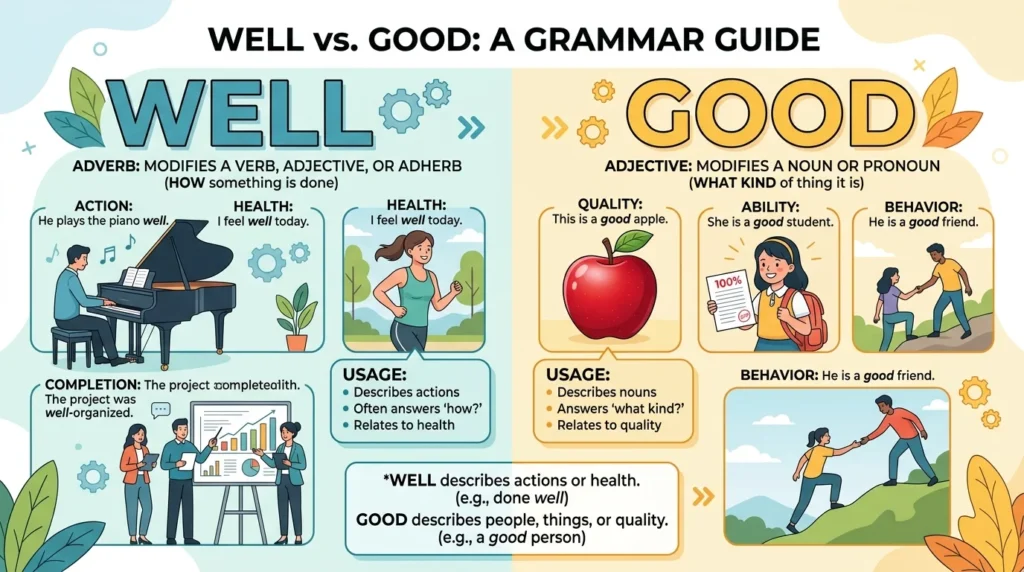
Quick Answer: Well vs. Good
Good usually describes a noun or pronoun.
He is a good student.
Well usually describes a verb or action.
He studies well.
The easiest rule
Good = adjective → describes a person or thing
Well = adverb → describes an action
Think:
She is good.
She sings well.
What Does “Good” Mean?
Good is primarily an adjective. It describes a person, place, thing, situation, or idea as being positive, satisfactory, suitable, skillful, or of high quality.
Examples of “Good”
She is a good teacher.
That was a good movie.
He is a good driver.
We had a good time.
This is a good idea.
In each sentence, good describes a noun or pronoun.
Good Before a Noun
One of the easiest ways to recognize good is when it appears directly before a noun.
a good book
a good student
a good meal
a good decision
a good opportunity
🎯 Key Insight: When you’re describing what someone or something is like, good is usually the right choice.
What Does “Well” Mean?
Well is primarily an adverb. It describes how an action is performed.
Examples of “Well”
She sings well.
He drives well.
They worked well together.
You explained the topic well.
The machine works well.
In these examples, well tells us how an action happens.
Well With Verbs
Look at the difference:
He is a good writer.
Here, good describes the person as a writer.
He writes well.
Here, well describes how he writes.
🎯 Key Insight: If you’re describing how an action is performed, well is usually the correct word.
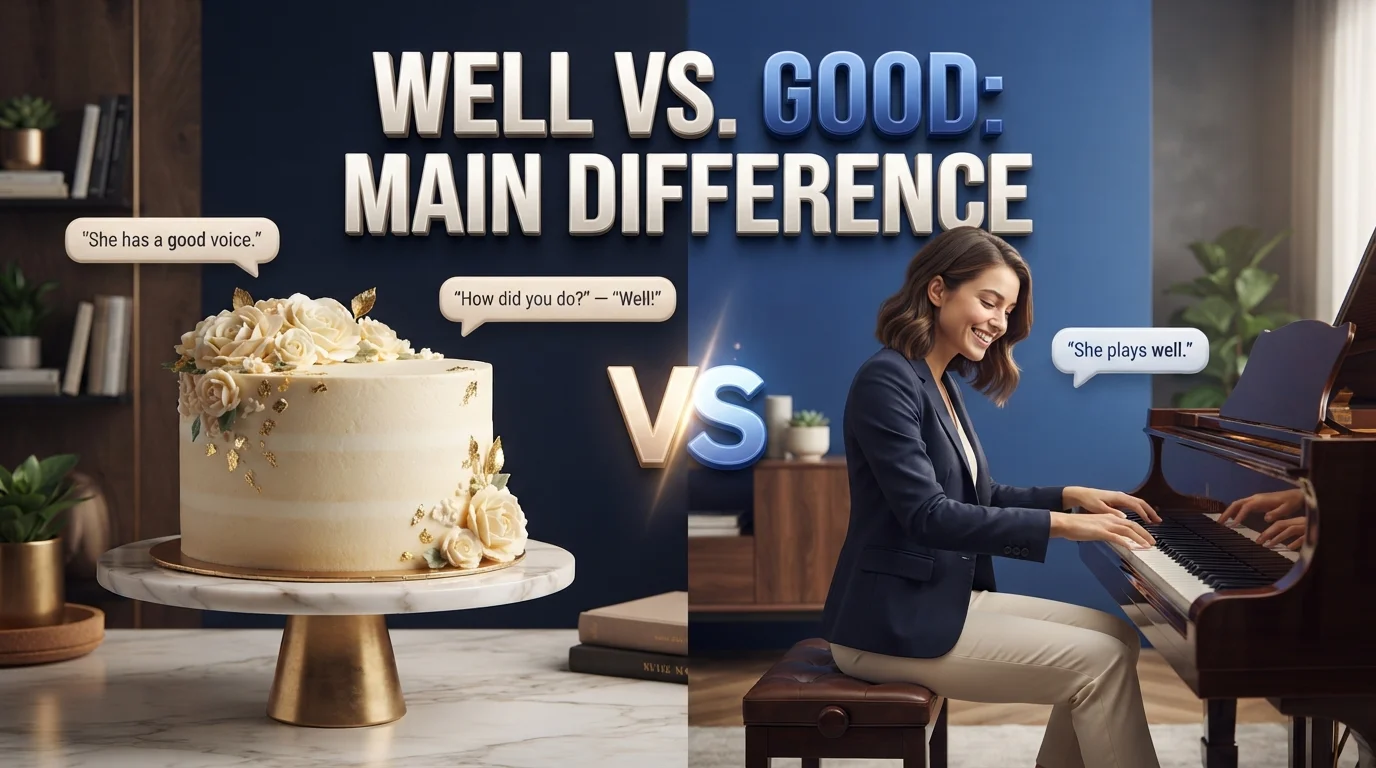
Well vs. Good: Main Difference
| Feature | Good | Well |
|---|---|---|
| Typical part of speech | Adjective | Adverb |
| Usually describes | Noun/pronoun | Verb/action |
| Example | She is a good singer. | She sings well. |
| Question it answers | What is it like? | How is it done? |
| Common use | Quality/character | Manner/performance |
| Memory clue | Person or thing | Action |
Compare
He is a good cook.
Good describes him.
He cooks well.
Well describes how he cooks.
This is the central distinction to remember.
Good vs. Well With Linking Verbs
This is where the rule becomes slightly more complicated.
After certain linking verbs, we normally use an adjective, so good can be correct even when there isn’t a noun immediately after it.
Common linking verbs include:
- be
- seem
- appear
- feel
- look
- smell
- taste
- sound
- become
Examples
You look good.
The food smells good.
That sounds good.
The cake tastes good.
She feels good.
Here, good describes the subject or its condition.
Why Not “Well”?
Because these verbs can function as linking verbs rather than action verbs.
Compare:
She looks good.
= Her appearance is good.
She looks well.
This can mean that she appears healthy, though it is less common in some varieties of everyday English.
🎯 Key Insight: After a linking verb, good is often the appropriate adjective.
“I Feel Good” vs. “I Feel Well”
This is one of the most famous well vs. good distinctions.
“I feel good.”
This usually means:
I feel happy, positive, or emotionally good.
Example:
I feel good about my decision.
“I feel well.”
This usually means:
I feel healthy or physically fine.
Example:
I feel well after recovering from the flu.
However, in everyday conversation, many native speakers use I feel good when they simply mean they feel fine.
🎯 Lesson: Feel good can describe emotional or general well-being; feel well traditionally emphasizes physical health.
“I Am Good” vs. “I Am Well”
Both can be correct, but they can communicate different things.
I am good.
This can mean:
- I am fine.
- I don’t need anything.
- I am morally good.
- I am capable or competent, depending on context.
For example:
No, thank you. I’m good.
This means:
I don’t need anything.
I am well.
This traditionally means:
I am healthy or in good health.
For example:
After a few days of rest, I am well again.
In casual American English, I’m good is extremely common as a response to How are you?
“How Are You?” — Good or Well?
Both are heard in English.
I’m good, thanks.
This is very common in everyday conversation.
I’m well, thanks.
This is also correct and can sound slightly more formal or traditional.
You may also hear:
I’m doing well.
This is especially useful because well correctly functions as an adverb modifying doing.
🎯 Best formal-safe response:
I’m doing well, thank you.
Good vs. Well in Real-World Usage
Scenario 1: Talking About a Student
She is a good student.
🎯 Lesson: Good describes the student.
But:
She studies well.
🎯 Lesson: Well describes how she studies.
Scenario 2: Talking About Cooking
He is a good cook.
🎯 Lesson: Good describes his ability or identity as a cook.
He cooks well.
🎯 Lesson: Well describes his cooking performance.
Scenario 3: Talking About a Movie
That is a good movie.
🎯 Lesson: The movie has good quality.
The actors performed well.
🎯 Lesson: Well describes the actors’ performance.
Scenario 4: Talking About Music
She is a good singer.
🎯 Lesson: Good describes the singer.
She sings well.
🎯 Lesson: Well describes the singing.
Scenario 5: Talking About Health
I don’t feel well.
🎯 Lesson: Here, well commonly means physically healthy or not sick.
Common Mistakes With Well and Good
Mistake 1: “She Sings Good”
❌ She sings good.
In standard formal English:
✅ She sings well.
Why?
Sings is a verb, and well describes how she sings.
She sings well.
Mistake 2: “He Is a Well Student”
❌ He is a well student.
✅ He is a good student.
Student is a noun, so you need the adjective good.
Mistake 3: “She Is a Well Singer”
❌ She is a well singer.
✅ She is a good singer.
But:
She sings well.
🎯 Remember: good singer, but sings well.
Mistake 4: “He Did Good on the Test”
In formal standard English:
❌ He did good on the test.
✅ He did well on the test.
Because well modifies the verb did.
However, do good is a legitimate expression when good is functioning as a noun meaning a beneficial act or result:
She wants to do good in the world.
That is different from saying someone performed well.
Good vs. Well: A Simple Formula
Use this shortcut:
Noun → Good
good student
good job
good performance
good idea
Verb → Well
study well
work well
perform well
explain well
But remember the linking-verb exception:
The food tastes good.
You look good.
That sounds good.
Good vs. Well in Questions
A useful trick is to ask what you’re describing.
“Was the movie good?”
You’re asking about the quality of the movie.
Answer:
Yes, it was good.
“Did the actors perform well?”
You’re asking about how they performed.
Answer:
Yes, they performed well.
🎯 Memory question:
What is it like? → good
How did it happen? → well
Good vs. Well in Different English Varieties
The basic grammar distinction is shared across American and British English.
However, everyday speech sometimes uses good in places where traditional grammar would recommend well, particularly in casual expressions such as:
I’m good.
This is standard and extremely common in modern conversational English.
For formal writing, it is still useful to maintain the adjective/adverb distinction where appropriate:
She performed well.
He explained the issue well.
Memory Tricks: Well vs. Good
🧠 Trick 1: Good = Thing
Think:
Good describes a thing or person.
a good book
a good teacher
🏃 Trick 2: Well = Way
Think:
Well describes the way something is done.
She runs well.
He works well.
🔄 Trick 3: Good Person, Well Action
Remember:
He is good.
He works well.
She is a good writer.
She writes well.
⭐ One-Line Memory Trick
Good describes what something is; well describes how something happens.
Expert Insight: Why “Good” and “Well” Cause Confusion
The confusion exists partly because well has developed beyond its traditional adverbial role.
In modern English, well can function in several ways. It can be an adverb:
She sings well.
It can also function as an adjective meaning healthy:
I am well.
And it can appear as a discourse marker:
Well, what should we do now?
Meanwhile, good is primarily an adjective but appears in several established expressions where its meaning depends on context:
Good morning.
Good luck.
Do good.
The safest approach is therefore not to memorize one rigid rule for every sentence. Instead, identify what grammatical role the word is performing.
Quick Test: Well or Good?
Choose the correct word.
1. She is a ________ teacher.
Answer: good
2. She teaches very ________.
Answer: well
3. He did ________ on the exam.
Answer: well
4. That was a ________ decision.
Answer: good
5. The food tastes ________.
Answer: good
6. He plays the piano very ________.
Answer: well
7. I feel ________ today.
Answer: good or well, depending on the intended meaning.
- I feel good → generally happy/positive
- I feel well → physically healthy
8. She is a ________ singer.
Answer: good
9. She sings ________.
Answer: well