
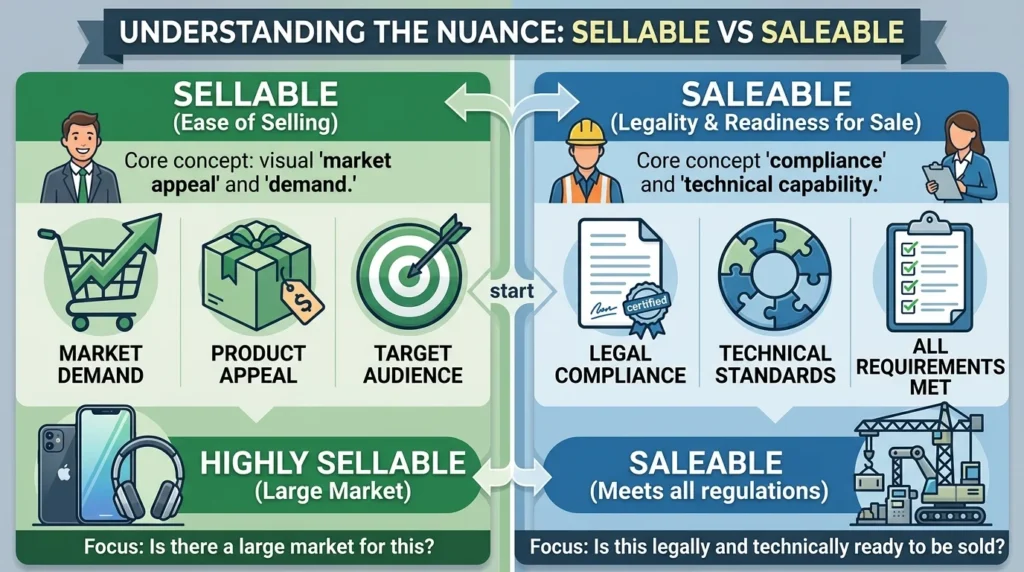
Quick Answer: Sellable vs. Saleable
Sellable and saleable both mean:
able or suitable to be sold
Examples
This product is highly sellable online.
This product is highly saleable online.
Both are understandable and can be correct.
The easiest rule
American English → sellable is often preferred
British English → saleable is often preferred
However, actual usage can vary, and sellable is also used in British English.
What Does “Sellable” Mean?
Sellable is an adjective meaning capable of being sold or likely to attract buyers.
It is formed from the verb sell plus the suffix -able.
Examples of “Sellable”
The designer created a highly sellable product.
We need to determine whether the idea is commercially sellable.
These products are attractive and easily sellable online.
The company wants to develop more sellable products.
🎯 Key Insight: Sellable emphasizes that something can be sold or has potential in the marketplace.
What Does “Saleable” Mean?
Saleable has essentially the same meaning as sellable.
It means fit or suitable for sale or capable of being sold.
Examples of “Saleable”
The company produces high-quality, saleable goods.
The property is in good condition and readily saleable.
The designer created a commercially saleable product.
Only saleable items will be displayed in the store.
🎯 Key Insight: Saleable is especially familiar in British and formal commercial English.

Sellable vs. Saleable: Main Difference
| Feature | Sellable | Saleable |
|---|---|---|
| Meaning | Able to be sold | Able to be sold |
| Part of speech | Adjective | Adjective |
| US English | Very common | Less common |
| UK English | Used | Traditionally common |
| Business context | Common | Common |
| Meaning difference | Essentially none | Essentially none |
| Best choice | Often preferred in US English | Often preferred in UK English |
Bottom Line
There is usually no meaningful difference in meaning.
The choice is mainly about spelling preference, regional usage, and style.
Sellable vs. Saleable: US and UK English
One of the most useful distinctions is regional.
American English
Sellable is generally the more natural choice.
The product needs to be more sellable.
American business and marketing writing commonly uses sellable.
British English
Saleable is traditionally well established.
The product needs to be more saleable.
You may also encounter sellable in modern British usage.
🎯 Lesson: If your audience is primarily American, sellable is a safe choice. If your audience is primarily British, saleable may fit the traditional spelling preference better.
Real-World Usage Scenarios
Scenario 1: Marketing
The company is looking for a more sellable product design.
🎯 Lesson: Sellable is natural when discussing products that are likely to attract buyers.
Scenario 2: Property
The house is in a desirable location and should be highly saleable.
🎯 Lesson: Saleable is often seen in formal British-style property and commercial writing.
Scenario 3: E-Commerce
We need to identify which products are most sellable online.
🎯 Lesson: Sellable works naturally in modern e-commerce language.
Scenario 4: Retail
Only saleable merchandise can be returned for a refund.
🎯 Lesson: Saleable can be used in formal retail policies to mean merchandise that is still fit for resale.
Scenario 5: International Business
The product must be commercially saleable in the target market.
🎯 Lesson: Saleable can have a formal, commercial tone, while sellable can sound more direct and conversational.
Sellable vs. Saleable in Business English
Both words can describe a product’s commercial potential.
Sellable
Often emphasizes:
- Ability to attract buyers
- Market appeal
- Ease of selling
- Commercial attractiveness
The new design is much more sellable.
Saleable
Can emphasize:
- Suitability for sale
- Commercial viability
- Fitness for resale
- Formal marketability
The goods are still in saleable condition.
The distinction is subtle, though. In many contexts, the words can simply be substituted for each other.
“Sellable” vs. “Saleable” vs. “Marketable”
These words are related but not perfectly identical.
Sellable
Means capable of being sold.
The product is sellable.
Saleable
Also means capable or suitable for being sold.
The goods are saleable.
Marketable
Usually means suitable for successful marketing or likely to appeal to a market.
The company developed a highly marketable product.
🎯 Key Insight: Something can be marketable without necessarily being easy to sell. Sellable and saleable focus more directly on the ability or suitability to be sold.
Common Mistakes With Sellable and Saleable
Mistake 1: Thinking One Is Always Wrong
❌ Saleable is incorrect.
Not necessarily.
Saleable is a legitimate English word.
Likewise:
❌ Sellable is always wrong.
Also false.
Sellable is a standard word and is especially common in American English.
Mistake 2: Mixing Regional Styles
If you’re writing an article primarily in American English, you might choose:
sellable
If you’re consistently using British English, you might choose:
saleable
The important thing is consistency.
🎯 Lesson: Match the spelling to your intended audience and maintain the same variety throughout your content.
Mistake 3: Confusing “Saleable” With “On Sale”
Saleable does not mean currently discounted.
The product is saleable.
means:
The product is suitable or able to be sold.
But:
The product is on sale.
usually means:
The product is currently being offered for purchase, often at a reduced price.
These are completely different ideas.
“Saleable” Does Not Mean “For Sale”
This distinction is particularly important.
Saleable
The damaged item is no longer saleable.
Meaning:
It is no longer suitable to be sold.
For sale
The damaged item is still for sale.
Meaning:
It is being offered to buyers.
A product can technically be for sale without being considered saleable in quality or condition.
Memory Tricks: Sellable vs. Saleable
🧠 Trick 1: Match “Sell”
Think:
sell → sellable
This makes sellable easy to remember.
🏷️ Trick 2: Match “Sale”
Think:
sale → saleable
This helps you remember the British-style spelling.
🌎 Trick 3: Remember the Region
US → sellable
UK → saleable
This is a useful shortcut, although both forms can appear in both varieties.
⭐ One-Line Memory Trick
Sellable and saleable mean almost the same thing; choose the spelling that fits your English variety.
Expert Insight: Why Are There Two Spellings?
The difference comes from two natural English formations.
Sellable is built directly from:
sell + -able
while saleable is associated with:
sale + -able
Both formations communicate the idea of something being capable or suitable for sale.
English has many spelling variations that developed through different regional and historical patterns. As a result, sellable and saleable coexist rather than one being universally “correct” and the other being an error.
For modern usage, regional preference and consistency are more important than trying to identify one universally superior spelling.
Quick Test: Sellable or Saleable?
1. The product is highly ________.
Answer: sellable or saleable
Both are possible.
2. The goods are no longer ________ because they are damaged.
Answer: sellable or saleable
Both are possible.
3. The company needs a more ________ design.
Answer: sellable or saleable
Both are possible.
4. Which spelling is especially common in American English?
Answer: sellable
5. Which spelling is traditionally associated with British English?
Answer: saleable
6. Does “saleable” mean “discounted”?
Answer: No.
It means capable or suitable for being sold.