
Quick Answer: Prime vs. Gatorade
Prime Hydration is a low-sugar, electrolyte-focused beverage, while traditional Gatorade sports drinks are designed primarily to provide fluid, electrolytes, and carbohydrates during physical activity.
Prime Hydration = low-sugar hydration drink
Gatorade = traditional sports drink with carbohydrates + electrolytes
Importantly, Prime Energy is a completely different product because it contains a substantial amount of caffeine.
What Is Prime?
Prime is a beverage brand associated with several products, most notably Prime Hydration and Prime Energy.
These products should not be treated as interchangeable.
Prime Hydration
Prime Hydration is marketed as an electrolyte beverage and is generally:
- Low in sugar
- Free of caffeine
- Sweetened without traditional high amounts of added sugar
- Designed around hydration and electrolytes
Prime Energy
Prime Energy is an energy drink, not simply a hydration drink.
It contains caffeine, making it fundamentally different from Prime Hydration.
🎯 Key Insight: When comparing Prime with Gatorade, make sure you’re talking about Prime Hydration, not Prime Energy.
What Is Gatorade?
Gatorade is a long-established sports-drink brand developed around hydration and athletic performance.
Traditional Gatorade products generally provide:
- Water
- Electrolytes
- Carbohydrates
- Flavoring and sweeteners
The exact nutritional profile depends on the specific Gatorade product.
Why Does Gatorade Contain Carbohydrates?
During prolonged or intense exercise, carbohydrates can provide an energy source while electrolytes and fluids help replace what is lost through sweat.
This makes traditional sports drinks particularly relevant for:
- Long workouts
- Endurance sports
- Hot environments
- Extended athletic activity
🎯 Key Insight: Gatorade’s traditional sports-drink formula is designed around hydration plus carbohydrate replacement, not simply low-calorie hydration.
Prime vs. Gatorade: Main Difference
| Feature | Prime Hydration | Traditional Gatorade |
|---|---|---|
| Primary purpose | Hydration | Hydration + sports fuel |
| Sugar | Typically very low | Typically contains carbohydrates |
| Electrolytes | Yes | Yes |
| Caffeine | No | Traditional versions generally no caffeine |
| Calories | Generally low | Generally higher |
| Carbohydrates | Very low | More substantial |
| Best fit | Everyday hydration or lower-calorie option | Longer/intense exercise requiring carbs |
| Product range | Hydration and energy products | Many sports/hydration products |
Important: Exact amounts vary by specific flavor and product formulation, so the label on the bottle you’re buying is the best source for current nutrition information.
Prime vs. Gatorade: Electrolytes
Both Prime Hydration and Gatorade provide electrolytes, but the types and amounts can differ.
Electrolytes commonly relevant to hydration include:
- Sodium
- Potassium
- Magnesium
- Chloride
One particularly important electrolyte during heavy sweating is sodium, because significant sodium can be lost through sweat.
🎯 Key Insight: More electrolytes does not automatically mean a drink is better. The right formulation depends on how much fluid, sodium, and carbohydrate you actually need.
Prime vs. Gatorade: Sugar
This is one of the biggest differences between the traditional versions.
Prime Hydration
Prime Hydration is designed to be low in sugar, making it attractive to people who want an electrolyte drink without the sugar content found in many conventional sports drinks.
Traditional Gatorade
Traditional Gatorade sports drinks contain carbohydrates, including sugar, which can be useful during prolonged physical activity.
Which Is Better?
It depends on your goal.
Want low sugar? → Prime Hydration may be preferable.
Need carbohydrates during prolonged exercise? → Traditional Gatorade may be more useful.
Prime vs. Gatorade: Caffeine
This is an important distinction.
Prime Hydration
Prime Hydration is caffeine-free.
Prime Energy
Prime Energy contains caffeine and should therefore not be treated like a simple hydration beverage.
Gatorade
Traditional Gatorade sports drinks are generally caffeine-free, although the broader Gatorade product lineup includes products with different formulations.
🎯 Lesson: Always check the specific product label rather than assuming every beverage under a brand has the same ingredients.
Prime vs. Gatorade for Exercise
Short or Moderate Workouts
For a shorter workout, you may not need a carbohydrate-containing sports drink at all.
Water can often be sufficient for ordinary exercise, depending on factors such as:
- Duration
- Intensity
- Temperature
- Sweat rate
- Individual needs
A low-sugar electrolyte drink may also be appealing if you want electrolytes without many calories.
Long or Intense Exercise
For prolonged or intense exercise, especially in heat, a traditional sports drink can have an advantage because it provides both fluids and carbohydrates, in addition to electrolytes.
🎯 Key Insight: The longer and harder the activity, the more relevant carbohydrate and sodium replacement can become.
Prime vs. Gatorade: Real-World Usage Scenarios
Scenario 1: Everyday Hydration
Someone wants a flavored drink with electrolytes but doesn’t want much sugar.
Prime Hydration may fit that preference.
🎯 Lesson: Low-sugar electrolyte drinks can be useful when carbohydrates aren’t the main goal.
Scenario 2: Long-Distance Running
A runner is exercising for several hours and needs both fluids and energy.
A traditional carbohydrate-containing sports drink such as Gatorade may be more useful.
🎯 Lesson: Long-duration exercise can increase the value of carbohydrates during activity.
Scenario 3: A Short Gym Session
Someone is doing a 30-minute strength workout.
They may not need either product specifically; water may be enough depending on the circumstances.
🎯 Lesson: A sports drink isn’t automatically necessary just because you’re exercising.
Scenario 4: Looking for Caffeine
Someone wants a beverage containing caffeine for an energy boost.
Prime Energy, rather than Prime Hydration, is the relevant Prime product.
🎯 Lesson: Don’t confuse Prime’s hydration and energy products.
Scenario 5: Hot Outdoor Activity
Someone is exercising outdoors for an extended period in hot weather and sweating heavily.
A beverage providing fluid, sodium, and carbohydrates may be particularly useful.
🎯 Lesson: Sweat losses and exercise duration matter more than the brand name.
Prime vs. Gatorade Reddit
When comparing Prime vs. Gatorade on Reddit, people often discuss taste, sugar content, hydration, price, and which drink is better for sports. Opinions vary because some consumers prefer Prime’s fruit flavors and low-sugar formula, while others prefer Gatorade’s familiar taste and traditional sports drink formulation.
Several common topics come up in these discussions:
Taste: Some people prefer Prime’s sweeter, fruit-forward flavors, while others like Gatorade’s classic sports drink taste.
Sugar content: Prime Hydration generally contains much less sugar than regular Gatorade, making it appealing to people who want to reduce their sugar intake.
Sports performance: Gatorade’s traditional formula provides carbohydrates and sodium that can be useful during prolonged, strenuous exercise.
Price and availability: Some consumers choose whichever brand is cheaper or easier to find.
Personal preference: Neither drink is universally preferred, and opinions about flavor and effectiveness differ.
Online opinions can help you understand consumer preferences, but personal experiences do not prove that one drink is healthier or more effective than the other.
It is also important to distinguish Prime Hydration from Prime Energy. Prime Hydration is caffeine-free, while Prime Energy contains a substantial amount of caffeine and is not appropriate for children.
For everyday hydration, water is generally sufficient for most people. During prolonged, intense exercise, a traditional sports drink may provide useful carbohydrates and electrolytes.
Prime vs. Gatorade Sales
Prime and Gatorade have different positions in the sports drink market. Gatorade is an established brand with extensive retail distribution and a long history of use among athletes. Prime gained rapid popularity through influencer marketing, social media attention, and its distinctive packaging.
Gatorade has several advantages in the marketplace:
Brand recognition: Gatorade has a long-standing reputation in sports and athletic training.
Retail distribution: Its products are widely available in supermarkets, convenience stores, and sporting venues.
Product variety: The brand offers traditional sports drinks, zero-sugar options, and other hydration products.
Established customers: Many athletes and consumers have used Gatorade for years.
Prime attracted attention through its association with popular online personalities and its colorful packaging. Its initial popularity helped it gain visibility among younger consumers, although strong social media interest does not always translate into lasting sales.
Sales comparisons also depend on the period, country, retail channels, and products included. Brand sales, company revenue, and sales of individual drink varieties are different measurements, so they should not be treated as interchangeable.
Gatorade’s larger presence in the sports drink market does not automatically make it nutritionally superior. Likewise, Prime’s popularity does not establish that it is more effective for hydration.
Prime vs. Gatorade Nutrition
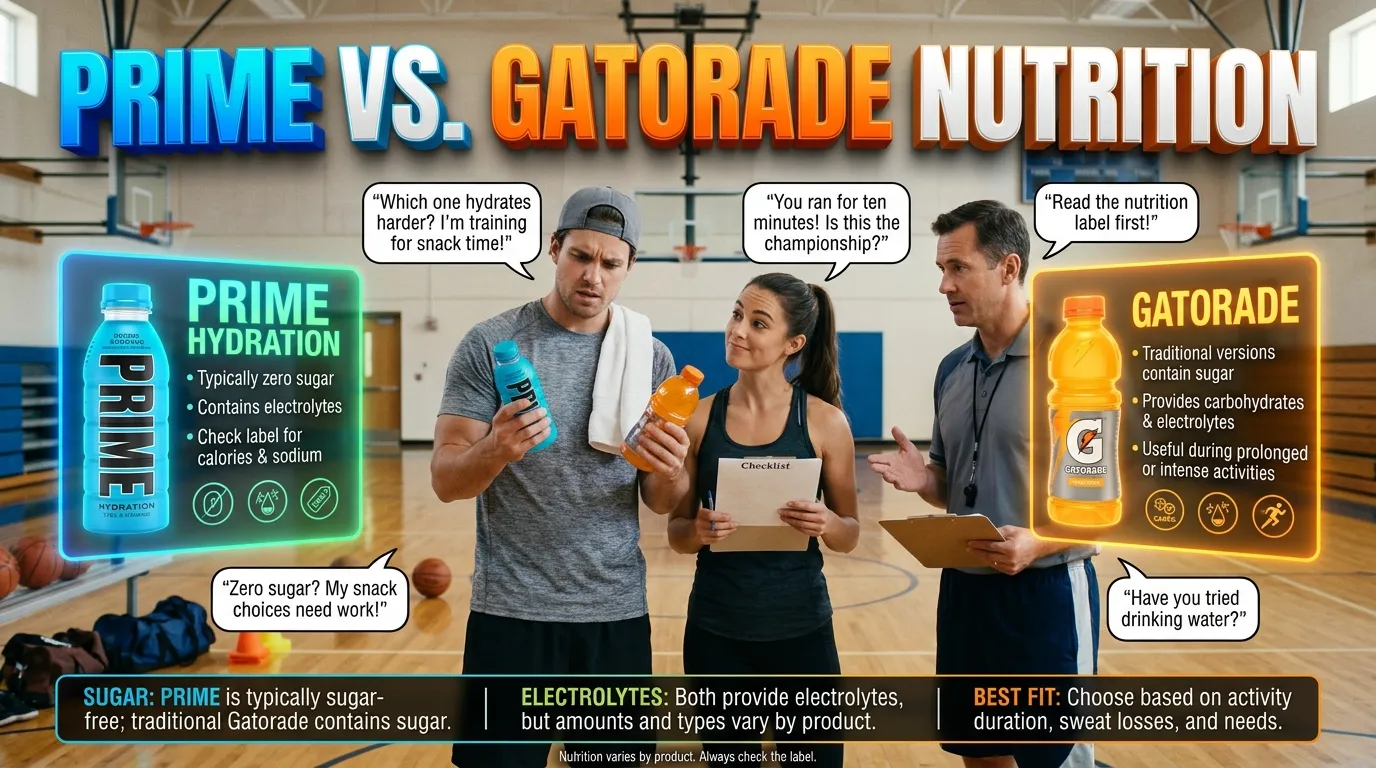
Prime Hydration and regular Gatorade have different nutritional profiles. Prime generally contains fewer calories and less sugar, while traditional Gatorade supplies more carbohydrates and sodium.
The following table compares representative US products. Values can vary by flavor, formulation, and bottle size.
Nutrient | Prime Hydration (16.9 fl oz) | Regular Gatorade (20 fl oz) |
|---|---|---|
Calories | About 25 | About 140 |
Total sugar | About 2 g | About 34 g |
Sodium | About 30 mg | About 270 mg |
Potassium | About 700 mg | About 75–80 mg |
Caffeine | 0 mg | 0 mg |
Prime Hydration is sweetened with non-sugar sweeteners and contains coconut water concentrate. Traditional Gatorade provides carbohydrates and electrolytes that can help replace some of the substances lost through sweat during prolonged exercise.
The nutritional differences matter because the drinks serve somewhat different purposes.
Prime Hydration may appeal to people who want a flavored drink with little sugar. Gatorade may be more useful during prolonged, strenuous exercise when the body needs both fluids and carbohydrate energy.
However, a higher potassium content does not automatically make a beverage the better sports drink. Sodium is particularly important for replacing sweat losses, and carbohydrate intake can help fuel endurance exercise.
For everyday hydration, most people do not need either product. Water is generally the simplest choice, while the benefits of sports drinks depend on the duration and intensity of activity.
Prime vs. Gatorade for Kids
When comparing Prime vs. Gatorade for kids, the most important consideration is whether a child needs a sports drink in the first place. For ordinary daily activities, school, and routine play, water is generally the preferred option.
Prime Hydration and traditional Gatorade differ in their sugar and electrolyte content, but neither is necessary for most children during normal daily activities.
Prime Hydration is caffeine-free and generally low in sugar. However, its electrolyte content does not make it essential for children, and parents should not assume that a drink marketed for hydration is automatically suitable for every situation.
Regular Gatorade contains sugar and sodium. These ingredients may be useful during prolonged, vigorous exercise, particularly in hot weather, but they are usually unnecessary for short periods of ordinary play.
Gatorade Zero contains no sugar and offers electrolytes, but a zero-sugar formula is not automatically better for every child or athletic activity.
Prime Energy is different from Prime Hydration. It contains caffeine and is not appropriate for children.
For example, a child playing outside for 30 minutes will usually do well with water. A young athlete participating in prolonged, intense training in hot weather may have different fluid and electrolyte needs.
Parents should consider a child’s age, activity level, dietary needs, and health conditions when choosing drinks. Regular consumption of sugary beverages can contribute to excess calorie intake and dental problems.
Verdict: Water is usually the best everyday drink for children. A sports drink may be appropriate during prolonged, intense exercise, depending on the circumstances. Prime Energy should not be confused with Prime Hydration or given to children.
Prime vs. Gatorade Zero
Prime Hydration and Gatorade Zero are both alternatives to traditional sugary sports drinks, but they differ in their electrolyte profiles.
Prime Hydration generally contains a small amount of sugar and a relatively high amount of potassium. Gatorade Zero contains no sugar and provides sodium and potassium without the carbohydrates found in regular Gatorade.
Feature | Prime Hydration | Gatorade Zero |
|---|---|---|
Sugar | Usually around 2 g per bottle | 0 g |
Calories | About 20–25 per bottle | Usually 0 per serving |
Sodium | Relatively low | Higher in common formulas |
Potassium | Relatively high | Lower than Prime’s representative formula |
Caffeine | None | None in the standard formula |
Carbohydrates | Very low | Very low |
Exact amounts depend on the flavor, serving size, and product formulation.
Prime Hydration may be appealing to someone who wants a low-sugar drink with a higher potassium content. Gatorade Zero may be more appropriate for someone who wants a zero-sugar beverage with a greater contribution of sodium.
Neither drink provides the same carbohydrate energy as traditional Gatorade. That difference can matter during prolonged endurance exercise, when athletes may need both fluid replacement and fuel.
Which is better? Prime Hydration offers more potassium in the representative formulas compared here, while Gatorade Zero offers zero sugar and more sodium. Neither is universally superior; the choice depends on activity, electrolyte needs, and personal preference.
Prime vs. Gatorade When Sick
Prime vs. Gatorade when sick depends on the type of illness and the amount of fluid being lost. When someone has a cold, fever, vomiting, or diarrhea, maintaining hydration is important, but different illnesses can require different approaches.
For a mild cold without significant fluid loss, water, soup, and other tolerated fluids are generally sufficient. Neither Prime nor Gatorade treats the underlying illness.
When vomiting or diarrhea causes dehydration, an oral rehydration solution (ORS) is generally a better choice than either beverage, particularly for children. ORS is formulated with a suitable balance of glucose and electrolytes to help the body absorb fluids.
Here is how the drinks compare in common situations:
Cold or mild fever: Water and other tolerated fluids are usually sufficient. Either drink may be an optional beverage for an otherwise healthy adult who tolerates it.
Vomiting: Take small, frequent sips of an appropriate fluid. If dehydration is a concern, an oral rehydration solution is preferable.
Diarrhea: ORS is generally more suitable than regular sports drinks because their sugar and electrolyte balance may not be appropriate for replacing intestinal fluid losses.
Poor appetite: Prioritize fluids that are easy to tolerate rather than relying on sports drinks for nutrition.
Heavy sweating: Fluid replacement is important, but the appropriate drink depends on the extent of fluid and electrolyte loss.
Prime Hydration contains relatively little sodium compared with traditional Gatorade. Neither product is specifically formulated to replace the fluid and electrolyte losses associated with significant vomiting or diarrhea as reliably as an appropriate ORS.
Seek medical attention if someone cannot keep fluids down, urinates much less than usual, becomes unusually drowsy, develops significant dizziness, or shows other signs of dehydration. Children, older adults, and people with certain medical conditions may need prompt assessment.
Verdict: For a mild illness, choose suitable fluids that you can tolerate. For dehydration caused by vomiting or diarrhea, use an appropriate oral rehydration solution rather than relying on Prime or Gatorade.
Prime vs. Gatorade vs. Powerade
Prime, Gatorade, and Powerade are all associated with sports hydration, but their formulas differ in sugar, sodium, potassium, and carbohydrate content.
Prime Hydration generally emphasizes low sugar and higher potassium, while traditional Gatorade and Powerade supply more carbohydrates and sodium that may be useful during demanding exercise.
Feature | Prime Hydration | Regular Gatorade | Regular Powerade |
|---|---|---|---|
Sugar | Low | High | High |
Carbohydrates | Very low | Higher | Higher |
Sodium | Low | Moderate | Moderate to relatively high, depending on formula |
Potassium | High | Lower | Varies by formula |
Caffeine | None | None in the traditional formula | None in the traditional formula |
Main advantage | Low sugar and high potassium | Familiar sports hydration formula | Another carbohydrate-and-electrolyte option |
Prime Hydration may suit people who want a low-sugar flavored beverage. Traditional Gatorade and Powerade can be more useful during prolonged, strenuous exercise because they provide carbohydrates for energy and sodium to help replace sweat losses.
For short or moderate workouts, water is usually sufficient for most people. During longer activities, particularly in hot weather, the need for carbohydrates and electrolytes becomes more relevant.
If sugar is a concern, compare Prime Hydration with Gatorade Zero and Powerade Zero rather than comparing it only with traditional sugary formulas.
Which is best?
For low sugar: Prime Hydration is a reasonable option.
For prolonged sports or endurance exercise: Traditional Gatorade or Powerade may be more useful.
For zero sugar: Compare the electrolyte amounts in Prime Hydration and the zero-sugar alternatives.
For everyday hydration: Water is generally sufficient.
Gatorade and Powerade are more similar to each other in their traditional formulations than either is to Prime Hydration. Still, no single brand is best for every athlete or activity.
Prime vs. Gatorade vs. BodyArmor
Prime, Gatorade, and BodyArmor compete in the sports and hydration drink market, but they have different formulations and product options. BodyArmor’s traditional sports drinks generally contain carbohydrates, while Prime Hydration is known for its low-sugar formula and relatively high potassium content.
Feature | Prime Hydration | Gatorade Thirst Quencher | BodyArmor Sports Drink |
|---|---|---|---|
Sugar | Low | High | Generally high |
Sodium | Low | Moderate | Varies by formula |
Potassium | High | Lower | Varies by formula |
Carbohydrates | Low | Higher | Generally higher |
Coconut water | Coconut water concentrate | Not a defining ingredient | Used in common formulations |
Lower-sugar options | Prime Hydration is already low in sugar | Gatorade Zero | Lower-sugar options are available |
Main advantage | Low sugar and high potassium | Carbohydrates and sodium for exercise | Variety of flavored sports drinks |
The precise nutritional content varies by product and flavor, so checking the individual label is important.
Prime Hydration may appeal to people who want a low-sugar drink. Traditional Gatorade can be useful for athletes who need carbohydrates and sodium during sustained exercise. BodyArmor offers another option for consumers who prefer its flavors or formulation.
Which is better for workouts?
For short or moderate workouts, water is generally sufficient. For longer or more strenuous exercise, especially in hot weather, a drink that provides carbohydrates and sodium may be more useful than a low-sugar beverage.
Which is better for reducing sugar?
Prime Hydration generally contains less sugar than traditional Gatorade and many regular BodyArmor formulas. However, lower sugar alone does not determine whether a drink is best for athletic performance.
Which is best for everyday hydration?
Water remains the simplest choice for most everyday situations. Sports drinks may be useful in specific circumstances, but most people do not need them to stay hydrated throughout the day.
Common Mistakes About Prime and Gatorade
Mistake 1: Assuming All Prime Drinks Are the Same
❌ “Prime has no caffeine.”
That’s not true for the entire Prime lineup.
Prime Hydration is caffeine-free, while Prime Energy contains caffeine.
Mistake 2: Assuming Gatorade Is Always Better for Hydration
A sports drink isn’t automatically superior to every other beverage.
The right choice depends on:
- Exercise duration
- Sweat loss
- Carbohydrate needs
- Sodium needs
- Personal preference
Mistake 3: Assuming Zero Sugar Means Better for Every Athlete
Not necessarily.
For long-duration exercise, carbohydrates can be useful fuel.
A low-sugar drink may be preferable when you’re simply looking for hydration without additional calories, but that doesn’t mean it is always the better sports-performance choice.
Mistake 4: Comparing Prime Energy With Traditional Gatorade
This is an apples-to-oranges comparison.
Prime Hydration ↔ Gatorade sports drink
is a more meaningful comparison than:
Prime Energy ↔ Gatorade
Prime Energy is an energy drink with caffeine, while traditional Gatorade is primarily a sports-hydration product.
Prime vs. Gatorade: Which Is Better?
There isn’t one universal winner.
Choose Prime Hydration if you prefer:
- Low sugar
- Low calories
- Electrolytes
- A caffeine-free hydration drink
- A flavored alternative to water
Choose traditional Gatorade if you want:
- Electrolytes
- Fluid
- Carbohydrates during prolonged exercise
- A traditional sports-drink formulation
- Fuel as well as hydration
Choose Water if:
- You’re doing ordinary daily activities
- Your workout is relatively short
- You don’t need additional carbohydrates or electrolytes
🎯 Expert Takeaway: The “best” drink depends more on the activity and your nutritional needs than on the brand.
Memory Trick: Prime vs. Gatorade
💧 Prime Hydration
Think:
Prime = low-sugar hydration
⚡ Prime Energy
Think:
Prime Energy = caffeine + energy
🏃 Gatorade
Think:
Gatorade = sports fuel + hydration
⭐ One-Line Memory Trick
Prime Hydration emphasizes low-sugar hydration; traditional Gatorade emphasizes hydration plus carbohydrates.
Expert Insight: Hydration Is More Than Choosing a Brand
Effective hydration depends on several factors, including:
- How much fluid you lose
- How much you sweat
- Sodium loss
- Exercise duration
- Exercise intensity
- Temperature
- Whether you need carbohydrate fuel
For a short workout, adding large amounts of sugar may be unnecessary.
For prolonged endurance activity, however, avoiding carbohydrates entirely may not be ideal because carbohydrates can help support performance.
That’s why athletes often choose different beverages for different situations rather than relying on one product all the time.
Quick Comparison: Prime or Gatorade?
For low sugar
Prime Hydration generally has the advantage.
For carbohydrate fuel
Traditional Gatorade generally has the advantage.
For caffeine-free hydration
Prime Hydration is caffeine-free, while traditional Gatorade products are generally caffeine-free.
For an energy drink
Prime Energy is the relevant Prime product.
For long-duration exercise
A carbohydrate-and-electrolyte sports drink can be useful, making traditional Gatorade a potentially better fit than a low-carbohydrate hydration drink.
For ordinary daily hydration
Water is often all you need.