
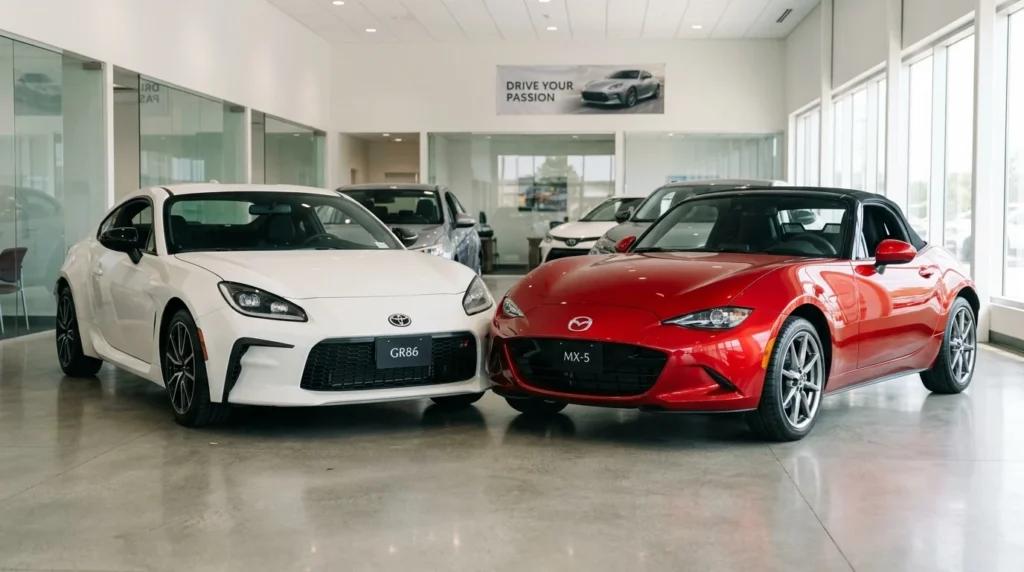
Toyota vs Mazda: Quick Answer
If your top priorities are long-term reliability, fuel efficiency, and resale value, Toyota is usually the better choice.
If you want a more engaging driving experience, upscale interiors, and sporty handling, Mazda is often the better option.
The right choice depends on your budget, driving style, and personal preferences.
What Is Toyota Known For?
Definition
Toyota is one of the world’s largest automobile manufacturers and is known for producing dependable, fuel-efficient, and long-lasting vehicles.
Key Strengths
- Exceptional reliability
- Strong resale value
- Excellent fuel economy
- Extensive dealer network
- Proven hybrid technology
Popular Models
- Toyota Corolla
- Toyota Camry
- Toyota RAV4
- Toyota Highlander
- Toyota Prius
Real Examples
- The Toyota Corolla is famous for long-term dependability.
- The Toyota RAV4 consistently ranks among the best-selling SUVs.
- The Toyota Prius helped popularize hybrid vehicles worldwide.
Key Insight: Toyota focuses heavily on reliability, efficiency, and low ownership costs.
What Is Mazda Known For?
Definition
Mazda is a Japanese automaker recognized for stylish vehicles, responsive handling, and premium features at competitive prices.
Key Strengths
- Sporty performance
- Premium interior design
- Attractive styling
- Excellent driving dynamics
- Strong safety features
Popular Models
- Mazda3
- Mazda CX-30
- Mazda CX-5
- Mazda CX-50
- Mazda MX-5 Miata
Real Examples
- The Mazda MX-5 Miata is one of the most celebrated sports cars in the world.
- The Mazda CX-5 is praised for combining practicality with enjoyable driving.
- The Mazda3 often feels more premium than many competitors.
Key Insight: Mazda focuses on delivering a more enjoyable and refined driving experience.
Toyota or Mazda SUV
When people search Toyota or Mazda SUV, they are often comparing models such as the Toyota RAV4 and Mazda CX-5, particularly for reliability, safety, price, comfort, and long-term ownership. The comparison is more useful when it is made model year by model year, because reliability, features, powertrains, and pricing can change between generations.
For example, Consumer Reports’ data for the 2021 model year placed both Mazda and Toyota among the strongest brands for predicted reliability, while its 2021 CX-5 review highlighted the Mazda’s ride comfort, handling, noise isolation, and interior quality.
Toyota vs Mazda SUV
Toyota and Mazda take somewhat different approaches to their SUV lineups.
A Toyota SUV such as the RAV4 is commonly considered alongside the Mazda CX-5 because both compete in the compact-SUV segment. The specific differences include dimensions, available powertrains, fuel economy, cargo capacity, interior design, driving characteristics, and equipment.
For a meaningful comparison, shoppers should compare equivalent versions rather than treating the brands as completely interchangeable. For example:
- Toyota RAV4 vs. Mazda CX-5
- Toyota RAV4 Hybrid vs. Mazda CX-50 Hybrid, where applicable
- Toyota Highlander vs. Mazda CX-90
- Toyota Corolla Cross vs. Mazda CX-30, depending on size requirements
Owner discussions also show that buyers often focus on different priorities, including reliability, interior quality, driving feel, purchase price, and maintenance. These are individual ownership considerations rather than universal differences between the two brands.
Mazda vs Toyota Longevity
Longevity depends on the individual vehicle, engine, transmission, maintenance history, mileage, driving conditions, and model year. It is therefore difficult to say that every Mazda or every Toyota will last longer.
Historical reliability data does provide useful context. Consumer Reports’ 2021 reliability report placed Mazda second and Toyota third among brands in its overall reliability ranking. The report also noted that Toyota had a broad range of models in its survey, while Mazda’s overall performance was supported by its relatively conservative approach to vehicle design and its use of established components.
For a used SUV, maintenance records can be just as important as the badge on the hood. A well-maintained Mazda with lower mileage may be a different ownership proposition from a poorly maintained Toyota with substantially higher mileage.
When researching longevity, check:
- Engine and transmission history
- Maintenance records
- Mileage
- Previous accidents
- Recall history
- Model-specific mechanical issues
- Rust or corrosion
- Previous ownership and usage
Mazda vs Toyota Safety
Safety should be evaluated by specific model and model year, rather than assuming one brand has the same safety performance across its entire SUV lineup.
Crash-test organizations such as the IIHS and NHTSA publish vehicle-specific safety information. For example, Consumer Reports’ 2021 CX-5 information lists good results for several IIHS crash-test categories.
When comparing a Toyota and Mazda SUV, examine:
- Crash-test results
- Automatic emergency braking
- Forward-collision warning
- Lane-departure and lane-keeping systems
- Blind-spot monitoring
- Adaptive cruise control
- Rear cross-traffic alert
- Headlight performance
Safety equipment can also vary by trim level, so comparing only the base model of one vehicle with a higher trim of another can give a misleading impression.
Toyota or Mazda More Reliable
Reliability is one of the most common reasons people compare Toyota and Mazda.
Historical Consumer Reports data shows that both brands have had strong reliability records, but reliability varies considerably by individual model and model year. For example, Consumer Reports’ 2021 report described the RAV4 as average in predicted reliability for that year’s lineup, while the RAV4 Prime and Venza were rated above average.
The Mazda CX-5 has also received positive reliability assessments in historical model-year data. Consumer Reports describes the second-generation CX-5 as having a mature design with established components and strong overall characteristics.
That means a useful comparison is not simply:
Toyota vs. Mazda
Instead, ask:
Which Toyota model and which Mazda model, for which model year, with what engine and transmission?
That approach produces a much more accurate reliability comparison.
Mazda vs Toyota Price
Purchase price varies according to model, trim, model year, mileage, location, condition, incentives, and whether the vehicle is new or used.
Used vehicles can make the comparison particularly interesting because depreciation can differ substantially between models. Current owner discussions about used CX-5 and RAV4 vehicles frequently mention differences in asking prices, mileage, equipment, and perceived value.
For example, when comparing two used SUVs, don’t look only at the advertised price. Compare:
- Purchase price
- Mileage
- Trim level
- Engine
- Drive system
- Service history
- Accident history
- Tire condition
- Warranty coverage
- Expected maintenance
A cheaper vehicle with substantially higher mileage is not necessarily the lower-cost purchase after considering its condition and upcoming maintenance.
Toyota or Mazda SUV: What Should You Compare?
If you’re researching Toyota or Mazda SUVs, the most useful comparison is based on your actual requirements:
| Factor | What to examine |
|---|---|
| Reliability | Model-year reliability history and maintenance records |
| Safety | IIHS/NHTSA results and available driver-assistance features |
| Price | New or used purchase price and trim level |
| Longevity | Engine, transmission, maintenance, mileage, and ownership history |
| Fuel economy | EPA ratings for the exact powertrain |
| Space | Passenger room and cargo capacity |
| Driving | Ride quality, handling, acceleration, and noise |
| Ownership | Service availability, parts, warranty, and maintenance |
| Resale | Local used-car market and model demand |
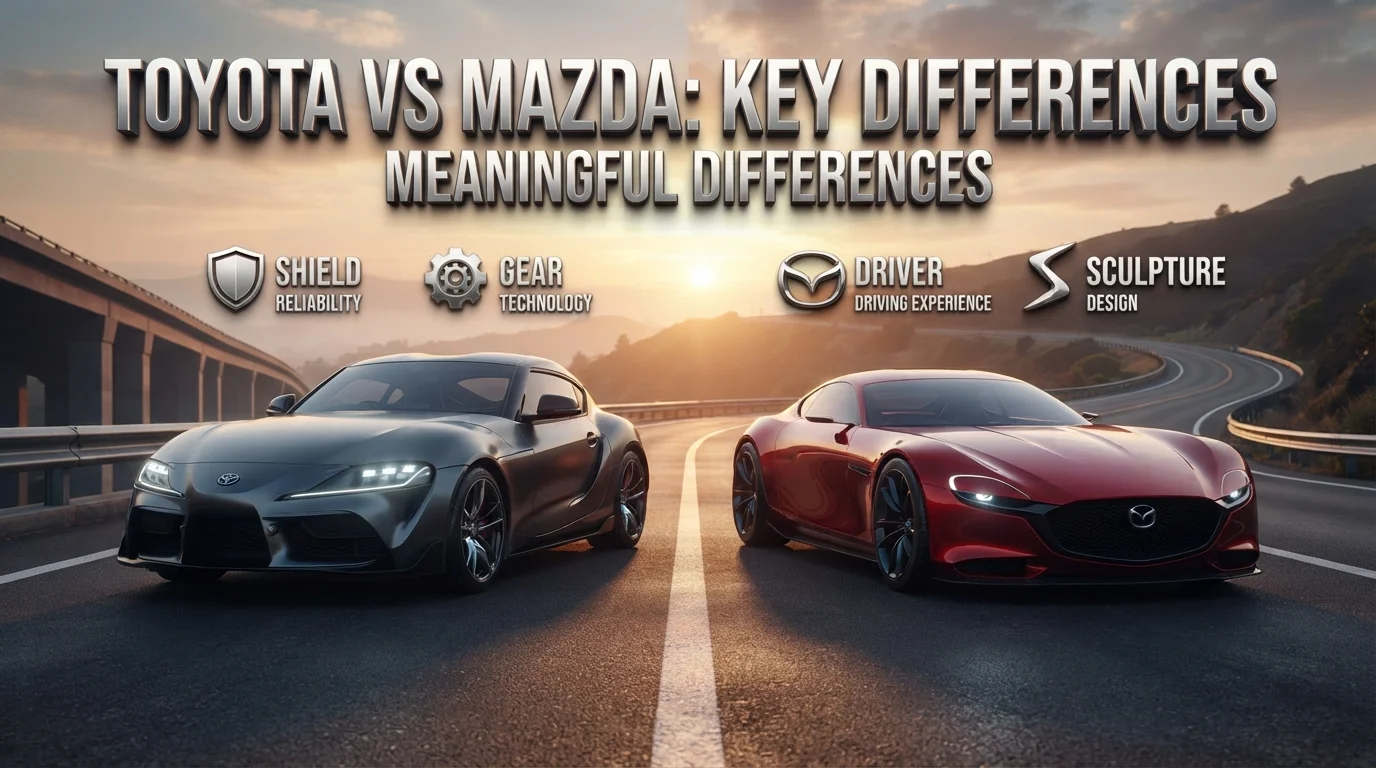
Toyota vs Mazda: Key Differences
Meaningful Differences
- Toyota prioritizes reliability and efficiency.
- Mazda prioritizes driving enjoyment and design.
- Toyota offers more hybrid options.
- Mazda often delivers a more upscale cabin experience.
- Toyota generally has stronger resale value.
Comparison Table
| Feature | Toyota | Mazda |
|---|---|---|
| Main Strength | Reliability | Driving Experience |
| Fuel Economy | Excellent | Very Good |
| Resale Value | Excellent | Good |
| Interior Quality | Good | Excellent |
| Hybrid Options | Extensive | Limited |
| Maintenance Costs | Generally Lower | Generally Moderate |
| Sporty Handling | Good | Excellent |
| Best For | Practical Buyers | Enthusiast Drivers |
Real-World Usage Scenarios
Example 1
Buyer A wants a vehicle that can last for many years with minimal problems.
Best Choice: Toyota
🎯 Lesson: Reliability-focused buyers often prefer Toyota.
Example 2
Buyer B enjoys winding roads and responsive steering.
Best Choice: Mazda
🎯 Lesson: Driving enthusiasts often appreciate Mazda’s handling.
Example 3
Buyer C wants maximum fuel savings.
Best Choice: Toyota Hybrid
🎯 Lesson: Toyota currently offers more established hybrid options.
Example 4
Buyer D wants a luxury-like interior without paying luxury-brand prices.
Best Choice: Mazda
🎯 Lesson: Mazda often delivers premium materials at competitive prices.
Example 5
Buyer E plans to sell the vehicle after several years.
Best Choice: Toyota
🎯 Lesson: Toyota vehicles typically maintain strong resale values.
Common Mistakes Buyers Make
Mistake 1: Assuming Toyota Is Better in Every Category
Toyota excels in reliability, but Mazda often offers superior driving engagement and interior quality.
Mistake 2: Ignoring Long-Term Ownership Costs
Maintenance, fuel economy, insurance, and resale value should all be considered.
Mistake 3: Choosing Based Only on Brand Reputation
The specific model matters as much as the brand itself.
Memory Tricks
Trick 1
Toyota = Trust
Think reliability, efficiency, and long-term ownership.
Trick 2
Mazda = Motion
Think sporty driving and dynamic performance.
Trick 3
Toyota Saves Money
Mazda Adds Excitement
This simple rule helps many buyers quickly identify the brand that fits their priorities.
Expert Insight
The difference between Toyota and Mazda reflects two distinct automotive philosophies. Toyota traditionally focuses on durability, efficiency, and mass-market appeal. Mazda places greater emphasis on driver engagement, vehicle balance, and design.
Interestingly, the two companies have collaborated on certain projects over the years, yet they continue to maintain unique identities. Toyota appeals to buyers seeking dependable transportation, while Mazda often attracts drivers looking for a more emotional connection with their vehicles.