
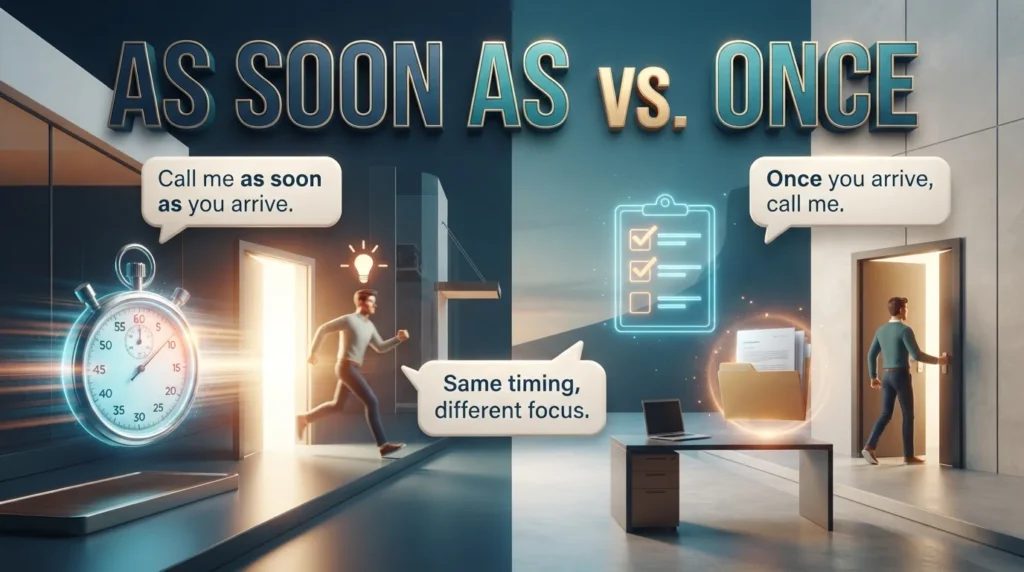
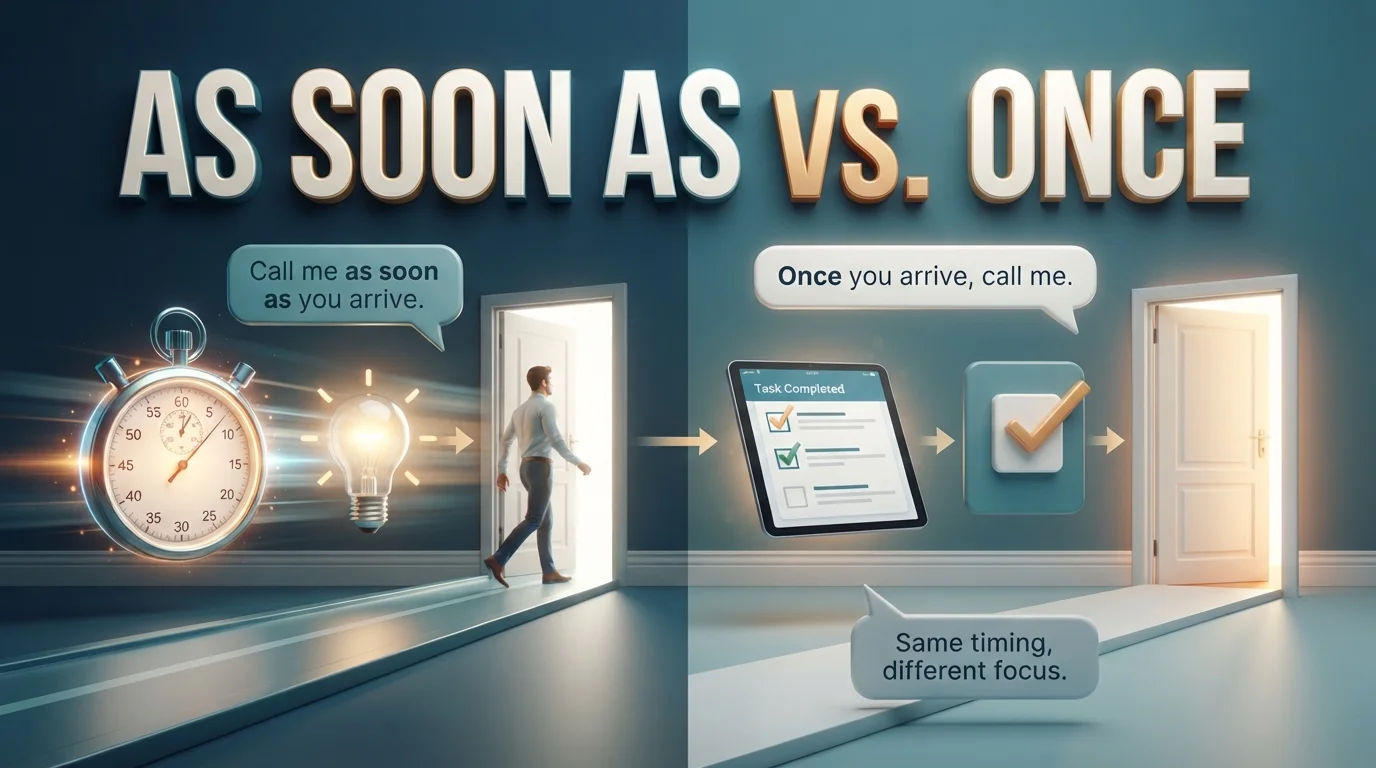
Quick Answer: As Soon As vs. Once
As soon as means immediately after or very shortly after something happens.
As soon as she arrives, we’ll start.
Once means after or when something has happened or a condition has been met.
Once she arrives, we’ll start.
The easiest rule
As soon as = immediately after
Once = after/when the condition is fulfilled
Compare
Call me as soon as you get home.
= Call me immediately after you get home.
Call me once you get home.
= Call me after you get home.
The first sentence places more emphasis on speed.
What Does “As Soon As” Mean?
As soon as is a subordinating conjunction that introduces a time clause.
It means immediately after something happens or at the earliest possible time after an event.
Examples
I’ll call you as soon as I arrive.
As soon as the rain stops, we’ll leave.
She started crying as soon as she heard the news.
Please reply as soon as possible.
In these examples, the phrase highlights the short interval between two events.
Key Idea
Event A happens → Event B follows immediately or very soon afterward.
For example:
As soon as the movie ends, we’ll go home.
The speaker emphasizes that they will leave right after the movie ends.
🎯 Key Insight: As soon as focuses on immediacy.
What Does “Once” Mean?
Once can also function as a conjunction introducing a time or condition.
In this context, it means after something happens, when something has happened, or as soon as a particular condition is met.
Examples
Once you finish your homework, you can play.
Once the meeting ends, I’ll call you.
Once we receive your payment, we’ll process the order.
Once she understands the problem, she’ll know how to fix it.
Here, once focuses on the fact that a particular event or condition must happen first.
🎯 Key Insight: Once focuses more on the completion of a condition or event than on the exact speed afterward.
As Soon As vs. Once: Main Difference
| Feature | As Soon As | Once |
|---|---|---|
| Basic meaning | Immediately after | After/when |
| Main emphasis | Speed and immediacy | Completion/condition |
| Time relationship | Very short interval | No specific interval required |
| Condition involved | Not necessarily | Often implies a condition |
| Example | Call me as soon as you arrive. | Call me once you arrive. |
| Tone | Stronger sense of urgency | More neutral |
Compare These Sentences
As soon as you finish, submit the form.
This strongly suggests:
Finish → submit immediately.
But:
Once you finish, submit the form.
means:
After finishing, submit the form.
The second sentence does not emphasize exactly how quickly the submission must happen.
As Soon As vs. Once: Real-World Usage Scenarios
Scenario 1: Calling Someone
I’ll call you as soon as I get home.
This means the person intends to call very soon after arriving home.
🎯 Lesson: Use as soon as when immediacy matters.
Scenario 2: Completing a Task
Once you finish the report, send it to me.
The important point is that the report must be finished first.
🎯 Lesson: Once emphasizes completion of the first task.
Scenario 3: Customer Service
We’ll ship your order as soon as payment is confirmed.
This suggests shipping will happen promptly after confirmation.
🎯 Lesson: As soon as is useful when you want to communicate speed.
Scenario 4: Business Process
Once we receive your application, we’ll review it.
The application must be received before the review begins.
🎯 Lesson: Once highlights a condition in a process.
Scenario 5: Travel
As soon as we arrive at the airport, I’ll text you.
This emphasizes that the text will be sent immediately after arrival.
Compare:
Once we arrive at the airport, I’ll text you.
This simply establishes the sequence.
🎯 Lesson: Both can work, but as soon as creates a stronger sense of urgency.
Can “As Soon As” and “Once” Be Interchangeable?
Often, yes.
Consider:
Once the meeting ends, we’ll leave.
and:
As soon as the meeting ends, we’ll leave.
Both establish the same basic sequence.
But the emphasis differs.
Once:
The meeting must end first.
As soon as:
The meeting must end first, and then we’ll leave immediately or very soon afterward.
Important Difference
If the timing after the first event matters, as soon as is more precise.
I’ll pay you as soon as I receive my salary.
This emphasizes prompt payment.
I’ll pay you once I receive my salary.
This only establishes that receiving the salary comes first.
Once Can Have Meanings That “As Soon As” Cannot
This is an important distinction.
Once can mean after a condition is satisfied, even when there is no strong emphasis on immediate timing.
For example:
Once you understand the basics, the advanced concepts will be easier.
This doesn’t necessarily mean the advanced concepts become easier immediately after understanding the basics.
It means understanding the basics is a condition or prerequisite.
You generally cannot replace once with as soon as without changing the meaning or making the sentence sound unnatural:
As soon as you understand the basics, the advanced concepts will be easier.
This suggests an immediate transition that may not be intended.
🎯 Key Insight: Once can express a broader condition or prerequisite; as soon as strongly emphasizes timing.
As Soon As Can Express Urgency
Because as soon as emphasizes immediacy, it is especially useful when giving instructions or communicating urgency.
Examples
Send me the document as soon as possible.
Call the doctor as soon as you notice the symptoms.
Let me know as soon as you have an answer.
Please respond as soon as you can.
Here, the idea of speed is important.
Compare
Let me know once you have an answer.
This means:
Tell me after you have an answer.
But:
Let me know as soon as you have an answer.
means:
Tell me promptly after you get the answer.
Once Can Express a Prerequisite
Once is particularly useful when one event must happen before another process can begin.
Examples
Once the application is approved, you can continue.
Once the payment is received, your order will be shipped.
Once the software is installed, restart your computer.
Once you understand the rules, the game becomes easier.
In these sentences, the first event establishes a condition for what comes next.
Common Mistakes With As Soon As and Once
Mistake 1: Thinking They Always Mean Exactly the Same Thing
They often overlap, but they aren’t completely identical.
As soon as = immediately after
Once = after/when the condition is met
The difference can be small, but it matters when timing is important.
Mistake 2: Using “Once” When Immediate Action Is Important
Suppose your boss wants a document immediately after a meeting.
Send me the report once the meeting ends.
This is correct, but it doesn’t strongly emphasize immediate action.
Better:
Send me the report as soon as the meeting ends.
🎯 Why? Because as soon as communicates urgency more clearly.
Mistake 3: Assuming “Once” Always Means “Immediately”
It doesn’t.
Once you understand the concept, you’ll find the next chapter easier.
The second event doesn’t necessarily happen immediately.
Once simply establishes a condition or sequence.
Mistake 4: Confusing “Once” With “One Time”
Once can also mean one time, which is a completely different use.
I visited London once.
Here, once means one time.
But:
Once I arrive, I’ll call you.
Here, once means after/when.
🎯 Lesson: Context determines which meaning of once is being used.
As Soon As vs. When
This is another useful comparison.
When
When I arrive, I’ll call you.
This establishes a time relationship.
As Soon As
As soon as I arrive, I’ll call you.
This adds the idea of immediacy.
Once
Once I arrive, I’ll call you.
This emphasizes that arrival is the condition that must happen first.
Simple Scale
When → neutral timing
Once → after/when the condition occurs
As soon as → immediately after
Grammar Rules for Future Time
One important grammar rule applies to all three expressions when they introduce a future time clause.
We normally use the present simple in the time clause, not will.
Correct
I’ll call you as soon as I arrive.
I’ll call you once I arrive.
I’ll call you when I arrive.
Incorrect in standard usage
❌ I’ll call you as soon as I will arrive.
❌ I’ll call you once I will arrive.
❌ I’ll call you when I will arrive.
The will belongs in the main clause:
I’ll call you
while the time clause uses:
as soon as I arrive
🎯 Key Insight: After as soon as, once, and when, use the present simple to refer to a future event.
Memory Tricks: As Soon As vs. Once
🧠 Trick 1: Speed vs. Condition
Remember:
As soon as = speed
Once = condition
⚡ Trick 2: Imagine a Race
If you mean:
“The moment this happens, I’ll do that.”
Use:
as soon as
If you mean:
“After this happens, the next step can happen.”
Use:
once
⭐ One-Line Memory Trick
As soon as = immediately after. Once = after the condition is met.
Expert Insight: The Subtle Semantic Difference
Both expressions establish a relationship between two events, but they foreground different aspects of that relationship.
As soon as is strongly temporal. It identifies a very short interval between the completion of one event and the beginning of another.
Once is more flexible. It can express temporal sequence, but it can also introduce a condition or prerequisite.
Compare:
As soon as the door opens, run inside.
The instruction emphasizes immediate action.
Once the door opens, you can enter.
The opening of the door is presented as the condition that permits entry.
This distinction explains why the two expressions are often interchangeable in casual sentences but not always interchangeable without a change in nuance.
Quick Test: As Soon As or Once?
1. I’ll call you ________ I get home.
Answer: as soon as or once
Both are grammatically correct.
As soon as emphasizes immediate calling.
2. ________ you finish the application, you can submit it.
Answer: once
This emphasizes completion as a prerequisite.
3. Please tell me ________ you receive the package.
Answer: as soon as
This emphasizes prompt notification.
4. ________ the payment is confirmed, we can process your order.
Answer: once
This emphasizes the payment confirmation as a condition.
5. She left ________ the meeting ended.
Answer: as soon as or once
As soon as suggests she left immediately.
Once simply establishes that the meeting ended before she left