
Quick Answer: Borders vs. Boarders
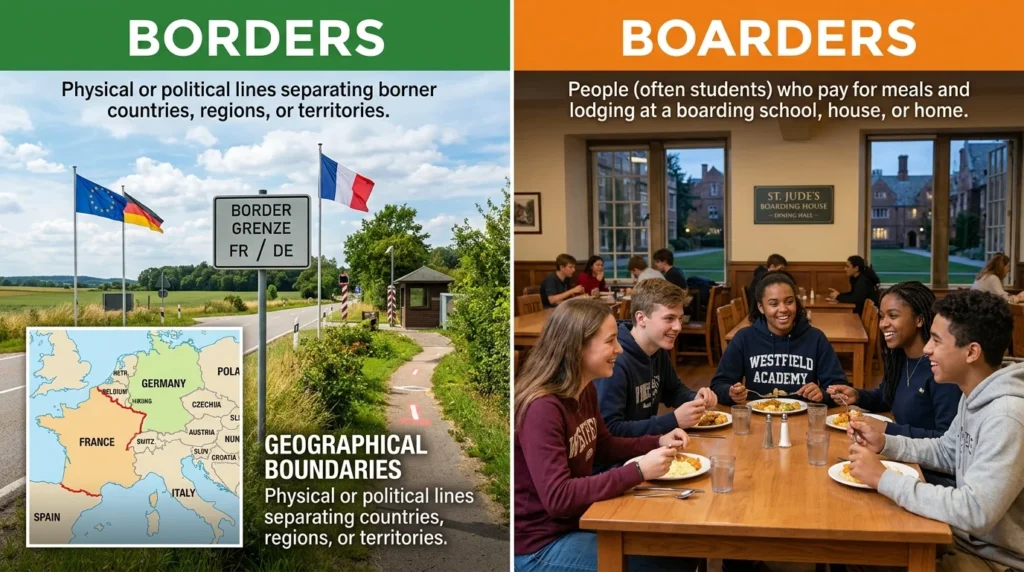
Borders is the plural of border, meaning boundaries or edges.
The two countries share borders.
Boarders is the plural of boarder, meaning people who receive accommodation and meals, or people who board something in certain contexts.
The school has several boarders.
The easiest rule
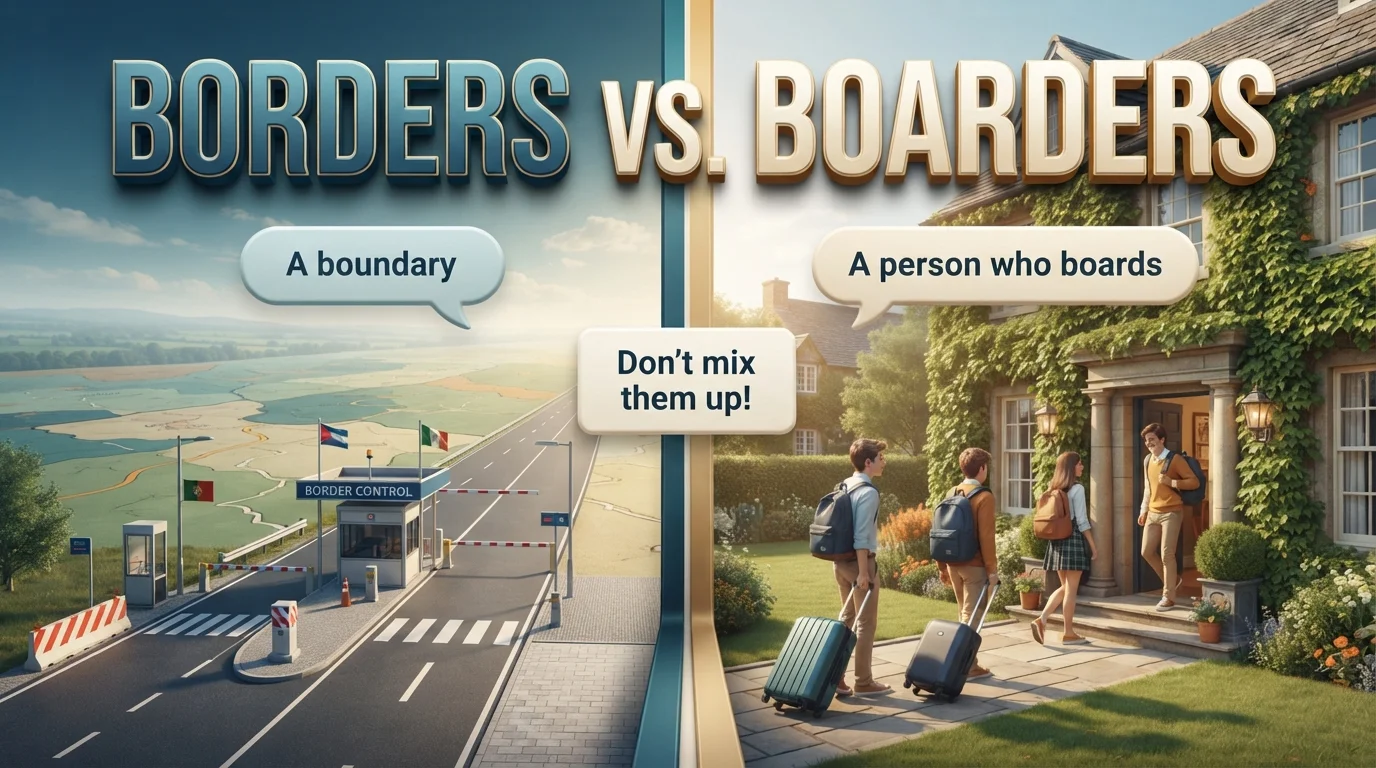
Border → boundary
Boarder → person who boards
If you’re talking about lines, boundaries, countries, edges, or limits, use borders.
If you’re talking about people staying somewhere or boarding a vehicle, use boarders.
What Does “Borders” Mean?
Borders is the plural noun or third-person singular verb form of border.
As a noun, a border is a line or area separating two places, regions, countries, or things.
Examples of “Borders”
The two countries share a border.
The countries have closed their borders.
The painting has decorative borders.
The river forms part of the border between the two regions.
The garden has flower borders around the lawn.
“Borders” as a Verb
Borders can also be a verb meaning touches, surrounds, or lies next to something.
The country borders several other nations.
The property borders a large forest.
Here, borders means is next to or shares a boundary with.
🎯 Key Insight: Borders is connected to the idea of a boundary or edge.
What Does “Boarders” Mean?
Boarders is the plural of boarder.
A boarder is generally a person who lives or stays somewhere and receives accommodation, often with meals, in exchange for payment.
Examples of “Boarders”
The school provides accommodation for boarders.
The house has three boarders.
The hostel is popular with student boarders.
The word comes from board, which historically refers to meals or food provided as part of accommodation.
Boarders in Transportation
A related use comes from the verb board, meaning to get onto a bus, train, plane, ship, or other vehicle.
The boarders were asked to wait at the gate.
However, in ordinary modern travel language, passengers is usually more natural than boarders.
🎯 Key Insight: Boarders refers to people, not boundaries.
Borders vs. Boarders: Main Difference
| Feature | Borders | Boarders |
|---|---|---|
| Singular | Border | Boarder |
| Meaning | Boundaries or edges | People who board/stay somewhere |
| Related word | Border | Board |
| Typical context | Countries, regions, objects, limits | Schools, accommodation, boarding |
| Example | The countries share borders. | The school has many boarders. |
| Memory clue | Boundary | Person |
Bottom Line
Borders = boundaries or edges.
Boarders = people who board or stay somewhere.
Borders in Different Contexts
Country Borders
The two countries share a long border.
Plural:
The region has several international borders.
Here, borders refers to geographical boundaries.
Object Borders
The document has decorative borders.
Here, a border means an outer edge or decorative boundary.
Garden Borders
She planted flowers along the garden borders.
Here, borders refers to areas or edges around a garden or lawn.
As a Verb
Canada borders the United States.
Here, borders means shares a boundary with.
🎯 Lesson: Whether you’re talking about geography, design, gardens, or neighboring areas, borders is associated with edges and boundaries.
Boarders in Different Contexts
Boarding School
The school has 200 boarders and 500 day students.
Here, boarders are students who live at the school.
Private Accommodation
The homeowner rents rooms to boarders.
Here, boarders are people who pay to stay in the home.
Boarding House
The boarding house accommodates several boarders.
Again, the word refers to people receiving accommodation.
🎯 Lesson: If you’re talking about people who live somewhere as boarders, use boarders.
Borders vs. Boarders: Real-World Usage Scenarios
Scenario 1: Geography
The two countries have closed their borders.
🎯 Lesson: Countries have borders, not boarders.
Scenario 2: Boarding School
The school provides separate facilities for boarders and day students.
🎯 Lesson: Students who live at the school are boarders.
Scenario 3: Design
The invitation has gold borders.
🎯 Lesson: Decorative edges are borders.
Scenario 4: Rental Accommodation
The homeowner has two boarders living upstairs.
🎯 Lesson: People staying in accommodation can be called boarders.
Scenario 5: Geography as a Verb
The state borders three other states.
🎯 Lesson: Borders can also be a verb meaning shares a boundary with.
Common Mistakes With Borders and Boarders
Mistake 1: “The Countries Share Boarders”
❌ The countries share boarders.
This suggests that the countries share people who are staying somewhere.
✅ The countries share borders.
Here, you’re talking about geographical boundaries.
Mistake 2: “The School Has Many Borders”
❌ The school has many borders.
If you’re talking about students who live at the school:
✅ The school has many boarders.
🎯 Why? The students board at the school.
Mistake 3: “The Garden Has Boarders”
If you’re talking about the edges of the garden:
❌ The garden has beautiful boarders.
✅ The garden has beautiful borders.
If you actually mean people living there, boarders could theoretically be correct—but that’s obviously a very different meaning.
Mistake 4: Confusing “Border” With “Board”
The words come from completely different concepts.
border → boundary
board → stay somewhere / get onto a vehicle
That difference helps explain their spelling.
Border vs. Boarder: Singular Forms
Understanding the singular forms makes the plural difference much easier.
Border
The border is closed.
Plural:
The borders are closed.
Boarder
The student is a boarder.
Plural:
The students are boarders.
Memory Pattern
border → borders
boarder → boarders
The extra a connects boarder to board.
Borders vs. Boarders and “Bordering”
Another useful word is bordering.
The region is bordering the sea.
More commonly:
The property borders the river.
Bordering is related to border, not board.
Word Family
Border:
- border
- borders
- bordered
- bordering
Board:
- board
- boards
- boarded
- boarding
- boarder
- boarders
🎯 Key Insight: Boarders belongs to the board word family.
Memory Tricks: Borders vs. Boarders
🗺️ Trick 1: Borders = Boundary
Think:
Border = boundary
So:
Borders = boundaries
Countries, states, gardens, pictures, and regions can all have borders.
🏠 Trick 2: Boarders = Board
Think:
Boarder = someone who boards
A person who boards at a school or house is a boarder.
✈️ Trick 3: The “A” Connects to Board
Look carefully:
border
vs.
boarder
The a in boarder reminds you of board.
⭐ One-Line Memory Trick
Borders mark boundaries; boarders are people who board.
Expert Insight: Why Are Borders and Boarders Confused?
The two words are pronounced very similarly in many varieties of English, making them homophones or near-homophones depending on accent.
Their spelling, however, reflects different word families.
Border is associated with a boundary or edge.
Boarder comes from board, historically connected with receiving food and accommodation and also with the verb board, meaning to get onto a vehicle.
This is a classic example of why English spelling cannot always be predicted from pronunciation.
When writing, identify the meaning first, then choose the spelling.
Quick Test: Borders or Boarders?
1. The two countries share several ________.
Answer: borders
2. The school has more than 100 ________.
Answer: boarders
3. The invitation has decorative ________.
Answer: borders
4. The students who live at the school are ________.
Answer: boarders
5. The property ________ a large lake.
Answer: borders
6. The hostel provides rooms for ________.
Answer: boarders