
Quick Answer: Continuous vs. Continuing
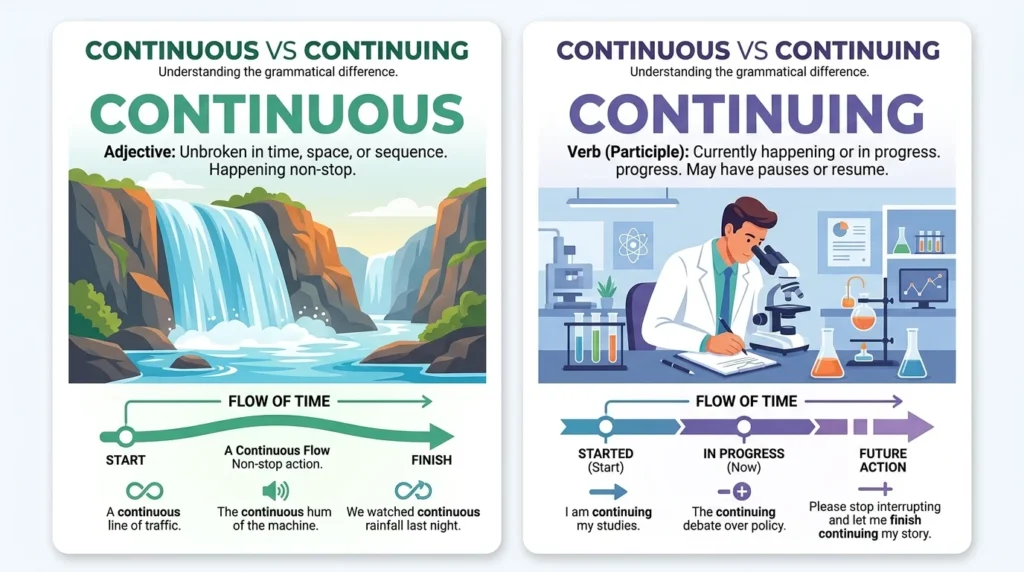
Continuous means without stopping or interruption.
There was continuous noise throughout the night.
Continuing means still happening or carrying on.
The continuing rain caused flooding.
The easiest rule
Continuous = no breaks
Continuing = still going on
If something happens without interruption, use continuous.
If something has not stopped and is still happening, use continuing.
What Does “Continuous” Mean?
Continuous is an adjective meaning happening or existing without interruption, breaks, or pauses.
The emphasis is on unbroken duration.
Examples
The machine produces a continuous stream of water.
We heard continuous noise from the construction site.
The road has a continuous line down the center.
The patient experienced continuous pain.
Continuous rain caused the river to rise.
In each example, the important idea is that something happens without a break.
🎯 Key Insight: Continuous answers the question:
“Does it happen without stopping?”
If yes, continuous may be the right choice.
What Does “Continuing” Mean?
Continuing is the present participle of continue, and it can also function as an adjective.
It means still happening, still existing, or carrying on.
Unlike continuous, it does not necessarily mean that there have been no interruptions.
Examples
The continuing conflict has affected the region.
We are concerned about the continuing rise in prices.
The company faces continuing financial difficulties.
Despite the continuing rain, the event went ahead.
Here, the focus is that the situation has not ended.
🎯 Key Insight: Continuing answers the question:
“Is it still going on?”
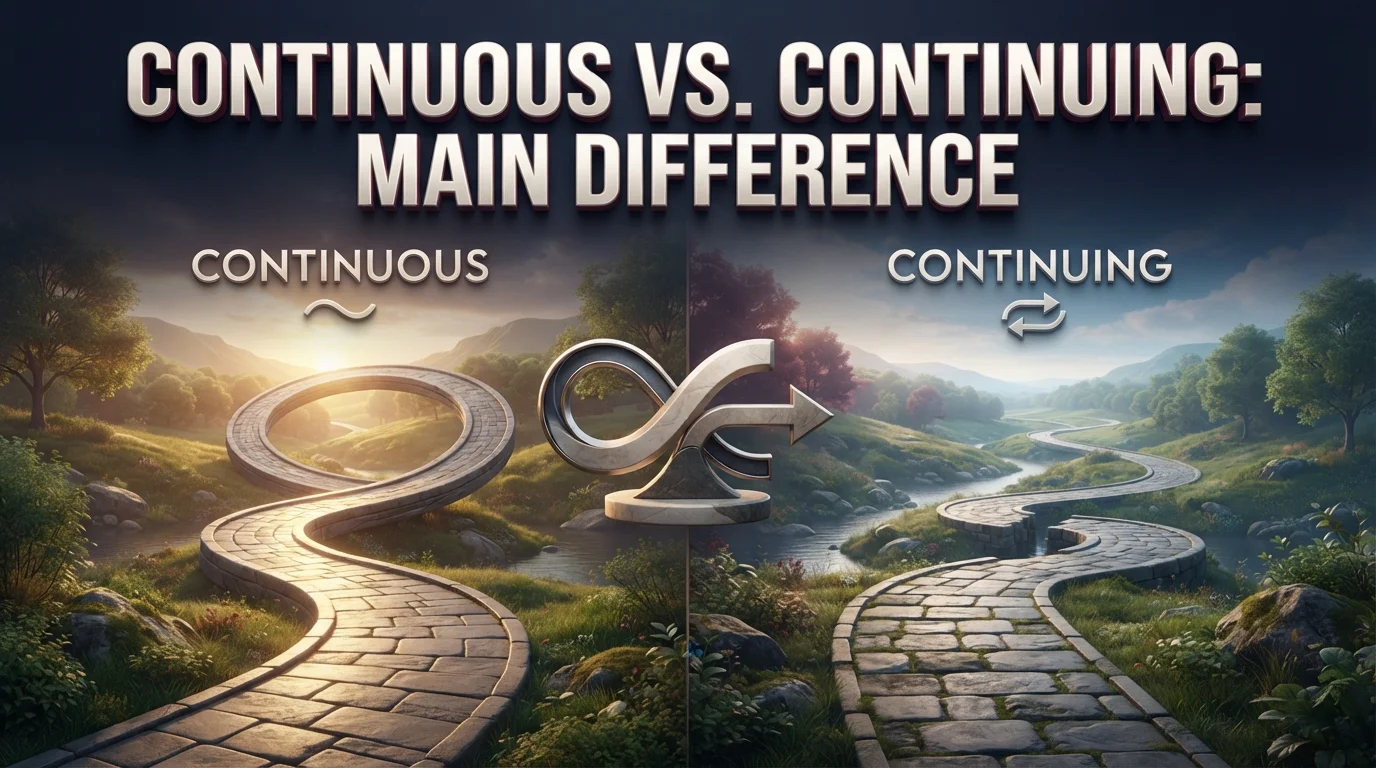
Continuous vs. Continuing: Main Difference
| Feature | Continuous | Continuing |
|---|---|---|
| Basic meaning | Happening without interruption | Still happening or carrying on |
| Main focus | No breaks | Persistence over time |
| Can include pauses? | Usually no | Yes, potentially |
| Emphasis | Unbroken activity | Ongoing situation |
| Example | Continuous rain for six hours | Continuing rain this week |
| Memory clue | No stop | Still going |
Bottom Line
Continuous = uninterrupted
Continuing = ongoing
This is the most important distinction to remember.
Continuous: Focus on No Interruption
When you use continuous, you’re emphasizing that something occurs from beginning to end without stopping.
Example
The alarm made a continuous sound for ten minutes.
The sound did not stop during those ten minutes.
Compare:
The alarm made a continuing sound.
This is less natural because continuing doesn’t specifically communicate the uninterrupted nature of the sound.
More Examples
Continuous rainfall caused flooding.
The patient was under continuous observation.
The system requires a continuous power supply.
The video contains continuous background noise.
🎯 Lesson: Use continuous when breaks or interruptions are important to the meaning.
Continuing: Focus on Ongoing Status
Continuing emphasizes that something remains active or has not ended.
It doesn’t necessarily tell us whether the activity has been uninterrupted.
Example
The continuing investigation has uncovered new evidence.
The investigation is still underway.
It doesn’t necessarily mean investigators have worked every second without stopping.
More Examples
The company is facing continuing pressure from competitors.
Continuing negotiations may lead to an agreement.
The continuing debate has divided public opinion.
She received continuing support from her family.
🎯 Lesson: Use continuing when the important idea is that something remains in progress or persists.
Continuous vs. Continuing: Real-World Usage Scenarios
Scenario 1: Rain
There was continuous rain for eight hours.
This means the rain didn’t stop during that period.
🎯 Lesson: Use continuous when emphasizing uninterrupted activity.
Scenario 2: Long-Term Problem
The continuing rain has caused delays.
This means the rain is still happening.
It doesn’t necessarily mean that it has rained every second.
🎯 Lesson: Use continuing when emphasizing an ongoing situation.
Scenario 3: Investigation
The continuing investigation has revealed new information.
The investigation is still in progress.
🎯 Lesson: Continuing is natural for processes that remain underway.
Scenario 4: Monitoring
The patient requires continuous monitoring.
The patient needs to be monitored without interruption.
🎯 Lesson: Continuous emphasizes uninterrupted monitoring.
Scenario 5: Support
The organization provided continuing support to the community.
The support continued over time.
🎯 Lesson: Continuing emphasizes persistence rather than an unbroken moment-by-moment activity.
Continuous vs. Continuing in Professional Writing
The distinction is especially useful in formal and business writing.
Continuous Improvement
Continuous improvement is a very common expression.
It refers to making improvements repeatedly and systematically over time.
The company is committed to continuous improvement.
Interestingly, this does not necessarily mean improvements happen literally every second without interruption.
It is an established expression describing an ongoing process of improvement.
Continuing Improvement
The company has made continuing improvements to its service.
This means improvements are still being made.
The phrase is possible, but continuous improvement is the more established expression in management and business contexts.
🎯 Key Insight: Some expressions are conventional, so context and established collocations matter in addition to the basic definition.
Continuous vs. Continual
Another word that often causes confusion is continual.
Continuous
Usually means:
without interruption
continuous noise
Continual
Usually means:
happening repeatedly, often with interruptions
continual interruptions
Compare
The machine produced continuous noise.
The noise did not stop.
The machine caused continual problems.
Problems happened repeatedly.
Memory Trick
Continuous = no breaks
Continual = repeated breaks
This distinction is useful when choosing precise vocabulary.
Continuing vs. Ongoing
Continuing and ongoing are often close in meaning.
The continuing investigation
The ongoing investigation
Both mean that the investigation is still in progress.
However, ongoing is often more natural in modern business and professional writing.
Examples
ongoing negotiations
ongoing research
ongoing discussions
continuing support
continuing concerns
🎯 Lesson: Continuing is correct, but some contexts strongly favor ongoing as the more natural collocation.
Common Mistakes With Continuous and Continuing
Mistake 1: Using “Continuous” for Something That Simply Remains
❌ The continuous investigation is still underway.
This can sound as though the investigation happens without interruption.
Better:
✅ The continuing investigation is still underway.
Or:
✅ The ongoing investigation is still underway.
🎯 Why? You’re emphasizing that the investigation hasn’t ended, not that it happens without breaks.
Mistake 2: Using “Continuing” When No Interruption Is Intended
The patient requires continuing monitoring.
This can mean monitoring that continues over time, but if the intended meaning is constant, uninterrupted monitoring, use:
The patient requires continuous monitoring.
🎯 Why? Continuous specifically emphasizes the absence of interruption.
Mistake 3: Thinking They Are Exact Synonyms
They overlap, but:
continuous = uninterrupted
while:
continuing = ongoing
This distinction is especially important in technical, medical, legal, and professional writing.
Continuous vs. Continuing: A Simple Substitution Test
Can you replace it with “without interruption”?
If yes, continuous is probably appropriate.
continuous monitoring
= monitoring without interruption
continuous noise
= noise without interruption
Can you replace it with “still happening”?
If yes, continuing is probably appropriate.
continuing negotiations
= negotiations still happening
continuing problems
= problems still occurring
Quick Formula
Continuous → uninterrupted
Continuing → still happening
Memory Tricks: Continuous vs. Continuing
🔄 Trick 1: Continuous = Constant
Think:
Continuous = constant, with no break
For example:
continuous music
The music keeps playing.
⏳ Trick 2: Continuing = Still
Think:
Continuing = still going
For example:
continuing negotiations
The negotiations are still happening.
⭐ One-Line Memory Trick
Continuous means “without a break”; continuing means “not finished yet.”
Expert Insight: Why the Difference Matters
Both words are derived from the idea of continuing over time, but English uses them to highlight different aspects of duration.
Continuous describes the internal pattern of an activity: it proceeds without interruption.
Continuing describes its status in relation to time: it remains active or has not ended.
Consider:
continuous rainfall
The emphasis is on rainfall occurring without interruption.
continuing rainfall
The emphasis is on rainfall that is still occurring.
This distinction becomes particularly valuable when precision matters. A process can be continuing even if it contains pauses, but something described as continuous generally cannot contain meaningful interruptions.
Quick Test: Continuous or Continuing?
1. The machine requires ________ power.
Answer: continuous
The power supply must not be interrupted.
2. The ________ investigation has raised new questions.
Answer: continuing
The investigation is still underway.
3. We experienced ________ noise throughout the night.
Answer: continuous
The noise did not stop.
4. The company faces ________ financial difficulties.
Answer: continuing
The difficulties remain present over time.
5. The patient requires ________ monitoring.
Answer: continuous
The intended meaning is uninterrupted monitoring.
6. The government is involved in ________ negotiations.
Answer: continuing
The negotiations are still taking place.