

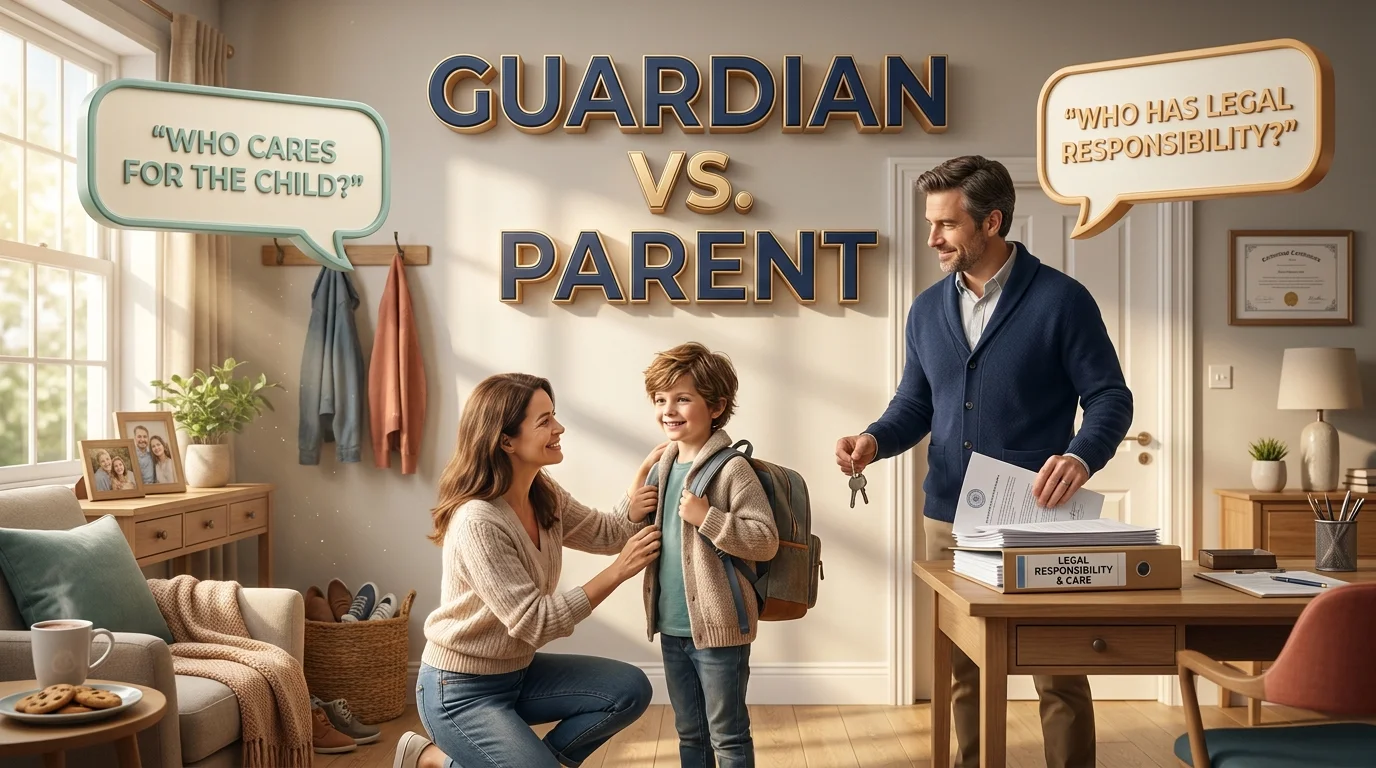
Quick Answer: Guardian vs. Parent
Parent refers to a child’s mother or father, whether by biological relationship, adoption, or another legally recognized parent-child relationship.
Guardian refers to a person legally authorized or appointed to care for a child or make decisions on the child’s behalf.
The easiest rule
Parent = parent-child relationship
Guardian = legal responsibility or authority
A parent may be a child’s guardian, but a guardian does not have to be the child’s parent.
What Does “Parent” Mean?
A parent is a person’s mother or father.
The term can refer to:
- A biological parent
- An adoptive parent
- A legally recognized parent
- In some contexts, a person who has assumed a legally recognized parental role
Examples
Her parents attended the school meeting.
The child’s mother is her legal parent.
His adoptive parents raised him from infancy.
🎯 Key Insight: Parent primarily describes the parent-child relationship.
What Does “Guardian” Mean?
A guardian is generally someone who has been given legal responsibility or authority to care for another person, particularly a child who needs someone to act on their behalf.
Guardianship can arise in different circumstances, and the exact powers of a guardian depend on the applicable law and court order.
Examples
The court appointed her uncle as the child’s guardian.
The guardian was responsible for making decisions on the child’s behalf.
The school requested the guardian’s signature.
🎯 Key Insight: Guardian primarily describes a legal role or responsibility.
Guardian vs. Parent: Main Difference
| Feature | Parent | Guardian |
|---|---|---|
| Basic meaning | Mother or father of a child | Person legally responsible for another person, often a child |
| Relationship | Parent-child relationship | Legal responsibility/authority |
| Must be biologically related? | No; adoptive/legal parents can be parents | No |
| Must be a parent? | Yes, by definition | No |
| Can make decisions for a child? | Generally, subject to applicable law | Often, depending on the type and scope of guardianship |
| Can be appointed by a court? | Not necessarily | Commonly |
| Example | The child’s father | The child’s aunt appointed by a court |
| Memory clue | Relationship | Responsibility |
Bottom Line
Parent describes who someone is in relation to the child.
Guardian describes a legal caregiving or decision-making role.
Can a Parent Also Be a Guardian?
Yes.
A parent can also have legal guardianship responsibilities for their child, depending on the jurisdiction and circumstances.
For example:
The child’s mother is both her parent and her legal guardian.
In ordinary situations, people may simply refer to her as the child’s parent rather than emphasizing the guardianship role.
🎯 Lesson: Parent and guardian are not mutually exclusive categories.
Can a Guardian Be a Parent?
Yes.
A parent can also serve as a guardian.
However, the important point is:
Not every guardian is a parent.
For example:
A child’s grandmother may be appointed as the child’s guardian.
She is the child’s guardian, but she is not necessarily the child’s parent.
Can a Guardian Be a Relative?
Yes.
A guardian may be:
- A grandparent
- An aunt or uncle
- An adult sibling
- Another relative
- Another suitable adult
The exact rules vary by jurisdiction.
Example
After the child’s parents could no longer provide care, the court appointed his grandmother as guardian.
🎯 Lesson: A guardian can be a relative without being a parent.
Guardian vs. Parent in School Forms
This is one of the places where the distinction matters.
A school form might ask:
Parent/Guardian Name
This wording recognizes that the person responsible for the child may be a parent, a guardian, or another legally authorized person, depending on the circumstances.
Example
If a child’s aunt has legal guardianship:
Parent/Guardian: Sarah Khan
She would provide her information as the child’s guardian, even though she is not the child’s parent.
🎯 Key Insight: “Parent/guardian” is often used when a form needs information from the adult legally responsible for the child.
Guardian vs. Parent in Medical Decisions
A parent or guardian may be asked to provide consent or make decisions for a child, but the exact authority depends on:
- Local law
- The child’s age
- The type of medical decision
- Court orders
- The parent’s legal status
- The guardian’s authority
Therefore, guardian and parent should not automatically be assumed to have identical legal powers in every situation.
Guardian vs. Parent in Legal Contexts
In legal writing, the distinction can become especially important.
Parent
Focuses on the person’s legal or familial relationship to the child.
The child’s legal parent requested custody.
Guardian
Focuses on the person’s court-recognized or legally established responsibility and authority.
The court appointed the child’s grandmother as guardian.
🎯 Lesson: In legal contexts, don’t treat the words as automatic synonyms.
Guardian vs. Custodian
Another term that is often confused with guardian is custodian.
These concepts can overlap, but they are not necessarily identical.
A custodian generally refers to someone who has physical care or custody of a child, while a guardian may have broader legal authority depending on the jurisdiction.
For example:
A parent may have physical custody of a child while another person has a different legal role.
Because family-law terminology varies considerably by jurisdiction, the exact distinction should be checked under the relevant local law.
Guardian vs. Parent: Real-World Usage Scenarios
Scenario 1: Biological Mother
Maria is the child’s mother.
🎯 Lesson: Maria is the child’s parent.
Scenario 2: Grandmother With Legal Guardianship
The court appointed Maria’s grandmother as her guardian.
🎯 Lesson: The grandmother is the guardian, even though she is not the parent.
Scenario 3: Adoptive Family
The child’s adoptive parents are legally recognized as her parents.
🎯 Lesson: A parent does not have to be biologically related to the child.
Scenario 4: School Form
Parent/Guardian signature required.
🎯 Lesson: The school is asking the adult with the relevant parental or legal responsibility.
Scenario 5: Parent Who Is Also Guardian
The child’s father is her parent and legal guardian.
🎯 Lesson: One person can hold both roles.
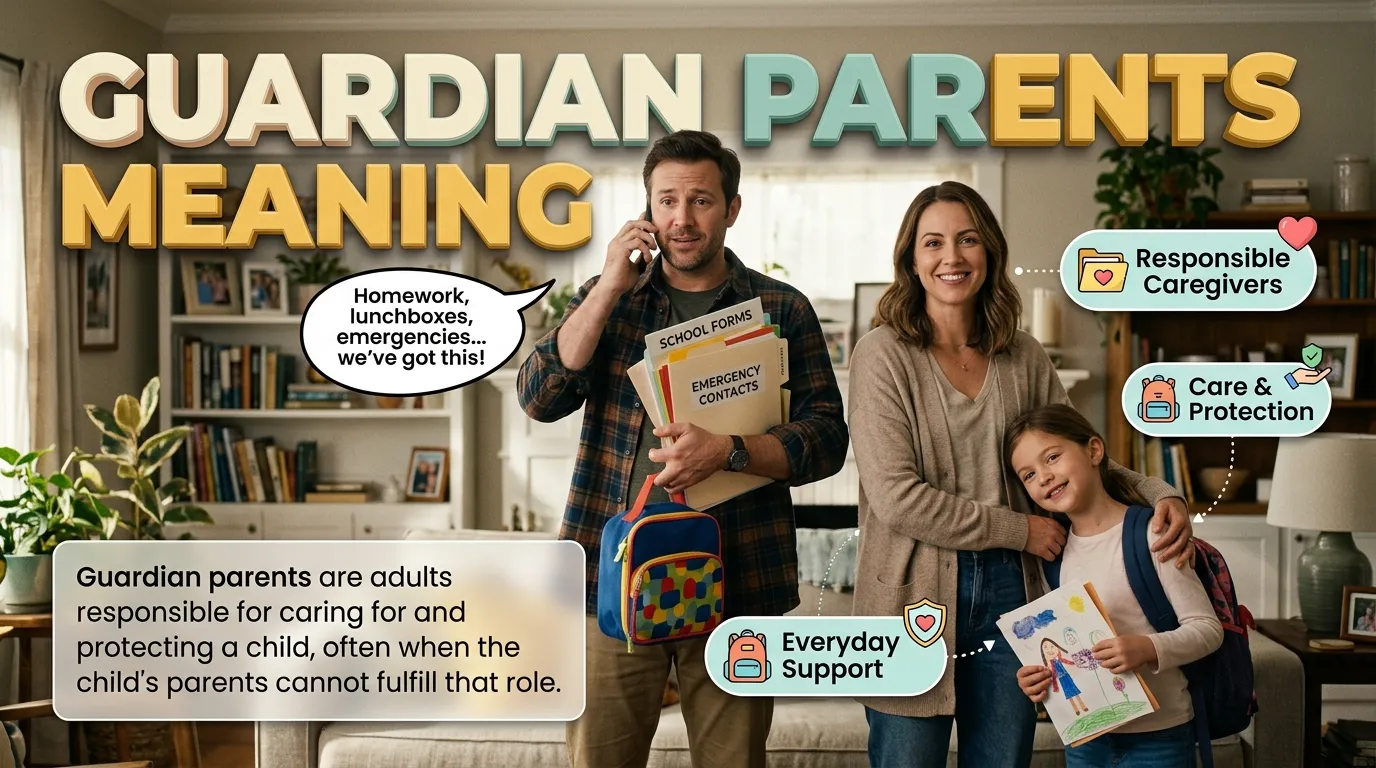
Guardian Parents Meaning
A parent or guardian is an adult who is responsible for a child’s care, safety, well-being, and, when applicable, legal decisions. A parent is typically a child’s mother or father, while a guardian is someone who has been given responsibility for the child, often through a legal arrangement.
The term parent or guardian commonly appears on school registration forms, medical consent documents, permission slips, and applications involving minors. It allows an organization to request information or authorization from the adult responsible for the child.
For example:
A school asks a parent or guardian to sign a field-trip permission slip.
A hospital requests consent from a parent or legally authorized guardian before certain treatments for a minor.
A sports club requires a parent or guardian to complete a child’s registration.
The phrase does not necessarily mean that a child has both a parent and a guardian. The word or indicates that the form may be completed by whichever person is appropriately responsible.
Parent Guardian Name
The term parent/guardian name refers to the full name of the parent or guardian responsible for the child or student.
When a form asks for this information, enter the name of the adult who is responsible for the child and who is completing or supporting the application.
For example:
Student name: Emma Johnson
Parent/guardian name: Michael Johnson
Relationship to student: Father
If the person completing the form is the child’s legal guardian rather than a parent, enter the guardian’s name instead.
Some forms provide separate fields for the mother’s name, father’s name, and guardian’s name. In that situation, follow the form’s specific instructions rather than entering the same person’s name in every field.
Guardian and Parents Difference
The main difference between a parent and a guardian is the nature of their relationship with the child and the legal authority they may have.
A parent is generally a child’s mother or father, including an adoptive parent. A guardian is a person who has been given responsibility for a child’s care or decision-making, often through a court order or another legally recognized arrangement.
Feature | Parent | Guardian |
|---|---|---|
Relationship | Usually the child’s mother or father | May be a relative or another responsible adult |
How the role arises | Through parenthood or adoption | Often through a legal appointment or recognized arrangement |
Responsibility | Typically includes care and upbringing | Depends on the guardian’s assigned responsibilities |
Legal authority | Generally has parental rights, subject to applicable law | Depends on the appointment and applicable law |
Example | A child’s mother signs a school form | An appointed aunt signs a school form within her authority |
A guardian is not automatically the same as a foster parent, caregiver, or babysitter. Those roles may involve caring for a child without granting the same legal decision-making powers.
The precise rights and responsibilities of parents and guardians vary by jurisdiction and individual circumstances.
Parent Guardian Signature
A parent/guardian signature is the signature of the parent or authorized guardian who is approving, acknowledging, or confirming the information on a document.
Schools, healthcare providers, sports organizations, and other institutions may request this signature when a child is involved.
For example, a school permission form might contain these fields:
Student’s name: Emma Johnson
Parent/guardian name: Michael Johnson
Relationship to student: Father
Parent/guardian signature: Michael Johnson’s signature
Date: October 17, 2026
When signing, the adult should read the document and understand what they are authorizing. A signature may indicate permission for a school trip, confirmation of information, or consent to participate in an activity.
If the signer is a guardian rather than a parent, they should ensure that their authority covers the decision involved. A person should not sign as a parent or legal guardian if they do not hold that role or have the necessary authorization.
Parent Guardian App
A parent guardian app is a mobile application or online platform that helps parents and authorized guardians manage information and activities related to a child.
Depending on the app, features may include:
School communication: Receiving messages from teachers and school administrators.
Attendance tracking: Viewing attendance records and absence notifications.
Academic information: Checking grades, assignments, and school announcements.
Permission forms: Reviewing and submitting consent forms.
Family communication: Receiving updates about school activities, schedules, and events.
Account management: Managing contact details and authorized guardian access.
Some apps are designed specifically for schools, while others support childcare, healthcare, family scheduling, or parental controls.
The exact meaning depends on the application being discussed. If you are looking for a particular parent or guardian app, its name or the school or service using it will help identify the correct one.
Parent or Guardian Letter
A parent or guardian letter is a written document provided by a child’s parent or authorized guardian to communicate information, grant permission, explain a situation, or confirm a child’s circumstances.
The contents depend on the purpose of the letter. Common examples include school absence explanations, field-trip permissions, travel authorization, and confirmation of guardianship.
Here is a simple example of a school permission letter.
Subject: Permission for School Activity
Dear Teacher,
I am writing to give permission for my child, [Child’s Full Name], to participate in [Name of School Activity] on [Date].
I understand the nature of the activity and authorize my child to participate.
Please contact me if any additional information is required.
Sincerely,
[Parent/Guardian’s Full Name]
[Relationship to Child]
[Contact Number]
[Date]
For official, legal, immigration, or travel purposes, the letter may need specific information, supporting documents, notarization, or consent from additional parties. Requirements depend on the receiving organization and applicable law.
Parent or Guardian in Spanish
The Spanish translation of parent or guardian is generally padre, madre o tutor legal, although the best wording depends on the context and the country.
Common translations include:
English | Spanish |
|---|---|
Parent | Padre or madre |
Parents | Padres |
Guardian | Tutor or tutora |
Legal guardian | Tutor legal or tutora legal |
Parent or guardian | Padre, madre o tutor legal |
Parent/guardian name | Nombre del padre, madre o tutor legal |
Parent/guardian signature | Firma del padre, madre o tutor legal |
Parent or guardian consent | Consentimiento del padre, madre o tutor legal |
On a school form, Nombre del padre, madre o tutor legal is a clear way to ask for the name of the responsible adult.
Spanish usage varies across countries. For example, representante legal may be more appropriate when referring broadly to a person’s legally authorized representative, while tutor legal specifically refers to a legal guardian in many contexts.
Parent Guardian Movie
The search phrase “Parent Guardian Movie” is ambiguous because it does not identify a unique film title. It could refer to a movie about parents and guardians, a film with a guardian character, or a title containing one of those words.
If you mean a particular movie, the release year, an actor’s name, or a few details about the plot would help identify it.
For example, you might be looking for a family drama about guardianship, a legal film involving custody of a child, or a movie whose title includes Guardian. These are different searches, so identifying the intended film is necessary before providing an accurate synopsis, cast list, or age rating.
Common Mistakes With Guardian and Parent
Mistake 1: Assuming Every Guardian Is a Parent
❌ The child’s guardian must be his father or mother.
Not necessarily.
A guardian may be a grandparent, relative, or another legally appointed adult.
Mistake 2: Assuming Every Parent Is Automatically Called a Guardian
In everyday language, we normally call a child’s mother or father a parent.
Whether that person is legally classified as a guardian depends on the applicable law and circumstances.
🎯 Why it happens: The responsibilities can overlap, but the terms describe different concepts.
Mistake 3: Thinking “Guardian” Means Foster Parent
A guardian and a foster parent are not automatically the same.
Foster care generally concerns a child being placed in someone’s care under a particular legal or child-welfare arrangement.
Guardianship concerns a specific legal authority or responsibility.
The two can overlap in some circumstances, but they should not automatically be treated as synonyms.
Mistake 4: Using the Words Interchangeably in Legal Documents
In casual conversation, the distinction may not matter.
In legal, medical, educational, or government documents, however, the exact status of the adult can matter significantly.
Parent vs. Guardian: Which Word Should You Use?
Use parent when you mean:
- Mother or father
- Biological parent
- Adoptive parent
- Legally recognized parent
Use guardian when you mean:
- A person legally appointed to care for a child
- Someone with legal authority over the child
- A non-parent who has been given guardianship
Compare
The parent attended the meeting.
This identifies the adult by their parental relationship.
The guardian attended the meeting.
This identifies the adult by their legal caregiving role.
Memory Tricks: Guardian vs. Parent
👨👩👧 Trick 1: Parent = Relationship
Think:
Parent → family relationship
🛡️ Trick 2: Guardian = Responsibility
Think:
Guardian → guards/protects and has legal responsibility
⭐ One-Line Memory Trick
Parent = who the person is to the child.
Guardian = what legal role the person has.
Expert Insight: Why the Distinction Matters
The difference between parent and guardian is fundamentally a distinction between relationship and legal role.
A parent-child relationship can exist through biology, adoption, or legal recognition.
Guardianship, on the other hand, is a legal framework that gives a person particular responsibilities and authority.
That’s why one child could have:
Parents + a guardian
or:
A parent who is also the guardian
depending on the circumstances and applicable law.
The exact rights of parents and guardians are jurisdiction-specific, so legal documents should always be interpreted according to the relevant law rather than relying solely on ordinary dictionary meanings.
Quick Test: Guardian or Parent?
1. “She is the child’s biological mother.”
Answer: Parent
2. “The court appointed the child’s uncle to care for him.”
Answer: Guardian
3. “His adoptive mother is his legal ________.”
Answer: Parent
4. “The school requested the child’s ________ to sign the form.”
If the adult has legal guardianship:
Answer: Guardian
5. “Can a grandmother be a guardian?”
Answer: Yes.
A grandmother can be appointed as a child’s guardian, depending on the applicable law and circumstances.
6. “Can a parent also be a guardian?”
Answer: Yes.
The roles can overlap.