

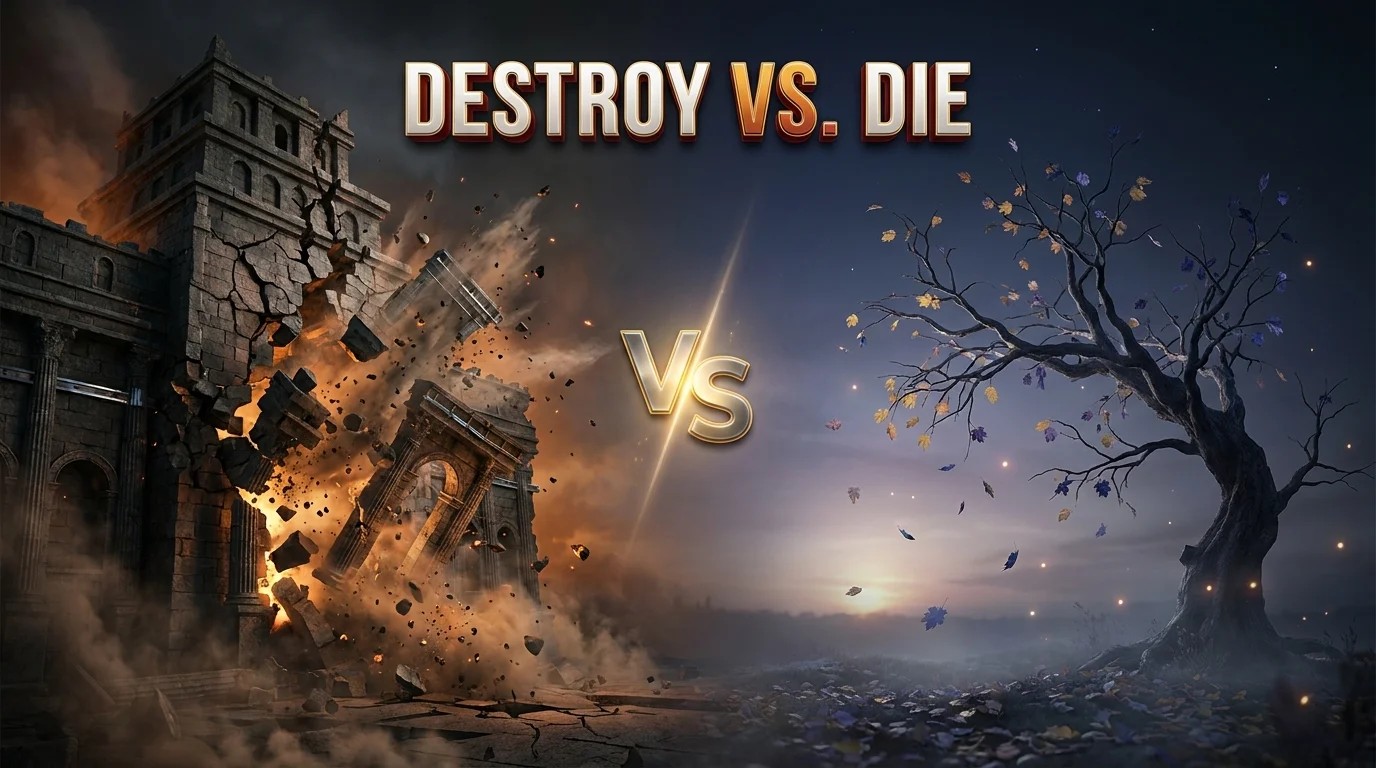
Quick Answer: Destroy vs. Die
Destroy = to cause something to be ruined or completely damaged.
Die = to stop living, functioning, or existing.
Compare:
- The fire destroyed the house. → The fire caused the damage.
- The plant died. → The plant itself stopped living.
🎯 Simple rule: Destroy is usually something you do to something; die is something that happens to the subject itself.
What Does “Destroy” Mean?
Destroy is a verb meaning to ruin, damage, demolish, or eliminate something.
It is normally a transitive verb, meaning it usually takes a direct object.
Examples of “Destroy”
The storm destroyed several buildings.
The fire destroyed the old documents.
The company destroyed the damaged products.
In each example, something causes another thing to be destroyed.
Grammar Pattern
The common structure is:
Subject + destroy + object
For example:
The earthquake destroyed the bridge.
Here:
- The earthquake = subject
- destroyed = verb
- the bridge = object
🎯 Key Insight: Destroy requires something that is destroyed.
What Does “Die” Mean?
Die means to stop living.
It can also be used figuratively or for things that stop functioning.
Examples of “Die”
The plant died during the drought.
The fish died because of the polluted water.
My phone died before I could call you.
The battery died overnight.
The subject itself is the thing that stops living or functioning.
Grammar Pattern
The common structure is:
Subject + die
For example:
The plant died.
You normally do not say:
❌ The plant died the garden.
Instead, if something caused the plant’s death:
✅ The heat killed the plant.
🎯 Key Insight: Die is normally an intransitive verb, so it does not directly take an object.
Destroy vs. Die: Main Difference
| Feature | Destroy | Die |
|---|---|---|
| Meaning | Ruin or eliminate something | Stop living or functioning |
| Verb type | Usually transitive | Usually intransitive |
| Needs an object? | Usually yes | No |
| Cause involved? | Something causes destruction | Subject experiences death |
| Example | “The fire destroyed the house.” | “The house burned down.” |
| Human example | “The disease destroyed his health.” | “He died.” |
| Object example | “The storm destroyed the crops.” | “The crops died.” |
Destroy vs. Die: The Most Important Difference
The easiest way to understand the distinction is to look at agency and grammatical structure.
Destroy
Someone or something causes destruction.
The hurricane destroyed the house.
The hurricane is responsible for the destruction.
Die
The subject ceases to live or function.
The plant died.
The plant is the subject experiencing the change.
🎯 Lesson: If you mean “cause something to be ruined,” use destroy. If you mean “stop living,” use die.
Real-World Usage Scenarios
Scenario 1: A Fire
The fire destroyed the building.
The fire caused the building to be ruined.
🎯 Lesson: Use destroy when describing the cause of the damage.
Scenario 2: A Plant
The plant died because it wasn’t watered.
The plant itself stopped living.
🎯 Lesson: Use die when the subject itself stops living.
Scenario 3: Crops
The drought destroyed the crops.
The drought caused severe damage to the crops.
You can also say:
The crops died during the drought.
Both are grammatical, but the focus changes.
🎯 Lesson: Destroyed emphasizes the damaging force; died emphasizes the condition of the crops.
Scenario 4: A Phone Battery
My phone died while I was traveling.
This is an informal way of saying the phone stopped working, usually because its battery ran out.
You could say:
The dead battery caused the phone to stop working.
🎯 Lesson: Die is also commonly used figuratively for devices and batteries.
Destroy vs. Die: Cause and Result
This distinction becomes especially clear when both words appear in the same situation.
Consider:
The disease destroyed his body.
versus:
He died from the disease.
The first sentence focuses on damage caused by the disease.
The second focuses on the person’s death.
Another example:
The fire destroyed the forest.
versus:
Many trees died in the fire.
The first focuses on destruction.
The second focuses on the trees no longer being alive.
Destroy vs. Die: Meaning
In Magic: The Gathering (MTG), destroy and die are related terms, but they do not mean exactly the same thing. Destroy describes an action or effect that removes a permanent from the battlefield, while die describes what happens when a creature goes from the battlefield to its owner’s graveyard.
Understanding this distinction is important because many MTG cards trigger when a creature dies, while others specifically destroy creatures or prevent them from being destroyed.
Key differences:
Destroy: An effect instructs a permanent to be destroyed. Examples include spells that say “Destroy target creature.”
Die: A creature dies when it moves from the battlefield to its owner’s graveyard.
Relationship: Destroying a creature usually causes it to die, provided it actually reaches its owner’s graveyard.
Exceptions: Exiling a creature, returning it to its owner’s hand, or moving it to another zone instead of the graveyard does not count as dying.
For example, if you cast a spell that says “Destroy target creature” and the creature goes to its owner’s graveyard, that creature dies. An ability that triggers whenever a creature dies can therefore trigger.
However, if a replacement effect exiles that creature instead, it does not die because it never reaches the graveyard.
Does Destroy Count as Dying in MTG?
Yes. In Magic: The Gathering, destroying a creature counts as dying if that creature is put into its owner’s graveyard from the battlefield. The official rules define “dies” as being put into a graveyard from the battlefield.
For example, if you cast a spell that says “Destroy target creature,” and the creature goes to its owner’s graveyard, it dies. Any abilities that trigger when that creature dies can trigger.
However, there are exceptions:
Indestructible: An indestructible creature cannot be destroyed by effects that say “destroy” or by lethal damage. It stays on the battlefield, so it does not die from that attempted destruction.
Exile replacement effects: If a replacement effect exiles the creature instead of allowing it to go to the graveyard, it does not die.
Regeneration: If a regeneration effect replaces a destruction event, the creature remains on the battlefield rather than dying from that event.
For example, if your creature has indestructible and your opponent casts a spell that says “Destroy target creature,” your creature survives. Since it never goes to the graveyard, it does not die.
MTG Dies vs. Sacrifice
In MTG, sacrifice and die are not the same action, but sacrificing a creature usually causes it to die.
Sacrifice means that a player puts a permanent they control into its owner’s graveyard, as instructed by a spell, ability, or cost. Die describes the resulting movement from the battlefield to the graveyard when the permanent is a creature.
For example, suppose you control a creature with the ability “Whenever this creature dies, draw a card.” If you sacrifice that creature to pay an ability’s cost, it goes to the graveyard and its death ability can trigger.
The important differences are:
Sacrifice: Describes how the creature is put into the graveyard.
Die: Describes a creature being put into the graveyard from the battlefield.
Destroy: Is a different action that can also cause a creature to die.
Indestructible: Does not prevent a creature from being sacrificed.
For instance, if you sacrifice an indestructible creature, it still goes to the graveyard and dies. Indestructible prevents destruction, not sacrifice.
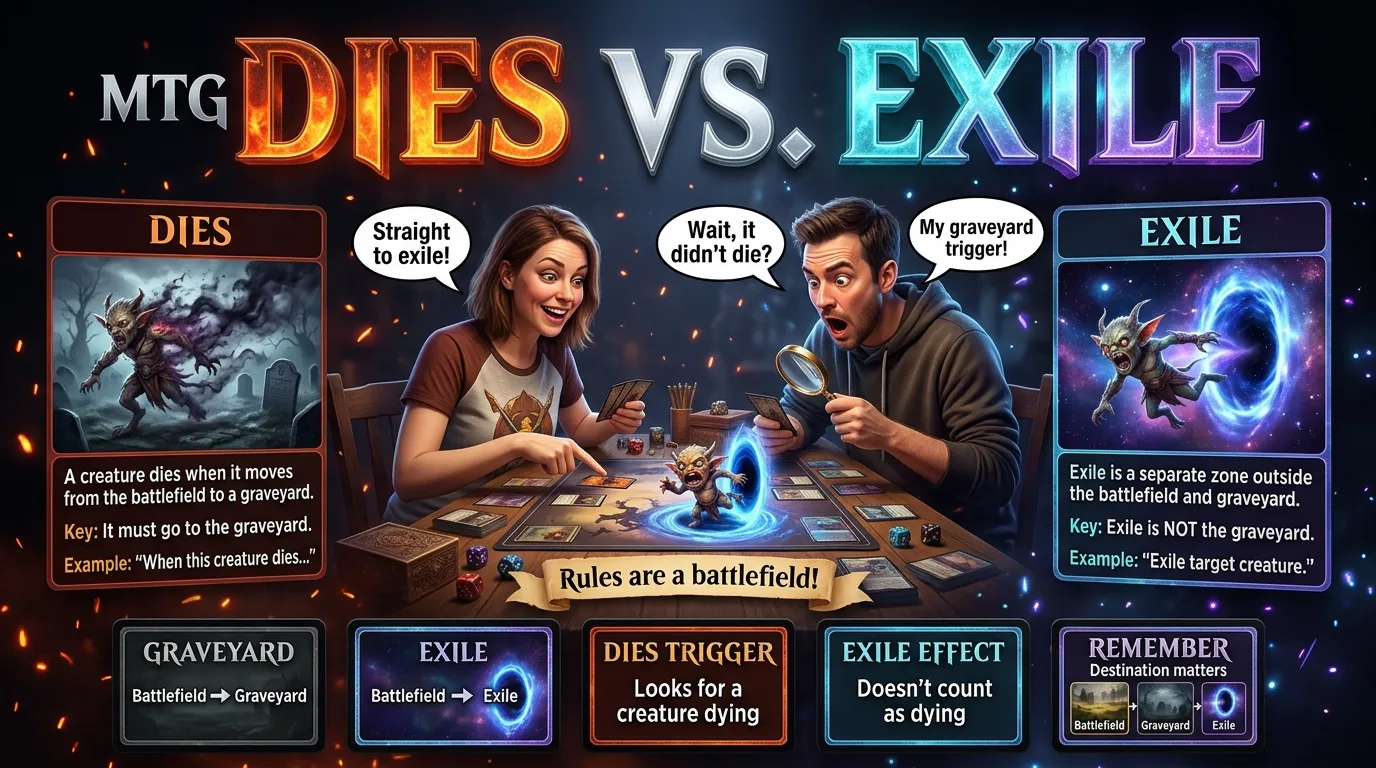
MTG Dies vs. Exile
The difference between dying and being exiled is that a creature dies when it goes from the battlefield to its owner’s graveyard, whereas an exiled creature goes to the exile zone instead.
Exiling a creature does not count as dying because the creature never enters the graveyard from the battlefield.
Consider these examples:
Your creature is destroyed and put into your graveyard. It dies.
Your creature is sacrificed and put into your graveyard. It dies.
Your opponent exiles your creature. It does not die.
Your creature is returned to your hand. It does not die.
This distinction matters when a card says, “Whenever a creature dies.” Such an ability does not trigger when a creature is exiled directly from the battlefield.
For example, suppose you control a creature that creates a token whenever another creature you control dies. If another creature you control is destroyed and goes to your graveyard, the ability can trigger. If that creature is exiled instead, the ability does not trigger.
Does Sacrifice Count as Dying in MTG?
Yes. Sacrificing a creature counts as dying if the creature moves from the battlefield to its owner’s graveyard.
Sacrifice is a separate game action from destruction, but both can result in a creature dying. This is why sacrifice strategies often work well with abilities that reward you when creatures die.
Examples:
You sacrifice a creature to activate an ability. It dies.
A spell instructs you to sacrifice a creature. It dies.
You sacrifice a creature with a death-triggered ability. That ability can trigger.
You sacrifice an indestructible creature. It still dies.
For example, imagine you control a creature that says, “Whenever this creature dies, each opponent loses 1 life.” If you sacrifice it to pay a cost, its ability can trigger after the sacrifice.
Remember that sacrifice is not destruction. An indestructible creature cannot be destroyed, but it can still be sacrificed.
Do Tokens Die in MTG?
Yes. Creature tokens can die in Magic: The Gathering. If a creature token moves from the battlefield to its owner’s graveyard, it counts as dying, so abilities that trigger when a creature dies can trigger.
After a token leaves the battlefield, it will cease to exist the next time state-based actions are checked. However, that does not undo the event that caused it to die.
Examples:
A 1/1 creature token takes lethal damage and goes to the graveyard. It dies.
You sacrifice a creature token. It dies.
A spell destroys a creature token, and it goes to the graveyard. It dies.
A creature token is exiled instead of going to the graveyard. It does not die.
For example, if you sacrifice a creature token while controlling a creature that says, “Whenever another creature dies, put a +1/+1 counter on this creature,” the ability can trigger.
The fact that the token ceases to exist afterward does not prevent death-triggered abilities from working.
MTG Dies vs. Put Into Graveyard
In MTG, “dies” is a specific term that means a creature is put into its owner’s graveyard from the battlefield. The phrase “put into a graveyard” is broader and can describe cards moving from other zones as well.
The key difference is the creature’s starting zone.
Examples:
A creature moves from the battlefield to its owner’s graveyard. It dies.
A creature card is milled from a library into a graveyard. It does not die.
A creature card is discarded from a hand into a graveyard. It does not die.
A creature is sacrificed from the battlefield and put into its owner’s graveyard. It dies.
For example, if an ability says, “Whenever a creature dies,” milling a creature card from your library will not trigger it. The card never entered the graveyard from the battlefield.
However, if that same creature is later played onto the battlefield and then destroyed, it dies when it goes to the graveyard.
Remember: Every creature that dies is put into a graveyard from the battlefield, but not every creature card put into a graveyard has died.
When Do Creatures Die in Combat?
In MTG, creatures typically die during combat when they receive lethal damage or are otherwise put into their owners’ graveyards from the battlefield.
Combat damage is dealt during the combat damage step. After damage is dealt, the game checks state-based actions. Creatures with lethal damage are destroyed and put into their owners’ graveyards unless something prevents that outcome.
Examples:
A 2/2 creature blocks a 3/3 creature. The 2/2 receives 3 damage and dies.
A 3/3 creature blocks a 2/2 creature. The 2/2 receives 3 damage and dies, while the 3/3 survives with 2 damage marked on it until the cleanup step.
Two 2/2 creatures fight in combat, each dealing 2 damage to the other. Both die.
A creature with indestructible receives lethal damage. It does not die from that damage.
First strike and double strike can change when creatures deal combat damage and which creatures survive. Creatures with first strike deal damage in the first-strike combat damage step, if applicable. Creatures that survive can then deal damage in the regular combat damage step.
For example, a 2/2 creature with first strike can kill an ordinary 2/2 blocker before the blocker deals regular combat damage. If the blocker dies in the first-strike step, it will not deal combat damage in the regular step.
Damage does not itself use the destroy action. Instead, lethal damage causes a creature to be destroyed through state-based actions. If the creature reaches its owner’s graveyard, it dies, and applicable death-triggered abilities can trigger.
Common Mistakes
Mistake 1: Using “Die” With a Direct Object
❌ The storm died the crops.
✅ The storm destroyed the crops.
Or:
✅ The crops died in the storm.
Why it happens: Learners sometimes treat die like destroy because both can describe something being lost.
Mistake 2: Using “Destroy” When You Mean “Stop Living”
❌ The old man destroyed yesterday.
✅ The old man died yesterday.
Why it happens: Destroy describes something being ruined, while die describes the end of life.
Mistake 3: Confusing “Destroy” With “Kill”
These words are related but not identical.
The disease killed the patient.
The disease destroyed his health.
Kill means to cause the death of a living thing.
Destroy means to ruin or eliminate something and does not necessarily mean death.
Mistake 4: Assuming “Die” Only Applies to People
Not true.
We can say:
- The plant died.
- The tree died.
- The battery died.
- The engine died.
- The fire died down.
Some of these are literal, while others are figurative.
Destroy vs. Kill vs. Die
These three words are especially easy to confuse.
| Word | Basic Meaning | Example |
|---|---|---|
| Destroy | Ruin or eliminate something | “The storm destroyed the house.” |
| Kill | Cause a living thing to die | “The disease killed the plant.” |
| Die | Stop living | “The plant died.” |
Easy Formula
Destroy = cause destruction
Kill = cause death
Die = experience death
This is one of the easiest ways to remember the distinction.
Memory Tricks
💥 Destroy = Damage
Think:
Destroy → Damage → Something gets ruined
💀 Die = Death
Think:
Die → Death → Something stops living
⭐ One-Line Memory Trick
You destroy something; something dies.
For example:
The fire destroyed the house.
The people inside died.
Expert Insight: Destroy Is Not the Same as Die
From a grammar perspective, destroy and die behave differently because they belong to different verb patterns.
Destroy is generally transitive:
The storm destroyed the bridge.
The verb takes the direct object the bridge.
Die is generally intransitive:
The bridge collapsed.
The plant died.
It does not normally take a direct object.
This grammatical difference explains why sentences such as “The disease destroyed his health” and “He died from the disease” work naturally, while “The disease died him” does not.
Quick Test: Destroy or Die?
1. “The earthquake ___ the building.”
Destroyed ✅
2. “The old tree ___ last winter.”
Died ✅
3. “The fire ___ several homes.”
Destroyed ✅
4. “The flowers ___ without water.”
Died ✅
5. “The disease ___ thousands of people.”
Killed ✅
6. “Thousands of people ___ from the disease.”
Died ✅