

Quick Answer: Apologizes vs. Apologies
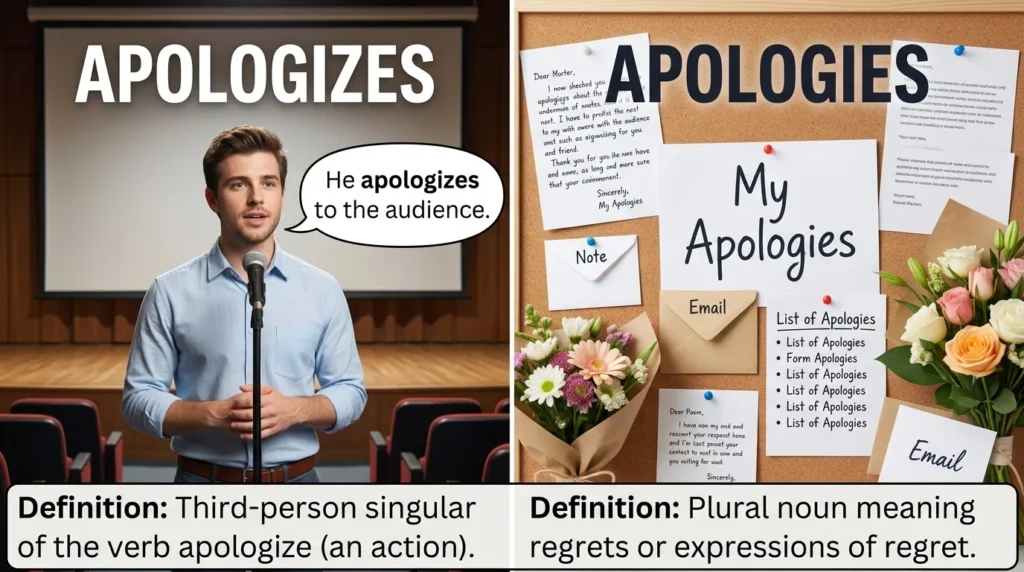
Apologizes = says sorry. It is the third-person singular present form of the verb apologize.
She apologizes for being late.
Apologies = expressions of regret. It is the plural noun form of apology.
Please accept my apologies for the delay.
The easiest way to remember:
- Apologizes = does the action
- Apologies = the words/expression of regret
Think:
Someone apologizes.
Someone gives or offers apologies.
What Does “Apologizes” Mean?
Apologizes is the third-person singular present tense of the verb apologize.
It is used with subjects such as:
- He
- She
- It
- A person
- A company
- An organization
Examples of “Apologizes”
- She apologizes for her mistake.
- He apologizes for arriving late.
- The company apologizes for the inconvenience.
- The manager apologizes to the customer.
In each sentence, apologizes describes an action.
Grammar Pattern
The basic structure is:
Subject + apologizes + for + reason
For example:
She apologizes for the confusion.
Or:
The company apologizes for the delay.
You can also use:
Subject + apologizes + to + person
For example:
He apologizes to his friend.
🎯 Key Insight: If you can replace the word with “says sorry,” you probably need apologizes.
What Does “Apologies” Mean?
Apologies is most commonly the plural form of the noun apology.
An apology is an expression of regret for something someone has done wrong or for an inconvenience they have caused.
Examples of “Apologies”
- Please accept my apologies for the mistake.
- My apologies for the late response.
- We offer our apologies for the inconvenience.
- He sent his apologies after missing the meeting.
Here, apologies is a noun.
Common Expressions With “Apologies”
You will often see apologies in polite or formal expressions:
My apologies.
My apologies for the delay.
Please accept my apologies.
Our apologies for any inconvenience.
🎯 Key Insight: If you’re talking about the expression of regret itself, use apologies.
Apologizes vs. Apologies
Apologizes and apologies are related to the word apologize, but they have different grammatical functions and cannot normally be substituted for each other. Apologizes is a verb, while apologies is a plural noun. Choosing between them depends on whether you are describing someone saying sorry or referring to expressions of regret.
Apologizes: Meaning and Use
Apologizes is the third-person singular present-tense form of the verb apologize. It is used with subjects such as he, she, it, or a singular person’s name.
For example:
-
She apologizes whenever she makes a mistake.
-
He apologizes to his friend for being late.
-
The manager apologizes for the inconvenience.
-
Maria apologizes to the customer.
Here, apologizes describes the action of saying sorry.
Notice the subject-verb relationship:
-
I apologize.
-
You apologize.
-
We apologize.
-
They apologize.
-
He apologizes.
-
She apologizes.
So, “she apologizes” is correct, but “she apologies” is not.
Apologies: Meaning and Use
Apologies is the plural form of the noun apology. It refers to expressions of regret or statements saying that someone is sorry.
For example:
-
Please accept my apologies for the delay.
-
My apologies for the misunderstanding.
-
He offered his apologies to the team.
-
We received several apologies after the mistake.
The word apologies is also commonly used by itself as a polite way to say sorry:
Apologies for the confusion.
In this expression, apologies is a noun, not a verb.
Apologizes vs. Apologies in a Sentence
The easiest way to see the difference is to compare their grammatical roles.
Apologizes:
The employee apologizes to the customer for the mistake.
Here, apologizes is the verb describing what the employee does.
Apologies:
The employee offered his apologies to the customer.
Here, apologies is a noun referring to the expression of regret.
Another comparison:
-
She apologizes to her brother. → She says sorry.
-
She sends her apologies to her brother. → Her expression of regret is being communicated.
Apologizes to Someone or Apologies to Someone?
Both expressions can be correct, but they use different grammar.
Use apologizes to someone when the subject is performing the action:
James apologizes to his teacher.
Use apologies to someone when apologies is functioning as a noun:
James sends his apologies to his teacher.
You can also say:
Please accept my apologies.
The important distinction is that apologizes is an action, whereas apologies is the noun referring to expressions of regret.
Apologizes to You vs. Apologies to You
The same distinction applies to apologizes to you and apologies to you.
Apologizes to you is a verb phrase:
He apologizes to you for his behavior.
It means that he says sorry to you.
Apologies to you uses apologies as a noun:
My apologies to you for the misunderstanding.
This means I am sorry to you or I offer my expressions of regret.
The phrase “my apologies to you” is grammatically different from “he apologizes to you.”
Apologize or Apologies for the Inconvenience?
Both can be correct, depending on the sentence structure.
I apologize for the inconvenience.
This is a complete sentence with apologize as the verb.
My apologies for the inconvenience.
This is also a standard expression, with apologies functioning as a noun.
We apologize for the inconvenience. is especially common in customer service, business communication, notices, and formal announcements.
For example:
We apologize for the inconvenience caused by the temporary closure.
You could also write:
Our apologies for the inconvenience.
Both communicate regret, but their grammatical structures are different.
Apologise vs. Apologize
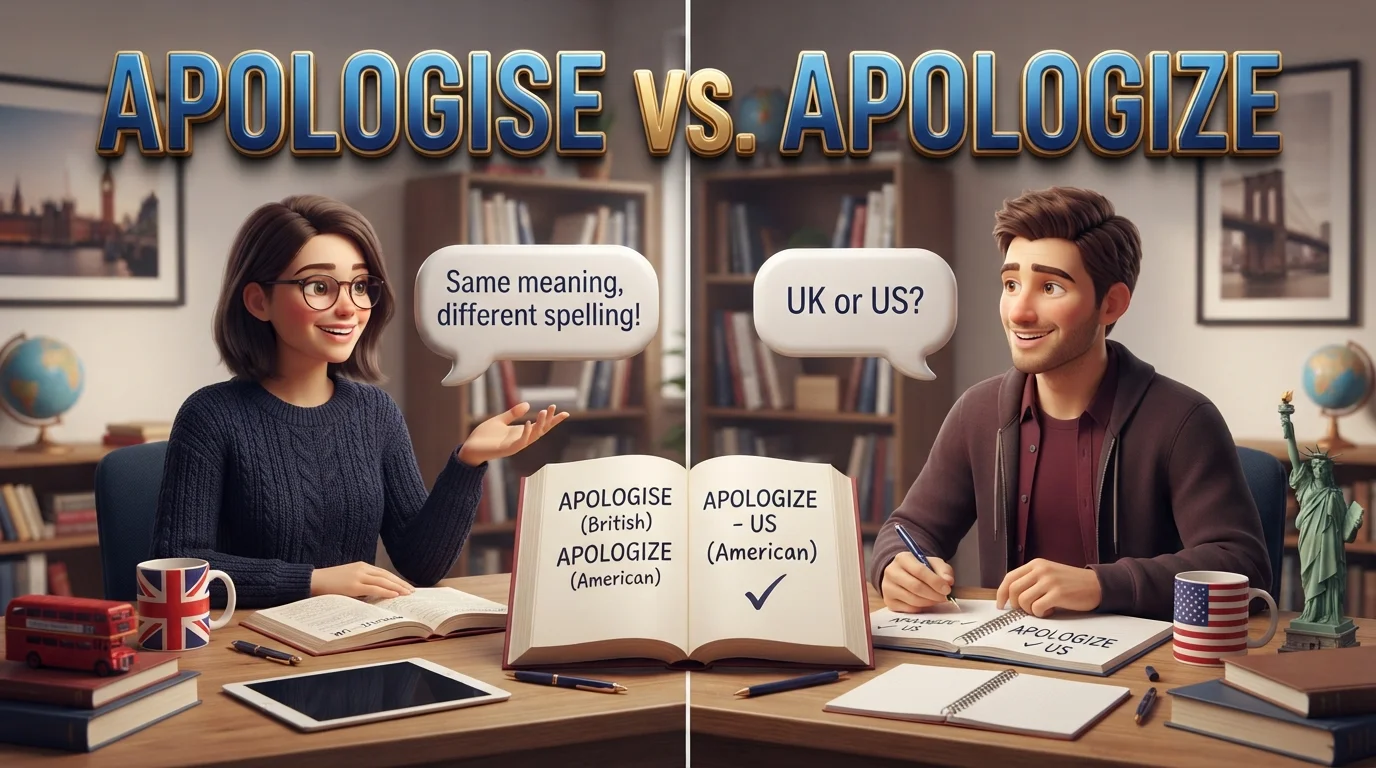
Apologize and apologise have the same meaning. The difference is primarily a matter of spelling convention.
Apologize is the standard spelling in American English.
Apologise is common in British English and many other varieties that generally follow British spelling conventions.
For example:
-
American English: I apologize for the delay.
-
British English: I apologise for the delay.
The noun remains apology and apologies in both varieties.
Apologises vs. Apologizes
Apologises and apologizes are also different spellings of the same verb form.
-
Apologizes → American English
-
Apologises → British English
For example:
She apologizes for being late. — American spelling
She apologises for being late. — British spelling
The meaning and grammatical function do not change.
My Apologies: Meaning and Use
My apologies is a polite expression used to acknowledge a mistake, inconvenience, misunderstanding, interruption, or other situation for which you feel sorry.
Examples include:
-
My apologies for the late response.
-
My apologies for the confusion.
-
My apologies—I misunderstood your question.
-
My apologies for keeping you waiting.
Although my apologies is plural in form, it is a conventional expression of regret. It does not mean that someone is literally making several separate apologies in every situation.
My Apologies or I Apologize?
Both are correct, but they have slightly different structures and tones.
I apologize uses a verb and directly states that the speaker is sorry:
I apologize for the mistake.
My apologies uses a noun phrase and is often a concise, polite way to express regret:
My apologies for the mistake.
In professional writing, either can work. The better choice depends on the surrounding sentence and the tone you want.
For example:
I apologize for the delay in responding to your email.
sounds like a direct personal apology.
My apologies for the delay in responding to your email.
is slightly more concise and can sound more formal or conventional.
Common Mistake: “She Apologies”
One of the most common errors is confusing apologies with apologizes.
Incorrect:
She apologies for being late.
Correct:
She apologizes for being late.
Why? Because she requires the third-person singular verb apologizes.
However, apologies is correct when it is being used as a noun:
She offered her apologies for being late.
A useful way to remember this is:
Apologizes = verb
Apologies = noun
Quick Comparison
| Word | Part of speech | Basic meaning | Example |
|---|---|---|---|
| apologize | Verb | To say sorry | I apologize for the mistake. |
| apologizes | Verb | Says sorry | She apologizes for the delay. |
| apologise | Verb | British spelling of apologize | I apologise for the error. |
| apologises | Verb | British spelling of apologizes | He apologises to his colleague. |
| apology | Noun | An expression of regret | He gave an apology. |
| apologies | Noun | More than one apology or a polite expression of regret | My apologies for the confusion. |
Which One Should You Use?
If you need a verb, use apologize/apologise or apologizes/apologises, depending on the subject and spelling convention.
If you need a noun, use apology/apologies.
For American English:
-
I apologize for the error.
-
She apologizes for the error.
-
Please accept my apologies.
For British English:
-
I apologise for the error.
-
She apologises for the error.
-
Please accept my apologies.
The key is not simply choosing the spelling that looks right. First determine whether the sentence needs a verb meaning “say sorry” or a noun meaning “an expression of regret.” Once you identify the grammatical role, the correct form becomes much easier to choose.
Apologizes vs. Apologies: The Main Difference
The key difference is part of speech.
Apologizes
- Verb
- Means says sorry
- Describes an action
- Used with a singular third-person subject
- Example: She apologizes for the mistake.
Apologies
- Noun
- Means expressions of regret
- Often used in polite or formal language
- Usually appears in phrases such as my apologies
- Example: My apologies for the mistake.
Comparison Table
| Feature | Apologizes | Apologies |
|---|---|---|
| Part of speech | Verb | Noun |
| Meaning | Says sorry | Expressions of regret |
| Basic form | Apologize | Apology |
| Used with | He, she, it, singular noun | My, our, his, her, their, etc. |
| Example | She apologizes for the delay. | My apologies for the delay. |
| Memory clue | Action | Expression |
Real-World Usage Scenarios
Scenario 1: Describing Someone Saying Sorry
She apologizes whenever she makes a mistake.
🎯 Lesson: Apologizes is correct because it describes what she does.
You could replace it with:
She says sorry whenever she makes a mistake.
Scenario 2: Offering an Apology
Please accept my apologies for the delay.
🎯 Lesson: Apologies is correct because it is the noun referring to the expression of regret.
Scenario 3: A Company Statement
The airline apologizes for the cancellation.
🎯 Lesson: Apologizes is a verb describing the company’s action.
Scenario 4: A Formal Email
My apologies for not responding sooner.
🎯 Lesson: Apologies is a noun. This is a common polite expression in emails and professional communication.
Scenario 5: Comparing the Two
She apologizes for the mistake and offers her apologies to everyone affected.
🎯 Lesson: Both words can appear in the same sentence because they perform different grammatical jobs.
Apologizes = the action
Apologies = the expression of regret
Common Mistakes With Apologizes and Apologies
Mistake 1: “She apologies”
❌ She apologies for being late.
✅ She apologizes for being late.
Why it happens:
The spelling of apologies looks like a natural verb form, but it is normally a noun.
The correct third-person singular verb is:
apologizes
Mistake 2: “My apologizes”
❌ My apologizes for the delay.
✅ My apologies for the delay.
Why it happens:
After my, you need a noun, not a verb.
Apologies is the noun.
Mistake 3: “He apology”
❌ He apology for the mistake.
✅ He apologizes for the mistake.
or:
✅ He offered an apology for the mistake.
Why it happens:
Apology is a noun, while apologize is the verb.
Mistake 4: “I apologizes”
❌ I apologizes for the confusion.
✅ I apologize for the confusion.
Why it happens:
Apologizes is used with a third-person singular subject.
Correct forms:
- I apologize
- You apologize
- We apologize
- They apologize
- He apologizes
- She apologizes
- The company apologizes
Apologize, Apologizes, Apology, and Apologies
Understanding the entire word family makes the difference much easier.
Apologize
Verb:
I apologize for the mistake.
Apologizes
Third-person singular verb:
She apologizes for the mistake.
Apology
Singular noun:
He offered an apology.
Apologies
Plural noun:
Please accept my apologies.
Quick Pattern
Verb:
apologize → apologizes
Noun:
apology → apologies
This distinction is extremely useful.
American and British English: Apologizes vs. Apologises
There is an important spelling difference between American and British English.
American English
apologize
apologizes
British English
apologise
apologises
The meaning and grammar are the same. The difference is primarily the spelling convention.
The noun remains:
apology
apologies
So if you’re writing for a US audience, apologizes is standard.
For a British audience, apologises is generally preferred.
Memory Tricks: Apologizes vs. Apologies
🗣️ Trick 1: Apologizes = Action
If someone does something, use the verb:
She apologizes.
Think:
Apologizes = says sorry
📝 Trick 2: Apologies = Words of Regret
If you’re talking about the sorry itself, use:
My apologies.
Think:
Apologies = expressions of regret
🔄 Trick 3: Use the “She” Test
Put she before the word.
She apologizes. ✅
She apologies. ❌
Now put my before it:
My apologies. ✅
My apologizes. ❌
This quick test can help you identify the correct form.
Expert Insight: Why Apologizes and Apologies Are Confused
The confusion comes from the way English changes nouns and verbs.
The noun apology becomes plural by changing:
apology → apologies
The verb apologize becomes third-person singular by adding -s:
apologize → apologizes
Because both forms contain apolog- and have similar endings, they are easy to confuse when writing.
But their grammatical roles are different:
She apologizes. → verb
Her apologies were sincere. → noun
The spelling becomes much easier once you identify the grammatical function of the word before choosing it.
Quick Test: Apologizes or Apologies?
Choose the correct word.
- She ________ for the misunderstanding.
- Please accept my ________.
- The company ________ for the inconvenience.
- His ________ were sincere.
- He ________ to his friend.
Answers
- apologizes
- apologies
- apologizes
- apologies
- apologizes
The Pattern
Apologizes = verb/action
Apologies = noun/expression of regret