
Quick Answer
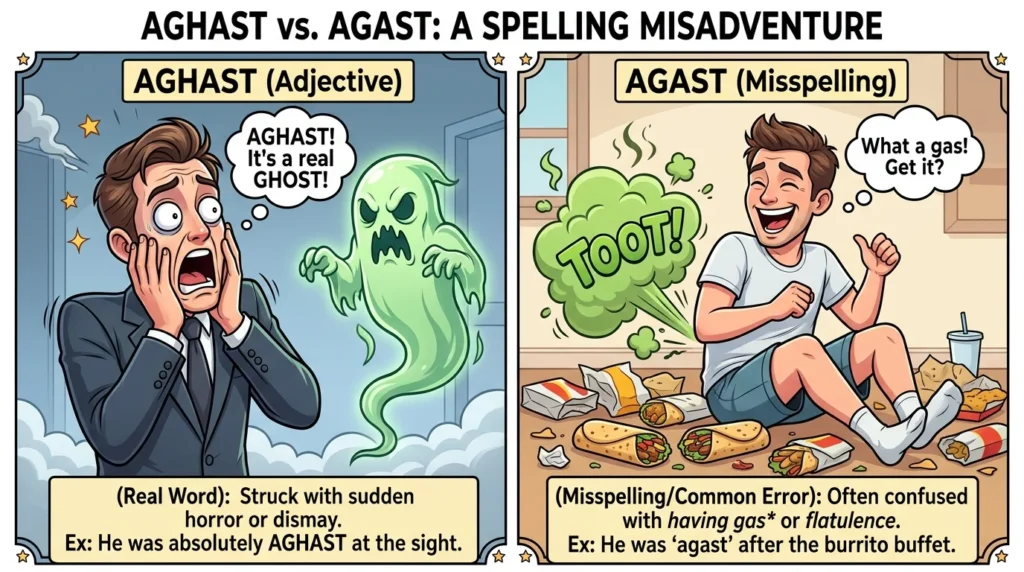
Aghast is the correct English word that means shocked, horrified, or filled with amazement.
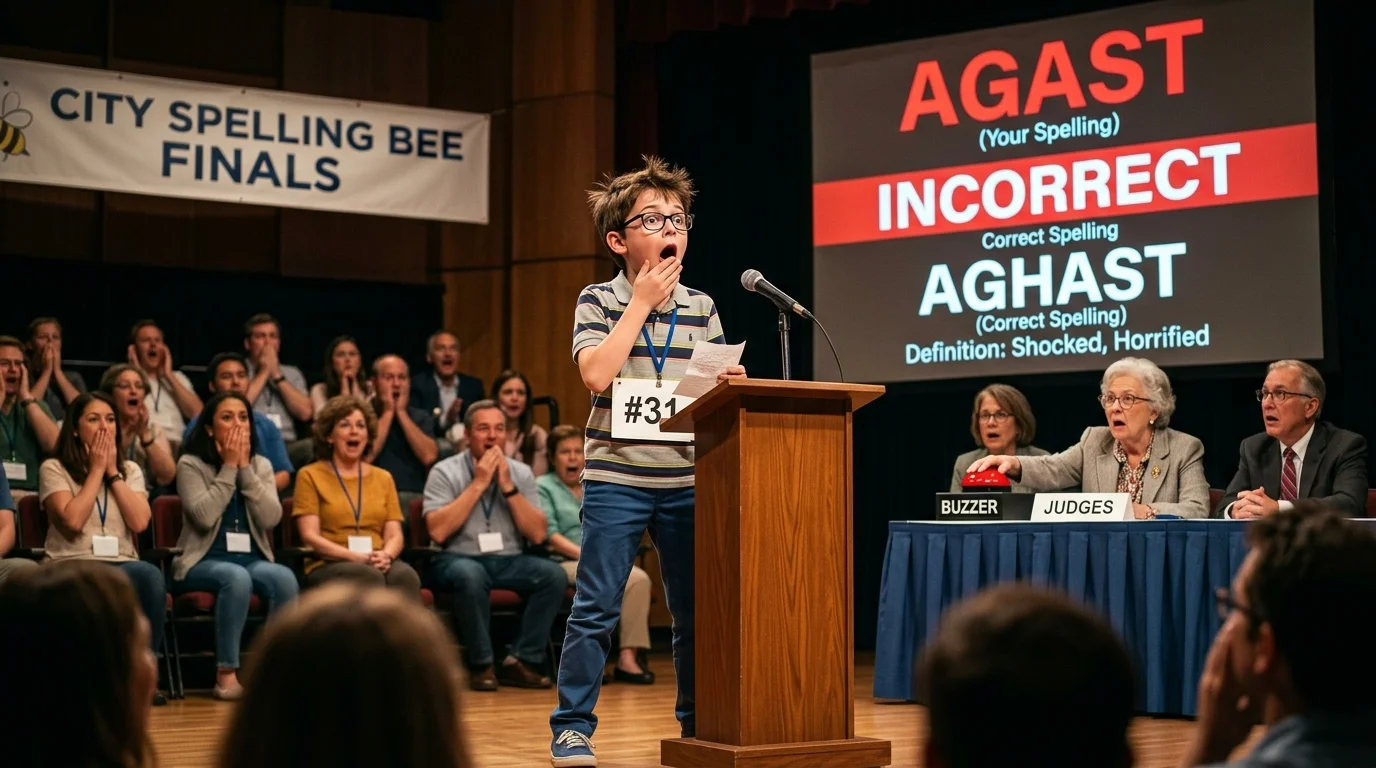
Agast is generally considered an incorrect spelling in modern English and should usually be replaced with aghast.
If you’re writing contemporary English, use aghast.
What Does “Agast” Mean?
Definition
The word agast is an old or obsolete spelling that occasionally appeared in historical English texts.
Today, it is rarely recognized as standard English.
Usage Rules
In modern writing:
- Avoid using agast.
- Most dictionaries prefer aghast.
- Readers may assume agast is a typo.
Examples
Historical or outdated usage:
- He stood agast at the terrible news.
- The villagers were agast at the sight.
Modern English would typically replace both examples with aghast.
Key Insight
Unless you are quoting historical literature, agast is generally not the preferred spelling.
What Does “Aghast” Mean?
Definition
Aghast is an adjective that describes someone who is shocked, horrified, stunned, or filled with disbelief.
Usage Rules
Use aghast when describing:
- Extreme surprise
- Horror
- Shock
- Disbelief
- Emotional astonishment
Examples
- She was aghast when she heard the news.
- The audience looked aghast after the unexpected announcement.
- He stood aghast at the damage caused by the storm.
Key Insight
Aghast is the accepted modern spelling and appears frequently in books, journalism, and everyday English.
Agast vs Aghast: Key Differences
Bullet Point Differences
- Aghast is the standard modern spelling.
- Agast is considered obsolete or incorrect in most contexts.
- Aghast appears in modern dictionaries.
- Agast is rarely used today.
- Aghast is suitable for professional and academic writing.
- Agast may confuse readers.
Comparison Table
| Feature | Agast | Aghast |
|---|---|---|
| Modern English Usage | Rare | Common |
| Dictionary Acceptance | Limited | Standard |
| Meaning | Historical form of aghast | Shocked or horrified |
| Professional Writing | Avoid | Recommended |
| Reader Recognition | Low | High |
| Example | Obsolete usage | She was aghast at the news |
Aghast Pronunciation
The word aghast is pronounced uh-GAST, with the stress on the second syllable. It is an adjective used to describe a feeling of shock, horror, or extreme surprise, usually caused by something unpleasant or unexpected.
The word has two syllables. The first syllable has a short, unstressed sound, while the second syllable carries the main emphasis.
For example: “She looked aghast when she heard the shocking news.”
Aghast Synonym
Aghast has several synonyms that express shock, horror, disbelief, or extreme surprise. These words can help you describe someone’s emotional reaction more precisely.
Here are some common synonyms for aghast:
Synonym | Meaning |
|---|---|
Appalled | Deeply shocked or horrified |
Horrified | Filled with fear or shock |
Astonished | Extremely surprised |
Stunned | Unable to react because of shock |
Shocked | Suddenly surprised or upset |
Dismayed | Distressed or disappointed |
Flabbergasted | Extremely surprised or amazed |
Bewildered | Confused and surprised |
Dumbfounded | Too shocked to speak |
Horrified | Feeling intense fear or disgust |
Examples using aghast synonyms:
She was appalled by the rude behavior.
Everyone looked horrified after seeing the damage.
I was astonished by his unexpected decision.
He stood stunned when he heard the announcement.
They were dumbfounded by the unbelievable results.
Although these words have similar meanings, they are not always interchangeable. For example, astonished can describe positive or negative surprise, while aghast generally expresses shock, horror, or dismay.
Aghast in French
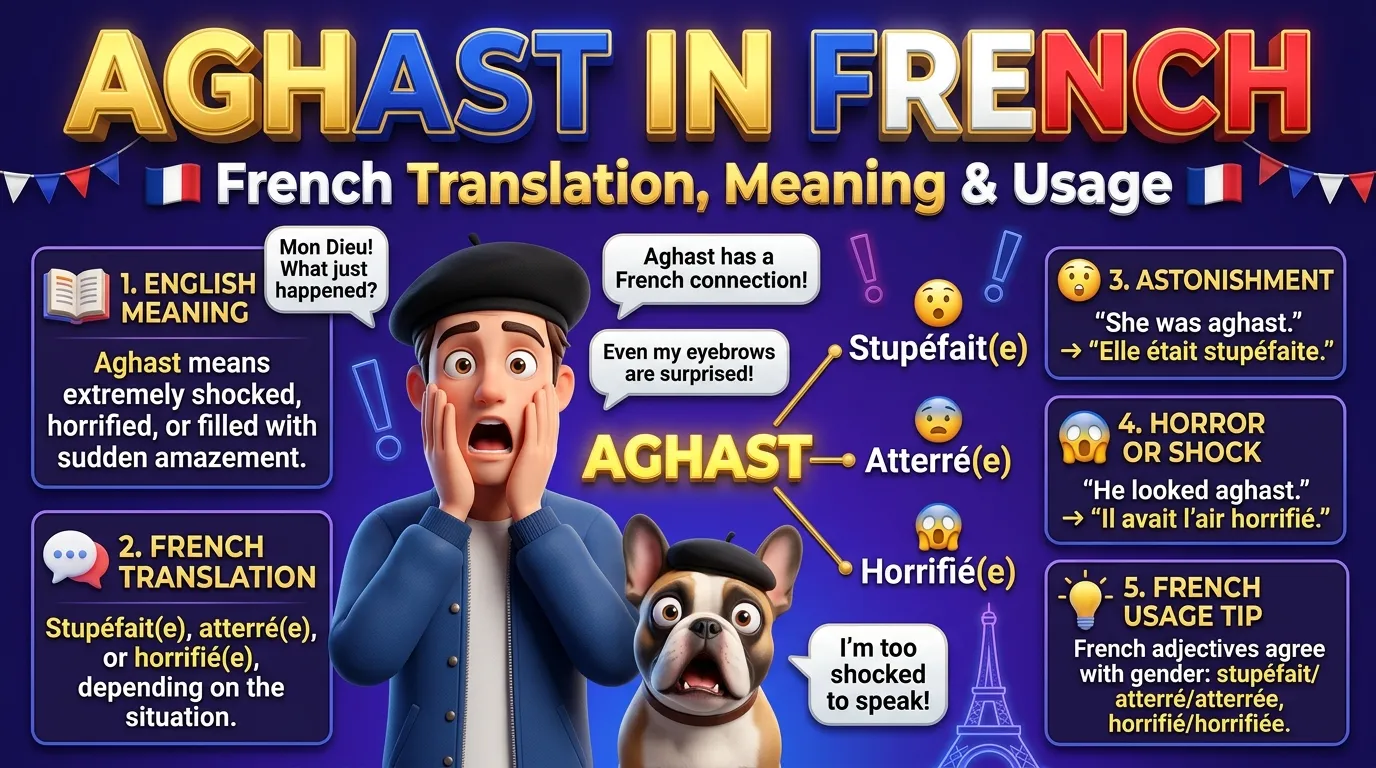
The English word aghast can be translated into French in several ways, depending on the context and intensity of the emotion.
Common French translations include:
Consterné(e): Deeply dismayed or shocked.
Horrifié(e): Horrified or filled with horror.
Stupéfait(e): Astonished or stunned.
Atterré(e): Overwhelmed by shock or distress.
Épouvanté(e): Terrified or extremely frightened.
Examples:
She was aghast at the news. — Elle était consternée par la nouvelle.
He looked aghast. — Il avait l’air horrifié.
They were aghast at the terrible discovery. — Ils étaient horrifiés par cette terrible découverte.
The best French translation depends on the situation. Horrifié works well when the reaction involves horror, while consterné is suitable when someone feels deeply shocked or dismayed.
Aghast in a Sentence
Aghast is commonly used in sentences to describe someone’s reaction to something shocking, frightening, or deeply upsetting. It often appears after linking verbs such as look, seem, stand, and be.
Here are some examples:
She stood aghast when she discovered the broken window.
I was aghast at the amount of money they had spent.
The teacher looked aghast after reading the student’s answer.
He stared at the accident scene, completely aghast.
We were aghast by the unexpected announcement.
Her parents were aghast when they learned about her decision.
Everyone looked aghast at the shocking photographs.
The audience sat aghast as the unexpected events unfolded.
She was aghast to discover that her belongings were missing.
They stood aghast at the destruction caused by the storm.
In these sentences, aghast communicates a stronger emotional reaction than ordinary surprise. It helps readers understand that someone is deeply shocked or horrified.
Aghast Examples
Understanding aghast in different situations can help you use it naturally in everyday conversations, storytelling, and creative writing.
Examples of aghast in everyday situations:
My mother was aghast when she saw the electricity bill.
I was aghast at how expensive the restaurant was.
She looked aghast when her friend revealed the secret.
The neighbors were aghast at the loud explosion.
He stood aghast after realizing his mistake.
Examples of aghast in emotional situations:
She was aghast at the cruel treatment of the animals.
His family looked aghast when they heard the terrible news.
The students were aghast at the unexpected school announcement.
I watched aghast as the argument became increasingly violent.
They were aghast at the unfair decision.
Examples of aghast in storytelling:
The princess stood aghast as the castle gates suddenly collapsed.
The detective looked aghast when he discovered the missing evidence.
Everyone stared aghast as the mysterious figure appeared.
The villagers were aghast when they saw the damage after the storm.
She opened the letter and gasped, aghast at its contents.
These examples show that aghast works particularly well when describing reactions to unexpected or disturbing events.
Aghast Past Tense
Aghast does not have a past-tense form because it is an adjective, not a verb. It describes an emotional state rather than an action.
However, you can use aghast in past-tense sentences by changing the accompanying verb.
For example:
Present tense: She is aghast at the news.
Past tense: She was aghast at the news.
Present tense: They look aghast.
Past tense: They looked aghast.
Present tense: He seems aghast.
Past tense: He seemed aghast.
You can also use had been aghast to describe a reaction that occurred before another past event.
Example: “She had been aghast when she first heard the announcement.”
A common mistake is trying to write aghasted as the past tense of aghast. This is incorrect in standard English.
Remember that was aghast, looked aghast, and had been aghast are correct ways to describe a past reaction.
Aghast vs. Appalled
Aghast and appalled are closely related adjectives because both describe strong emotional reactions to shocking or unpleasant situations. However, they have slightly different meanings and are not always interchangeable.
Aghast describes someone who feels shocked, horrified, or extremely surprised by something unexpected. It often emphasizes the immediate emotional reaction.
Appalled describes someone who feels deep shock, disgust, or disapproval, especially in response to something offensive, cruel, or unacceptable.
Consider these examples:
She was aghast when she saw the enormous fire.
She was appalled by the cruel treatment of the animals.
In the first sentence, aghast emphasizes her shock and horror at an unexpected event. In the second, appalled emphasizes her strong disapproval of cruel behavior.
Key differences:
Aghast | Appalled |
|---|---|
Emphasizes shock or horror | Emphasizes shock, disgust, or disapproval |
Often describes an immediate reaction | Often expresses a judgment about something unpleasant |
Can involve fear or surprise | Commonly involves moral or emotional outrage |
She looked aghast at the accident. | She was appalled by the behavior. |
More examples:
The parents were aghast at the unexpected news.
The parents were appalled by the school’s unfair treatment of students.
He stood aghast when the building collapsed.
He was appalled by the dishonest actions of his colleague.
Which word should you use?
Choose aghast when you want to emphasize someone’s shock, horror, or disbelief. Choose appalled when you want to emphasize someone’s strong disapproval, disgust, or outrage.
Taken Aghast
The expression “taken aghast” is not a standard or natural English expression. It is generally a mistaken combination of two different constructions: taken aback and aghast.
Taken aback means suddenly surprised or shocked by something unexpected. Aghast means extremely shocked or horrified by something unpleasant.
Here is how to use them correctly:
1. Taken aback
Use this expression when someone is unexpectedly surprised or unsettled.
Examples:
I was taken aback by her unexpected question.
He looked taken aback when the manager criticized his work.
We were taken aback by the sudden announcement.
2. Aghast
Use this adjective when someone experiences intense shock or horror.
Examples:
She was aghast at the terrible news.
They stood aghast at the destruction.
I was aghast when I discovered what had happened.
3. Taken aback and aghast
You can use both expressions in one sentence when you want to communicate surprise followed by horror.
Example: “She was taken aback and then stood aghast when she discovered the truth.”
Remember these distinctions:
Correct: Taken aback.
Correct: Completely aghast.
Correct: Left aghast.
Incorrect: Taken aghast.
The safest choice is taken aback for unexpected surprise and aghast for extreme shock or horror.
Real-World Usage Scenarios
Scenario 1
❌ I was agast when I saw the accident.
✅ I was aghast when I saw the accident.
🎯 Lesson: Use aghast to express shock or horror.
Scenario 2
❌ The teacher looked agast at the students’ behavior.
✅ The teacher looked aghast at the students’ behavior.
🎯 Lesson: Modern English prefers aghast.
Scenario 3
❌ Everyone was agast by the sudden announcement.
✅ Everyone was aghast by the sudden announcement.
🎯 Lesson: Aghast is the correct spelling for formal and informal writing.
Scenario 4
❌ She sounded agast after hearing the rumor.
✅ She sounded aghast after hearing the rumor.
🎯 Lesson: Replace agast with aghast in contemporary English.
Scenario 5
❌ The community was agast at the outcome.
✅ The community was aghast at the outcome.
🎯 Lesson: Use the standard dictionary spelling.
Common Mistakes
Mistake 1: Dropping the “H”
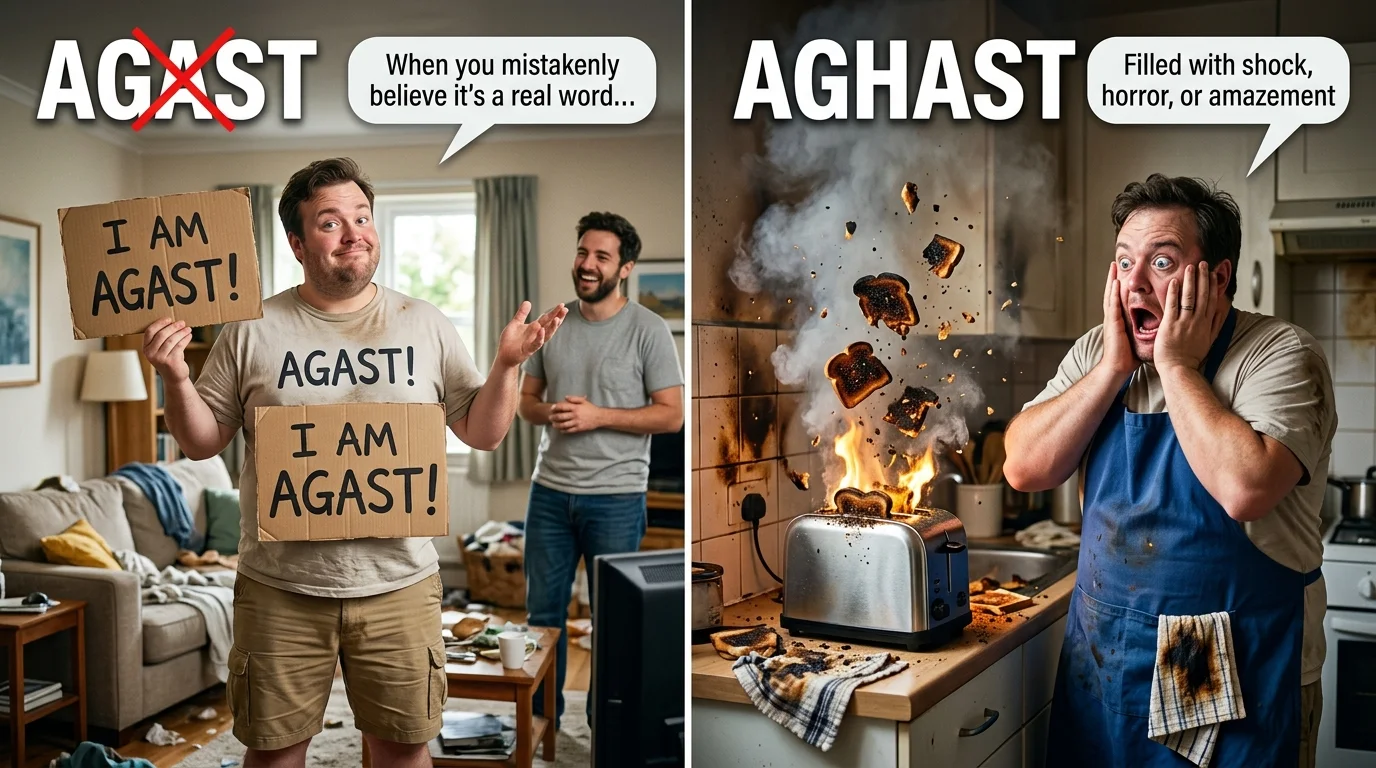
Many people accidentally write agast because the silent “h” in aghast is easy to overlook.
Why it happens:
The pronunciation does not strongly emphasize the “h.”
Correction:
Always spell the word as aghast.
Mistake 2: Assuming Agast Is a Modern Alternative
Some writers believe agast is simply a shorter version of aghast.
Why it happens:
Many English words have accepted spelling variations.
Correction:
Modern English overwhelmingly prefers aghast.
Mistake 3: Copying Historical Spellings
Older literature may contain alternative spellings.
Why it happens:
English spelling was less standardized in earlier centuries.
Correction:
Use aghast unless quoting historical sources.
Memory Tricks
Trick 1
Think of “Agh!”
When people are shocked, they might say:
“Agh!”
That sound appears at the beginning of aghast.
Trick 2
Aghast = Agh + Astonished
Both relate to shock and surprise.
Trick 3
If you’re expressing horror or disbelief, remember:
The correct modern spelling includes the letter H.
Expert Insight
The word aghast comes from older English forms related to fear, terror, and astonishment. Over time, English spelling became standardized, and aghast emerged as the dominant accepted form.
Although historical texts occasionally contain agast, modern dictionaries, style guides, publishers, and educational institutions overwhelmingly recommend aghast.
Because English spelling evolved over centuries, some obsolete forms survived in literature, but contemporary writing standards favor clarity and consistency. For that reason, professional writers, editors, and teachers use aghast almost exclusively.