
Quick Answer: Borders vs. Boarders
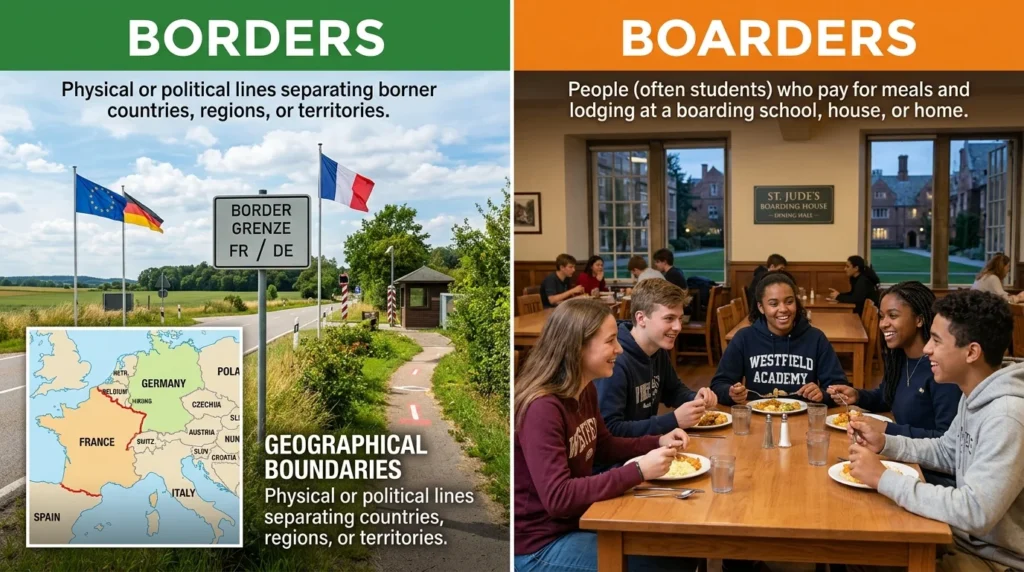
Borders is the plural of border, meaning boundaries or edges.
The two countries share borders.
Boarders is the plural of boarder, meaning people who receive accommodation and meals, or people who board something in certain contexts.
The school has several boarders.
The easiest rule
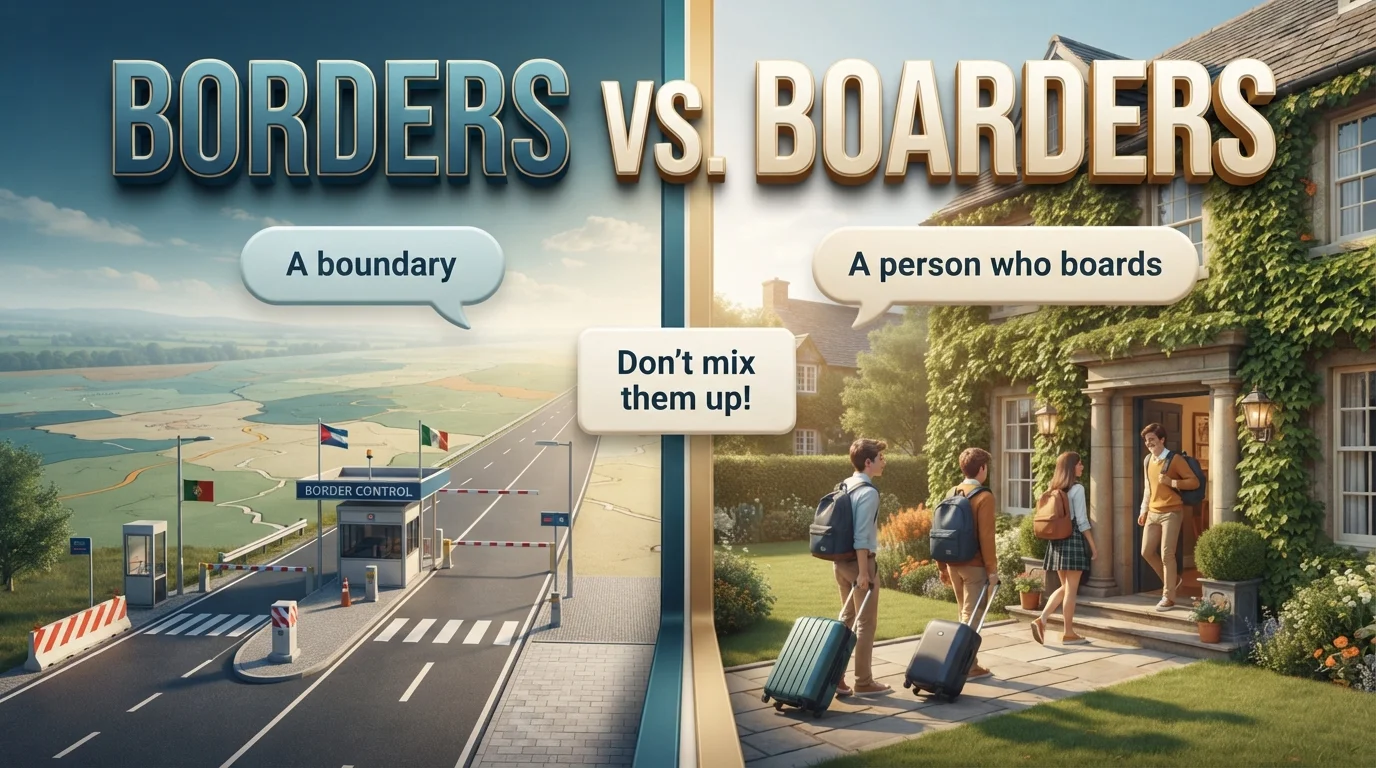
Border → boundary
Boarder → person who boards
If you’re talking about lines, boundaries, countries, edges, or limits, use borders.
If you’re talking about people staying somewhere or boarding a vehicle, use boarders.
What Does “Borders” Mean?
Borders is the plural noun or third-person singular verb form of border.
As a noun, a border is a line or area separating two places, regions, countries, or things.
Examples of “Borders”
The two countries share a border.
The countries have closed their borders.
The painting has decorative borders.
The river forms part of the border between the two regions.
The garden has flower borders around the lawn.
“Borders” as a Verb
Borders can also be a verb meaning touches, surrounds, or lies next to something.
The country borders several other nations.
The property borders a large forest.
Here, borders means is next to or shares a boundary with.
🎯 Key Insight: Borders is connected to the idea of a boundary or edge.
What Does “Boarders” Mean?
Boarders is the plural of boarder.
A boarder is generally a person who lives or stays somewhere and receives accommodation, often with meals, in exchange for payment.
Examples of “Boarders”
The school provides accommodation for boarders.
The house has three boarders.
The hostel is popular with student boarders.
The word comes from board, which historically refers to meals or food provided as part of accommodation.
Boarders in Transportation
A related use comes from the verb board, meaning to get onto a bus, train, plane, ship, or other vehicle.
The boarders were asked to wait at the gate.
However, in ordinary modern travel language, passengers is usually more natural than boarders.
🎯 Key Insight: Boarders refers to people, not boundaries.
Borders vs. Boarders Meaning
Borders vs. boarders is a comparison between two words that sound exactly alike but have different meanings and spellings. Both are plural forms: borders comes from border, while boarders comes from boarder.
Borders refers to boundaries, edges, or dividing lines between places or areas. A border can separate countries, states, properties, or sections of an object.
Boarders refers to people who receive meals and accommodation at a place, such as a boarding school, hostel, or private home, usually in exchange for payment.
Examples:
Borders: The two countries share several borders.
Boarders: The boarding school provides meals and rooms for its boarders.
The easiest way to remember the difference is that borders divide places, while boarders are people who receive room and board.
Borders vs. Boarders in a Sentence
Seeing both words in complete sentences makes their meanings easier to understand.
Examples of Borders
The country strengthened security along its borders.
The garden has wooden borders around the flower beds.
The river forms part of the border between the two regions.
The artist painted a decorative border around the picture.
Several states share borders with neighboring states.
The map clearly shows the borders between countries.
The property borders a large public park.
In these examples, borders refers to boundaries, edges, or the act of adjoining something.
Examples of Boarders
The school provides comfortable rooms for its boarders.
The hostel accommodates 150 boarders.
The family welcomed two boarders into their home.
The boarding school serves breakfast and dinner to its boarders.
The house has separate bedrooms for the boarders.
The school organizes weekend activities for its boarders.
The landlord provides meals for the boarders living in the house.
In these examples, boarders refers to people who live somewhere and receive accommodation, often with meals.
Borders vs. Boarders: Quick Comparison
| Word | Meaning | Example |
|---|---|---|
| Borders | Boundaries or dividing lines | The borders between the countries are clearly marked. |
| Boarders | People receiving accommodation, often with meals | The boarders eat dinner together. |
Remember that borders can also be a verb, as in “The property borders a lake.” Boarders can also be a verb form, as in “The airline boards passengers,” although boarders in that context would mean people or things that board only in other grammatical constructions. In ordinary usage, the noun boarders most often means people receiving accommodation.
Borders vs. Boarders on Reddit
When people search for borders vs. boarders on Reddit, they may be looking for explanations of the spelling difference, examples of common mistakes, or humorous situations involving the two words.
The distinction is straightforward:
Borders means boundaries or edges.
Boarders means people who live somewhere while receiving accommodation, often with meals.
For example, a sentence about countries should generally use borders: “The countries share borders.” A sentence about students living at a residential school should use boarders: “The school welcomes new boarders.”
Because the words are homophones, they sound alike in ordinary speech. That makes them easy to confuse when writing, especially when relying on spell-checking alone.
A useful way to check a sentence is to ask whether it refers to a boundary or a person receiving accommodation. If it refers to a boundary, choose border. If it refers to a person living somewhere under a boarding arrangement, choose boarder.
Reddit discussions can provide informal examples of how people encounter this confusion, but the spelling distinction itself does not depend on online opinions.
Border vs. Boarder Meme
The difference between border and boarder can make a simple spelling joke because the two words sound identical but describe completely different things.
Here is a text-based meme idea:
Top text: “When your teacher asks you to explain the difference between border and boarder.”
Image idea: A student standing beside a huge map with a clearly marked country boundary, while another student sits at a boarding-school dining table with a plate of food.
Bottom text: “One separates countries. The other is waiting for dinner.”
Another simple joke:
Border: “I separate countries.”
Boarder: “I just need a room and breakfast.”
The humor comes from the similar pronunciation and the contrast between a geographical boundary and a person receiving accommodation.
Boarder Student Meaning
A boarder student is a student who lives at a school or in accommodation arranged through a school and typically receives meals as part of the boarding arrangement.
The more natural and widely used term is boarder or boarding student. A day student, by contrast, attends classes at school but usually returns home after the school day.
For example:
“The school has 300 boarders and 500 day students.”
“As a boarder, Mia lives in the school’s residence hall.”
“Boarders eat their meals in the school dining hall.”
Boarders commonly live in dormitories, residence halls, or boarding houses. Depending on the institution, they may receive meals, supervision, study facilities, and organized activities.
Important distinction: A boarder is not simply any student. The word specifically refers to someone who lives at the school or under a boarding arrangement. A student who attends school during the day and lives at home is generally called a day student.
Boarder vs. Tenant
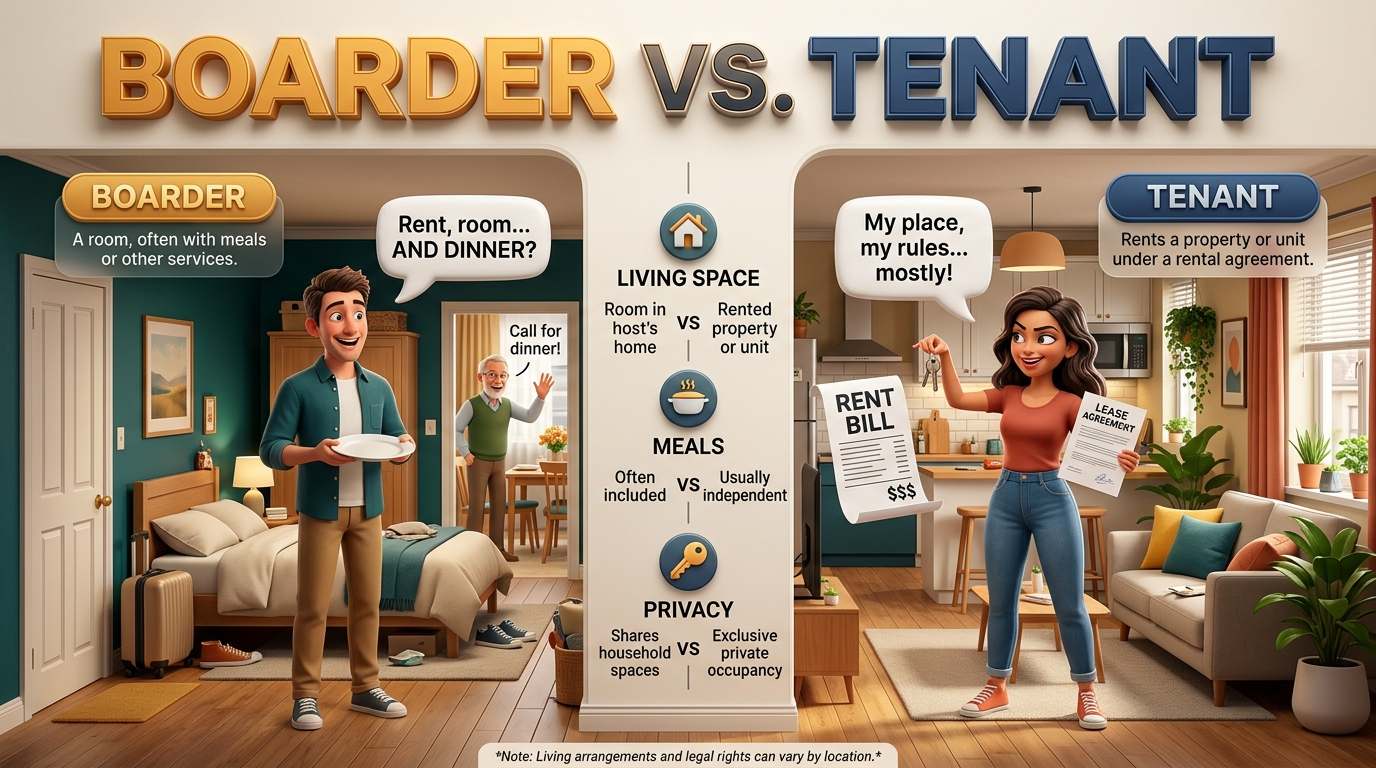
A boarder and a tenant are both people who may pay to live somewhere, but their living arrangements are not necessarily the same.
A boarder typically receives accommodation and may also receive meals or other household services. Boarders often live in a room within someone else’s home or in a boarding establishment.
A tenant rents a property or part of a property under a rental arrangement or lease. A tenant may rent an entire apartment, a house, or an individual room. Meals are not normally included as part of the tenancy.
Boarder vs. Tenant Examples
Boarder:
A family rents a furnished room to a boarder and provides breakfast and dinner.
The boarding house offers meals and shared living facilities to its boarders.
A student pays for a room and meals at a residential school.
Tenant:
A tenant rents an apartment under a one-year lease.
The landlord collects monthly rent from the tenant.
Three tenants share a rented house and divide the utility bills.
Key Differences
| Feature | Boarder | Tenant |
|---|---|---|
| Main arrangement | Accommodation, often with meals | Rental of property or space |
| Meals included | May be included | Usually separate |
| Typical setting | Boarding house, private home, boarding school | Apartment, house, or rented room |
| Agreement | Depends on the arrangement | Often governed by a lease or rental agreement |
The legal distinction varies by location. In some jurisdictions, a person renting a room in a private home may be legally classified as a lodger, tenant, or boarder depending on the contract, services provided, and applicable law. The label alone does not determine a person’s legal rights.
Hostel Boarder Meaning
A hostel boarder is a person who stays and lives in a hostel under a boarding or accommodation arrangement. Depending on the hostel, the arrangement may include meals, a bed, shared facilities, and other services.
For example:
The hostel provides three meals a day for its boarders.
Every hostel boarder must follow the residence rules.
The hostel has separate accommodation areas for male and female boarders.
The term is especially understandable in educational or residential settings where students stay away from home. However, in everyday English, hostel resident, hostel guest, or hostel student may sound more natural depending on the situation.
A person staying temporarily in a travel hostel is more commonly called a guest or hostel guest. A student living in a school hostel may naturally be called a boarder.
Country Border or Boarder?
The correct expression is country border, not country boarder, when referring to the boundary separating one country from another.
A country border is a geographical or political boundary between countries. It may be marked by fences, walls, rivers, mountains, checkpoints, or other features.
Examples:
The two countries share a long border.
Travelers must show their passports when crossing the country border.
The river forms a natural border between the neighboring countries.
Border officials checked the travelers’ documents.
Boarder refers to a person receiving accommodation, often with meals, so it does not normally make sense when referring to a country’s geographical boundary.
Compare these sentences:
Correct: The soldiers guarded the country’s borders.
Incorrect for the intended meaning: The soldiers guarded the country’s boarders.
Correct: The school welcomed its new boarders.
Incorrect for the intended meaning: The school welcomed its new borders.
Final Memory Trick
Border = boundary.
Boarder = person who receives room and board.
If you are talking about countries, property lines, or the edges of something, use border or borders. If you are talking about students or other people who live somewhere under a boarding arrangement, use boarder or boarders.
Borders vs. Boarders: Main Difference
| Feature | Borders | Boarders |
|---|---|---|
| Singular | Border | Boarder |
| Meaning | Boundaries or edges | People who board/stay somewhere |
| Related word | Border | Board |
| Typical context | Countries, regions, objects, limits | Schools, accommodation, boarding |
| Example | The countries share borders. | The school has many boarders. |
| Memory clue | Boundary | Person |
Bottom Line
Borders = boundaries or edges.
Boarders = people who board or stay somewhere.
Borders in Different Contexts
Country Borders
The two countries share a long border.
Plural:
The region has several international borders.
Here, borders refers to geographical boundaries.
Object Borders
The document has decorative borders.
Here, a border means an outer edge or decorative boundary.
Garden Borders
She planted flowers along the garden borders.
Here, borders refers to areas or edges around a garden or lawn.
As a Verb
Canada borders the United States.
Here, borders means shares a boundary with.
🎯 Lesson: Whether you’re talking about geography, design, gardens, or neighboring areas, borders is associated with edges and boundaries.
Boarders in Different Contexts
Boarding School
The school has 200 boarders and 500 day students.
Here, boarders are students who live at the school.
Private Accommodation
The homeowner rents rooms to boarders.
Here, boarders are people who pay to stay in the home.
Boarding House
The boarding house accommodates several boarders.
Again, the word refers to people receiving accommodation.
🎯 Lesson: If you’re talking about people who live somewhere as boarders, use boarders.
Borders vs. Boarders: Real-World Usage Scenarios
Scenario 1: Geography
The two countries have closed their borders.
🎯 Lesson: Countries have borders, not boarders.
Scenario 2: Boarding School
The school provides separate facilities for boarders and day students.
🎯 Lesson: Students who live at the school are boarders.
Scenario 3: Design
The invitation has gold borders.
🎯 Lesson: Decorative edges are borders.
Scenario 4: Rental Accommodation
The homeowner has two boarders living upstairs.
🎯 Lesson: People staying in accommodation can be called boarders.
Scenario 5: Geography as a Verb
The state borders three other states.
🎯 Lesson: Borders can also be a verb meaning shares a boundary with.
Common Mistakes With Borders and Boarders
Mistake 1: “The Countries Share Boarders”
❌ The countries share boarders.
This suggests that the countries share people who are staying somewhere.
✅ The countries share borders.
Here, you’re talking about geographical boundaries.
Mistake 2: “The School Has Many Borders”
❌ The school has many borders.
If you’re talking about students who live at the school:
✅ The school has many boarders.
🎯 Why? The students board at the school.
Mistake 3: “The Garden Has Boarders”
If you’re talking about the edges of the garden:
❌ The garden has beautiful boarders.
✅ The garden has beautiful borders.
If you actually mean people living there, boarders could theoretically be correct—but that’s obviously a very different meaning.
Mistake 4: Confusing “Border” With “Board”
The words come from completely different concepts.
border → boundary
board → stay somewhere / get onto a vehicle
That difference helps explain their spelling.
Border vs. Boarder: Singular Forms
Understanding the singular forms makes the plural difference much easier.
Border
The border is closed.
Plural:
The borders are closed.
Boarder
The student is a boarder.
Plural:
The students are boarders.
Memory Pattern
border → borders
boarder → boarders
The extra a connects boarder to board.
Borders vs. Boarders and “Bordering”
Another useful word is bordering.
The region is bordering the sea.
More commonly:
The property borders the river.
Bordering is related to border, not board.
Word Family
Border:
- border
- borders
- bordered
- bordering
Board:
- board
- boards
- boarded
- boarding
- boarder
- boarders
🎯 Key Insight: Boarders belongs to the board word family.
Memory Tricks: Borders vs. Boarders
🗺️ Trick 1: Borders = Boundary
Think:
Border = boundary
So:
Borders = boundaries
Countries, states, gardens, pictures, and regions can all have borders.
🏠 Trick 2: Boarders = Board
Think:
Boarder = someone who boards
A person who boards at a school or house is a boarder.
✈️ Trick 3: The “A” Connects to Board
Look carefully:
border
vs.
boarder
The a in boarder reminds you of board.
⭐ One-Line Memory Trick
Borders mark boundaries; boarders are people who board.
Expert Insight: Why Are Borders and Boarders Confused?
The two words are pronounced very similarly in many varieties of English, making them homophones or near-homophones depending on accent.
Their spelling, however, reflects different word families.
Border is associated with a boundary or edge.
Boarder comes from board, historically connected with receiving food and accommodation and also with the verb board, meaning to get onto a vehicle.
This is a classic example of why English spelling cannot always be predicted from pronunciation.
When writing, identify the meaning first, then choose the spelling.
Quick Test: Borders or Boarders?
1. The two countries share several ________.
Answer: borders
2. The school has more than 100 ________.
Answer: boarders
3. The invitation has decorative ________.
Answer: borders
4. The students who live at the school are ________.
Answer: boarders
5. The property ________ a large lake.
Answer: borders
6. The hostel provides rooms for ________.
Answer: boarders