
Quick Answer
Choose Bose if you prioritize comfort, simplicity, excellent noise cancellation, and balanced sound.
Choose Sony if you want more features, stronger bass, advanced customization, and better overall value for money.
For most users, Sony offers more features, while Bose excels in comfort and ease of use.
What Is Bose?
Definition
Bose is a premium audio company known for headphones, earbuds, speakers, and advanced noise-canceling technology.
Key Strengths
- Exceptional comfort
- Industry-leading noise cancellation
- Balanced and natural sound
- User-friendly design
- Premium build quality
Popular Products
- Bose QuietComfort Ultra Headphones
- Bose QuietComfort Earbuds
- Bose Smart Speaker Series
- Bose SoundLink Speakers
Key Insight
Bose focuses on delivering a smooth and effortless listening experience rather than overwhelming users with numerous features.
What Is Sony?
Definition
Sony is a global electronics company that produces a wide range of audio products, including some of the world’s most popular headphones and earbuds.
Key Strengths
- Powerful and customizable sound
- Advanced app controls
- Excellent battery life
- Strong noise cancellation
- Innovative audio technology
Popular Products
- Sony WH-1000XM Series
- Sony WF-1000XM Series
- Sony ULT Series Speakers
- Sony Home Audio Systems
Key Insight
Sony often packs more technology and customization options into its products than competitors.
Bose or Sony Headphones
When comparing Bose or Sony headphones, the most useful factors are sound profile, noise cancellation, comfort, battery life, microphone quality, connectivity, and price. Both brands offer several headphone and earbud models, so the comparison can change depending on the specific products involved.
For example, someone choosing between over-ear models such as the Sony WH-1000XM5 and a Bose QuietComfort model may care more about active noise cancellation and sound customization, while someone comparing wireless earbuds may prioritize fit, portability, call quality, and battery life.
Bose vs Sony Sound Quality
Bose and Sony headphones can produce high-quality sound, but they do not necessarily have identical sound signatures. Sound quality is also subjective because listeners have different preferences for bass, vocals, treble, and overall balance.
When comparing two specific models, consider:
- Bass response
- Vocal clarity
- Treble detail
- Soundstage
- Equalizer controls
- Codec support
- Wired versus wireless listening
- Whether the headphones are being used for music, movies, gaming, or calls
A person who prefers stronger bass may have a different preference from someone who wants a more balanced presentation. Therefore, Bose vs Sony sound quality is better evaluated by comparing equivalent models rather than judging the two brands as a whole.
Bose vs Sony Earbuds
The Bose vs Sony earbuds comparison is slightly different from an over-ear headphone comparison because fit and portability become particularly important.
When comparing wireless earbuds, look at:
- Active noise cancellation
- Transparency or ambient mode
- Ear-tip fit
- Comfort during extended use
- Battery life
- Charging case
- Call quality
- Water or sweat resistance
- Multipoint connectivity
- App and EQ features
For example, Sony’s premium wireless earbuds and Bose’s QuietComfort Earbuds use different designs and software features, so the best fit depends on what the listener values rather than simply choosing based on the brand name.
Sony WH-1000XM5 vs Bose QuietComfort Headphones
The Sony WH-1000XM5 vs Bose QuietComfort headphones comparison is a more specific way to evaluate the two brands.
Both are premium wireless noise-canceling headphone lines, but shoppers should compare the exact generation and model because Bose and Sony regularly update their product ranges.
Important comparison points include:
Noise cancellation: Examine how effectively each model reduces voices, traffic, airplane noise, and other environmental sounds.
Comfort: Consider ear-cup size, headband pressure, weight, and how comfortable the headphones remain during several hours of use.
Sound: Listen for differences in bass, vocals, treble, and overall balance. App-based EQ controls can also affect how much you can customize the sound.
Battery: Compare the manufacturers’ stated battery-life figures and whether those figures change when active noise cancellation is enabled.
Calls: Microphone performance matters if you regularly use headphones for meetings or phone calls.
Controls and software: Sony and Bose use different companion apps and control systems, so features such as EQ, device switching, and customization can differ.
Rather than treating one specification as decisive, compare the features that correspond to how you actually plan to use the headphones.
Bose or Sony Wired Headphones
If you’re specifically searching for Bose or Sony wired headphones, the comparison changes because wireless features such as Bluetooth, charging, and wireless battery life become less important.
For wired listening, focus on:
- Driver quality
- Frequency response
- Comfort
- Cable quality
- Connector type
- Impedance
- Compatibility with your audio source
- Whether an amplifier or DAC is required
Some headphones can also operate in wired mode while offering additional wireless features. Check the specifications of the exact model before assuming that every wireless headphone works identically when connected by cable.
Bose vs Sony vs Beats Headphones
A Bose vs Sony vs Beats comparison adds another brand with its own product lineup and sound preferences.
Instead of comparing the brands generally, compare equivalent models based on:
| Feature | What to check |
|---|---|
| Sound | Bass, vocals, treble, balance |
| Noise cancellation | ANC performance in real-world environments |
| Comfort | Weight, ear cups, headband pressure |
| Battery | Rated wireless listening time |
| Calls | Microphone and voice clarity |
| Connectivity | Bluetooth, multipoint, wired options |
| App | EQ and customization features |
| Price | Current price of the specific model |
| Ecosystem | Compatibility with your phones and other devices |
This is particularly important because a premium model from one brand may have a completely different feature set from an entry-level model from another.
Bose vs Sony Speakers
The Bose vs Sony speakers comparison should be treated separately from headphones because speaker design, room acoustics, portability, and intended use have a much larger effect on the listening experience.
For portable speakers, compare:
- Maximum volume
- Bass response
- Battery life
- Size and weight
- Water resistance
- Bluetooth range
- Stereo or speaker-pairing features
- Outdoor performance
For home speakers, also consider room size, placement, connectivity, TV compatibility, and whether the system supports additional speakers.
In other words, Bose vs Sony is not one single comparison. The relevant differences depend heavily on whether you’re choosing headphones, earbuds, portable speakers, or a home audio system.
Bose vs Sony: Key Differences
Sound Quality
Bose
- Balanced sound signature
- Clear vocals
- Natural presentation
- Less bass emphasis
Sony
- Stronger bass response
- Greater customization
- Dynamic and energetic sound
- Adjustable EQ settings
Noise Cancellation
Bose
- Extremely effective noise cancellation
- Consistent performance
- Simple controls
Sony
- Excellent noise cancellation
- Adaptive environmental adjustments
- More user controls
Comfort
Bose
- Lightweight design
- Softer ear cushions
- Better for long listening sessions
Sony
- Comfortable but slightly heavier in many models
Features
Bose
- Simpler interface
- Fewer advanced settings
- Easy setup
Sony
- Extensive customization
- Advanced mobile app
- More smart features
Bose vs Sony Comparison Table
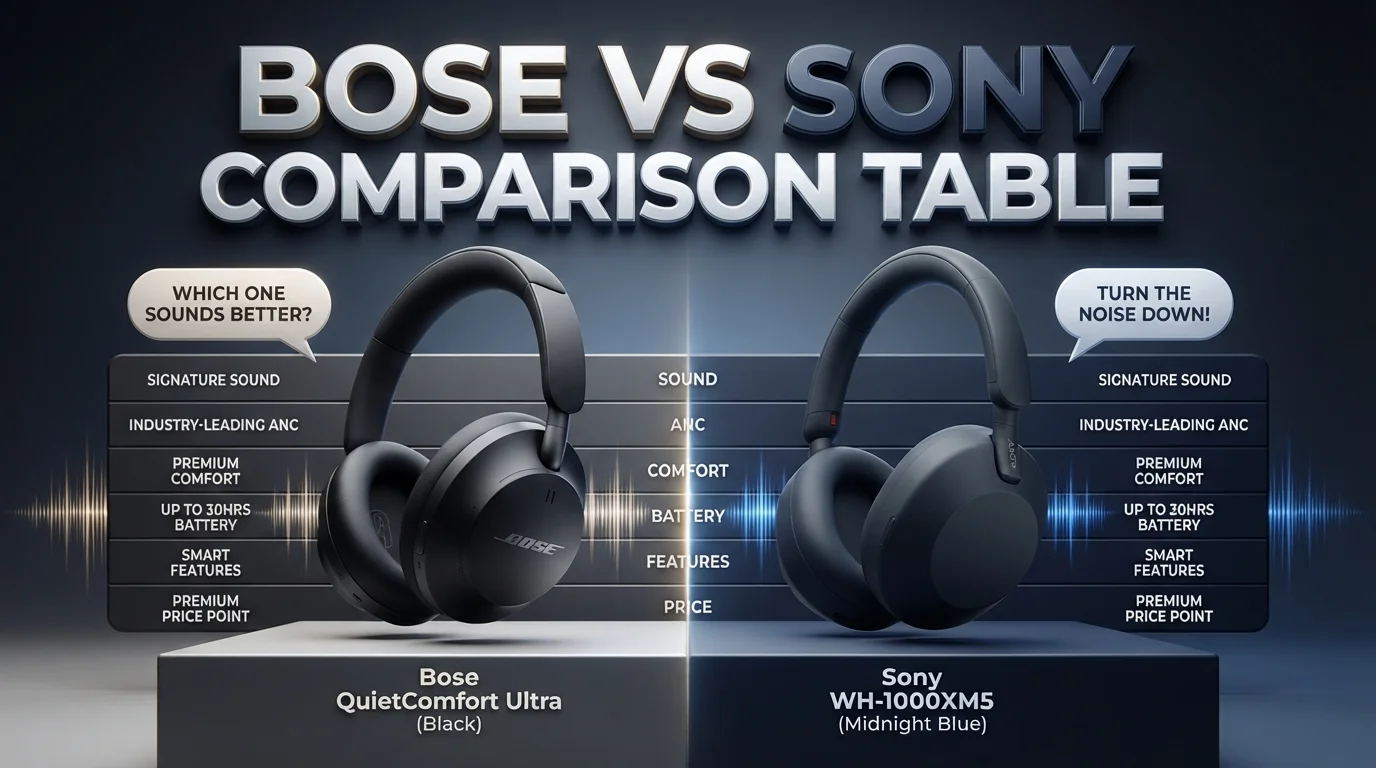
| Feature | Bose | Sony |
|---|---|---|
| Sound Profile | Balanced and natural | Bass-rich and customizable |
| Noise Cancellation | Excellent | Excellent |
| Comfort | Outstanding | Very Good |
| App Features | Basic | Advanced |
| EQ Customization | Limited | Extensive |
| Battery Life | Very Good | Excellent |
| Best For | Comfort and simplicity | Features and flexibility |
| Value for Money | Good | Excellent |
Real-World Usage Scenarios
Scenario 1: Frequent Traveler
Person A: “I spend hours on airplanes every month.”
Person B: “Bose may be your best choice because of its comfort and noise cancellation.”
🎯 Lesson: Bose excels for long travel sessions.
Scenario 2: Bass Lover
Person A: “I listen to hip-hop and EDM every day.”
Person B: “Sony’s customizable sound and stronger bass may suit you better.”
🎯 Lesson: Sony generally appeals more to bass enthusiasts.
Scenario 3: Office Worker
Person A: “I need headphones for meetings and focus.”
Person B: “Either works well, but Bose often feels more comfortable during all-day wear.”
🎯 Lesson: Comfort can be more important than extra features.
Scenario 4: Tech Enthusiast
Person A: “I love tweaking settings and audio profiles.”
Person B: “Sony offers significantly more customization.”
🎯 Lesson: Sony is ideal for users who enjoy personalization.
Scenario 5: Casual Listener
Person A: “I just want something that works.”
Person B: “Bose provides a simpler experience with minimal setup.”
🎯 Lesson: Simplicity is one of Bose’s biggest strengths.
Common Mistakes
Mistake #1
❌ Assuming Sony always has better sound.
✅ Sound preference is subjective.
Why it happens: Different listeners prefer different sound signatures.
Mistake #2
❌ Assuming Bose has better performance in every category.
✅ Sony often leads in features and customization.
Why it happens: Bose’s reputation can overshadow Sony’s technological advantages.
Mistake #3
❌ Buying based solely on brand reputation.
✅ Consider your listening habits and priorities.
Why it happens: Marketing often influences purchasing decisions more than actual needs.
Easy Memory Tricks
Trick #1
Bose = Balance
Think:
- Balanced sound
- Balanced design
- Balanced experience
Trick #2
Sony = Settings
Think:
- More settings
- More customization
- More features
Trick #3
Traveler vs Tinkerer
- Traveler → Bose
- Tinkerer → Sony
This simple rule works for many buyers.
Expert Insight
The Bose versus Sony debate is not about which brand is objectively better. Instead, it is about which brand aligns better with your priorities. Bose has built its reputation around comfort, simplicity, and premium noise cancellation. Sony has focused on innovation, customization, and feature-rich products.
In recent years, Sony has gained a strong advantage among tech enthusiasts due to its advanced apps, audio processing technologies, and customizable sound profiles. However, Bose remains a top choice for travelers, professionals, and users seeking a hassle-free premium listening experience.