

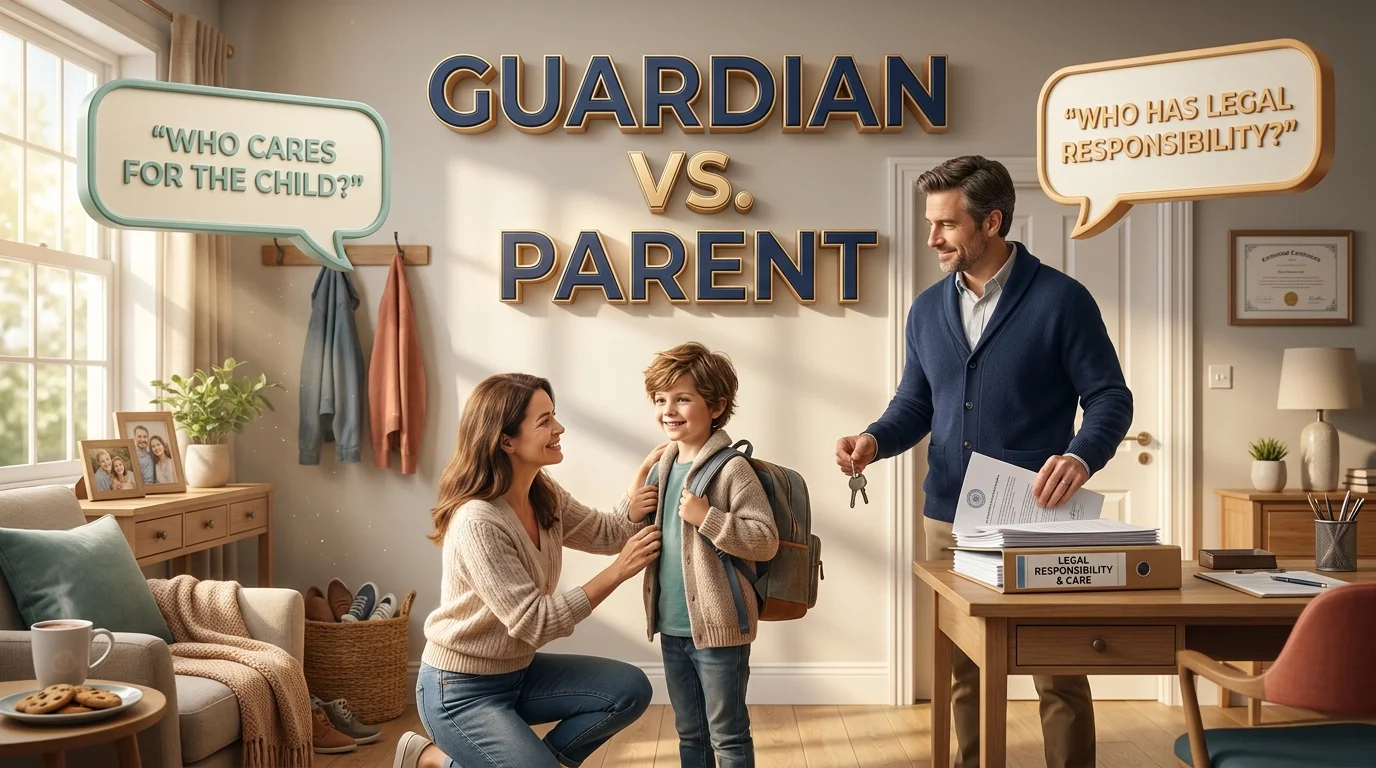
Quick Answer: Guardian vs. Parent
Parent refers to a child’s mother or father, whether by biological relationship, adoption, or another legally recognized parent-child relationship.
Guardian refers to a person legally authorized or appointed to care for a child or make decisions on the child’s behalf.
The easiest rule
Parent = parent-child relationship
Guardian = legal responsibility or authority
A parent may be a child’s guardian, but a guardian does not have to be the child’s parent.
What Does “Parent” Mean?
A parent is a person’s mother or father.
The term can refer to:
- A biological parent
- An adoptive parent
- A legally recognized parent
- In some contexts, a person who has assumed a legally recognized parental role
Examples
Her parents attended the school meeting.
The child’s mother is her legal parent.
His adoptive parents raised him from infancy.
🎯 Key Insight: Parent primarily describes the parent-child relationship.
What Does “Guardian” Mean?
A guardian is generally someone who has been given legal responsibility or authority to care for another person, particularly a child who needs someone to act on their behalf.
Guardianship can arise in different circumstances, and the exact powers of a guardian depend on the applicable law and court order.
Examples
The court appointed her uncle as the child’s guardian.
The guardian was responsible for making decisions on the child’s behalf.
The school requested the guardian’s signature.
🎯 Key Insight: Guardian primarily describes a legal role or responsibility.
Guardian vs. Parent: Main Difference
| Feature | Parent | Guardian |
|---|---|---|
| Basic meaning | Mother or father of a child | Person legally responsible for another person, often a child |
| Relationship | Parent-child relationship | Legal responsibility/authority |
| Must be biologically related? | No; adoptive/legal parents can be parents | No |
| Must be a parent? | Yes, by definition | No |
| Can make decisions for a child? | Generally, subject to applicable law | Often, depending on the type and scope of guardianship |
| Can be appointed by a court? | Not necessarily | Commonly |
| Example | The child’s father | The child’s aunt appointed by a court |
| Memory clue | Relationship | Responsibility |
Bottom Line
Parent describes who someone is in relation to the child.
Guardian describes a legal caregiving or decision-making role.
Can a Parent Also Be a Guardian?
Yes.
A parent can also have legal guardianship responsibilities for their child, depending on the jurisdiction and circumstances.
For example:
The child’s mother is both her parent and her legal guardian.
In ordinary situations, people may simply refer to her as the child’s parent rather than emphasizing the guardianship role.
🎯 Lesson: Parent and guardian are not mutually exclusive categories.
Can a Guardian Be a Parent?
Yes.
A parent can also serve as a guardian.
However, the important point is:
Not every guardian is a parent.
For example:
A child’s grandmother may be appointed as the child’s guardian.
She is the child’s guardian, but she is not necessarily the child’s parent.
Can a Guardian Be a Relative?
Yes.
A guardian may be:
- A grandparent
- An aunt or uncle
- An adult sibling
- Another relative
- Another suitable adult
The exact rules vary by jurisdiction.
Example
After the child’s parents could no longer provide care, the court appointed his grandmother as guardian.
🎯 Lesson: A guardian can be a relative without being a parent.
Guardian vs. Parent in School Forms
This is one of the places where the distinction matters.
A school form might ask:
Parent/Guardian Name
This wording recognizes that the person responsible for the child may be a parent, a guardian, or another legally authorized person, depending on the circumstances.
Example
If a child’s aunt has legal guardianship:
Parent/Guardian: Sarah Khan
She would provide her information as the child’s guardian, even though she is not the child’s parent.
🎯 Key Insight: “Parent/guardian” is often used when a form needs information from the adult legally responsible for the child.
Guardian vs. Parent in Medical Decisions
A parent or guardian may be asked to provide consent or make decisions for a child, but the exact authority depends on:
- Local law
- The child’s age
- The type of medical decision
- Court orders
- The parent’s legal status
- The guardian’s authority
Therefore, guardian and parent should not automatically be assumed to have identical legal powers in every situation.
Guardian vs. Parent in Legal Contexts
In legal writing, the distinction can become especially important.
Parent
Focuses on the person’s legal or familial relationship to the child.
The child’s legal parent requested custody.
Guardian
Focuses on the person’s court-recognized or legally established responsibility and authority.
The court appointed the child’s grandmother as guardian.
🎯 Lesson: In legal contexts, don’t treat the words as automatic synonyms.
Guardian vs. Custodian
Another term that is often confused with guardian is custodian.
These concepts can overlap, but they are not necessarily identical.
A custodian generally refers to someone who has physical care or custody of a child, while a guardian may have broader legal authority depending on the jurisdiction.
For example:
A parent may have physical custody of a child while another person has a different legal role.
Because family-law terminology varies considerably by jurisdiction, the exact distinction should be checked under the relevant local law.
Guardian vs. Parent: Real-World Usage Scenarios
Scenario 1: Biological Mother
Maria is the child’s mother.
🎯 Lesson: Maria is the child’s parent.
Scenario 2: Grandmother With Legal Guardianship
The court appointed Maria’s grandmother as her guardian.
🎯 Lesson: The grandmother is the guardian, even though she is not the parent.
Scenario 3: Adoptive Family
The child’s adoptive parents are legally recognized as her parents.
🎯 Lesson: A parent does not have to be biologically related to the child.
Scenario 4: School Form
Parent/Guardian signature required.
🎯 Lesson: The school is asking the adult with the relevant parental or legal responsibility.
Scenario 5: Parent Who Is Also Guardian
The child’s father is her parent and legal guardian.
🎯 Lesson: One person can hold both roles.
Common Mistakes With Guardian and Parent
Mistake 1: Assuming Every Guardian Is a Parent
❌ The child’s guardian must be his father or mother.
Not necessarily.
A guardian may be a grandparent, relative, or another legally appointed adult.
Mistake 2: Assuming Every Parent Is Automatically Called a Guardian
In everyday language, we normally call a child’s mother or father a parent.
Whether that person is legally classified as a guardian depends on the applicable law and circumstances.
🎯 Why it happens: The responsibilities can overlap, but the terms describe different concepts.
Mistake 3: Thinking “Guardian” Means Foster Parent
A guardian and a foster parent are not automatically the same.
Foster care generally concerns a child being placed in someone’s care under a particular legal or child-welfare arrangement.
Guardianship concerns a specific legal authority or responsibility.
The two can overlap in some circumstances, but they should not automatically be treated as synonyms.
Mistake 4: Using the Words Interchangeably in Legal Documents
In casual conversation, the distinction may not matter.
In legal, medical, educational, or government documents, however, the exact status of the adult can matter significantly.
Parent vs. Guardian: Which Word Should You Use?
Use parent when you mean:
- Mother or father
- Biological parent
- Adoptive parent
- Legally recognized parent
Use guardian when you mean:
- A person legally appointed to care for a child
- Someone with legal authority over the child
- A non-parent who has been given guardianship
Compare
The parent attended the meeting.
This identifies the adult by their parental relationship.
The guardian attended the meeting.
This identifies the adult by their legal caregiving role.
Memory Tricks: Guardian vs. Parent
👨👩👧 Trick 1: Parent = Relationship
Think:
Parent → family relationship
🛡️ Trick 2: Guardian = Responsibility
Think:
Guardian → guards/protects and has legal responsibility
⭐ One-Line Memory Trick
Parent = who the person is to the child.
Guardian = what legal role the person has.
Expert Insight: Why the Distinction Matters
The difference between parent and guardian is fundamentally a distinction between relationship and legal role.
A parent-child relationship can exist through biology, adoption, or legal recognition.
Guardianship, on the other hand, is a legal framework that gives a person particular responsibilities and authority.
That’s why one child could have:
Parents + a guardian
or:
A parent who is also the guardian
depending on the circumstances and applicable law.
The exact rights of parents and guardians are jurisdiction-specific, so legal documents should always be interpreted according to the relevant law rather than relying solely on ordinary dictionary meanings.
Quick Test: Guardian or Parent?
1. “She is the child’s biological mother.”
Answer: Parent
2. “The court appointed the child’s uncle to care for him.”
Answer: Guardian
3. “His adoptive mother is his legal ________.”
Answer: Parent
4. “The school requested the child’s ________ to sign the form.”
If the adult has legal guardianship:
Answer: Guardian
5. “Can a grandmother be a guardian?”
Answer: Yes.
A grandmother can be appointed as a child’s guardian, depending on the applicable law and circumstances.
6. “Can a parent also be a guardian?”
Answer: Yes.
The roles can overlap.