
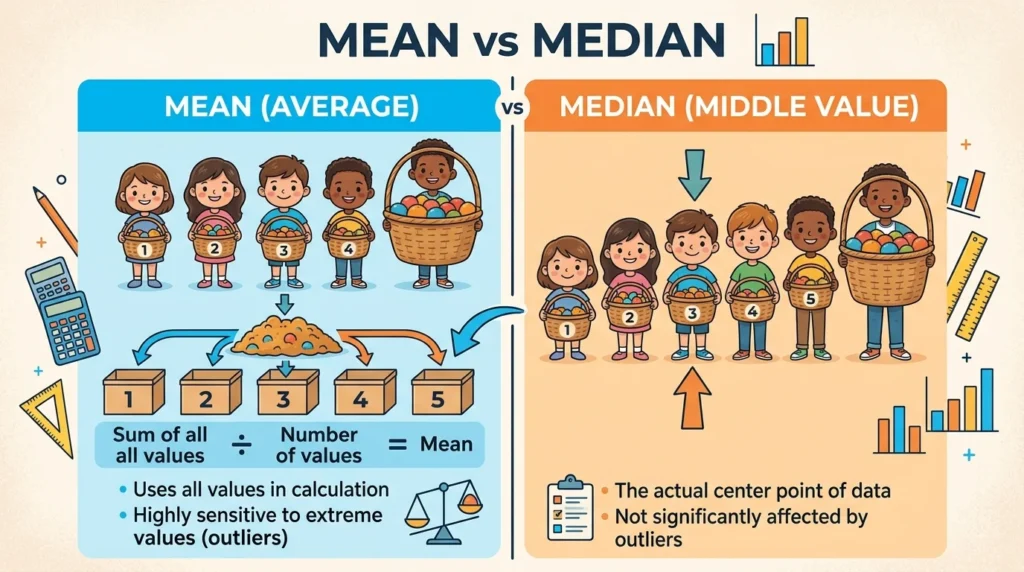
Mean and median are two of the most common ways to describe the center of a set of numbers. They are both measures of central tendency, but they calculate that center in very different ways.
The mean is what people often call the average: add all the values together and divide by the number of values.
The median is the middle value after the numbers have been arranged from smallest to largest.
Although they look and sound similar, they serve completely different purposes.
Understanding the difference is especially important when working with income, test scores, prices, ages, statistics, research data, and other numerical information.
Quick Answer: Relieve vs. Relief
Relieve = to reduce or remove something unpleasant.
This medicine may relieve the pain.
Relief = the feeling or state that comes when something unpleasant is reduced or removed.
The medicine provided relief from the pain.
The easiest way to remember:
Relieve = do something
Relief = the result or feeling
What Does “Relieve” Mean?
Relieve is a verb. It means to make something unpleasant less severe or to remove it completely.
It can be used with things such as:
- Pain
- Stress
- Anxiety
- Pressure
- Discomfort
- Hunger
- Boredom
- Responsibility
- Duties
Examples of “Relieve”
- The medicine relieved her headache.
- A short break can relieve stress.
- The new treatment helped relieve his pain.
- The manager relieved her of some responsibilities.
In each example, relieve describes an action or change.
Common Grammar Patterns
Relieve + something
The medication relieved the pain.
Relieve someone of + something
The assistant relieved him of some of his duties.
Help relieve + something
Exercise can help relieve stress.
🎯 Key Insight: If the word describes reducing or removing a problem, you usually need relieve.
What Does “Relief” Mean?
Relief is primarily a noun.
It can describe the feeling of comfort or reassurance that occurs when something painful, stressful, or worrying has been reduced or removed.
Examples of “Relief”
- She felt a sense of relief when she heard the good news.
- The medicine provided relief from the pain.
- He sighed with relief after the exam ended.
- There was visible relief on her face.
Common Expressions With “Relief”
A sense of relief
A sigh of relief
Relief from pain
Relief from stress
Much to my relief
For example:
Much to my relief, the missing documents were found.
🎯 Key Insight: Relief is the comfort or release experienced after a problem becomes less severe.
Relieve vs. Relief: The Main Difference
The central distinction is grammatical:
Relieve
- Verb
- Describes an action
- Means to reduce or remove something unpleasant
- Example: The medicine relieved the pain.
Relief
- Noun
- Describes a feeling, state, or result
- Means comfort after something unpleasant is reduced
- Example: The medicine provided relief.
Comparison Table
| Feature | Relieve | Relief |
|---|---|---|
| Part of speech | Verb | Noun |
| Meaning | Reduce or remove something unpleasant | Comfort after something unpleasant is reduced |
| Focus | Action | Result/feeling |
| Example | This may relieve pain. | This provides pain relief. |
| Common phrase | Relieve stress | A sense of relief |
| Memory clue | Do | Feeling/result |
Real-World Usage Scenarios
Scenario 1: Headache
The medicine relieved my headache.
🎯 Lesson: Relieve is correct because the sentence describes what the medicine did.
Compare:
The medicine gave me relief from my headache.
Here, relief is the noun describing the result.
Scenario 2: Stress
Taking a walk can relieve stress.
🎯 Lesson: Relieve is a verb because it describes an action that reduces stress.
Scenario 3: Good News
I felt enormous relief when I heard the results.
🎯 Lesson: Relief is a noun because it describes the feeling experienced after the worry disappeared.
Scenario 4: Completing an Exam
She sighed with relief after finishing the exam.
🎯 Lesson: The phrase “with relief” describes the emotional response to the end of a stressful situation.
Scenario 5: Removing Responsibility
The supervisor relieved him of his duties.
🎯 Lesson: Relieve can also mean to remove a responsibility or obligation from someone.
Common Mistakes With Relieve and Relief
Mistake 1: “This gives me relieve”
❌ This gives me relieve.
✅ This gives me relief.
Why it happens:
After give, you need the noun relief.
give + relief
Mistake 2: “It provides relieve”
❌ This treatment provides relieve from pain.
✅ This treatment provides relief from pain.
Why it happens:
Provides needs a noun here.
provide + relief
Mistake 3: “It will relief the pain”
❌ This medicine will relief the pain.
✅ This medicine will relieve the pain.
Why it happens:
After will, you need the base form of the verb.
will + relieve
Not:
❌ will + relief
Mistake 4: “I feel relieve”
❌ I feel relieve after hearing the news.
Better:
✅ I feel relief after hearing the news.
Or:
✅ I feel relieved after hearing the news.
This introduces another useful word:
Relieve → relieved → relief
Relieve, Relieved, Relief, and Relieving
Understanding the entire word family makes the difference much easier.
Relieve
Verb:
The medicine may relieve the pain.
Relieved
Adjective/past participle:
I was relieved to hear the news.
Relief
Noun:
I felt a sense of relief.
Relieving
Present participle:
The treatment is relieving the discomfort.
Quick Pattern
Relieve = action
Relieved = feeling
Relief = noun/result
Relieved vs. Relief
This is another common source of confusion.
Relieved
Describes how a person feels.
She was relieved when the problem was solved.
Relief
Names the feeling itself.
She felt relief when the problem was solved.
Compare:
I am relieved.
= This describes my emotional state.
I feel relief.
= This identifies the feeling I’m experiencing.
🎯 Key Insight: Relieved describes a person; relief names the feeling.
How to Choose Between Relieve and Relief
Ask yourself:
Am I describing an action that reduces something?
Use relieve.
Exercise can relieve stress.
Am I naming the feeling or result?
Use relief.
Exercise gave me relief from stress.
Am I describing how someone feels?
Use relieved.
She felt relieved after the meeting.
Memory Tricks: Relieve vs. Relief
🧠 Trick 1: Relieve = Verb
Think:
Relieve = reduce
Both are actions.
The medicine relieves pain.
😌 Trick 2: Relief = Feeling
Think:
Relief = comfort
I felt relief when the danger passed.
🔤 Trick 3: “I Feel Relief”
This sentence is a useful memory anchor:
I feel relief.
You feel relief, but you relieve pain.
⭐ One-Line Memory Trick
You relieve a problem; you feel relief afterward.
Relieve vs. Alleviate
Relieve and alleviate are often synonyms when discussing pain, stress, or discomfort.
The medicine relieved the pain.
The medicine alleviated the pain.
Both are correct.
However, relieve is more common in everyday English, while alleviate can sound more formal.
Relieve vs. Release
These words are also sometimes confused.
Relieve
Means to reduce or remove something unpleasant.
The treatment relieved the pain.
Release
Means to let go, free, or make something available.
The company released a new product.
They released the animal into the wild.
They may overlap in certain contexts, but they are not generally interchangeable.
Expert Insight: The Grammar Behind Relieve and Relief
Relieve and relief belong to the same word family but occupy different grammatical roles.
The verb relieve describes an action:
The treatment relieved the symptoms.
The noun relief describes the resulting state or experience:
The treatment provided relief from the symptoms.
This distinction appears in many English word families where a verb and noun have related meanings:
- decide → decision
- approve → approval
- arrive → arrival
- relieve → relief
The spelling isn’t always predictable, so learning the words as grammatical pairs is useful.
Quick Test: Relieve or Relief?
Choose the correct word.
- The medicine helped ________ her pain.
- He felt a huge sense of ________ after hearing the news.
- Exercise can ________ stress.
- The treatment provided immediate ________.
- She was ________ to discover that everyone was safe.
Answers
- relieve
- relief
- relieve
- relief
- relieved
The Pattern
Relieve = verb/action
Relief = noun/feeling
Relieved = describes someone’s emotional state
FAQs About Mean vs. Median
What is the difference between mean and median?
The mean is the arithmetic average of all the values. The median is the middle value after the values are arranged in order.
Which is better, mean or median?
Neither is always better. The best choice depends on the data.
For relatively balanced data, the mean can be useful. For strongly skewed data or data with major outliers, the median is often more representative.
Is the mean always greater than the median?
No. The mean can be greater than, less than, or equal to the median depending on the distribution.
Why is median better for income?
Income data can contain extremely high values. Those values can pull the mean upward, while the median is much less affected.
Can the mean and median be the same?
Yes.
For example:
2, 4, 6, 8, 10
Mean = 6
Median = 6
What happens to the mean when you add an extreme value?
An extreme value can substantially increase or decrease the mean, depending on whether it is unusually high or low.
What happens to the median when you add an extreme value?
The median usually changes much less because it depends primarily on the order and position of the observations.
What is the easiest way to remember mean vs. median?
Remember:
Mean = average.
Median = middle.
Conclusion
The difference between mean and median is simple once you understand how each one finds the center of a data set.
Mean is the arithmetic average:
Add all the values and divide by the number of values.
Median is the middle value:
Put the values in order and find the center.
The most important practical difference is their response to outliers. The mean can be pulled significantly by unusually high or low values, while the median is generally much more resistant.
Final memory trick:
Mean = average.
Median = middle.
When data is skewed or contains extreme values, check the median. When the data is relatively balanced and you want every value to contribute directly to the calculation, the mean is often useful.