
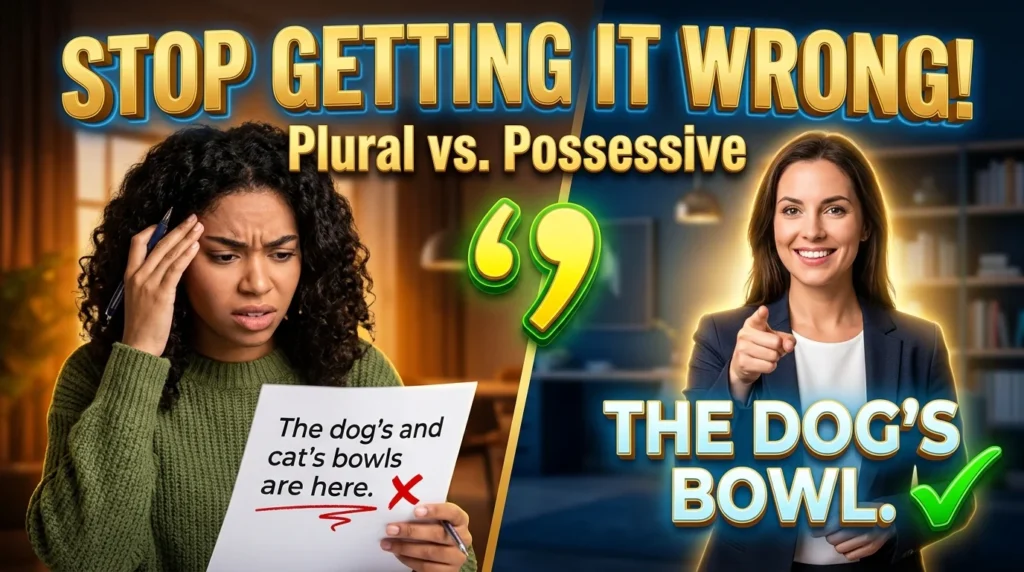
Plural or possessive is one of the most common grammar questions for English learners and native speakers alike. While these forms may look similar, they serve completely different purposes. A missing or misplaced apostrophe can change the meaning of a sentence and make your writing appear less polished.
Although plural and possessive nouns sometimes differ by only an apostrophe, they represent different grammatical ideas. Plural nouns show that there is more than one person, place, thing, or idea, while possessive nouns show ownership, relationship, or association.
In this guide, you’ll learn the difference between plural and possessive nouns, discover easy grammar rules, see real-world examples, avoid common mistakes, and master simple memory tricks that will help you use them correctly every time.
Quick Answer
The difference between plural and possessive is simple:
- Plural means more than one.
- Possessive means ownership or belonging.
Examples
- Dogs are friendly. (Plural: more than one dog.)
- The dog’s leash is new. (Singular possessive: one dog owns the leash.)
- The dogs’ owner arrived. (Plural possessive: several dogs share one owner.)
Quick Rule: If you’re talking about quantity, use the plural. If you’re showing ownership or association, use the possessive.
What Is a Plural?
A plural noun refers to more than one person, place, thing, or idea. Most plural nouns are formed by adding -s or -es to the singular form, although some nouns have irregular plural forms.
When to Use a Plural
Use a plural noun when:
- There is more than one item.
- You’re referring to multiple people or objects.
- No ownership is being shown.
Examples
- Three books are on the table.
- The students finished their homework.
- Several cars were parked outside.
- Two dogs played in the yard.
- Many trees line the street.
Irregular Plurals
Some nouns do not follow the regular -s rule.
| Singular | Plural |
|---|---|
| Child | Children |
| Man | Men |
| Woman | Women |
| Person | People |
| Mouse | Mice |
| Tooth | Teeth |
| Foot | Feet |
| Goose | Geese |
Key Insight
A plural noun simply tells the reader that there is more than one of something. It does not indicate ownership.
What Is a Possessive?
A possessive noun shows that someone or something owns, has, or is associated with something else.
Possessive nouns are usually formed by adding an apostrophe (‘) and sometimes an s.
Singular Possessive
For most singular nouns, add ‘s.
Examples
- The teacher’s laptop
- The dog’s toy
- Sarah’s notebook
- The car’s engine
- My friend’s house
Plural Possessive
For regular plural nouns ending in -s, add only an apostrophe.
Examples
- The students’ projects
- The dogs’ owner
- The teachers’ lounge
- The cars’ engines
- The players’ uniforms
Irregular Plural Possessive
Irregular plural nouns don’t end in -s, so add ‘s.
| Plural | Possessive |
|---|---|
| Men | Men’s |
| Women | Women’s |
| Children | Children’s |
| People | People’s |
| Mice | Mice’s (less common but correct when showing possession) |
Examples
- Men’s jackets
- Women’s shoes
- Children’s books
- People’s opinions
Key Insight
Possessive nouns answer the question:
Who owns it?
Plural vs Possessive: Key Differences
Quick Comparison
- Plural = More than one
- Possessive = Ownership or relationship
| Feature | Plural | Possessive |
|---|---|---|
| Meaning | More than one | Ownership or association |
| Apostrophe | No | Yes |
| Purpose | Shows quantity | Shows possession |
| Example | Dogs | Dog’s |
| Example Sentence | The dogs bark. | The dog’s collar is blue. |
How to Tell If a Word Is Plural or Possessive
Ask yourself these questions:
Question 1
Am I talking about more than one?
If yes, use the plural.
Example:
- Five cats slept on the porch.
Question 2
Am I showing ownership?
If yes, use the possessive.
Example:
- The cat’s food bowl is empty.
Question 3
Do several owners share something?
If yes, use the plural possessive.
Example:
- The cats’ toys were scattered around the room.
Real-World Usage Scenarios
Example 1: School
❌ The students homework was difficult.
✅ The students’ homework was difficult.
🎯 Lesson: The homework belongs to multiple students, so use the plural possessive.
Example 2: Pet
❌ The dogs leash broke.
✅ The dog’s leash broke.
🎯 Lesson: One dog owns the leash.
Example 3: Shopping
❌ Several shoe’s were on sale.
✅ Several shoes were on sale.
🎯 Lesson: You’re talking about more than one shoe, not ownership.
Example 4: Family
❌ The children toys are everywhere.
✅ The children’s toys are everywhere.
🎯 Lesson: “Children” is already plural, so add ‘s to make it possessive.
Example 5: Office
❌ The employees parking lot is full.
✅ The employees’ parking lot is full.
🎯 Lesson: The parking lot belongs to multiple employees.
Common Mistakes
Mistake 1
❌ Apples’s are delicious.
✅ Apples are delicious.
Why? You’re making the noun plural, not possessive.
Mistake 2
❌ The teachers lounge is upstairs.
✅ The teacher’s lounge is upstairs.
Why? One teacher owns or is associated with the lounge.
Mistake 3
❌ Mens clothing
✅ Men’s clothing
Why? “Men” is an irregular plural. The possessive form is men’s.
Mistake 4
❌ Childrens books
✅ Children’s books
Why? “Children” is already plural. Add ‘s for possession.
Mistake 5
❌ The cats food is ready.
✅ The cat’s food is ready.
Why? One cat owns the food.
Memory Tricks
These simple tricks make the difference easy to remember.
Trick 1
Plural = More than one.
No apostrophe is usually needed.
Trick 2
Possessive = Possession.
If something belongs to someone, you’ll usually need an apostrophe.
Trick 3
Ask:
Can I replace the phrase with “belongs to”?
If yes, use the possessive.
Example:
The teacher’s book
↓
The book belongs to the teacher.
Trick 4
Think:
Ownership = Apostrophe.
Quantity = No apostrophe.
Expert Insight
Many apostrophe mistakes happen because writers confuse plural forms with possessive forms. In professional writing, misplaced apostrophes are among the most common punctuation errors.
A helpful way to avoid mistakes is to identify the noun’s role before writing. If the noun simply names more than one thing, make it plural. If it shows ownership or association, make it possessive.
Remember that irregular plurals such as men, women, children, and people require ‘s to become possessive because they don’t end in -s.
Frequently Asked Questions
What is the difference between plural and possessive?
A plural noun shows that there is more than one person, place, or thing. A possessive noun shows ownership or association.
Does every possessive noun need an apostrophe?
Yes. Standard English uses an apostrophe to indicate possession, either with ‘s or a trailing apostrophe after regular plural nouns ending in -s.
Is “dogs” plural or possessive?
Dogs is plural.
Dog’s is singular possessive.
Dogs’ is plural possessive.
Is “children’s” plural or possessive?
Children’s is possessive.
The plural noun is children.
Why is “men’s” correct instead of “mens”?
Because men is already the plural form of man. To make it possessive, add ‘s, resulting in men’s.
How do I know where to put the apostrophe?
Ask whether the noun owns or is associated with something. If it does, use the appropriate possessive form. If it simply refers to more than one item, no apostrophe is needed.
Can a word be both plural and possessive?
Yes. A noun can be plural possessive, such as:
- Teachers’ lounge
- Students’ assignments
- Dogs’ park
These forms indicate that multiple people or things share ownership or association.
What are the most common plural and possessive mistakes?
Common mistakes include:
- Using apostrophes to form simple plurals.
- Forgetting apostrophes in possessive nouns.
- Confusing irregular plural possessives like children’s, men’s, and women’s.
Conclusion
Understanding plural or possessive nouns is essential for clear, accurate writing. The difference comes down to one simple idea:
- Use plural when you’re referring to more than one person, place, or thing.
- Use possessive when you’re showing ownership, relationship, or association.
A quick way to remember is: Plural means many; possessive means belongs to. By applying this simple rule and practicing with real examples, you’ll avoid common grammar mistakes and write with greater confidence in school, at work, and in everyday communication.