

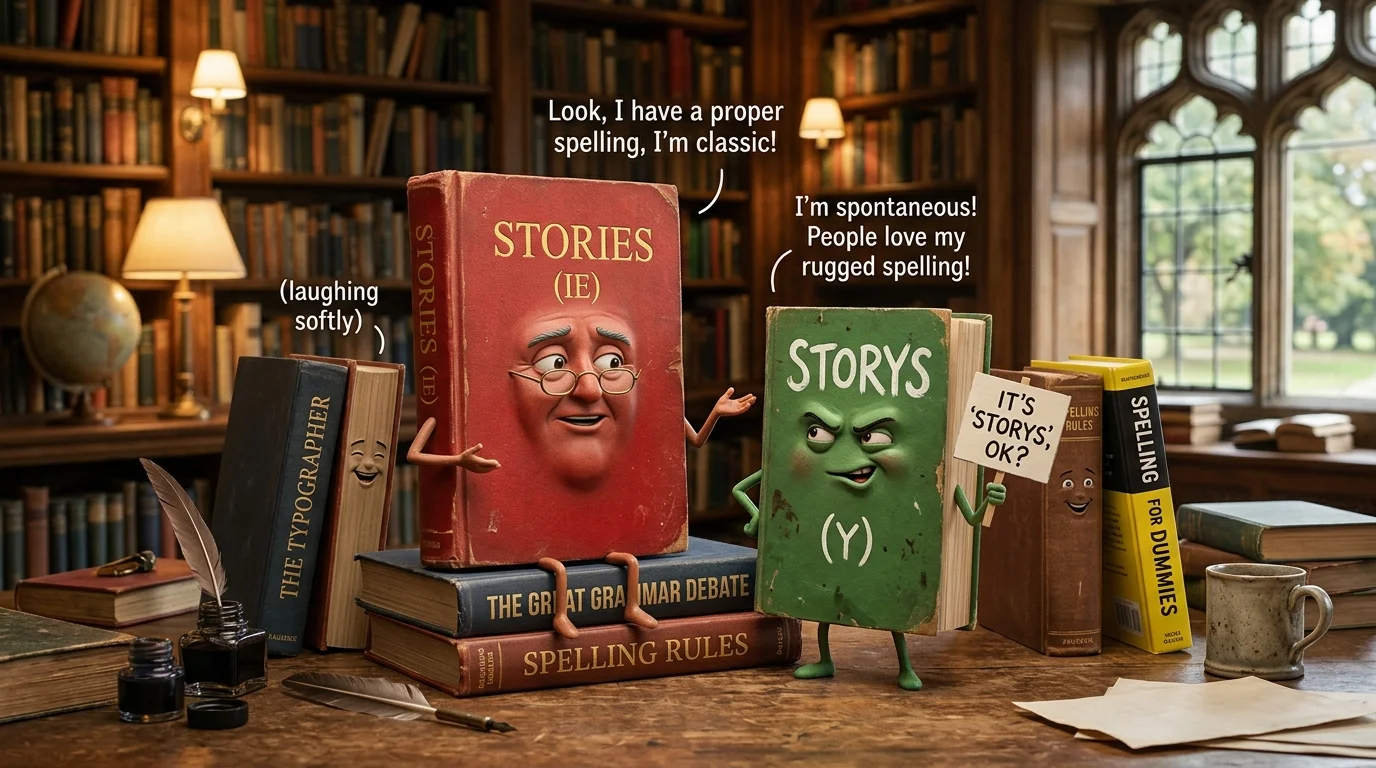
Quick Answer: Storys vs Stories
- Stories is the correct plural form of story.
- Storys is incorrect and should not be used.
Quick Examples
✅ She told several interesting stories.
✅ The book contains short stories from around the world.
❌ She told several interesting storys.
❌ The book contains short storys from around the world.
What Does “Stories” Mean?
Stories is the plural form of story.
A story can refer to:
- A narrative or tale
- A fictional account
- A real-life experience
- A news report
- A level of a building (in some contexts)
When to Use Stories
Use stories when referring to more than one story.
Examples
- Children enjoy listening to bedtime stories.
- The magazine published several inspiring stories.
- Her stories captivated the audience.
- The website features success stories from customers.
Key Insight
Whenever you mean “more than one story,” the correct form is stories.
What Does “Storys” Mean?
Storys is not a correct English word.
It is a spelling mistake caused by adding -s directly to story instead of applying the correct pluralization rule.
Why Does This Mistake Happen?
Many nouns form plurals like this:
- Book → Books
- Chair → Chairs
- Table → Tables
As a result, some writers incorrectly assume:
Story → Storys ❌
However, nouns ending in a consonant + y require a spelling change.
Examples
Incorrect:
- I read many storys last year.
- The teacher shared several storys.
Correct:
- I read many stories last year.
- The teacher shared several stories.
Key Insight
If a noun ends in a consonant followed by y, replace the y with ies to form the plural.
Storys vs Stories: Key Differences
Quick Comparison
- Stories = Correct plural form
- Storys = Misspelling
Comparison Table
| Feature | Stories | Storys |
|---|---|---|
| Correct English Spelling | Yes | No |
| Dictionary Recognition | Yes | No |
| Plural of Story | Yes | No |
| Accepted in Formal Writing | Yes | No |
| Example | Interesting stories | ❌ Interesting storys |
Why “Stories” Is Correct: The Grammar Rule
Rule: Consonant + Y → IES
When a noun ends with a consonant followed by y, change the y to ies when making it plural.
Examples
| Singular | Plural |
| Story | Stories |
| City | Cities |
| Baby | Babies |
| Family | Families |
| Party | Parties |
Key Insight
Because story ends with the consonant r followed by y, the plural becomes stories.
Real-World Usage Scenarios
Example 1
❌ She enjoys writing short storys.
✅ She enjoys writing short stories.
🎯 Lesson: Use stories when referring to multiple narratives.
Example 2
❌ The newspaper published several storys.
✅ The newspaper published several stories.
🎯 Lesson: News reports are also called stories.
Example 3
Teacher: What kind of books do you like?
Student: I enjoy adventure stories.
🎯 Lesson: The correct plural is stories.
Example 4
❌ He shared funny storys during dinner.
✅ He shared funny stories during dinner.
🎯 Lesson: Replace y with ies.
Example 5
❌ The website features customer success storys.
✅ The website features customer success stories.
🎯 Lesson: Professional writing requires stories.
Common Mistakes People Make
Mistake 1: Simply Adding S
Incorrect:
- Storys
Correct:
- Stories
Why It Happens
Writers apply the standard plural rule instead of the special y-to-ies rule.
Mistake 2: Forgetting the Consonant + Y Rule
Incorrect:
- Storys
- Familys
- Partys
Correct:
- Stories
- Families
- Parties
Why It Happens
English pluralization rules can be easy to overlook.
Mistake 3: Using Storys in Professional Writing
Incorrect:
- The report contains customer storys.
Correct:
- The report contains customer stories.
Why It Matters
Incorrect spelling can make writing appear less professional.
Memory Tricks to Remember the Difference
Trick 1: Y Changes to IES
Remember:
Story → Stories
Simply replace:
Y → IES
Trick 2: Think of City → Cities
If you know:
City → Cities
Then remember:
Story → Stories
Both follow the same rule.
Trick 3: Visual Pattern
Correct:
Stories
Incorrect:
Storys
Whenever a word ends in a consonant + y, the plural typically ends in ies.
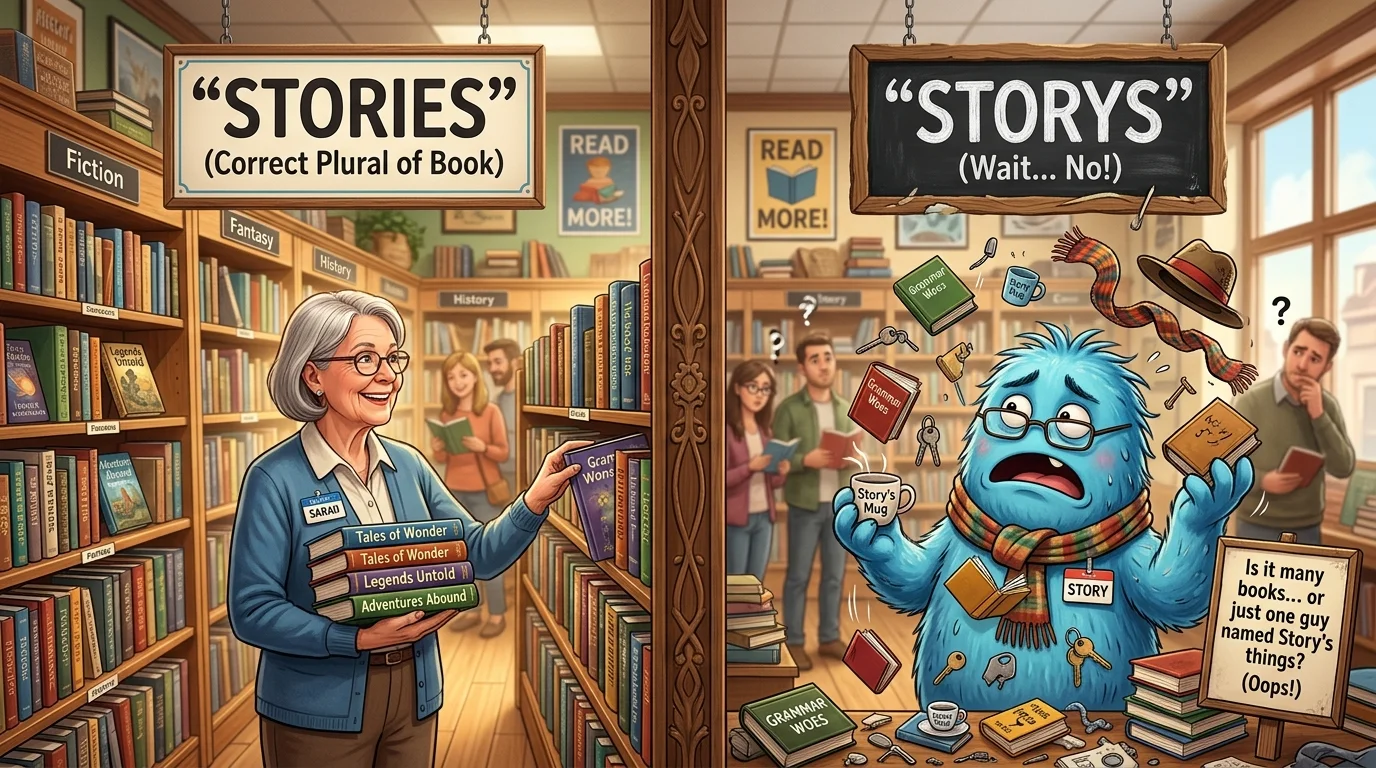
Expert Insight: Why English Uses “Stories”
The plural form stories follows a centuries-old English spelling rule designed to preserve pronunciation and readability.
When a noun ends in a consonant followed by y, replacing y with ies creates a smoother written form and clearer pronunciation.
This pattern applies to many common English words, including:
- Story → Stories
- Family → Families
- Party → Parties
- Country → Countries
Because the rule is firmly established in modern English grammar, stories is the only accepted plural form.