
Quick Answer: Possess vs Posses
- Possess is the correct verb spelling meaning “to own or have.”
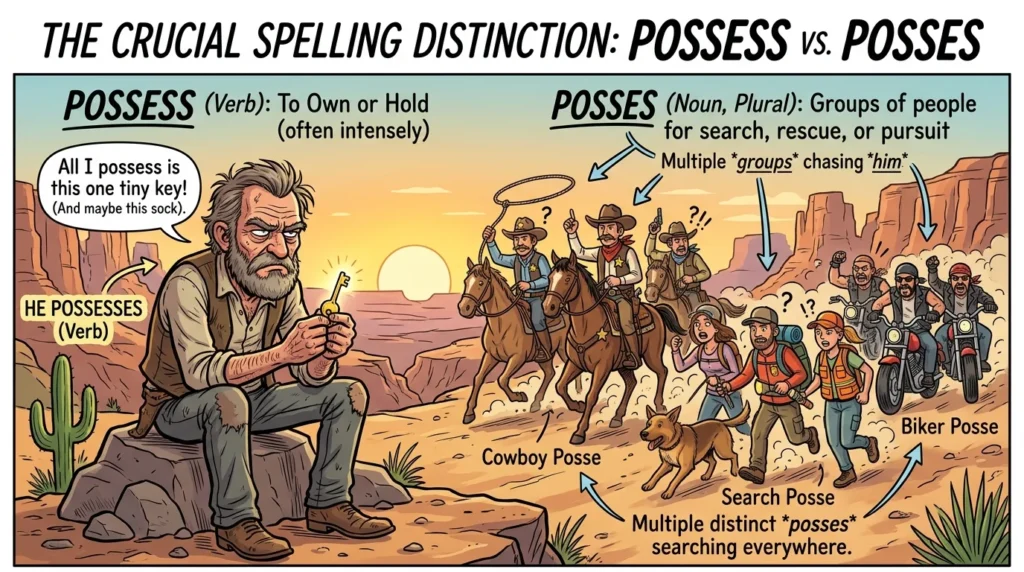
- Posses is generally incorrect when used as a verb (it is only a rare plural noun meaning groups of outlaws).
Quick Examples
✅ She possesses strong leadership skills.
❌ She posses strong leadership skills.
What Does “Possess” Mean?
Possess is a verb that means:
- To own something
- To have control over something
- To hold a quality, skill, or trait
When to Use Possess
Use possess when talking about:
- Ownership (objects, money, property)
- Skills or qualities
- Control or influence
Examples
- He possesses great talent.
- They possess valuable knowledge.
- She possesses a calm personality.
- The company possesses multiple patents.
Key Insight
Whenever you mean “to have or own,” the correct verb is possess.
What Does “Posses” Mean?
Posses is NOT the verb form of possess.
However, it does exist as a noun:
- A posse means a group of people (often law enforcement or a group of individuals)
- Posses is the plural of “posse”
Example (Rare Usage)
- The sheriff called for two posses to search the area.
👉 But this is unrelated to the verb “possess.”
Why Confusion Happens
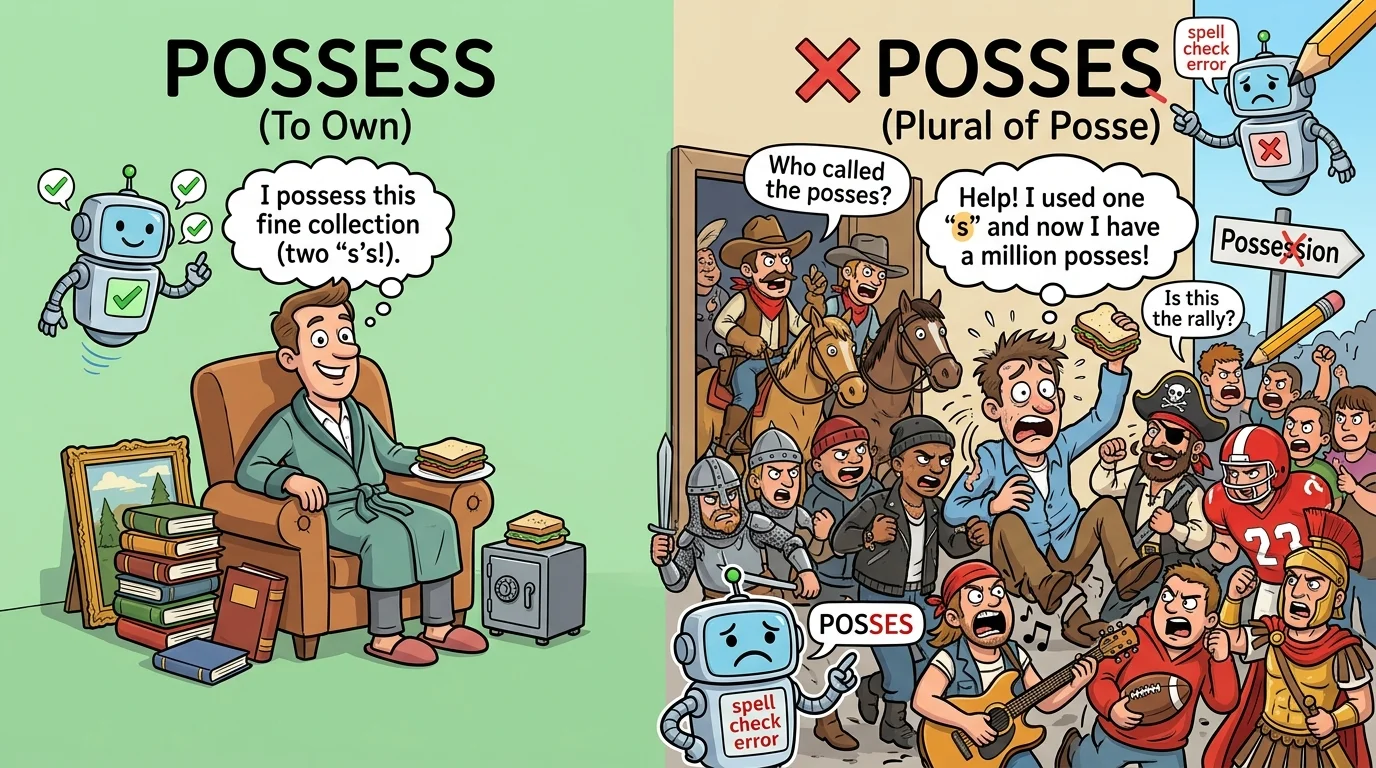
People mistakenly drop one “s” and assume:
Possess → Posses ❌
But in reality, the verb always uses double “s”.
Possess vs Posses: Key Differences
Quick Comparison
- Possess = Verb meaning to own/have (correct usage)
- Posses = Plural noun of “posse” (different meaning)
Comparison Table
| Feature | Possess | Posses |
|---|---|---|
| Part of Speech | Verb | Noun (plural of posse) |
| Meaning | To own or have | Groups of people (posses of lawmen/outlaws) |
| Common Usage | Very common | Rare |
| Correct for “owning” | Yes | No |
| Example | She possesses talent | The posses gathered |
Why “Possess” Is Correct: The Grammar Rule
Rule: Double S for “-sess” Verbs
Some English verbs use double consonants to maintain correct pronunciation:
- Possess
- Possession
- Possessing
- Possessed
Related Word Family
| Base | Forms |
| Possess | Possession, Possessive, Possessing |
Key Insight
The double s is required to preserve the correct sound and structure.
Possess vs. Posses: Meaning
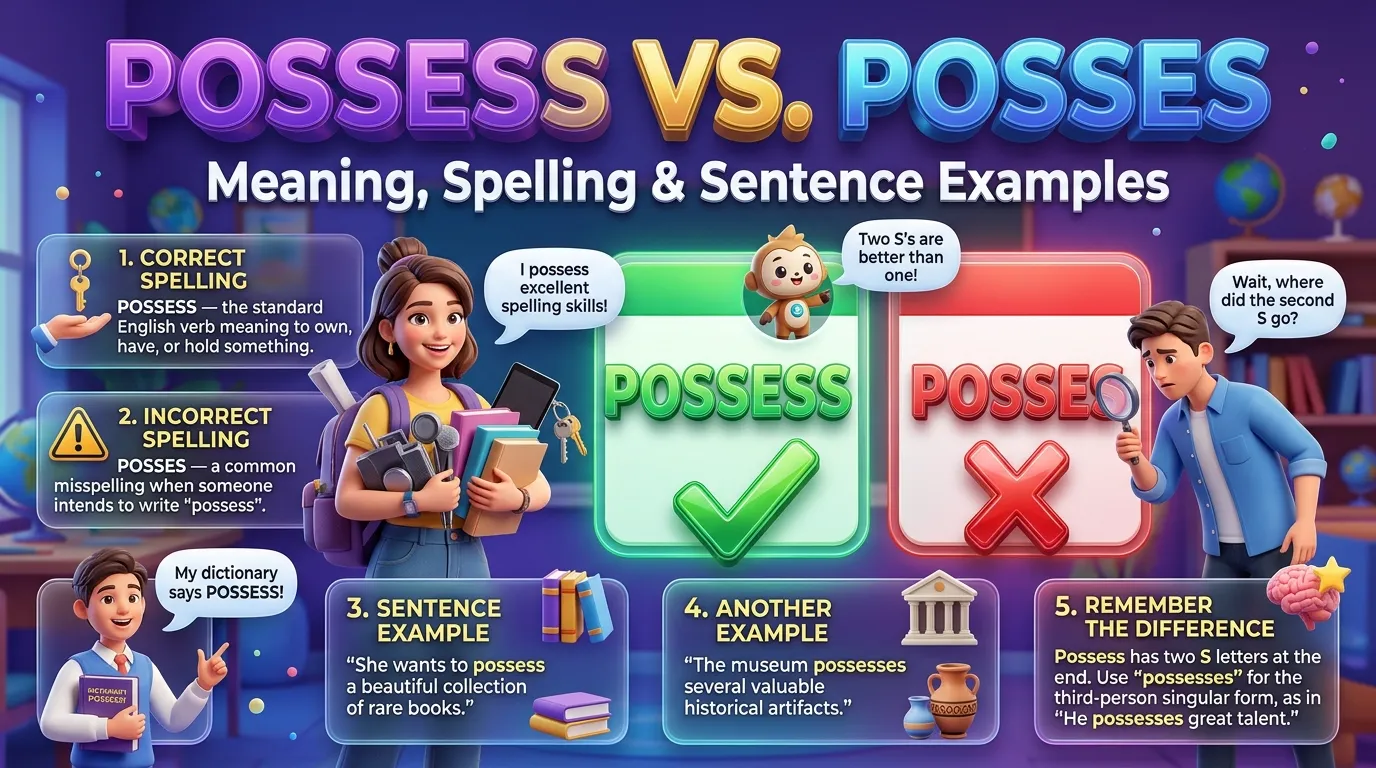
Possess and posses look almost identical, but they have different grammatical uses. Possess is a standard English verb meaning to own, have, or hold something. Posses is also a real English word, but it is the plural form of posse, which refers to a group of people organized to pursue or capture someone, traditionally by law enforcement.
The main difference is that possess describes ownership or having something, while posses refers to multiple groups of people called posses.
For example, “She wants to possess her own home” means she wants to own a house. In contrast, “The posses gathered in the town” refers to multiple groups of people.
Remember that possess contains two s’s at the end, while posses has one s before the ending.
Possess vs. Posses in a Sentence
The easiest way to understand possess vs. posses is to examine how each word functions in a sentence. Although their spellings are similar, they communicate different ideas.
Examples using possess:
I want to possess enough knowledge to solve difficult problems.
Some people possess natural leadership skills.
She hopes to possess a house near the beach.
Every student should possess the confidence to express their ideas.
He does not possess the necessary documents for the application.
In these sentences, possess means to own, have, or hold something.
Examples using posses:
Several posses gathered outside the courthouse.
The sheriff organized two posses to search the surrounding area.
Historical stories often describe posses pursuing wanted criminals.
The different posses worked together to locate the missing outlaw.
The town was once protected by local posses.
Here, posses refers to more than one posse, a group traditionally organized to help law enforcement.
Compare these sentences:
She wants to possess valuable knowledge.
The sheriff organized several posses to search the area.
The first sentence discusses having knowledge, while the second describes multiple groups of people.
Possess vs. Posses Examples
Both words can be used correctly, but their meanings depend on the context. Looking at them side by side makes the difference easier to remember.
Possess
Posses
I possess a valuable collection.
The posses searched the countryside.
She wants to possess a new house.
Several posses joined the search.
They possess useful information.
The posses arrived before sunset.
He does not possess enough experience.
Local posses helped capture the criminals.
We possess the skills to complete the task.
Two posses gathered near the town.
Quick tip: If you are talking about ownership, abilities, qualities, or having something, use possess. If you are referring to multiple groups traditionally organized to pursue criminals, use posses.
Is Posses a Word?
Yes, posses is a correct English word, but it is not the plural form of possess. It is the plural of posse, which means a group of people, traditionally organized by a sheriff or other law enforcement authority, to help capture criminals or maintain order.
For example:
The sheriff called for two posses to search the area.
Several posses traveled through the countryside.
The posses helped local authorities find the escaped prisoners.
However, if you want to describe owning something, posses is incorrect. You should use possess.
For example:
Correct: I possess a beautiful home.
Incorrect: I posses a beautiful home.
There is also a common spelling confusion because possess and posses share almost the same letters. Remember that the verb possess ends in double s, while the plural noun posses ends in -es.
Possess Something
The expression “possess something” means to own, have, hold, or control a particular thing. The word something acts as the object of the verb possess.
You can use this expression when discussing physical objects, personal qualities, abilities, knowledge, or other characteristics.
Examples:
I want to possess something valuable that I can pass down to my children.
She hopes to possess a house of her own one day.
Every good teacher should possess strong communication skills.
He does not possess anything that belongs to the company.
You must possess the required qualifications to apply for this position.
They possess something that could help solve the mystery.
The verb possess is transitive, meaning it normally takes an object when used in its ownership-related sense.
For example:
She possesses a car.
He possesses great talent.
They possess valuable knowledge.
In each sentence, the object explains what the person has or owns.
You can also use possess something in questions and negative sentences:
Do you possess a valid driving license?
Does she possess the necessary experience?
I do not possess enough information to answer that question.
Possess Singular
Possess is the base form of a verb, not a singular noun. Its grammatical form changes depending on the subject and tense of the sentence.
In the simple present tense, use possess with I, you, we, and they. Use possesses with he, she, and it.
Examples:
I possess a small collection of books.
You possess excellent communication skills.
We possess the knowledge needed for this project.
They possess several properties.
He possesses remarkable leadership qualities.
She possesses a natural talent for writing.
The company possesses valuable resources.
Notice that possesses is the correct third-person singular form of possess.
Here is a simple comparison:
Subject
Correct verb
Example
I
Possess
I possess a car.
You
Possess
You possess great skills.
We
Possess
We possess useful information.
They
Possess
They possess several houses.
He
Possesses
He possesses a strong personality.
She
Possesses
She possesses artistic talent.
It
Possesses
It possesses unique features.
Remember: Use possess with plural subjects and I/you. Use possesses with singular third-person subjects such as he, she, and it. Use posses only when referring to multiple groups called posses.
Real-World Usage Scenarios
Example 1
❌ She posses great communication skills.
✅ She possesses great communication skills.
🎯 Lesson: Skills are always something you possess, not posses.
Example 2
❌ They posses valuable assets.
✅ They possess valuable assets.
🎯 Lesson: Ownership requires possess.
Example 3
Teacher: What qualities does he have?
Student: He possesses strong discipline.
🎯 Lesson: Personality traits are described using possess.
Example 4
❌ The company posses several trademarks.
✅ The company possesses several trademarks.
🎯 Lesson: Legal ownership uses possess.
Example 5
❌ The thief posses stolen goods.
✅ The thief possesses stolen goods.
🎯 Lesson: Even in negative contexts, the correct verb is possess.
Common Mistakes People Make
Mistake 1: Dropping One “S”
Incorrect:
- Posses
Correct:
- Possess
Why It Happens
The spoken form does not clearly emphasize the double “s.”
Mistake 2: Confusing With “Posse”
Incorrect assumption:
- Posses = possess
Correct understanding:
- Posse = group of people (different word entirely)
Mistake 3: Using Posses in Formal Writing
Incorrect:
- He posses leadership skills.
Correct:
- He possesses leadership skills.
Why It Matters
Spelling errors reduce clarity and professionalism.
Memory Tricks to Remember the Difference
Trick 1: Think “Possess = Double Ownership”
Double “s” = stronger meaning of having something.
Possess = double S = ownership
Trick 2: Link It to “Possession”
If you know:
- Possession
Then remember:
- Possess
Same root, same double “s.”
Trick 3: Visual Pattern
Correct:
Possess
Incorrect:
Posses
Always look for the double s-s in the middle.
Expert Insight: Why “Possess” Uses Double S
The word possess comes from Latin origins where doubling consonants helped maintain pronunciation clarity and grammatical structure.
English preserved this spelling pattern in related words:
- Possess
- Possession
- Possessive
Because of this consistent word family, possess is the only correct modern English spelling when used as a verb.