
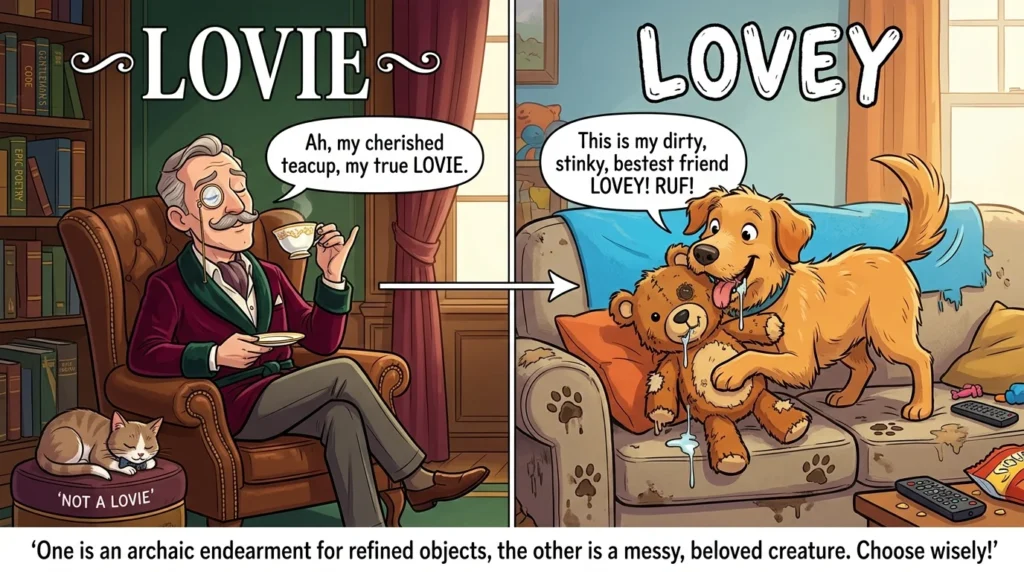

Quick Answer
Lovey is the standard and more common spelling. It is usually used as a term of affection for a loved one or a comfort object, especially for children.
Lovie is an alternative spelling that some people use as a nickname or pet name, but it is less common.
Examples:
- Correct and common: Good morning, lovey.
- Acceptable alternative: I miss you, lovie.
Deep Explanation: Lovie
Lovie is an alternative spelling of lovey. It is primarily used as:
- A pet name for a romantic partner
- A nickname for someone dear to you
- An affectionate term on social media or in text messages
- A personal spelling preference
Common Uses of Lovie
People often use lovie in messages like:
- Goodnight, lovie.
- I love you, lovie.
- Thanks for your help, lovie.
Key Insight
Lovie is generally informal and affectionate. It is not usually found in formal writing or dictionaries as frequently as lovey.
Real Examples
✅ Sleep well, lovie.
✅ I can’t wait to see you, lovie.
✅ You’re my favorite person, lovie.
Deep Explanation: Lovey
Lovey is the standard spelling and the one most dictionaries recognize.
It commonly refers to:
- A term of endearment for someone you love
- A pet name for a romantic partner
- A comforting object, such as a child’s favorite blanket or stuffed toy
Meaning 1: A Term of Affection
Examples:
- How are you today, lovey?
- Come here, lovey.
Meaning 2: A Child’s Comfort Item
Examples:
- The baby won’t sleep without her lovey.
- He carries his lovey everywhere.
Key Insight
Unlike lovie, lovey has an additional meaning in parenting and child development. It can refer to a security blanket, stuffed animal, or another comforting object.
Lovie vs Lovey: Key Differences
Quick Differences
- Lovey is the standard and more common spelling.
- Lovie is an alternative, informal spelling.
- Lovey can also mean a child’s comfort object.
- Both can be used as affectionate nicknames.
| Feature | Lovie | Lovey |
|---|---|---|
| Meaning | Alternative affectionate spelling | Standard affectionate term and comfort object |
| Grammar | Informal alternative | Standard English spelling |
| Usage | Nicknames and text messages | Everyday English and parenting contexts |
| Dictionary Recognition | Less common | Widely recognized |
| Example | Goodnight, lovie. ✅ | Goodnight, lovey. ✅ |
Lovie or Lovey Blanket
Both lovie and lovey are used to describe a child’s special comfort object, such as a small blanket, soft toy, or piece of fabric that provides emotional reassurance. However, “lovey blanket” is the more common spelling in American English when referring to a child’s favorite comfort blanket. “Lovie blanket” also appears as an alternative spelling, especially in informal writing and product names.
A lovey blanket is often soft, lightweight, and easy for a baby or toddler to hold. Children may carry it while sleeping, traveling, or experiencing unfamiliar situations. Having a familiar object nearby can help them feel secure and calm.
Examples:
My daughter takes her lovey blanket everywhere she goes.
The baby fell asleep while holding his favorite lovey.
She bought a soft lovey blanket for her newborn nephew.
He gets upset when he cannot find his beloved lovie.
The spelling lovey is generally the safer choice for standard American English writing. However, lovie is also understandable and may appear in brand names or personal preferences. Both spellings communicate the same basic idea in this context.
Lovie Meaning in Relationship
In a relationship, lovie is an affectionate, informal nickname for someone you love or care about. It can be used between romantic partners, family members, or close friends, depending on the relationship and the way they communicate.
The spelling lovey is also used for this meaning. Both forms express warmth, fondness, and emotional closeness, although individual preferences may vary.
For example, someone might call their partner “lovie” in a text message to make it sound sweet and personal. The word is similar in feeling to love, sweetie, honey, or darling.
Examples:
“Good morning, lovie! I hope you have a wonderful day.”
“I miss you, lovie. I wish you were here.”
“Thank you for always supporting me, my lovie.”
“Sleep well, lovie. I’ll talk to you tomorrow.”
In romantic relationships, the term can communicate affection without sounding as formal as a full expression of love. However, it is not exclusively romantic. A parent might use it for a child, or close friends might use it as a playful nickname.
The meaning ultimately depends on the context, tone, and relationship between the people using it.
Lovey-Dovey Meaning
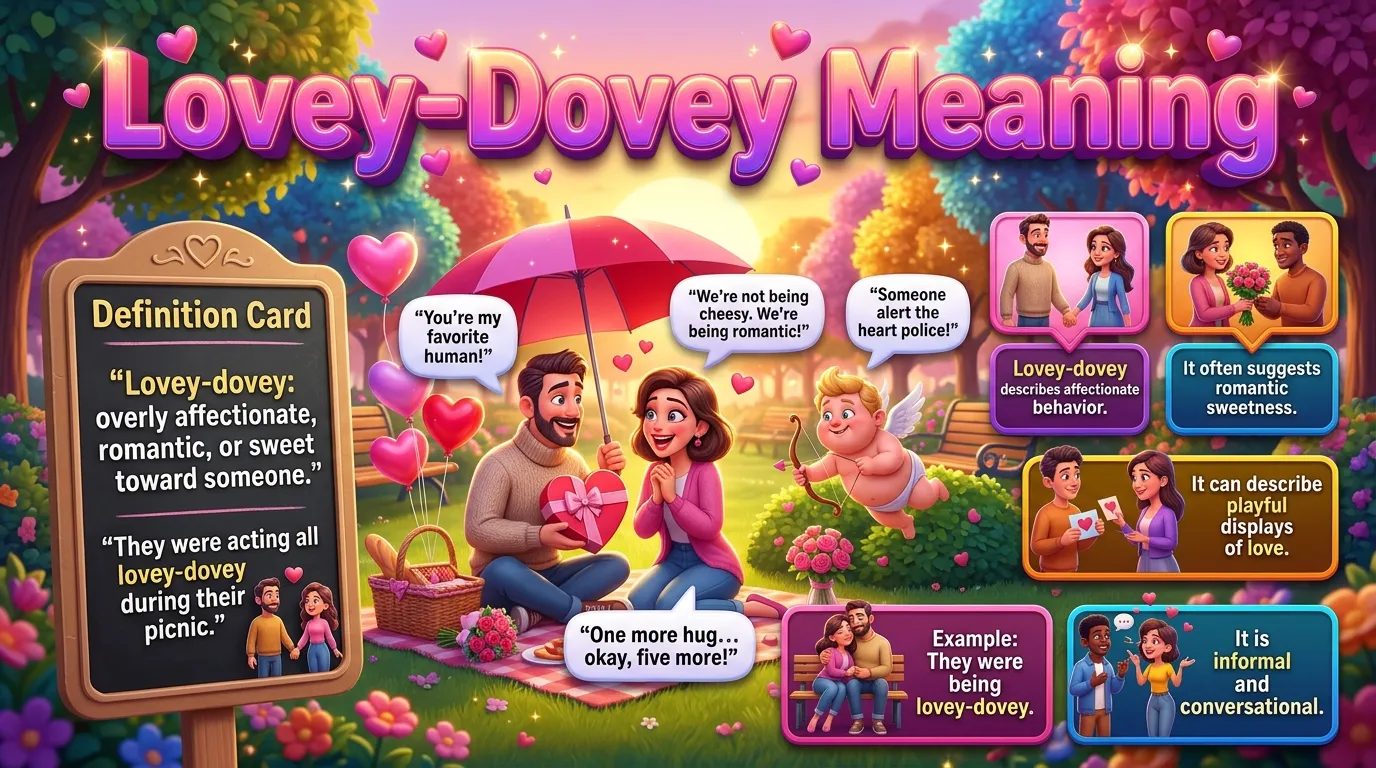
Lovey-dovey is an informal expression describing people who show a lot of affection toward each other, especially through romantic words, gestures, or behavior. It often suggests that a couple is openly sweet, affectionate, or deeply absorbed in their romantic feelings.
The expression can be used positively to describe a loving couple. It can also sound teasing or mildly critical when someone thinks the affection is excessive or overly sentimental.
Examples:
The couple was acting lovey-dovey throughout the entire dinner.
They exchanged lovey-dovey messages all afternoon.
My friends become very lovey-dovey whenever they are together.
He wrote a lovey-dovey note for his girlfriend.
Everyone smiled when the newlyweds started acting lovey-dovey.
For example, if two people hold hands, exchange affectionate compliments, and constantly express how much they love each other, someone might describe them as lovey-dovey.
The expression is usually informal and is common in everyday conversation. It is less suitable for formal academic or professional writing.
Although lovey can be used as a term of affection, lovey-dovey describes affectionate behavior or a romantic atmosphere. The two expressions are related in tone but have different meanings.
Is Lovey a Word?
Yes, “lovey” is a recognized English word with more than one meaning. Its meaning depends on how it is used in a sentence.
First, lovey can refer to a soft comfort object that a baby or young child becomes attached to. This might be a small blanket, a stuffed animal, or another familiar item that helps the child feel secure.
Second, lovey can be used as an affectionate nickname for a loved one. In this sense, it is an informal term that expresses tenderness or fondness.
Third, lovey-dovey is a related expression describing affectionate or romantic behavior.
Examples:
The toddler cannot sleep without her lovey.
“Are you okay, lovey?” she asked gently.
The lovey-dovey couple held hands during the movie.
The word is informal, so it is more common in conversations, personal messages, parenting discussions, and casual writing than in formal documents.
It is also worth distinguishing lovey from lovely. The word lovey can be a noun or an affectionate form of address, while lovely is generally an adjective meaning beautiful, pleasant, or delightful.
For example, “You are lovely” describes someone positively, while “Hello, lovey” uses lovey as an affectionate form of address.
Lovey Plural
The standard plural of lovey is “loveys.” When a word ends in a consonant followed by y, the y usually changes to ies when forming the plural.
For example:
One lovey, two loveys.
One baby, two babies.
One puppy, three puppies.
One story, several stories.
When referring to children’s comfort objects, loveys means two or more blankets, stuffed toys, or other familiar items that provide comfort.
Examples:
The daycare keeps extra loveys in case a child forgets one.
Her twins each have their own loveys.
We packed two loveys for the long trip.
The store sells personalized loveys for babies.
The same plural spelling applies when lovey is used as an affectionate nickname, although this use is less common in the plural.
For example, someone might jokingly refer to a group of affectionate partners as “loveys,” but the intended meaning would depend on the context.
Use loveys in standard writing rather than lovies when forming the plural of lovey. If the original spelling is lovie, its plural would ordinarily be lovies.
My Lovey Meaning
“My lovey” is an affectionate expression meaning someone or something especially dear to you. Its exact meaning depends on whether you are talking about a person or a comfort object.
When used for a person, my lovey is a sweet nickname that communicates love, closeness, and tenderness. A person might use it for a romantic partner, child, or another loved one.
For example:
“I love you, my lovey.” — An affectionate message to someone you love.
“Goodnight, my lovey.” — A tender way to say goodnight.
“You always make me smile, my lovey.” — An expression of warmth and appreciation.
When used for a child’s comfort object, my lovey refers to the special blanket or soft toy that the child feels attached to.
For example:
“Where is my lovey?” — A child is looking for a favorite comfort object.
“She sleeps with my lovey every night.” — Depending on the context, this may refer to a particular cherished blanket or toy.
In romantic messages, “my lovey” often sounds playful, gentle, and intimate. It is not a formal term, and it does not have a fixed romantic meaning in every situation. The relationship between the speakers determines how the expression is understood.
In short, if someone calls you “my lovey,” they are usually expressing affection or fondness. If a child refers to a blanket as “my lovey,” the word describes a cherished comfort object instead.
Real-World Usage Scenarios
Example 1
Text Message:
I miss you, lovie.
🎯 Lesson: Lovie works naturally as a pet name in casual messages.
Example 2
Conversation:
Person A: Where’s Emma’s blanket?
Person B: She calls it her lovey.
🎯 Lesson: Only lovey can refer to a child’s comfort object.
Example 3
Partner:
Morning, lovey. Did you sleep well?
🎯 Lesson: Lovey is a common and standard term of affection.
Example 4
Social Media Post:
Happy birthday, lovie! Have an amazing day.
🎯 Lesson: Lovie is acceptable in informal and affectionate writing.
Common Mistakes
Mistake 1: Thinking One Spelling Is Always Wrong
❌ Lovie is incorrect.
✅ Lovie is an alternative, informal spelling.
Why it happens: People assume only dictionary spellings are acceptable in personal communication.
Mistake 2: Using Lovie for a Child’s Security Blanket
❌ The toddler lost her lovie.
✅ The toddler lost her lovey.
Why it happens: The meaning of a comfort object is generally associated with lovey, not lovie.
Mistake 3: Using Either Word in Formal Writing
❌ Dear Lovey, regarding our business proposal…
✅ Dear Ms. Johnson, regarding our business proposal…
Why it happens: These words are terms of affection and are usually unsuitable for professional communication.
Memory Tricks
Remember this simple rule:
Lovey = Love + Y
Think of the Y in lovey as standing for:
Your favorite person or your child’s favorite toy.
Remember this:
- Lovey = Standard spelling
- Lovie = Informal nickname spelling
Expert Insight
The word lovey has been used in English for centuries as a term of endearment. Over time, it also developed a specialized meaning in parenting, referring to a child’s comforting possession, such as a blanket or stuffed animal.
The spelling lovie emerged largely through personal preference, text messaging, and social media usage. Because affectionate nicknames often have flexible spellings, many people use lovie without considering it incorrect.
However, dictionaries, style guides, and educational resources generally recognize lovey as the standard form. In formal or published writing, lovey is usually the preferred spelling.