
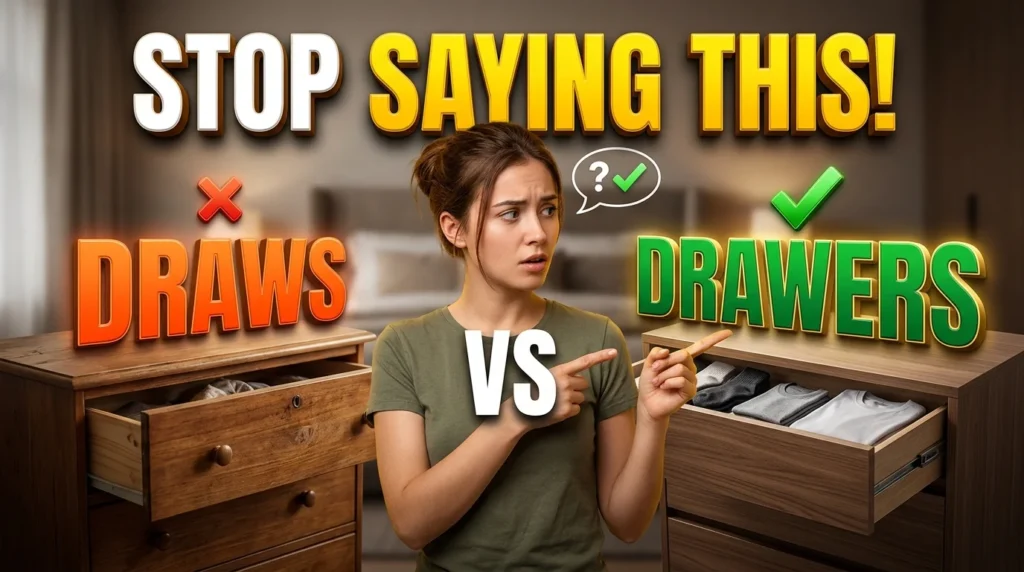
Draws vs drawers is a surprisingly common point of confusion in English. The words look almost identical, and in some accents they even sound alike. However, they have completely different meanings and grammatical roles.
Draws is usually a verb, while drawers is most commonly a plural noun. Mixing them up can lead to spelling mistakes and awkward sentences, especially in writing.
In this guide, you’ll learn the difference between draws and drawers, when to use each one, pronunciation tips, real-world examples, common mistakes, and easy memory tricks so you’ll never confuse them again.
Quick Answer
The difference between draws and drawers is simple:
- Draws is the third-person singular form of the verb draw, meaning to sketch, pull, attract, or take out.
- Drawers is the plural of drawer, meaning sliding storage compartments in furniture. In some contexts, especially British English, drawers can also refer to underwear.
Example:
- She draws beautiful landscapes every weekend.
- He keeps his documents in the top drawers of his desk.
Quick Rule: If you’re describing an action, use draws. If you’re talking about storage compartments (or, in some regions, underwear), use drawers.
What Does “Draws” Mean?
Draws is a verb. It is the third-person singular present tense of draw.
Depending on the context, draws can have several meanings.
Common Meanings of Draws
- Creates a picture or sketch.
- Pulls something toward oneself.
- Attracts attention or people.
- Removes something from a container.
- Ends in a tie in sports.
Examples
- She draws cartoons for children’s books.
- The magnet draws metal objects.
- The museum draws thousands of visitors every year.
- He draws cash from the ATM every Friday.
- The team often draws its matches.
Key Insight
Whenever draws describes an action, it is functioning as a verb.
What Does “Drawers” Mean?
Drawers is the plural form of drawer, a noun.
A drawer is a sliding storage compartment built into furniture such as a desk, dresser, or cabinet.
In British English, drawers is also a traditional or informal word for underwear.
Examples
- She organized all the kitchen drawers.
- The files are stored in the bottom drawers.
- He cleaned every drawer in the dresser.
- (British English) He packed extra drawers for the trip.
Key Insight
Drawers names things, not actions.
Draws vs Drawers: Key Differences
| Feature | Draws | Drawers |
|---|---|---|
| Part of Speech | Verb | Plural noun |
| Meaning | Performs an action | Storage compartments or underwear (UK) |
| Function | Describes what someone or something does | Names physical objects |
| Singular Form | Draw | Drawer |
| Example | She draws portraits. | The drawers are full of clothes. |
Pronunciation Difference
Although these words look similar, they are pronounced differently.
| Word | Approximate Pronunciation |
|---|---|
| Draws | “drawz” (one syllable) |
| Drawers | “draw-erz” (two syllables, though some accents may blend them) |
In some regional accents, particularly fast speech, drawers may sound very similar to draws, which contributes to the confusion.
Real-World Usage Scenarios
Example 1: Art Class
❌ She drawers amazing portraits.
✅ She draws amazing portraits.
🎯 Lesson: Use draws for the action of sketching.
Example 2: Bedroom
❌ Put your socks in the top draws.
✅ Put your socks in the top drawers.
🎯 Lesson: Storage compartments are drawers.
Example 3: Office
❌ The cabinet drawers many customers.
✅ The company draws many customers.
🎯 Lesson: Draws can mean “attracts.”
Example 4: Home Organization
❌ She cleaned all the draws in her dresser.
✅ She cleaned all the drawers in her dresser.
🎯 Lesson: Furniture contains drawers, not draws.
Example 5: Sports
❌ The team drawers every other game.
✅ The team draws every other game.
🎯 Lesson: In sports, draws means “finishes in a tie.”
Common Mistakes
Mistake 1
Incorrect: He keeps his tools in the desk draws.
Correct: He keeps his tools in the desk drawers.
Why? You’re referring to storage compartments.
Mistake 2
Incorrect: She drawers beautiful flowers.
Correct: She draws beautiful flowers.
Why? Sketching is an action, so you need the verb.
Mistake 3
Incorrect: The museum drawers tourists every summer.
Correct: The museum draws tourists every summer.
Why? Here, draws means “attracts.”
Memory Tricks
Use these simple tricks to remember the difference:
- Draws = Does. Both are verbs that describe an action.
- Drawers = Furniture. Think of the extra -er in drawer as referring to a container or object.
- If you can replace the word with attracts, pulls, or sketches, choose draws.
- If you’re talking about a desk, dresser, or cabinet, choose drawers.
Expert Insight
The confusion between draws and drawers often comes from pronunciation rather than grammar. In several English dialects, the unstressed middle vowel in drawers may be reduced, making it sound closer to draws in casual speech. However, in writing, the distinction is straightforward:
- Draws is always a verb.
- Drawers is a plural noun.
Recognizing whether you need an action or a thing is the easiest way to choose the correct word.
Frequently Asked Questions
Is “draws” a verb or a noun?
Draws is most commonly the third-person singular form of the verb draw. In some specialized contexts, such as sports or lotteries, draw can also be a noun, but draws in everyday grammar is usually a verb.
What are drawers in furniture?
Drawers are sliding compartments used for storing clothes, documents, kitchen utensils, or other items in furniture like dressers, desks, and cabinets.
Why do people confuse draws and drawers?
They are spelled similarly and may sound alike in certain accents, but they belong to different parts of speech and have different meanings.
Can “drawers” mean underwear?
Yes. In traditional or informal British English, drawers can refer to underwear, though the term is less common today.
How do I know which word to use?
Ask yourself one question:
- Is it an action? → Draws
- Is it a storage compartment or object? → Drawers
Conclusion
Although draws and drawers differ by only a few letters, they serve completely different purposes in English.
- Use draws when describing an action, such as sketching, pulling, attracting, or tying in a game.
- Use drawers when referring to storage compartments or, in some British contexts, underwear.
Remember this simple rule: Actions draw; furniture has drawers. Keeping this distinction in mind will help you write more accurately and confidently.