

Quick Answer
BU commonly means “Backup”, “Business Unit,” or “Be You” depending on context.
BC most commonly means “Because” in texting and online messaging, although it can also mean “Before Christ” or other terms in specific situations.
The correct meaning depends entirely on where and how the abbreviation is being used.
What Does “BU” Mean?
Definition
BU is an abbreviation with several meanings depending on the situation.
Common Meanings
- Backup
- Business Unit
- Be You
- Boston University (in education contexts)
Usage Rules
The surrounding conversation usually reveals which meaning is intended.
Examples
- I have a BU plan in case this project fails.
- Our company’s marketing BU exceeded its targets.
- Just BU and stay confident.
Key Insight
Unlike many abbreviations, BU does not have one universally accepted meaning.
What Does “BC” Mean?
Definition
BC is an abbreviation commonly used in texting and online communication.
Common Meanings
- Because
- Before Christ
- British Columbia
- Business Continuity
Usage Rules
In casual messaging, BC most often means because.
Examples
- I stayed home bc it was raining.
- The event occurred in 300 BC.
- She moved to BC last year.
Key Insight
Context is essential when interpreting the meaning of BC.
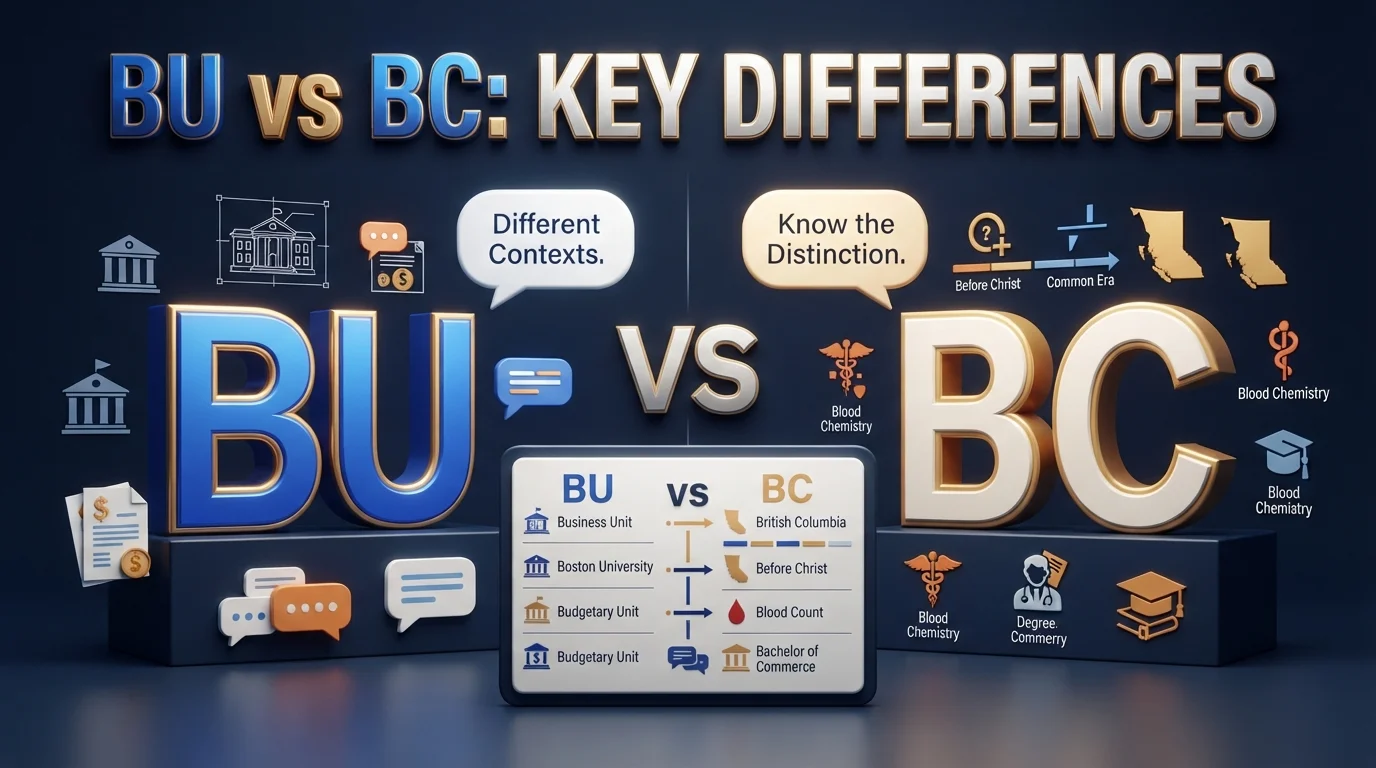
BU vs BC: Key Differences
Quick Comparison
- BU has multiple meanings.
- BC often means “because” in texting.
- BU is less standardized.
- BC is more commonly recognized in online messaging.
- Both depend heavily on context.
- Neither has a single universal definition.
Comparison Table
| Feature | BU | BC |
|---|---|---|
| Type | Abbreviation | Abbreviation |
| Common Meaning | Backup, Business Unit, Be You | Because |
| Texting Usage | Less common | Very common |
| Business Usage | Common | Common |
| Educational Usage | Possible | Less common |
| Context Required | Yes | Yes |
Real-World Usage Scenarios
Example 1
Friend: “Why didn’t you come?”
Reply: “I stayed home bc I was sick.”
🎯 Lesson: In texting, BC usually means “because.”
Example 2
Manager: “Which BU handles customer support?”
Employee: “The service BU does.”
🎯 Lesson: In business settings, BU often means Business Unit.
Example 3
Friend: “What if the plan fails?”
Reply: “We have a BU strategy.”
🎯 Lesson: BU can mean backup.
Example 4
Motivational Post
“Don’t change for others. Just BU.”
🎯 Lesson: BU may also mean “Be You.”
Common Mistakes
Mistake #1
❌ Assuming BU always has one meaning.
✅ The meaning changes based on context.
Why it happens: Many abbreviations serve multiple purposes.
Mistake #2
❌ Assuming BC only refers to historical dates.
✅ In texting, BC often means “because.”
Why it happens: People are familiar with historical BC usage.
Mistake #3
❌ Using abbreviations in formal documents.
✅ Spell out the full term when clarity matters.
Why it happens: Abbreviations can be misunderstood by readers.
Memory Tricks
Trick #1
BC = Because
Think:
B → Be
C → Cause
This helps you remember the texting meaning.
Trick #2
BU = Backup
Think of BU as your backup plan when something goes wrong.
Trick #3
Check the Context
Whenever you see BU or BC, look at the surrounding sentence first.
Expert Insight
Abbreviations have become increasingly common due to texting, social media, and digital communication. While they save time, they also create ambiguity because the same letters can represent multiple phrases. This is especially true for BU and BC.
Professional writers, educators, and communication experts recommend using the full phrase whenever there is a risk of confusion. In casual communication, however, these abbreviations remain widely used and understood within the appropriate context.