
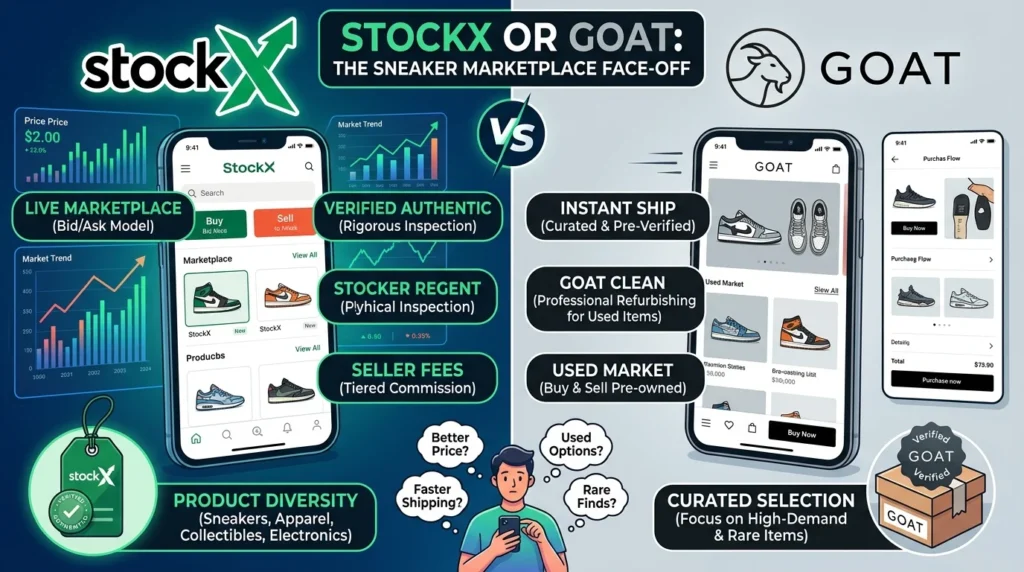
Quick Answer: StockX vs. GOAT
StockX = marketplace focused heavily on market pricing, bids, and asks.
GOAT = marketplace known for sneakers, broader product presentation, and more flexible purchasing options.
Neither platform is automatically better for everyone.
If you want to track market prices and place bids, StockX may be preferable.
If you prioritize selection, product browsing, and buyer-friendly return options on eligible items, GOAT may be preferable.
What Is StockX?
StockX is an online marketplace where people buy and sell sneakers, streetwear, electronics, collectibles, and other products.
One of StockX’s defining features is its market-style buying system.
How StockX Works
A seller can list an item for sale, while buyers can place bids.
The platform’s marketplace model allows buyers and sellers to interact around market prices.
StockX also offers authentication services for eligible products.
Why People Use StockX
StockX is particularly attractive to people who want to:
- Compare market prices
- Place bids
- Monitor price movements
- Buy popular sneakers
- Sell collectible products
- Research resale values
🎯 Key Insight: StockX feels more like a marketplace for price discovery and trading than a traditional online sneaker store.
What Is GOAT?
GOAT is an online marketplace specializing heavily in sneakers, apparel, accessories, and other fashion and collectible products.
GOAT offers several ways to purchase products, including standard listings and, for eligible items, Instant purchases.
Why People Use GOAT
GOAT can appeal to shoppers who want:
- A large sneaker selection
- Product browsing
- New and used options on eligible products
- Instant purchases
- Authentication
- A straightforward shopping experience
GOAT also has a formal return policy for eligible purchases. As of its June 2026 policy, eligible U.S. buyers can generally request a return within 30 days of receiving an item, although exclusions and fees apply.
🎯 Key Insight: GOAT often feels more like a sneaker-focused shopping platform, although it also operates as a resale marketplace.
StockX vs. GOAT: Main Difference
| Feature | StockX | GOAT |
|---|---|---|
| Main focus | Resale marketplace | Sneaker/fashion marketplace |
| Bids | Yes | Offers available on eligible items |
| Market pricing | Strong emphasis | Available but more shopping-oriented |
| Authentication | Yes, for eligible products | Yes |
| Sneaker selection | Extensive | Extensive |
| Used products | More limited depending on category | Available for eligible products |
| Returns | Policy varies by item/order | Eligible purchases generally have a 30-day return window |
| Buying experience | Market/trading oriented | Shopping oriented |
| Instant buying | Available through marketplace features | Available for eligible “Instant” items |
| Best for | Price tracking and resale-market activity | Sneaker shopping and flexible purchase options |
StockX vs. GOAT: Authentication
Authentication is one of the biggest reasons people use either marketplace instead of buying directly from an unknown seller.
StockX
StockX routes eligible products through its verification process before they reach the buyer, although some newer marketplace features have different fulfillment structures.
StockX also offers an optional verification service for certain Listings Marketplace purchases. The company currently lists this optional service at $12.50 for eligible listings.
GOAT
GOAT also uses authentication processes for eligible marketplace products.
GOAT states that items determined to be replicas can be rejected, with buyers receiving a refund under its policies.
🎯 Lesson: Both platforms are built around authentication, but authentication does not mean every possible product or transaction follows exactly the same process.
StockX vs. GOAT: Buying Experience
StockX
StockX is particularly useful if you like the idea of:
“What is the current market price?”
You can monitor listings and bids and make purchasing decisions based on marketplace activity.
This makes StockX appealing to sneaker enthusiasts who think about resale value and market pricing.
GOAT
GOAT tends to provide a more traditional shopping experience.
You browse products, select a size, review available purchase options, and check out.
Some eligible products are available through GOAT’s Instant system, which can provide faster fulfillment because the item is already within GOAT’s fulfillment network.
🎯 Lesson: StockX leans toward marketplace trading, while GOAT leans more toward shopping and discovery.
StockX vs. GOAT: Prices
Prices can vary considerably between the two platforms.
The same sneaker might be:
$250 on StockX
and:
$265 on GOAT
—or the opposite.
The difference can come from:
- Seller pricing
- Buyer demand
- Seller fees
- Shipping
- Processing fees
- Taxes
- Market conditions
- Promotions
- Available inventory
Best Strategy
Don’t simply compare the listed sneaker price.
Compare the final checkout price.
🎯 Key Insight: The cheapest listing isn’t necessarily the cheapest purchase after shipping, taxes, and platform fees.
StockX vs. GOAT: Returns
This is one area where the platforms can differ significantly.
GOAT Returns
GOAT currently allows eligible buyers to request a return within 30 days of receiving the item.
However, refunds are generally issued as GOAT Credit, and shipping costs plus a potential return processing fee can be deducted. GOAT states that the U.S. return processing fee can be up to 15% of the item’s price, depending on circumstances.
Certain purchases—including final-sale, used, auction, custom, and other excluded items—may not qualify for standard returns.
StockX Returns
StockX’s return eligibility depends on the product and applicable marketplace policies.
Because resale marketplaces can have different rules for different products and transaction types, it’s important to check the specific listing’s return eligibility before purchasing.
🎯 Lesson: If easy returns matter to you, check the exact item’s policy before checkout, rather than assuming every product is returnable.
StockX vs. GOAT: Shipping
Shipping varies by destination and product.
For example, GOAT currently lists standard U.S. shipping at $14.95 for the contiguous United States, with different rates for other regions.
International customers may also be responsible for applicable customs duties and taxes.
StockX shipping costs also vary according to the marketplace, product, and destination.
🎯 Key Insight: Always compare the final delivered price, especially for international purchases.
StockX vs. GOAT: Selling Sneakers
StockX for Sellers
StockX provides a marketplace where sellers can list products and participate in its seller-level fee structure.
StockX updated its seller program in 2026, including changes to Flex seller fees.
GOAT for Sellers
GOAT also allows users to list eligible products for sale.
Seller fees vary depending on factors such as location and fulfillment method. GOAT’s current fee policy lists different fees for different regions and selling methods.
🎯 Lesson: If you’re selling, don’t choose based only on the headline commission. Calculate your actual payout after all fees.
StockX vs. GOAT: Real-World Usage Scenarios
Scenario 1: You Want the Lowest Market Price
“I don’t care which platform I use. I just want the sneaker at the lowest total price.”
Check both StockX and GOAT and compare the final checkout price.
🎯 Lesson: Don’t assume one marketplace is always cheaper.
Scenario 2: You Want to Place a Bid
“I don’t want to pay the current asking price. I’d rather make an offer based on the market.”
StockX may be especially appealing because of its strong bid/ask marketplace structure.
🎯 Lesson: StockX is particularly useful for market-oriented buyers.
Scenario 3: You Want to Return the Sneakers
“I’m worried the shoes won’t work for me and want a return option.”
GOAT may be more attractive for eligible purchases, because its current policy provides a 30-day return window, subject to exclusions and deductions.
🎯 Lesson: Always verify return eligibility before purchasing.
Scenario 4: You Want to Browse Sneakers
“I want to explore different sneakers and compare styles.”
GOAT can be appealing because its platform is strongly centered around sneaker discovery and shopping.
🎯 Lesson: GOAT often provides a more traditional retail-like browsing experience.
Scenario 5: You Want to Resell Sneakers
“I bought a limited sneaker and want to sell it.”
Compare StockX and GOAT based on:
- Current sale price
- Seller fees
- Payout
- Shipping requirements
- Demand
- Buyer activity
🎯 Lesson: The platform with the highest selling price isn’t necessarily the one that gives you the highest payout.
Common Mistakes About StockX and GOAT
Mistake 1: Assuming StockX Is Always Cheaper
❌ “StockX is always cheaper than GOAT.”
Not necessarily.
Prices fluctuate constantly, and the final price depends on fees and shipping.
Mistake 2: Assuming GOAT Is Always More Expensive
❌ “GOAT always costs more.”
Also incorrect.
The price difference can change depending on the sneaker, size, seller inventory, and marketplace demand.
Mistake 3: Comparing Only the Sneaker Price
Suppose:
StockX = $220
GOAT = $225
That doesn’t automatically mean StockX is cheaper.
You need to compare:
Item price + shipping + processing fees + taxes = final price
Mistake 4: Assuming Authentication Guarantees Perfection
Authentication systems are designed to identify products that don’t meet marketplace standards, but no marketplace should be treated as an absolute guarantee against every possible issue.
Always inspect your purchase when it arrives and use the platform’s buyer-protection process if something appears wrong.
Mistake 5: Assuming Every GOAT Product Can Be Returned
GOAT’s current return policy has significant exclusions, including certain final-sale, used, custom, auction, and special items.
🎯 Lesson: Check the item’s return status before ordering.
StockX vs. GOAT: Which Is Better?
Choose StockX if you value:
- Market pricing
- Bid/ask functionality
- Price tracking
- Resale-market activity
- A trading-oriented buying experience
Choose GOAT if you value:
- Sneaker-focused browsing
- A broad sneaker marketplace
- Eligible used products
- Instant purchase options
- More flexible returns on eligible items
Choose Both if:
You’re buying an expensive sneaker.
Why?
Because prices can differ significantly between marketplaces.
Search StockX → Search GOAT → Compare final price → Check return policy → Buy
That’s often a smarter strategy than choosing one platform automatically.
Memory Trick: StockX vs. GOAT
📈 StockX = Market
Think:
StockX → stocks → market
StockX’s name and marketplace model make it easy to associate with price discovery and trading.
🐐 GOAT = Sneakers
Think:
GOAT → sneaker marketplace
GOAT is especially well known for its sneaker-focused shopping experience.
⭐ One-Line Memory Trick
StockX is more market-focused; GOAT is more shopping-focused.
Expert Insight: Why Prices Differ Between StockX and GOAT
Resale marketplaces don’t have one universal price.
Each platform has its own:
- Sellers
- Buyers
- Inventory
- Fees
- Demand patterns
- Promotions
- Fulfillment systems
This creates small or sometimes substantial price differences.
A sneaker’s “market value” therefore isn’t necessarily a single number.
Instead, you can think of it as a range across marketplaces.
This is especially important for limited sneakers, where individual sizes can have very different prices.
Quick Test: StockX or GOAT?
1. You want to track bids and asks.
Answer: StockX ✅
2. You want to compare sneaker prices across marketplaces.
Answer: Both ✅
3. You want an eligible sneaker with a return option.
Answer: GOAT may be preferable ✅
4. You want to sell a rare sneaker.
Answer: Compare both platforms ✅
5. You want the lowest final price.
Answer: Check both ✅
6. You want a market-oriented resale experience.
Answer: StockX ✅