

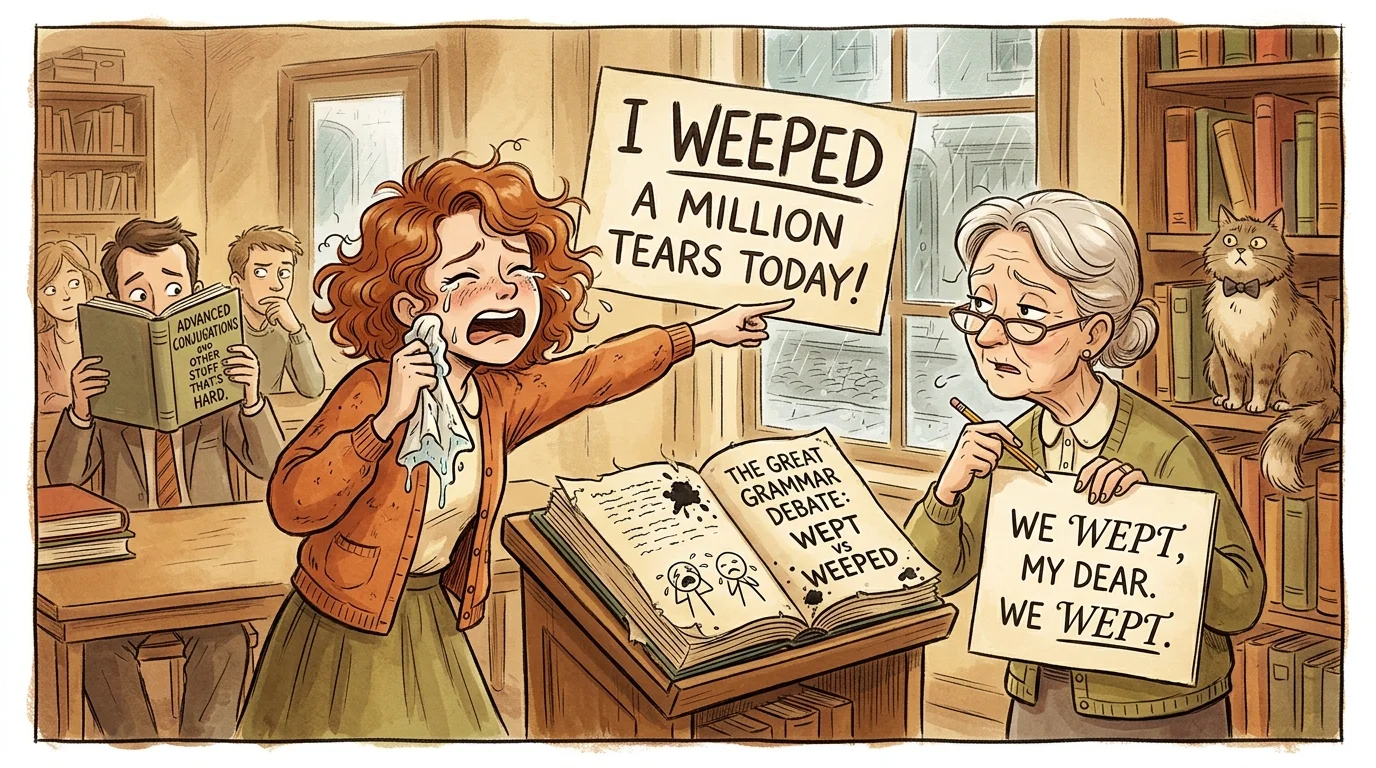
Quick Answer: Weeped vs Wept
- Wept is the correct past tense and past participle of weep.
- Weeped is generally considered nonstandard and should usually be avoided.
Quick Examples
✅ She wept when she heard the news.
✅ The child wept quietly.
❌ She weeped when she heard the news.
❌ The child weeped quietly.
What Does “Wept” Mean?
Wept is the past tense and past participle of weep.
The verb weep means:
- To cry
- To shed tears
- To express deep sadness or emotion
When to Use Wept
Use wept when describing crying or shedding tears in the past.
Examples
- She wept after hearing the emotional story.
- He wept with joy at the reunion.
- The family wept during the farewell ceremony.
- Many people wept after the tragic announcement.
Key Insight
In modern English, wept is the accepted and preferred past form of weep.
What Does “Weeped” Mean?
Weeped is a nonstandard past-tense form created by applying the regular -ed rule to weep.
Why Does This Mistake Happen?
Many English verbs are regular:
- Walk → Walked
- Jump → Jumped
- Talk → Talked
Because of this pattern, some writers assume:
Weep → Weeped ❌
However, weep is an irregular verb.
Examples
Incorrect in standard English:
- She weeped all night.
- He weeped after the ceremony.
Correct:
- She wept all night.
- He wept after the ceremony.
Key Insight
Although weeped may occasionally appear in historical or dialectal usage, wept is the form expected in modern writing and speech.
Weeped vs Wept: Key Differences
Quick Comparison
- Wept = Correct standard past tense
- Weeped = Nonstandard or incorrect in modern English
Comparison Table
| Feature | Wept | Weeped |
|---|---|---|
| Standard English | Yes | No |
| Past Tense of Weep | Yes | Rarely accepted |
| Dictionary Preferred Form | Yes | No |
| Formal Writing | Yes | No |
| Example | She wept softly. | ❌ She weeped softly. |
Why “Wept” Is Correct
The verb weep belongs to a group of irregular English verbs that do not form their past tense by adding -ed.
Similar Irregular Verbs
| Present | Past |
| Keep | Kept |
| Sleep | Slept |
| Weep | Wept |
| Sweep | Swept |
Notice the pattern:
- Keep → Kept
- Sleep → Slept
- Weep → Wept
- Sweep → Swept
Key Insight
The ending changes from -eep to -ept rather than adding -ed.
Real-World Usage Scenarios
Example 1
❌ She weeped after watching the movie.
✅ She wept after watching the movie.
🎯 Lesson: Use wept for past actions involving crying.
Example 2
❌ The audience weeped during the performance.
✅ The audience wept during the performance.
🎯 Lesson: Emotional reactions in the past require wept.
Example 3
Friend: How did she react?
Friend: She wept when she received the letter.
🎯 Lesson: Wept is the standard past-tense form.
Example 4
❌ He has weeped many times since the incident.
✅ He has wept many times since the incident.
🎯 Lesson: The past participle is also wept.
Example 5
❌ They weeped over the loss.
✅ They wept over the loss.
🎯 Lesson: Formal writing favors wept.
Common Mistakes People Make
Mistake 1: Adding -ED
Incorrect:
- Weeped
Correct:
- Wept
Why It Happens
People assume all verbs follow regular past-tense patterns.
Mistake 2: Forgetting That Weep Is Irregular
Incorrect:
- She has weeped.
Correct:
- She has wept.
Why It Happens
Irregular verbs must be memorized because they don’t follow standard rules.
Mistake 3: Using Weeped in Academic Writing
Incorrect:
- The witness weeped during testimony.
Correct:
- The witness wept during testimony.
Why It Matters
Using the standard form improves accuracy and professionalism.
Memory Tricks to Remember the Difference
Trick 1: Match It With “Keep”
Think:
- Keep → Kept
- Weep → Wept
The pattern is almost identical.
Trick 2: Group Similar Verbs
Remember these together:
- Sleep → Slept
- Sweep → Swept
- Weep → Wept
Trick 3: Think “Tears = T”
The word wept ends with T, making it easier to associate with tears shed in the past.
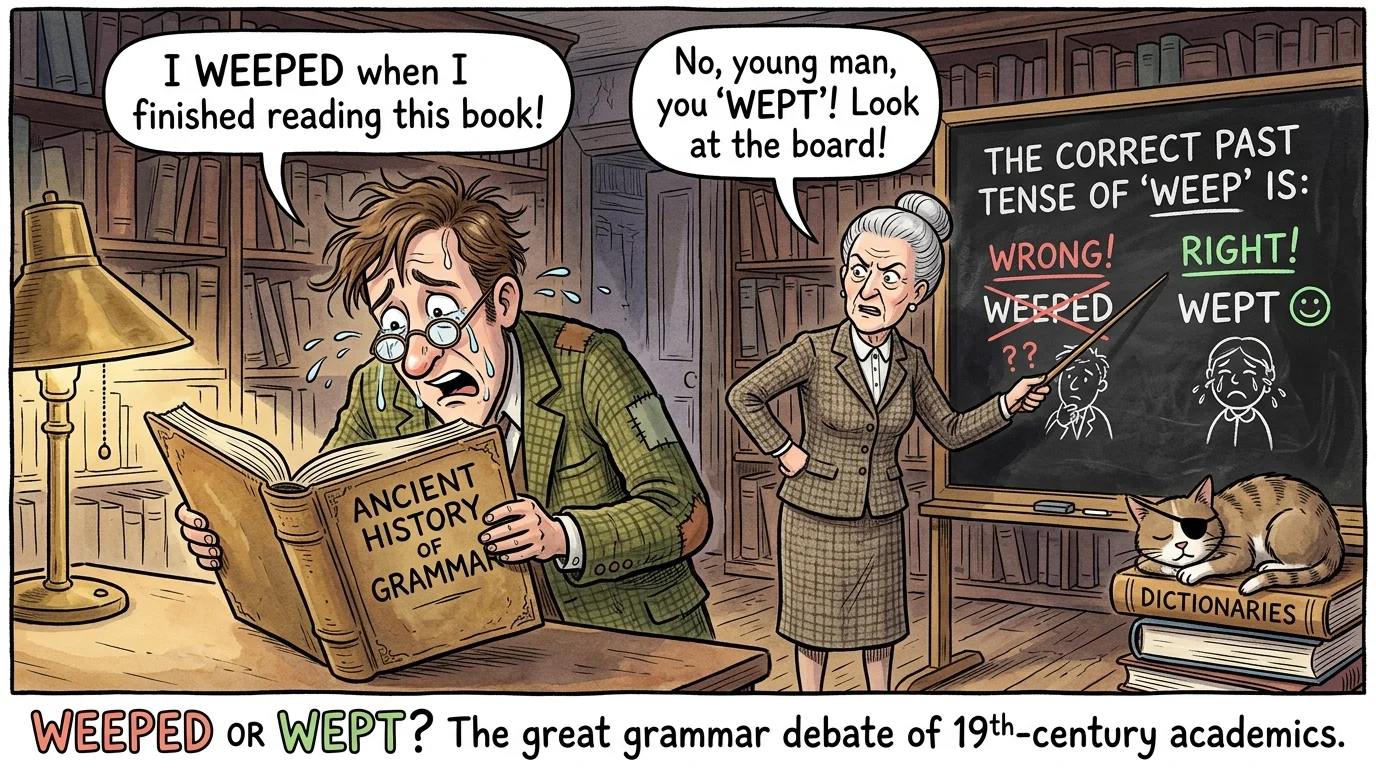
Expert Insight: Why English Uses “Wept”
The word wept comes from older Germanic language patterns that influenced English long before modern grammar rules developed.
Many common verbs retained irregular forms over centuries, including:
- Keep → Kept
- Sleep → Slept
- Sweep → Swept
- Weep → Wept
Because these forms became deeply established through centuries of usage, modern English continues to treat wept as the standard past tense.
As a result, weeped is rarely accepted in edited, professional, academic, or formal writing.