
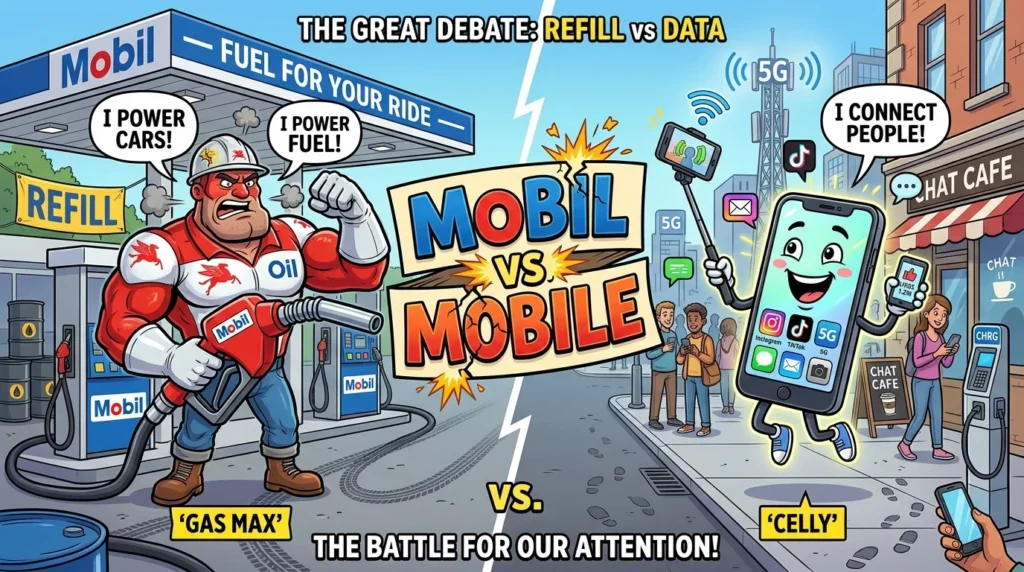

Quick Answer: Mobil vs Mobile
Mobile is the standard English word that means movable, portable, or related to mobile phones.
Mobil is generally a proper noun (such as the Mobil fuel brand) or a spelling used in some other languages like Indonesian, German, or Turkish.
If you’re writing in English, you almost always need mobile, not mobil.
What Does “Mobil” Mean?
Definition
Mobil is not commonly used as a standard English word.
Instead, it usually refers to:
- The Mobil petroleum brand
- A word in some foreign languages meaning “car” or “vehicle”
- A proper noun rather than a common English adjective
Usage Contexts
Brand Name
Mobil is a well-known oil and gas brand.
Example:
- I stopped at a Mobil station to fill up my car.
- The company sells Mobil motor oils worldwide.
- Many drivers trust Mobil lubricants.
Foreign Language Usage
In Indonesian, “mobil” means “car.”
Examples:
- Saya membeli mobil baru.
- Mobil itu sangat cepat.
These are not English-language uses.
Key Insight
When writing normal English sentences, “mobil” is usually incorrect unless you are referring to the brand or using a foreign-language term.
What Does “Mobile” Mean?
Definition
Mobile is an English adjective and noun that describes something movable, portable, or capable of changing location.
It is also commonly associated with mobile phones and wireless technology.
Common Uses of Mobile
1. Mobile Phone
Examples:
- I forgot my mobile at home.
- She bought a new mobile phone.
- Please call me on my mobile.
2. Portable or Movable
Examples:
- The company operates a mobile clinic.
- Mobile workforces are becoming more common.
- The equipment is fully mobile.
3. Technology and Communications
Examples:
- Mobile applications are growing rapidly.
- Mobile internet usage continues to increase.
- Businesses invest heavily in mobile marketing.
Key Insight
In modern English, “mobile” is the correct spelling in nearly all contexts involving phones, portability, movement, or wireless technology.
Mobil vs Mobile: Key Differences
Difference Summary
- Mobile = Standard English word
- Mobil = Brand name or foreign-language word
- Mobile = Used for phones, technology, movement
- Mobil = Rarely used in English grammar
Mobil vs Mobile Comparison Table
| Feature | Mobil | Mobile |
|---|---|---|
| Meaning | Brand name or foreign-language word | Movable, portable, phone-related |
| Part of Speech | Usually proper noun | Noun and adjective |
| Standard English Usage | Rare | Very common |
| Technology Context | Incorrect | Correct |
| Phone Context | Incorrect | Correct |
| Example | Mobil gas station | Mobile phone |
Real-World Usage Scenarios
Scenario 1
❌ I lost my mobil yesterday.
✅ I lost my mobile yesterday.
🎯 Lesson: Use mobile when referring to a phone.
Scenario 2
❌ Mobile oil is my favorite brand.
✅ Mobil oil is my favorite brand.
🎯 Lesson: Use Mobil when referring to the petroleum brand.
Scenario 3
❌ The company launched a new mobil app.
✅ The company launched a new mobile app.
🎯 Lesson: Technology-related content uses mobile.
Scenario 4
❌ We need a mobil workforce.
✅ We need a mobile workforce.
🎯 Lesson: Mobile describes something capable of moving.
Scenario 5
❌ I charged my mobil overnight.
✅ I charged my mobile overnight.
🎯 Lesson: Phones require the spelling mobile.
Common Mistakes People Make
Mistake 1: Dropping the Final “e”
Many writers accidentally type “mobil” instead of “mobile.”
Why It Happens
- Typing errors
- Autocorrect issues
- Influence from other languages
Correction
Always use mobile when discussing:
- Phones
- Apps
- Internet
- Portable devices
- Wireless technology
Mistake 2: Confusing the Brand With the Word
Some people assume Mobil is an alternative spelling of mobile.
Correction
Mobil is primarily a brand name.
Mobile is the standard English word.
Mistake 3: Using Mobil in SEO Content
Writers sometimes accidentally optimize for “mobil” when the intended topic is mobile devices.
Correction
Use “mobile” for:
- Mobile SEO
- Mobile marketing
- Mobile applications
- Mobile devices
Memory Tricks to Remember the Difference
Trick 1
Mobile ends with “e” just like phone.
Mobile → Phone
Trick 2
Think of:
Mobil = Brand
Mobile = Device
Trick 3
If you’re discussing technology, the correct word is almost always mobile.

Expert Insight: Why Mobile Became the Standard English Form
The word mobile comes from Latin roots associated with movement and mobility.
Over time, English adopted mobile to describe:
- Things that move
- Portable objects
- Wireless communication devices
The spelling mobil did not become standard English usage. Instead, it survived mainly as a trademarked brand name and as a word in several non-English languages.
As mobile technology expanded worldwide, “mobile” became firmly established in dictionaries, style guides, and professional writing.