

Quick Answer
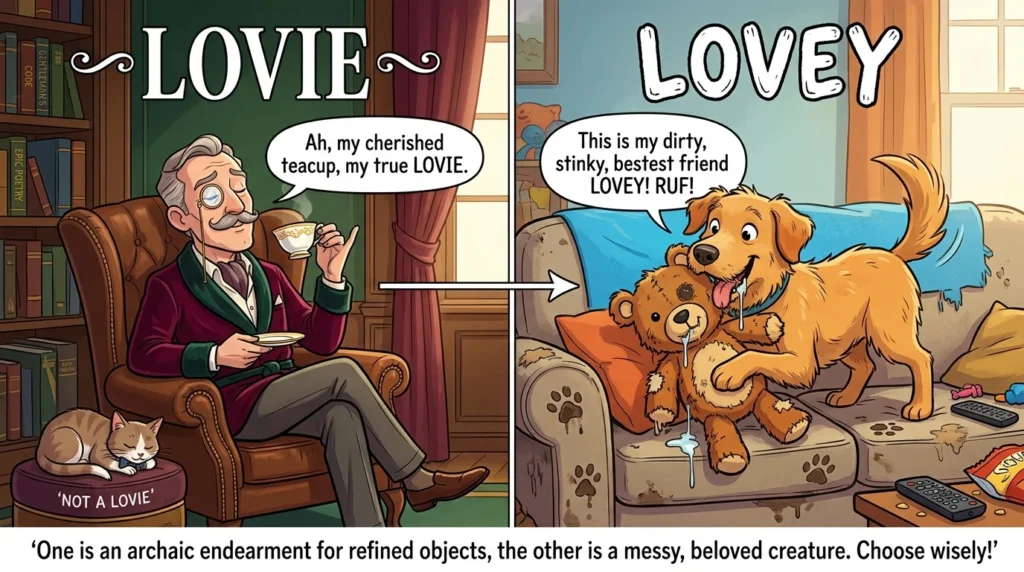
Lovey is the standard and more common spelling. It is usually used as a term of affection for a loved one or a comfort object, especially for children.
Lovie is an alternative spelling that some people use as a nickname or pet name, but it is less common.
Examples:
- Correct and common: Good morning, lovey.
- Acceptable alternative: I miss you, lovie.
Deep Explanation: Lovie
Lovie is an alternative spelling of lovey. It is primarily used as:
- A pet name for a romantic partner
- A nickname for someone dear to you
- An affectionate term on social media or in text messages
- A personal spelling preference
Common Uses of Lovie
People often use lovie in messages like:
- Goodnight, lovie.
- I love you, lovie.
- Thanks for your help, lovie.
Key Insight
Lovie is generally informal and affectionate. It is not usually found in formal writing or dictionaries as frequently as lovey.
Real Examples
✅ Sleep well, lovie.
✅ I can’t wait to see you, lovie.
✅ You’re my favorite person, lovie.
Deep Explanation: Lovey
Lovey is the standard spelling and the one most dictionaries recognize.
It commonly refers to:
- A term of endearment for someone you love
- A pet name for a romantic partner
- A comforting object, such as a child’s favorite blanket or stuffed toy
Meaning 1: A Term of Affection
Examples:
- How are you today, lovey?
- Come here, lovey.
Meaning 2: A Child’s Comfort Item
Examples:
- The baby won’t sleep without her lovey.
- He carries his lovey everywhere.
Key Insight
Unlike lovie, lovey has an additional meaning in parenting and child development. It can refer to a security blanket, stuffed animal, or another comforting object.
Lovie vs Lovey: Key Differences
Quick Differences
- Lovey is the standard and more common spelling.
- Lovie is an alternative, informal spelling.
- Lovey can also mean a child’s comfort object.
- Both can be used as affectionate nicknames.
| Feature | Lovie | Lovey |
|---|---|---|
| Meaning | Alternative affectionate spelling | Standard affectionate term and comfort object |
| Grammar | Informal alternative | Standard English spelling |
| Usage | Nicknames and text messages | Everyday English and parenting contexts |
| Dictionary Recognition | Less common | Widely recognized |
| Example | Goodnight, lovie. ✅ | Goodnight, lovey. ✅ |
Real-World Usage Scenarios
Example 1
Text Message:
I miss you, lovie.
🎯 Lesson: Lovie works naturally as a pet name in casual messages.
Example 2
Conversation:
Person A: Where’s Emma’s blanket?
Person B: She calls it her lovey.
🎯 Lesson: Only lovey can refer to a child’s comfort object.
Example 3
Partner:
Morning, lovey. Did you sleep well?
🎯 Lesson: Lovey is a common and standard term of affection.
Example 4
Social Media Post:
Happy birthday, lovie! Have an amazing day.
🎯 Lesson: Lovie is acceptable in informal and affectionate writing.
Common Mistakes
Mistake 1: Thinking One Spelling Is Always Wrong
❌ Lovie is incorrect.
✅ Lovie is an alternative, informal spelling.
Why it happens: People assume only dictionary spellings are acceptable in personal communication.
Mistake 2: Using Lovie for a Child’s Security Blanket
❌ The toddler lost her lovie.
✅ The toddler lost her lovey.
Why it happens: The meaning of a comfort object is generally associated with lovey, not lovie.
Mistake 3: Using Either Word in Formal Writing
❌ Dear Lovey, regarding our business proposal…
✅ Dear Ms. Johnson, regarding our business proposal…
Why it happens: These words are terms of affection and are usually unsuitable for professional communication.
Memory Tricks
Remember this simple rule:
Lovey = Love + Y
Think of the Y in lovey as standing for:
Your favorite person or your child’s favorite toy.
Remember this:
- Lovey = Standard spelling
- Lovie = Informal nickname spelling
Expert Insight
The word lovey has been used in English for centuries as a term of endearment. Over time, it also developed a specialized meaning in parenting, referring to a child’s comforting possession, such as a blanket or stuffed animal.
The spelling lovie emerged largely through personal preference, text messaging, and social media usage. Because affectionate nicknames often have flexible spellings, many people use lovie without considering it incorrect.
However, dictionaries, style guides, and educational resources generally recognize lovey as the standard form. In formal or published writing, lovey is usually the preferred spelling.