

Quick Answer
BU commonly means “Backup”, “Business Unit,” or “Be You” depending on context.
BC most commonly means “Because” in texting and online messaging, although it can also mean “Before Christ” or other terms in specific situations.
The correct meaning depends entirely on where and how the abbreviation is being used.
What Does “BU” Mean?
Definition
BU is an abbreviation with several meanings depending on the situation.
Common Meanings
- Backup
- Business Unit
- Be You
- Boston University (in education contexts)
Usage Rules
The surrounding conversation usually reveals which meaning is intended.
Examples
- I have a BU plan in case this project fails.
- Our company’s marketing BU exceeded its targets.
- Just BU and stay confident.
Key Insight
Unlike many abbreviations, BU does not have one universally accepted meaning.
What Does “BC” Mean?
Definition
BC is an abbreviation commonly used in texting and online communication.
Common Meanings
- Because
- Before Christ
- British Columbia
- Business Continuity
Usage Rules
In casual messaging, BC most often means because.
Examples
- I stayed home bc it was raining.
- The event occurred in 300 BC.
- She moved to BC last year.
Key Insight
Context is essential when interpreting the meaning of BC.

Is BU or BC Better for Business?
Boston University (BU) and Boston College (BC) are both respected private universities in Massachusetts, but the better choice for business depends on your preferred specialization, learning environment, and career goals. BU offers its undergraduate business degree through the Questrom School of Business, while BC’s traditional undergraduate business programs are housed in the Carroll School of Management.
BU may be a better fit for students who want a business education connected to a large, urban research university with opportunities to explore areas such as finance, marketing, business analytics, information systems, and entrepreneurship. Questrom’s curriculum includes business fundamentals, concentrations, career development, and experiential projects involving real business challenges. Source: BU’s official Questrom curriculum.
BC may be a better fit for students who prefer a management education integrated with liberal arts learning, ethical leadership, and a strong emphasis on developing well-rounded business professionals. The Carroll School offers concentrations in accounting, finance, marketing, business analytics, management, and other business disciplines. Source: BC’s Carroll School of Management.
When comparing BU vs. BC for business, consider these factors:
Curriculum: Compare the required courses and available concentrations in your intended field.
Career preparation: Look at internship opportunities, career advising, employer connections, and graduate outcomes.
Campus environment: BU has a large urban campus along the Charles River, while BC’s main undergraduate campus is in Chestnut Hill.
Cost and financial aid: Compare the actual financial aid offers and expected four-year expenses rather than tuition alone.
Personal fit: Consider class sizes, student culture, academic flexibility, and the environment in which you are most likely to thrive.
Verdict: BU is worth a close look if you want a broad business education within a large urban university. BC is worth considering if you value its integrated liberal arts and management approach. Neither school is universally better; your intended concentration and career goals should guide the decision.
BU or BC Reddit: What Do Students Say?
Students comparing BU and BC on Reddit often focus on practical differences that rankings cannot fully capture, including campus atmosphere, social life, academic pressure, career opportunities, and the overall student experience.
When reading BU or BC Reddit discussions, remember that individual experiences are subjective. A student who prefers BU’s urban environment may find BC’s campus less appealing, while someone who values a traditional residential campus may feel the opposite. Neither experience establishes that one university is objectively better.
For business students, useful questions to investigate include whether students feel supported by academic advisers, how accessible internships are, what career resources are available, and whether the campus culture suits their personalities.
You can explore discussions through these searches:
Use Reddit as a source of personal perspectives, not as a substitute for official program information, current admissions data, or verified career outcomes. When possible, compare comments from students studying the same major and graduating in similar years.
BU or BC Ranking
The answer to which university ranks higher depends on the ranking system and category being compared. Overall national university rankings, undergraduate business rankings, and subject-specific rankings measure different things.
For the 2027 U.S. News national university rankings, published in September 2026, Boston University reported a ranking of No. 34 among national universities. Source: BU’s ranking announcement.
BC also publishes rankings for its undergraduate business programs and individual disciplines. Its Carroll School reported strong subject rankings in the 2026 U.S. News undergraduate business rankings, including finance, accounting, marketing, business analytics, and entrepreneurship. Source: BC’s Carroll School academic information.
These figures should not be treated as a direct comparison of every aspect of the two universities. An overall university ranking is different from a ranking of business programs, and neither directly measures how well a particular student will perform after graduation.
When evaluating BU or BC rankings, compare the same publication, ranking year, and category. If your goal is to study finance, for example, a finance-specific ranking and the curriculum may be more useful than the universities’ overall positions.
Verdict: Do not choose BU or BC based on a single ranking number. Consider program quality, career preparation, cost, academic flexibility, and student fit alongside rankings.
Is BU or BC Harder to Get Into?
Boston University and Boston College are both highly selective universities, so admission to either requires a strong application. Which is harder to get into depends on the admission cycle, applicant pool, academic division, and individual application.
For the incoming Class of 2030, BU reported an admission rate of 14.8%, based on 79,498 applications. Source: BU’s Class of 2030 profile.
BC reported an admission rate of 13.4% for its Class of 2030, based on 41,923 applications. Source: BC’s official admission statistics.
Based on these published figures, BC had the lower overall admission rate for the Class of 2030. However, the difference does not establish that every BC program is harder to enter than every BU program. The universities have different applicant pools, application patterns, and undergraduate divisions.
Students should strengthen their applications by taking appropriately challenging courses, maintaining strong grades, demonstrating meaningful extracurricular involvement, and writing thoughtful essays that explain their interests and experiences.
Verdict: Based on the reported Class of 2030 admission rates, BC was slightly more selective overall. Both universities remain competitive, and applicants should avoid assuming that admission to either is guaranteed by grades or test scores alone.
BU or BC Acceptance Rate
The acceptance rate indicates the percentage of applicants admitted to a university during a particular admissions cycle. It is a useful measure of overall selectivity, but it does not tell you the exact probability that an individual applicant will be accepted.
The latest published Class of 2030 figures provide the following comparison:
| Admissions measure | Boston University | Boston College |
|---|---|---|
| Applicants | 79,498 | 41,923 |
| Reported acceptance rate | 14.8% | 13.4% |
| Admission cycle | Class of 2030 | Class of 2030 |
Sources: BU’s Class of 2030 profile and BC’s admission statistics.
BC’s acceptance rate was 1.4 percentage points lower than BU’s for this incoming class. That makes BC more selective by this particular measure, but acceptance rates can change from year to year.
Applicants should also remember that admission is holistic. Grades, course rigor, extracurricular activities, essays, recommendations, and other factors may influence the outcome. Applicants to different undergraduate divisions may also face different considerations.
Verdict: BC had the lower overall acceptance rate for the Class of 2030. Use this comparison as a snapshot of selectivity, not as a complete measure of academic quality or individual admission chances.
Boston College vs. Boston University Acceptance Rate
The Boston College vs. Boston University acceptance rate comparison is useful for students deciding where to apply, especially when both universities are on their college lists.
For the Class of 2030, BC reported a 13.4% acceptance rate, while BU reported 14.8%. This means BC admitted a smaller proportion of applicants in that cycle.
However, the number of applications received by each school also differed considerably. BU received 79,498 applications, compared with BC’s 41,923. The larger applicant pool does not automatically make BU more selective, because selectivity depends on the proportion of applicants admitted rather than the total number of applications alone.
For applicants, the practical lesson is to apply to both schools if they fit your academic and financial goals, rather than using the acceptance rate as the only deciding factor. A strong application should explain why the university’s particular academic offerings and campus environment match your interests.
It is also wise to review each school’s current application requirements, testing policies, deadlines, and financial aid options before submitting an application.
Is BU or BC Better for Pre-Med?
Both Boston University and Boston College can be suitable choices for students planning to attend medical school. Neither university automatically provides a better route to medical school admission; your undergraduate academic performance, science preparation, clinical experience, research, service, and MCAT performance will matter substantially.
BU offers pre-health advising to help students plan prerequisite coursework, understand application requirements, and evaluate their academic preparation. Its advising resources also explain how medical school application services calculate science and overall GPAs. Source: BU Pre-Health FAQs.
BC’s Pre-Health Program is open to students across its undergraduate majors. It provides advising on course selection, health-related experience, standardized examinations, and the application process for medical and other health professional schools. Source: BC Pre-Health Program.
When deciding between the two, compare the following:
Academic preparation: Review the required biology, chemistry, physics, mathematics, and other prerequisite courses.
Research opportunities: Investigate access to laboratories, faculty research, and undergraduate research programs.
Clinical experience: Consider how you will gain appropriate patient-facing or healthcare experience.
Advising: Ask how pre-health advisers help students plan courses and prepare competitive applications.
Academic fit: Choose a major you genuinely enjoy and can perform well in while completing medical school prerequisites.
A university’s proximity to hospitals or medical research facilities may create opportunities, but access alone does not guarantee a research position, clinical placement, or medical school acceptance.
Verdict: BU and BC are both reasonable options for pre-med students. Compare advising, research access, prerequisite scheduling, cost, and the environment in which you can maintain strong academic performance.
BU or BC GPA
When comparing BU or BC GPA requirements, it is important to distinguish between the GPA needed for undergraduate admission, the GPA students typically earn after enrolling, and the GPA required for a particular program or opportunity.
For admission, BU’s published Class of 2029 profile reported a middle 50% high school GPA range of 3.7–4.0. This describes the reported range for the incoming class, not a universal minimum requirement for every applicant. Source: BU’s Class Profile.
A comparable GPA figure should be checked against BC’s official admissions information for the same entering class. The two universities may calculate or report academic records differently, particularly for applicants whose high schools do not use a standard 4.0 grading scale.
For students already enrolled, there is no single GPA that applies to every purpose. A student may need to meet different academic standards for good standing, scholarships, honors programs, internships, or graduate school applications.
Pre-med students face an additional consideration: medical schools evaluate both overall GPA and science GPA, alongside other parts of the application. BU’s pre-health resources explain how centralized application services may recalculate GPAs according to their own rules.
Verdict: Neither BU nor BC should be chosen solely on the assumption that it offers an easier GPA. Review the relevant academic policies, grading environment, course requirements, and support services before deciding.
Final Verdict: Should You Choose BU or BC?
Boston University and Boston College are both strong options, but their differences matter more than a simple ranking comparison.
Choose BU if Questrom’s business curriculum, its large urban research-university environment, or its pre-health advising and academic opportunities best match your goals.
Choose BC if you prefer the Carroll School’s management education, its integration of business and liberal arts, or its campus environment and pre-health advising resources.
For business students, compare the exact concentrations and career support available. For pre-med students, prioritize academic preparation, advising, clinical and research opportunities, and the ability to maintain a strong GPA.
Ultimately, the better university is the one that fits your intended field, financial circumstances, learning preferences, and long-term plans. Rankings and acceptance rates can help you narrow your choices, but they should support—not replace—a careful comparison of the programs themselves.
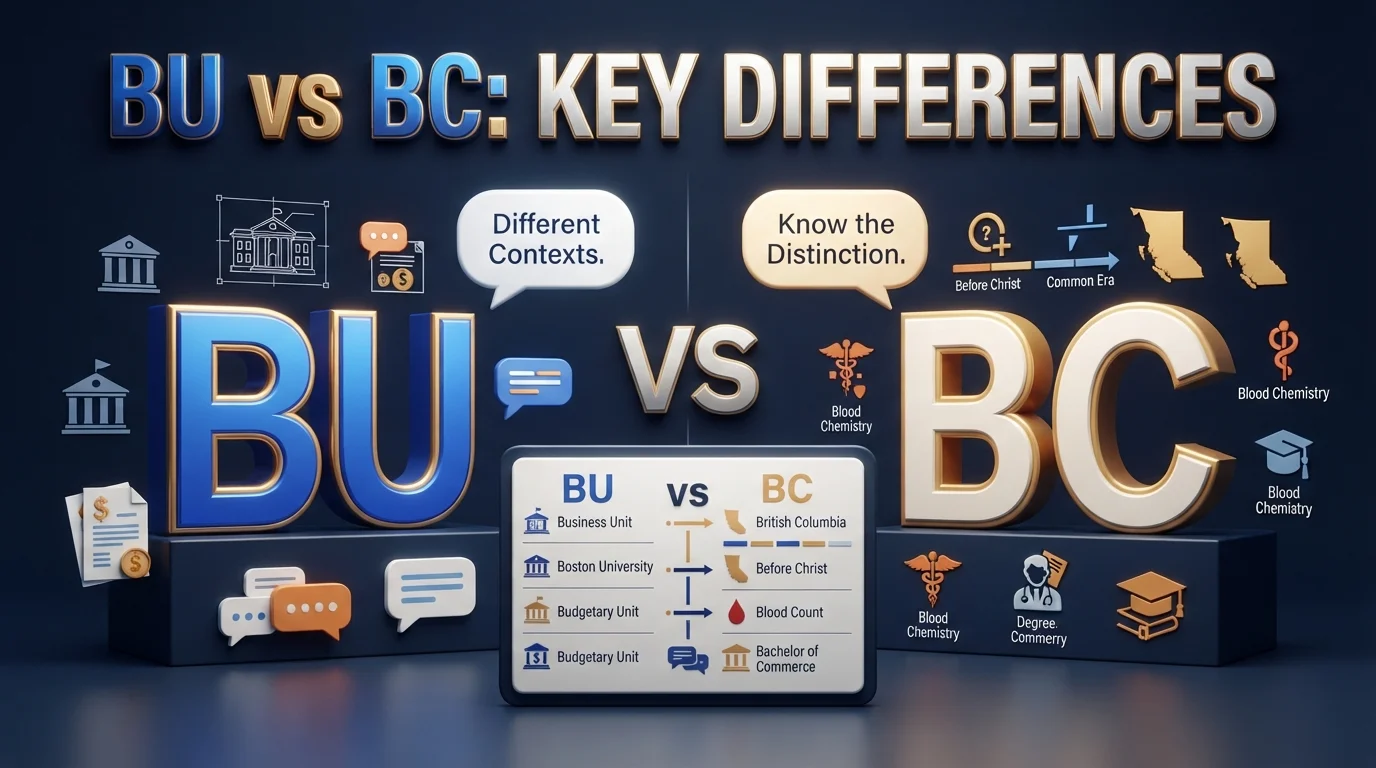
BU vs BC: Key Differences
Quick Comparison
- BU has multiple meanings.
- BC often means “because” in texting.
- BU is less standardized.
- BC is more commonly recognized in online messaging.
- Both depend heavily on context.
- Neither has a single universal definition.
Comparison Table
| Feature | BU | BC |
|---|---|---|
| Type | Abbreviation | Abbreviation |
| Common Meaning | Backup, Business Unit, Be You | Because |
| Texting Usage | Less common | Very common |
| Business Usage | Common | Common |
| Educational Usage | Possible | Less common |
| Context Required | Yes | Yes |
Real-World Usage Scenarios
Example 1
Friend: “Why didn’t you come?”
Reply: “I stayed home bc I was sick.”
🎯 Lesson: In texting, BC usually means “because.”
Example 2
Manager: “Which BU handles customer support?”
Employee: “The service BU does.”
🎯 Lesson: In business settings, BU often means Business Unit.
Example 3
Friend: “What if the plan fails?”
Reply: “We have a BU strategy.”
🎯 Lesson: BU can mean backup.
Example 4
Motivational Post
“Don’t change for others. Just BU.”
🎯 Lesson: BU may also mean “Be You.”
Common Mistakes
Mistake #1
❌ Assuming BU always has one meaning.
✅ The meaning changes based on context.
Why it happens: Many abbreviations serve multiple purposes.
Mistake #2
❌ Assuming BC only refers to historical dates.
✅ In texting, BC often means “because.”
Why it happens: People are familiar with historical BC usage.
Mistake #3
❌ Using abbreviations in formal documents.
✅ Spell out the full term when clarity matters.
Why it happens: Abbreviations can be misunderstood by readers.
Memory Tricks
Trick #1
BC = Because
Think:
B → Be
C → Cause
This helps you remember the texting meaning.
Trick #2
BU = Backup
Think of BU as your backup plan when something goes wrong.
Trick #3
Check the Context
Whenever you see BU or BC, look at the surrounding sentence first.
Expert Insight
Abbreviations have become increasingly common due to texting, social media, and digital communication. While they save time, they also create ambiguity because the same letters can represent multiple phrases. This is especially true for BU and BC.
Professional writers, educators, and communication experts recommend using the full phrase whenever there is a risk of confusion. In casual communication, however, these abbreviations remain widely used and understood within the appropriate context.